 ProMapRanker
Best Modern Architecture in Data Integration Platforms in 2026

Key takeaways
- To be plain about the angle: this article covers data integration platforms with modern architectures, such as cloud ELT, change data capture, and warehouse-native design.
- Fivetran suits teams that want fully managed connectors and are willing to pay for reliability.
- Airbyte suits teams that want open-source control and custom connectors at a lower starting cost.
- Stitch and Hevo suit smaller teams that want simple, managed pipelines without heavy engineering.
- Matillion, Qlik Talend, Boomi, and Azure Data Factory suit larger teams with warehouse, governance, or application integration needs.
Quick comparison
| Pick | Great for | Pricing starts at | Free tier | |
|---|---|---|---|---|
 Fivetran | Managed cloud ELT | See website | Yes | Visit |
 Airbyte | Open-source ELT and custom connectors | $20 per month | Yes | Visit |
 Stitch | Simple managed replication | $100 per month | No | Visit |
 Hevo Data | No-code ELT for smaller teams | See website | Yes | Visit |
 Matillion | Warehouse-native transformation | See website | No | Visit |
 Qlik Talend | Enterprise integration and governance | See website | No | Visit |
 Boomi | Application and SaaS integration | See website | No | Visit |
 Azure Data Factory | Microsoft cloud integration | See website | No | Visit |
The best modern architecture in data integration platforms
Modern data integration usually means ELT rather than old ETL: data is loaded into a cloud warehouse first, then transformed there with SQL or dbt. It also means change data capture for near real-time updates, managed connectors that handle API changes, and separation of storage and compute so teams pay for what they use. We compared official pricing pages, connector catalogs, CDC support, transformation options, and deployment models for platforms that are live in 2026.
Fivetran is the reference point for modern ELT. It moves data from SaaS apps, databases, and files into a cloud warehouse, handling API changes, schema drift, and retries without manual pipeline work. Change data capture keeps database sources close to real time, and built-in dbt support lets teams transform data in the warehouse after loading. A free tier up to a set volume lets small teams test the platform before paying.
The catch is pricing. Fivetran charges on monthly active rows plus a base charge per connection, so a backfill or a high-volume event source can raise the bill sharply. Teams with steady, moderate volumes usually find the reliability worth the cost, since engineering time saved on broken pipelines is real. Teams with very high event volumes should model costs carefully and compare Airbyte or Hevo first.
- Large catalog of fully managed connectors
- Automatic schema handling
- Change data capture and dbt integration
- Usage-based pricing can grow fast with high-volume data
- Costs are harder to predict for backfills and event data
Airbyte suits teams that want control. The open-source version can be self-hosted for free, apart from infrastructure costs, and the community has built a large connector catalog covering many SaaS apps and databases. Custom connectors can be built when a source is not covered, which matters for internal tools or niche systems. Cloud plans start at 20 dollars per month for Standard, with higher tiers for larger workloads.
The trade-off is ownership. Self-hosting saves license fees but adds work for upgrades, monitoring, and scaling, so a team without DevOps capacity may prefer Airbyte Cloud or Fivetran. Transformations also happen outside Airbyte, usually with dbt or SQL in the warehouse, which is standard for modern ELT but needs SQL skills. For engineering-led teams, Airbyte gives the best balance of control and cost.
- Open-source self-hosted option with no license cost
- Large community connector catalog
- Cloud plans for teams that do not want to self-host
- Self-hosting means your team owns maintenance and upgrades
- Transformations need dbt or SQL in the warehouse
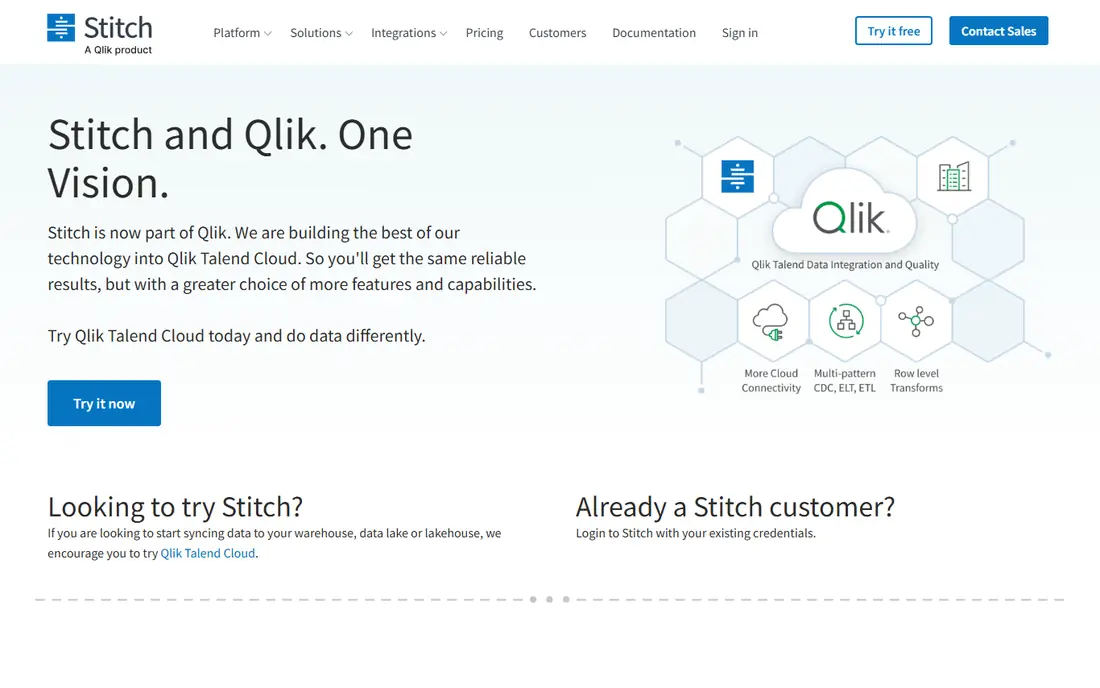
Stitch is the simplest managed option on this list. A small team can connect a SaaS source, pick a warehouse destination, and have data replicating in minutes, with no infrastructure to manage. Pricing starts at 100 dollars per month for a set row tier, which makes budgeting straightforward for predictable workloads. For a startup or a small analytics team, that simplicity is a genuine benefit.
The limits are flexibility and depth. Stitch offers limited transformation inside the platform and limited change data capture compared with Fivetran or Airbyte, so complex pipelines need work in the warehouse. It also covers fewer sources and destinations. Teams that outgrow simple replication will likely move to Airbyte or Fivetran, but teams that stay simple will find Stitch hard to beat for ease.
- Very simple setup for standard sources
- Fully managed with no infrastructure to run
- Clear row-tier pricing
- Limited transformation and CDC options
- Fewer destinations and less flexibility than larger platforms
Hevo suits small and mid-size teams that want pipelines without writing code. Sources can be connected through a visual interface, schema changes are handled by the platform, and change data capture keeps many database sources fresh. A free tier covers small volumes, and paid plans add dbt-based transformations and more sources. That combination makes Hevo a practical first ELT tool for a growing company.
The catch is scale and transformation depth. Event-tier pricing means a sudden volume spike can push a team into a higher tier, so costs need monitoring. Teams with heavy transformation needs may also prefer Matillion or dbt in the warehouse. For a team moving from spreadsheets to a warehouse, Hevo gives a clear and manageable path.
- No-code pipeline setup with managed schema updates
- Change data capture on many sources
- Free tier for small volumes
- Pricing rises with event tiers, so high-volume teams should model costs
- Transformation options are lighter than warehouse-native tools
Matillion represents warehouse-native architecture at its clearest. Instead of moving data through a separate engine, Matillion pushes transformations down into the warehouse, using its compute and scaling. That design suits teams already standardized on Snowflake, BigQuery, or Redshift, since data stays in the warehouse and performance follows warehouse scaling. A visual builder plus SQL and Python covers both analysts and engineers.
The downside is pricing transparency and fit. Matillion quotes on credits, so a team must go through a sales process to get a firm figure. Teams without a major cloud warehouse will also get less value, since the platform is built around those destinations. For warehouse-centered teams with heavy transformation work, Matillion is a strong modern choice.
- Push-down transformation that runs inside Snowflake, BigQuery, or Redshift
- Visual pipeline builder with SQL and Python
- Agentic pipeline features
- Pricing is quoted on credits, so comparison takes a sales process
- Best value is tied to a major cloud warehouse
Qlik Talend suits enterprises that need integration plus governance, not just pipelines. It combines data integration with data quality checks, metadata management, and governance controls, which matter for regulated industries and large organizations. Change data capture, inherited from Qlik Replicate, supports near real-time replication, and hybrid deployment covers both cloud and on-premises sources.
The trade-off is size and price. Qlik Talend is quoted on capacity, covering volume, executions, and duration, so a small team cannot easily compare it from a pricing page. The platform also carries more features than a small analytics team needs. For an enterprise that must prove data quality and lineage, that breadth is the point, and Qlik Talend is a leading option.
- Broad integration, data quality, and governance in one platform
- Change data capture from Qlik Replicate heritage
- Hybrid cloud support
- Pricing is quoted on capacity, so budgeting needs a sales review
- Platform can feel large for a small team
Boomi fits teams whose integration problem is applications, not just analytics. It connects SaaS apps, on-premises systems, and APIs through a low-code visual builder, with pre-built templates for common business processes. That makes it useful for order, customer, and finance flows that must move between systems in real time, not just into a warehouse for reporting.
The catch is focus. Boomi is an application integration platform first, so a team whose main need is warehouse ELT may find Fivetran or Airbyte a better fit. Pricing is also quoted and usage-based, so scoping a project with Boomi needs a clear volume and connector count. For business process integration, though, Boomi remains a widely used modern platform.
- Low-code platform for connecting business applications
- Pre-built process templates
- Application, data, and API integration in one place
- Pricing is quoted and usage-based, so costs need careful scoping
- Data warehouse ELT is not its main strength
Azure Data Factory suits teams already on Microsoft Azure. It moves and transforms data across Azure services, on-premises sources, and SaaS apps, with visual pipelines and code options for engineers. Serverless scaling means pipelines can handle variable workloads without managing servers, and integration with Azure Synapse, Databricks, and Microsoft Fabric keeps data work inside one cloud.
The limit is ecosystem fit. Teams on AWS or Google Cloud will get less value and may prefer a cloud-neutral tool such as Fivetran or Airbyte. Azure pricing also spans several meters, such as pipeline runs and data movement, so a cost estimate needs a real workload test. For Azure-centered teams, Data Factory is the natural modern choice.
- Native integration with Azure services and Microsoft data tools
- Visual and code-based pipeline design
- Serverless scaling
- Best value is inside the Azure ecosystem
- Pricing is usage-based across several meters and can be hard to predict
How we picked these
We compared official pricing pages, connector catalogs, CDC support, transformation models, and deployment options for platforms live in 2026. We kept only platforms with a clear modern architecture claim, such as cloud ELT, CDC, or warehouse-native design, and a live product teams can buy or trial. We mixed managed ELT, open-source, warehouse-native, enterprise, application, and cloud-native platforms so different kinds of data teams can find a fit. We left out tools that reached end of life, including Flowise, which is not listed here as a live option.
How to choose a modern data integration platform
Start with the destination. If your analytics live in Snowflake, BigQuery, or Redshift, a warehouse-native or ELT platform that loads there first is the modern route. If your need is moving data between business apps in real time, an application platform such as Boomi fits better. Naming the destination and the latency need, such as hourly, near real-time, or streaming, narrows the list faster than any feature comparison.
Next, count connectors and CDC needs. List every source you must connect in the next year, and check each platform's catalog for those exact sources, not just a total connector count. If a database source must stay fresh, confirm CDC support and latency for that source. A platform with many connectors but no CDC for your main database will disappoint in production.
Then model total cost at real volumes. Usage-based pricing on rows, events, credits, or capacity can all look cheap at trial size and expensive at production size. Run a volume estimate for your largest sources, including backfills, and ask each vendor for a written estimate at that volume. Finally, test transformation fit. Confirm whether transformations happen in the warehouse with SQL or dbt, in the platform with a visual builder, or in both, and pick the model your team can actually maintain.
Architecture patterns to know
ELT loads raw data into the warehouse first, then transforms it there, which keeps the raw history and lets analysts work with familiar SQL. CDC captures row changes from a database log, giving near real-time updates without full reloads. Warehouse-native design pushes compute into the warehouse, so scaling follows warehouse capacity. Streaming design moves events as they happen, which suits operational use cases but adds complexity.
Questions to ask every vendor
Ask how schema changes are handled, what happens when a source API changes, and how failed syncs are retried and alerted. Ask about data residency, security certifications, and support hours for production incidents. Ask for a trial on your own largest source, since a demo on a small sample hides performance and cost problems that only appear at scale.
Frequently asked questions
What is modern data integration architecture?
Modern architecture usually means cloud ELT, where data is loaded into a cloud warehouse first and transformed there, plus change data capture for fresh data and managed connectors that handle API changes. It contrasts with older ETL, where data was transformed in a separate engine before loading. Separation of storage and compute is another hallmark, since it lets teams scale each part independently.
Is ELT better than ETL?
ELT is usually better for cloud analytics, since it keeps raw data in the warehouse, uses warehouse compute for transformation, and lets analysts work in SQL. ETL still fits cases where data must be cleaned or masked before it reaches a destination, such as strict compliance rules. Many teams use ELT for analytics and ETL-style steps inside the warehouse for sensitive data.
What is change data capture?
Change data capture, or CDC, reads a database log to capture inserts, updates, and deletes as they happen, rather than reloading whole tables. That gives fresher data with less load on the source system. CDC matters most for operational reporting and for databases that change often, such as orders, customers, and inventory.
How much do data integration platforms cost?
Costs vary widely by model. Stitch starts at 100 dollars per month, Airbyte Cloud starts at 20 dollars per month, and Fivetran offers a free tier up to a set volume before usage pricing applies. Enterprise platforms such as Matillion and Qlik Talend are quoted, so a sales review is needed. Model costs at your real volumes, including backfills, before choosing.
Do I need engineers to run a modern integration platform?
It depends on the platform. Stitch and Hevo are built for smaller teams with little engineering, while Airbyte self-hosted and Matillion suit engineering-led teams. Managed platforms such as Fivetran reduce engineering work but still need someone who understands sources, warehouses, and data quality.
Can a modern platform handle real-time data?
Some can. CDC-based platforms give near real-time updates for databases, and streaming platforms handle event data as it arrives. Batch ELT platforms that sync hourly are not real-time, so check latency for each source rather than assuming a platform is real-time because it uses modern architecture.
Sources
See where you really rank - block by block
ProMapRanker scans Google Maps across a grid of your service area. Simple monthly plans from $19, white-label on every plan.
Start freeKeep reading
 zoro.to alternatives
Best Zoro.to Alternatives in 2026
We compare the best zoro.to alternatives in 2026, listing only legal licensed anime streaming services, from Crunchyroll to free options for fans today.
Read → zip alternatives
Best Zip Alternatives in 2026
We compare the best zip alternatives for buy now, pay later in 2026, covering pay-in-4 plans, fees, spending limits, and credit reporting options today.
Read → yesware alternatives
Best Yesware Alternatives in 2026
Compare the best yesware alternatives for sales email tracking, templates, and sequences, with current pricing and honest tradeoffs for small sales teams.
Read →