 ProMapRanker
Best Mobile In-App Messaging Software in 2026

Key takeaways
- Sendbird, Stream, and CometChat are the most complete chat APIs here, with ready UI kits, moderation, and mobile SDKs.
- PubNub and Ably suit teams that want to build chat on proven real time infrastructure, with lower entry prices.
- TalkJS and Amity suit smaller product teams that need messaging in an app quickly, without a large engineering effort.
- Pricing is mostly per monthly active user, so model cost at your expected user count, not just at the entry tier.
- Free tiers and trials help test SDKs, but check monthly active user limits, concurrent connection limits, and moderation features before launch.
Quick comparison
| Pick | Great for | Pricing starts at | Free tier | |
|---|---|---|---|---|
 Sendbird | Enterprise chat at scale | $399 per month | Free trial | Visit |
 Stream Chat | Social and marketplace chat | $399 per month | Yes | Visit |
 CometChat | Pre built UI kits and fast launch | $299 per month | Yes | Visit |
 PubNub | Real time infrastructure for chat | $98 per month | Yes | Visit |
 TalkJS | Simple in-app messaging for products | $279 per month | Yes | Visit |
 MirrorFly | Self hosted and licensed chat | $399 per month | No | Visit |
 Amity | Social features plus chat | See website | Yes | Visit |
 Ably | Real time data and chat building blocks | $29 per month | Yes | Visit |
 Pusher | Real time channels for apps | See website | Yes | Visit |
The best mobile in-app messaging software
In-app messaging software lets users chat inside your mobile app, without switching to SMS or a separate messenger. The tools below provide chat APIs, SDKs for iOS and Android, and hosted infrastructure, so your team does not have to build real time messaging from scratch.

Sendbird is a mature choice for product teams that need private messaging, group chats, and large community channels in a mobile app. SDKs cover iOS, Android, and web, and UIKit components speed up the first release. Moderation tools, message search, and analytics help larger teams manage chat at scale.
The entry price is high for a small app, and the per user model means costs grow as the app grows. For a mid size or enterprise product where chat reliability and moderation matter, Sendbird is a proven option.
- Mature chat API and SDKs
- Moderation and supergroups
- Strong mobile UI kits
- Entry price is high for small apps
- Costs rise with monthly active users
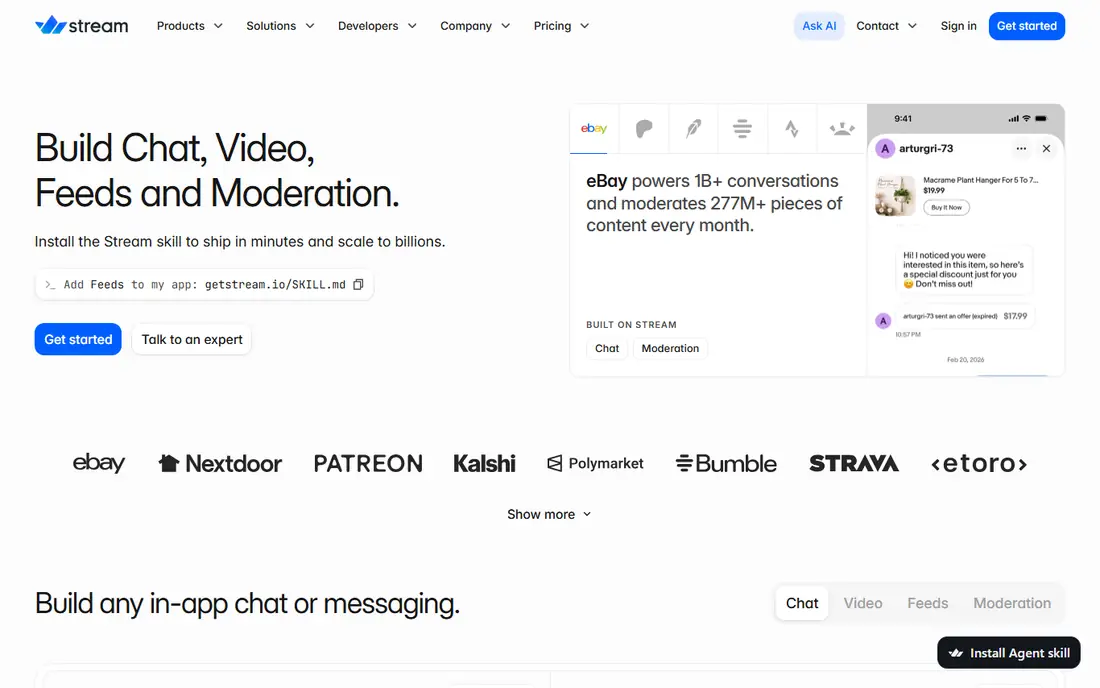
Stream Chat is a close rival to Sendbird, with a focus on social, community, and marketplace messaging. Features include reactions, threads, typing indicators, read receipts, and moderation, with SDKs for iOS, Android, React Native, and web. A free tier to 1,000 monthly active users lets small teams test a real product before paying.
Paid pricing starts at $399 per month billed annually for 10,000 monthly active users in published comparisons, with a higher monthly rate on monthly billing. For a social or marketplace app that needs polished chat quickly, Stream is a strong pick.
- Free tier to 1,000 monthly active users
- Rich reactions, threads, and moderation
- Strong React and mobile SDKs
- Paid tier starts at a similar level to Sendbird
- Advanced features sit on higher plans
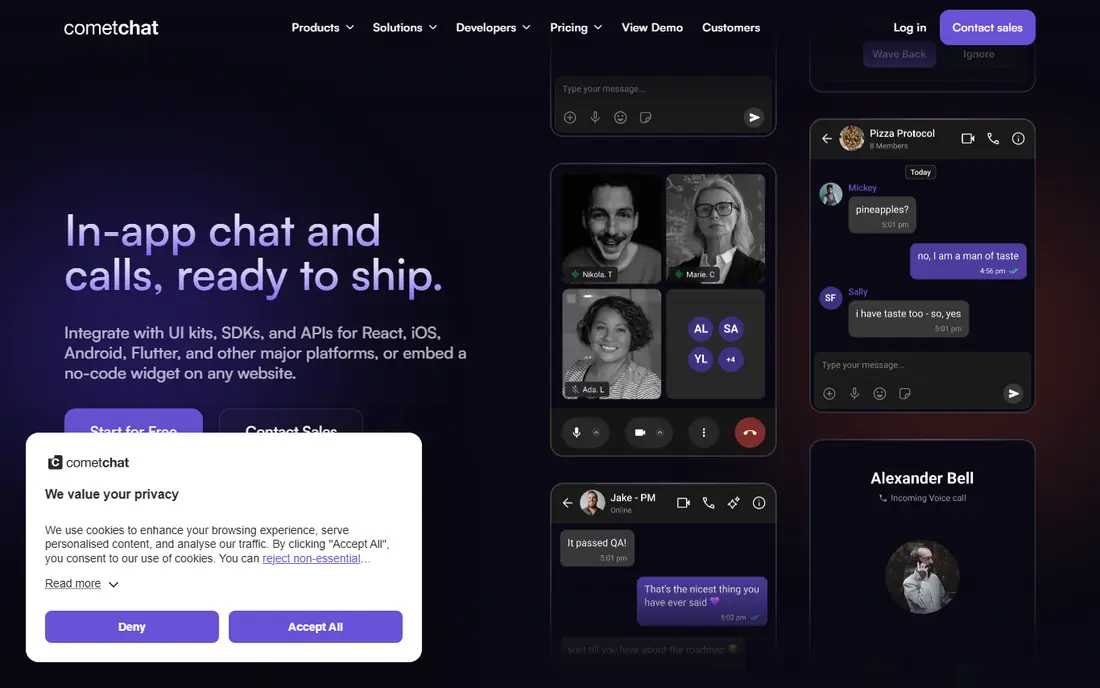
CometChat emphasizes a fast first release, with pre built UI kits, chat widgets, and SDKs for mobile and web. Teams can add text chat, voice, and video calling from one vendor, which suits dating, social, education, and community apps that need more than text alone. A small free tier supports development and testing.
Customization at the protocol level is less open than with PubNub or Ably, since CometChat is a full chat product rather than raw infrastructure. For teams that value speed to launch over building every detail themselves, it is a practical choice.
- UI kits for fast launch
- Voice and video alongside chat
- Free tier for development
- Less protocol level customization than infrastructure tools
- Costs rise with users
PubNub provides real time data infrastructure that teams shape into chat, with presence detection, message history, and global delivery. The entry price is lower than full chat APIs, which suits developers who want control over the chat experience and already have engineering capacity. A free tier supports testing.
The trade-off is effort. PubNub gives you the pipes, not a finished chat interface, so your team builds UI, moderation, and message logic. For developer heavy teams that want infrastructure control, that trade is worth it.
- Low entry price
- Global real time network
- Presence and message history tools
- Chat features must be built on top
- Pricing depends on transactions as well as users
TalkJS targets product teams and startups that need messaging without a long integration project. It supports one to one and group conversations, with notifications by email, SMS, and push, and a JavaScript API that works well in web and mobile web views. Pricing starts at $279 per month for 10,000 monthly active users in published comparisons.
It is less suited to huge live event chats with tens of thousands of concurrent participants. For marketplaces, support, tutoring, and community products with normal conversation volumes, TalkJS is a clean, focused option.
- Simple setup for product teams
- One to one and group messaging
- Email, SMS, and push notifications
- Less suited to very large live event chat
- Pricing rises with monthly active users
MirrorFly, from Contus, offers chat APIs and SDKs with self hosted and licensed deployment options, alongside cloud plans. That choice matters for teams with data residency, compliance, or customization needs that a shared cloud service cannot meet. Features include real time messaging, voice and video calling, file sharing, and pre built UI components.
Self hosting means your team runs and scales the infrastructure, which adds operational work. For enterprises that need control over hosting and source code, MirrorFly is a distinctive option in this list.
- Self hosted and licensed options
- Chat, voice, and video in one SDK
- Source code licensing for some plans
- Self hosting needs your own infrastructure
- Entry price is high
Amity, formerly Eko, provides chat alongside social features such as feeds, stories, and live video, which suits community and creator apps. Mobile SDKs help teams add a social layer without building feeds and chat as separate systems. Moderation tools support community management at scale.
Pricing for larger use is quote based, so small teams should confirm the free tier limits and the first paid step before committing. For an app where chat is part of a wider social experience, Amity covers more ground than a chat only API.
- Chat plus social feeds and video
- SDKs for mobile
- Moderation tools
- Pricing is quote based for larger use
- Social features may be more than some apps need
Ably provides real time messaging infrastructure with a low entry price and a generous free tier, including millions of messages per month. Its chat SDK, launched in 2025, adds conversation building blocks on top of that network, with channels, presence, and message history. That combination suits teams that already use Ably for live data and want chat on the same platform.
The chat SDK is newer than Sendbird or Stream, so check the current feature list for threads, read receipts, and moderation before choosing it for a complex chat product. For a cost sensitive team building chat on reliable infrastructure, Ably is worth testing.
- Very low entry price
- Generous free message allowance
- Reliable global real time network
- Chat SDK is newer than rivals
- Some chat features were still maturing in late 2025
Pusher Channels provides real time event delivery for web and mobile apps, which teams can use as a building block for chat, notifications, and live updates. A free tier supports testing, and SDKs cover many languages and frameworks. Setup is simple compared with running your own WebSocket servers.
Like PubNub and Ably, Pusher is infrastructure, not a finished chat app. Your team builds the chat interface, message storage, and moderation. For a small team that needs real time delivery and already plans to build its own chat UI, Pusher is a low cost starting point.
- Simple real time channels
- Free tier for testing
- Wide language and framework support
- Chat UI and moderation must be built by your team
- Not a full chat product out of the box
How we picked these
We compared official pricing pages, SDK documentation, and published October 2026 pricing comparisons for chat APIs and real time platforms. We kept only tools live in 2026 with mobile SDKs or mobile friendly APIs, and we favored a mix of full chat products and infrastructure options so different team sizes and budgets are covered. Prices are starting paid prices where published, and should be confirmed on the vendor site at your user count.
Choosing chat software without a costly surprise
Model cost at three user counts: launch, six months, and a successful year. A vendor that looks cheap at 1,000 monthly active users can become expensive at 25,000, especially when concurrent connection limits and message overages apply. Ask each vendor for a quote at your forecast, not just the entry tier price.
Moderation and safety from day one
Chat in a consumer app needs moderation, blocking, reporting, and message retention rules from launch, not as a later fix. Check whether moderation is included in the plan you can afford, or whether it is an enterprise add on. For apps used by minors, check age gating, reporting, and data handling rules with extra care.
Mobile SDK quality matters
Test the iOS and Android SDKs in a real app before committing. Check offline handling, push notification delivery, message sync across devices, and battery impact. A chat API that looks good in a web demo can behave differently on a low end Android phone with a weak connection.
Data, compliance, and exit
Confirm data residency, encryption, and whether the vendor will sign a data processing agreement or, for health apps, a HIPAA business associate agreement where needed. Also check how you export message history if you later switch vendors, since chat data is hard to migrate once users depend on it.
Frequently asked questions
What is mobile in-app messaging software?
It is a chat API, SDK, or real time platform that lets users send messages inside your mobile app, without leaving for SMS or another messenger. Vendors handle message delivery, storage, presence, and notifications, while your team builds the chat interface or uses a pre built UI kit.
How much does in-app chat software cost?
Entry paid prices here range from $29 per month for Ably to $399 per month for Sendbird and Stream, with free tiers for testing on several tools. Final cost depends on monthly active users, concurrent connections, message volume, and add ons such as moderation.
Is there a free plan for in-app messaging?
Yes, on several tools. Stream offers a free tier to 1,000 monthly active users, PubNub and Ably offer free tiers for testing, and CometChat, TalkJS, Amity, and Pusher offer free or trial access. Check user and connection limits, since free tiers are for testing and small launches.
Should I choose a full chat API or real time infrastructure?
Choose a full chat API such as Sendbird, Stream, or CometChat if you want UI kits and moderation ready to use. Choose infrastructure such as PubNub, Ably, or Pusher if your team wants to build a custom chat experience and control the data layer.
Can in-app chat handle voice and video too?
Some tools can. CometChat and MirrorFly offer voice and video calling alongside text chat, while Sendbird and Stream also offer calling products. Check whether calling is included in the chat plan or sold as a separate product.
How do I handle moderation in in-app chat?
Use the vendor moderation tools for blocking, reporting, profanity filters, and admin review, and set clear community rules in your app. For large communities, plan staffing for manual review, since automated filters alone rarely catch every problem.
Sources
See where you really rank - block by block
ProMapRanker scans Google Maps across a grid of your service area. Simple monthly plans from $19, white-label on every plan.
Start freeKeep reading
 worlds best local seo company
8 Worlds Best Local SEO Companies for Map Pack Growth in 2026
Compare the worlds best local seo company options for Google Business Profile work, citations, reviews, and multi-location rankings and reporting in 2026.
Read → world's best web hosting company
World's Best Web Hosting Company in 2026
Searching for the world's best web hosting company? We compared 10 hosts on price, renewal rates, speed, and support to help you choose well today in 2026.
Read → who's got the best nanny tax services
Who's Got the Best Nanny Tax Services in 2026
We answer who's got the best nanny tax services, comparing full filing, back taxes, software, and pricing so families can handle nanny taxes correctly.
Read →