 ProMapRanker
5 Strong MLOps Platforms in 2026


Open-source experiment tracking and model registry · Pricing starts at: $0 (open source)
Direct answer
For open-source experiment tracking and model registry, MLflow is where this list starts. Alternatives: Kubeflow for DIY MLOps on Kubernetes, and ClearML for open-core full-lifecycle MLOps. The full list of 5 tools follows, with prices and free plan facts.
Key takeaways
- MLflow takes the first slot, best suited to open-source experiment tracking and model registry.
- Comet is the one to check for experiment tracking plus LLM observability.
- MLflow, Kubeflow, ClearML, Weights & Biases, Comet: these are the 5 tools out of 5 that offer a free plan.
- The cheapest monthly starting price in the list is $15/user/month, offered by ClearML.
- The main caution on MLflow: entry-level interface compared to commercial tools.
Quick comparison
| Pick | Great for | Pricing starts at | Free tier | |
|---|---|---|---|---|
| MLflow | Open-source experiment tracking and model registry | $0 (open source) | Yes | Visit |
 Kubeflow | DIY MLOps on Kubernetes | $0 (open source) | Yes | Visit |
 ClearML | Open-core full-lifecycle MLOps | $15/user/month (Pro) | Yes | Visit |
 Weights & Biases | Collaborative experiment tracking | See website | Yes | Visit |
 Comet | Experiment tracking plus LLM observability | $19/user/month (Pro) | Yes | Visit |
5 MLOps platforms in detail
Short on time? The summary and table above give the quick view of 5 MLOps platforms, and the profiles that follow give the detail behind each entry.
MLflow is a good fit for open-source experiment tracking and model registry. The ecosystem is MLflow's real strength.
Running a tracking server, a model registry database, and artifact storage at team scale is your job. On top of that, nearly every framework, cloud vendor, and external tool links up with it, and Databricks provides a managed MLflow as part of its product if you later want hosting without building it yourself. Starting cost for MLflow: $0. You can start on MLflow without paying.
Trade-offs to know: Entry-level interface compared to commercial tools.
- Enormous community and integration ecosystem
- Fully free and open source
- Collaboration features are thin
Kubeflow makes the most sense for DIY MLOps on Kubernetes. The honest catch is the operating burden. The same setup runs on a laptop, on-prem, or any cloud, which no managed service can match.
Watch-outs: Installation can be rough.
Beyond that, the modular design is a genuine advantage. For a small team without system engineers, the ramp-up time and maintenance work can exceed the value. It shines for organizations already standardized on Kubernetes, not as a first MLOps step. It is an open-source toolkit you assemble on Kubernetes, with modular components for notebooks, training, pipelines, hyperparameter tuning, serving, and a model registry. What you pay to start with Kubeflow: $0. Free access exists with Kubeflow.
- Vendor-neutral CNCF graduated project
- Portable across clouds and on-prem
- Needs real Kubernetes expertise
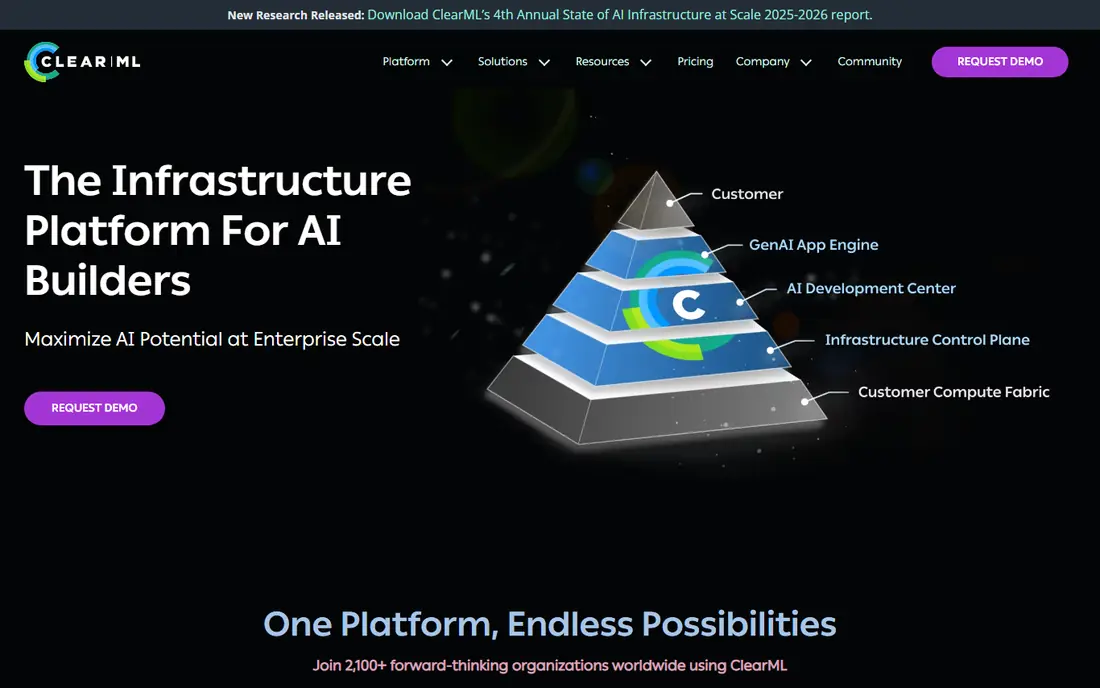
ClearML is designed for open-core full-lifecycle MLOps. It is an open-core product that aims to run your entire AI workflow: experiment management, pipeline orchestration, data versioning, remote execution, and model serving. From a buyer's view, if your complaint is that tracking alone does not get models to production, ClearML is aimed at exactly that gap.
Pricing for the hosted Pro plan begins at $15 per user a month, but extras and support are quoted separately, so confirm the full picture before budgeting. ClearML is capable but not straightforward, and its breadth means there is more to learn than with a pure tracker. Also, experiment logging is close to automatic: attach ClearML to existing training code and it records parameters, metrics, and artifacts with minimal changes. Also, the open-source core means you can self-host without paying. The hosted cloud plan stays free for up to three team members with 100GB of storage. What you pay to start with ClearML: $15/user/month. You can start on ClearML without paying.
Trade-offs to know: Noticeable ramp-up time.
- Near-automatic experiment logging
- Not just tracking
- Hosted plan prices extras separately
Think of Weights & Biases for collaborative experiment tracking. If your data scientists already know one name in this space, it is probably Weights & Biases. Its dashboards are genuinely pleasant to use, and the integration libraries for PyTorch, TensorFlow, and other frameworks take only a few lines of code to set up.
Where it is weaker: Free level has usage limits.
Also, Weights & Biases does not publish its cloud pricing, so you cannot budget from the website; you need to talk to sales. As for the details, model registry features let you promote winning versions to staging and production with an audit trail. Beyond that, the product is now part of CoreWeave, which has not changed how teams use it day to day. More specifically, the free plan is ample for individual experimentation but restricted enough that an expanding team will need a premium plan sooner than it expects. Check the vendor site for Weights & Biases pricing; none is listed in this comparison. Weights & Biases includes a free tier.
- Built-in Sweeps hyperparameter search
- Deep integrations with widely used frameworks
- Advanced governance costs more
In short, Comet is for experiment tracking plus LLM observability. On the MLOps side, you get run tracking, dataset management, a model registry, and production monitoring. The Pro plan at $19 per user a month layers on team members, 1,500 training hours, and more storage.
Beyond that, teams that train infrequently will never notice; teams training daily should model their usage before committing. As for the details, the free level is genuinely usable: one team member, 100GB of storage, tracking, datasets, and the registry included. That makes Comet a reasonable way to try a full-featured system before spending anything. For everyday use, on the GenAI side, Opik traces LLM calls, scores agent behavior, and helps you evaluate prompts. Comet pricing: $19/user/month. A free plan is available with Comet.
Where it is weaker: Interface carries plenty of features.
- Opik spans LLM tracing and evaluation
- Model registry and production monitoring included
- Pro plan caps training hours
Our selection method
Each tool was reviewed on what its vendor publishes: price, plan limits, core features and stated drawbacks. We did not run hands-on tests. Where a price is missing, the vendor does not list one publicly or ties it to a quote. Always confirm before budgeting. The order reflects how well each tool fits the most common buying scenario for MLOps platforms, then price clarity, then free plan access. It is a starting point, not a verdict.
Things to verify first
- Get a written quote from Weights & Biases; the list shows no starting price for them.
- Read the fine print on the free plans from MLflow, Kubeflow, ClearML and others; seat, project and feature caps differ.
- Read the limits listed for MLflow first: entry-level interface compared to commercial tools.
- Price MLflow for your actual team size; headline prices rarely include add-ons or overage.
- Check whether the features you need in Weights & Biases sit on the entry plan or only on higher tiers.
Frequently asked questions
Do I need Kubernetes to do MLOps?
Managed trackers and hyperscaler products abstract the infrastructure away entirely. Only choose the Kubernetes route if your team already operates clusters.
How are the tools for MLOps platforms ordered?
The order follows typical fit for MLOps platforms, with MLflow first and Comet last, then price clarity and free access. It is editorial judgement, not a score, so another team could rank the tools differently.
Which MLOps system is a good match for generative AI and LLM work?
The first pick on this list is MLflow, because it suits open-source experiment tracking and model registry. Kubeflow is better for DIY MLOps on Kubernetes, and ClearML for open-core full-lifecycle MLOps. Check price and limits against your own needs before choosing.
Is MLflow enough for a small team?
MLflow takes care of experiment tracking and a model registry at no cost, which handles the most typical early pain: lost or unreproducible experiments. It falls short on hosted infrastructure, scheduled pipelines, and production monitoring, so teams typically add managed services or migrate when those needs appear.
Do these tools publish their prices?
Not all of them. Weights & Biases publishes no starting price, so expect a quote request for it. The rest, MLflow included, show a starting price, though seats and billing terms still change the final cost.
Is MLflow the right pick for everyone comparing MLOps platforms?
No single tool suits every team. MLflow comes first because it fits open-source experiment tracking and model registry, while Kubeflow suits DIY MLOps on Kubernetes and ClearML suits open-core full-lifecycle MLOps. Match the tool to your own size, budget and workflow before deciding.
Sources
See where you really rank - block by block
ProMapRanker scans Google Maps across a grid of your service area. Simple monthly plans from $19, white-label on every plan.
Start freeKeep reading
 zoho inventory alternatives
6 Alternatives to Zoho Inventory, Compared on Price and Fit
Zoho Inventory alternatives: 6 tools compared on price, free plans and fit. Katana leads the list for manufacturers. Fit and flaws are laid out for each entry.
Read → zoho crm alternatives
Best Zoho CRM Alternatives (2026)
Need Zoho CRM alternatives? We compare 7 tools on cost, free access and who each suits. Every pick gets a straight assessment. Built for quick decisions.
Read → zelle alternatives
Best Zelle Alternatives in 2026
Compare the best Zelle alternatives for sending money to friends, paying sellers and moving funds abroad, with honest notes on fees, speed and safety in 2026.
Read →