 ProMapRanker
Best Mentoring Software in 2026


HR-led mentoring with strong reporting · Pricing starts at: See website
Key takeaways
- MentorcliQ gives the clearest published entry price for a large program, at $9,900 per year for up to 100 employees, while several rivals price by quote only.
- Mentorloop is the most transparent choice for a smaller program, with a published Pro plan at $299 per month.
- Together, Chronus, and Qooper suit larger or more complex programs, but buyers should expect a sales conversation before they get a firm number.
- PushFar stands out for a low-risk start because it offers a free tier for individual users alongside paid organization plans.
- The participant definition matters as much as the headline price, so confirm who counts as billable before you sign.
Quick comparison
| Pick | Great for | Pricing starts at | Free tier | |
|---|---|---|---|---|
| Together | HR-led mentoring with strong reporting | See website | No | Visit |
 MentorcliQ | Large enterprise programs | $9,900 per year | No | Visit |
 Chronus | Highly customized enterprise programs | See website | No | Visit |
 Qooper | AI-assisted matching at scale | See website | No | Visit |
 Mentorloop | Smaller programs with flat pricing | $299 per month | Free trial | Visit |
 PushFar | Career development with a free start | See website | Yes | Visit |
 Guider | Skills-based mentoring programs | See website | No | Visit |
 10KC | Informal networking and peer connection | See website | No | Visit |
 Mentornity | Small and growing programs | $289 per month | Free trial | Visit |
The best mentoring software
We compared official feature pages, published pricing, and public user reviews to find tools that run real programs, not just a list of names. These nine cover large enterprise rollouts, mid-size teams, and small programs that need to start quickly.
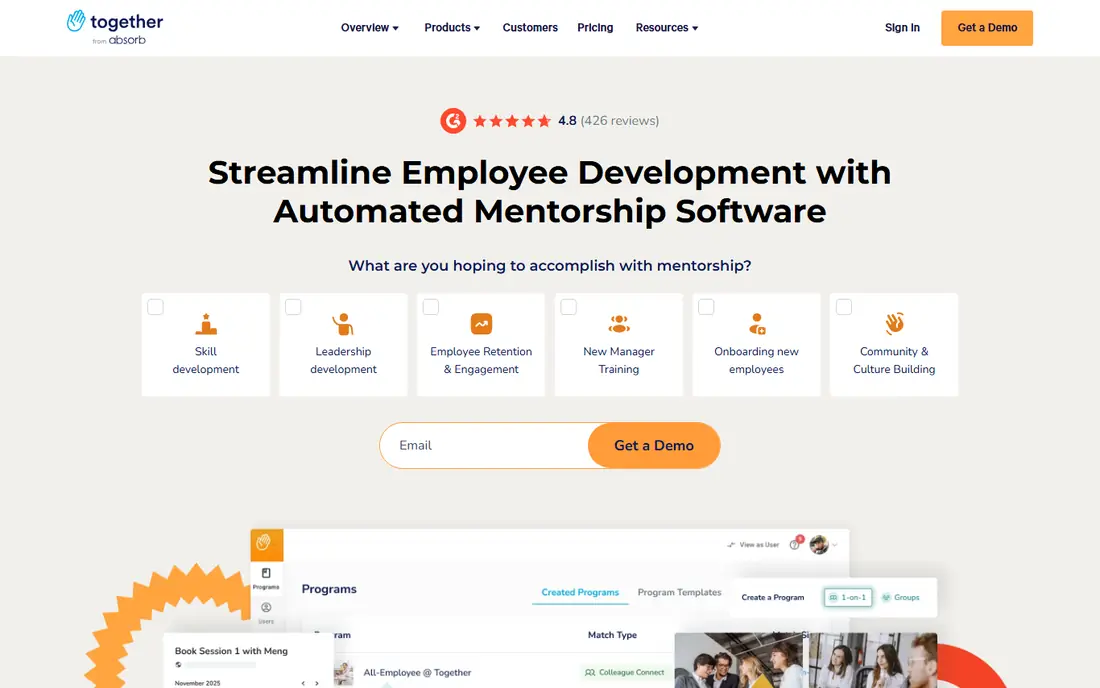
Together suits an HR team that wants structure without building a program from spreadsheets. Admins can run one-to-one mentoring, group programs, peer mentoring, and onboarding tracks from one place, and participants get agendas, goals, and reminders that keep pairs moving. The reporting tools help a program owner show participation, session activity, and goal progress to leadership, which is often the hardest part of keeping a program funded.
The trade-off is price clarity. Together directs buyers to a demo and a quote, so a small team cannot budget from the website alone. That is common in this category, but it still means a longer buying cycle. If your program has several hundred people or several program types at once, the depth is worth the extra step. For a single small pilot, ask early about minimums and who counts as an active user.
- Flexible matching workflows
- Program templates and goal tracking
- Integrations with common HR and calendar tools
- No published starting price
- Can be more than a small team needs for a simple pilot
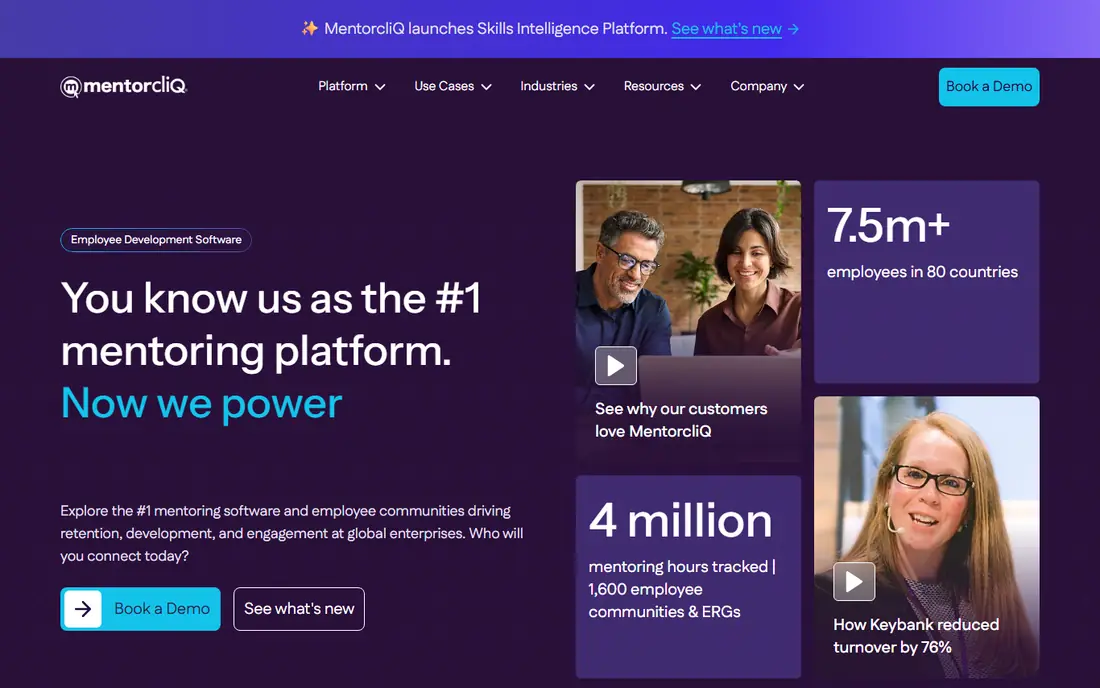
MentorcliQ is built for organizations that run mentoring as a formal talent program rather than a casual perk. It offers guided program design, matching help, session structure, and reporting that ties activity to outcomes. The entry tier, CliQ Start, is listed at $9,900 per year for up to 100 employees, which gives larger buyers a real number to take into a budget meeting.
The catch is that the most useful extras, including a dedicated success coach and deeper ROI dashboards, sit on CliQ Plus and CliQ Complete, which are priced by quote. That does not make the entry plan weak, but buyers who want hands-on support should price the upgrade before they commit. MentorcliQ fits best when a company has a clear owner, a defined cohort, and a need to show results across more than one program cycle.
- Published entry price for up to 100 employees
- Guided program design
- ROI and analytics tools on higher tiers
- Higher tiers are quote only
- Full ROI reporting sits above the entry tier
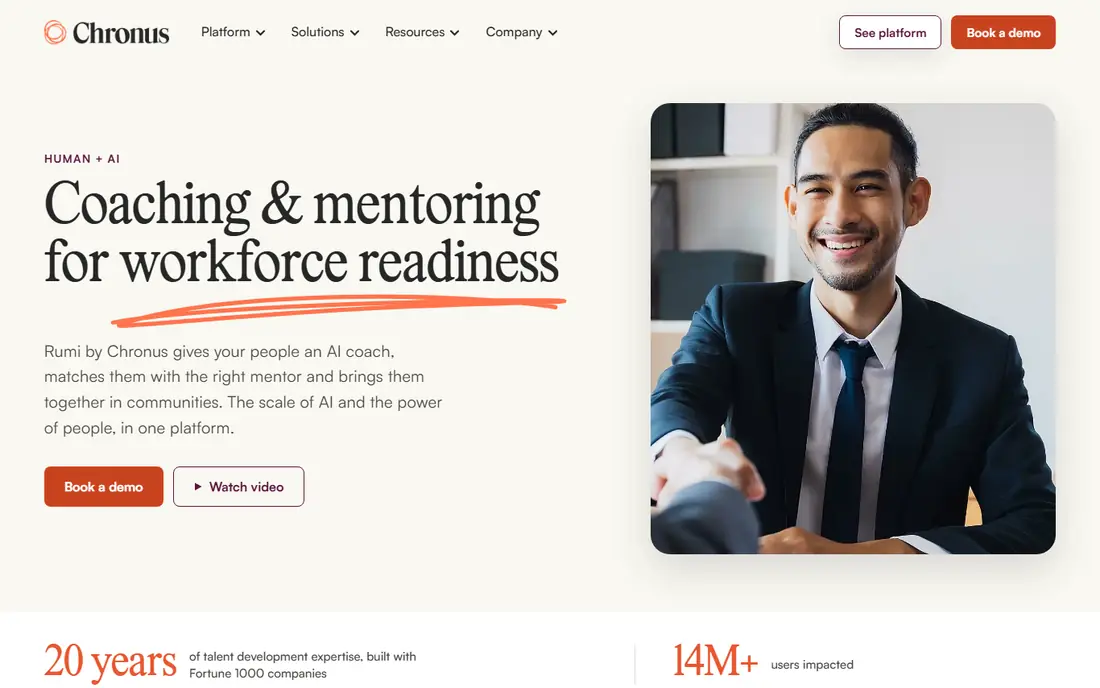
Chronus has been in this market for many years, and that shows in the way it handles complex programs. It supports mentoring journeys, employee communities, and guided conversation prompts, so pairs are less likely to stall after the first meeting. Admins can shape programs around leadership development, onboarding, diversity goals, or skills growth, rather than forcing every group into the same template.
The downside is the buying experience. Pricing is by quote, and a customized rollout takes planning, data work, and internal promotion. Small teams may find that heavy for a first program. Chronus earns its place for large employers that need one platform to serve several audiences, with controls and reporting that satisfy HR, legal, and IT reviewers alike.
- Long track record with large employers
- Guided journeys and communities
- Strong customization options
- Pricing is quote only
- Setup can take real planning time
Qooper puts matching at the center. Its system can pair people based on goals, skills, and preferences, while admins keep the ability to review and adjust matches. That mix helps when a program grows past the point where manual pairing is practical. It also supports coaching and peer learning alongside mentoring, which suits an organization running more than one development format.
Buyers should go in knowing that pricing depends on program scope and participant volume, and that a demo is part of the process. The platform is not a quick self-serve signup, and a two-person team may not need its full range. For mid-size and large programs, though, the combination of templates, training content, session guidance, and reporting makes the sales step easier to justify.
- Matching automation with admin control
- Mentoring, coaching, and peer learning in one place
- Mobile access and reminders
- No published price
- Broad configuration can feel heavy for a tiny team
Mentorloop is the pick we point small and mid-size teams to first, mainly because the price is on the table. Pro starts at $299 per month and covers matching, communication tools, resource tracks, and standard reporting. That clarity lets a program owner compare it directly with a spreadsheet-based pilot and show a finance lead exactly what the first year costs.
The platform keeps the participant experience simple, with sign-up, matching, messaging, and check-ins in one place. Program health views flag pairs that have gone quiet, which is a practical feature that many tools bury. The limit is scale and depth: enterprise features such as custom matching algorithms, bulk matching, and wider HR system integrations sit on a higher tier starting at $1,298 per month. For most programs under a few hundred people, Pro is enough to start.
- Clear published Pro price
- Quick matching and self-matching
- Program health tracking
- Deeper enterprise integrations sit on a higher tier
- Less customization than enterprise rivals
PushFar takes a wider view than matching alone. It pairs mentoring with career progression tools, so participants can map skills, set development goals, and track progress over time. That angle suits teams that want mentoring to connect to promotions, internal moves, or skills growth, not just friendly conversations.
The free tier for individual users makes it the lowest-risk way to try the experience before asking for a budget. Organization pricing is not published, so a company rollout still needs a quote. PushFar also offers integrations with learning systems and single sign-on on organization plans. If your main need is a simple, polished mentoring program with a gentle on-ramp, start with the free tier and test the matching and goal tools with a real group.
- Free tier for individual users
- Career progression tools beyond mentoring
- Mobile apps
- Organization pricing is not published
- Enterprise features vary by plan
Guider focuses on the link between mentoring and skills. Instead of matching on job title alone, it can match on the skills a mentee wants to build and the skills a mentor can share. That makes it a good fit for upskilling programs, leadership pipelines, and inclusion programs where the goal is measurable growth rather than general networking.
Guider also offers a high level of setup help, including branding, sign-up forms, and program design support. That help is valuable, but it also means the product is sold as a guided service as much as a self-serve tool, and pricing is by quote. Teams that want to launch fast with little internal admin time may like that model. Teams that want to buy online and start the same day will find it slower.
- AI-assisted matching tied to skills
- Custom branding and program design help
- Live engagement reporting
- Pricing is quote only
- Best value comes with hands-on setup support
10KC is different from the rest of this list on purpose. It focuses on informal connections, such as coffee chats and peer introductions, rather than long, formal mentoring relationships. That makes it useful for onboarding, cross-team connection, and early-career programs where the goal is belonging and exposure, not a six-month development plan.
The simple experience is the point, and also the limit. If you need detailed goal tracking, formal reporting for leadership development, or complex matching rules, a platform such as Together or Chronus will serve you better. Use 10KC when the problem is that people in a large company never meet, and a light, regular nudge to connect would fix more than a formal program would.
- Light, informal connection formats
- Good for early-career and cross-team networking
- Simple participant experience
- Not a fit for heavily structured programs
- Pricing is quote only
Mentornity suits a program that is past the spreadsheet stage but not ready for an enterprise contract. Paid plans start from $289 per month, with a free trial to test the setup, and the platform covers matching, scheduling, session tracking, and reports. It also works for universities and community programs, not just companies, which widens its templates and use cases.
The honest limit is depth. Larger rivals offer wider HR system integrations and more customization for very large employers. Mentornity trades some of that depth for a clearer price and a faster start, which is the right trade for many small and mid-size programs. If your program grows into several thousand people with complex integration needs, plan to revisit the choice at renewal time.
- Published entry pricing
- Supports employee, student, and community programs
- Scheduling and reporting included
- Fewer deep enterprise integrations than larger rivals
- Smaller public review base
How we picked these
We compared official feature pages, published pricing, and public user reviews, and we kept only platforms that still offer mentoring software in October 2026 and fit the topic. We favored tools with clear program management, matching, goal or session tracking, and reporting, and we noted where pricing was published and where it required a quote. We did not claim hands-on testing, and we treated vendor claims with care by checking them against review listings and comparison sources.
What to check before you buy mentoring software
Start with the program you actually plan to run, not the feature list. A formal leadership program needs goals, structured sessions, and reporting. An onboarding program needs fast matching and simple check-ins. A networking program needs light, frequent connections. Picking the format first stops you from paying for depth you will never use, or buying a light tool for a program that needs real structure.
Matching, goals, and follow-through
Matching gets the attention, but follow-through decides the result. Ask how the tool handles pairs that go quiet, how session notes and goals are stored, and how admins can step in without reading private messages. Look for reminders, agenda templates, and simple health views. A tool that only makes the first match and then goes silent will leave you doing the hard work by hand.
Pricing and participant counts
Ask for the annual total in writing, including any implementation or support fees, and ask exactly who counts as a billable participant. Some vendors count every enrollee, others count only matched users, and that difference can change the bill by a large amount. Also ask what happens when a cohort ends: do seats roll over, or do you pay again for the next group? Get the renewal terms before the first cohort starts.
Privacy, access, and integrations
Mentoring involves personal career goals, so check single sign-on, data controls, and how the vendor handles data when a contract ends. Confirm which HR, calendar, email, and chat tools it connects with, and test the participant experience on a phone, since many mentees will use it there. A clean admin dashboard means little if participants find the tool hard to open and use.
Frequently asked questions
Which mentoring software is the best?
There is no single winner for every program. Together and MentorcliQ suit larger, formal programs, Mentorloop suits smaller teams that want a published price, and PushFar suits a low-risk pilot. Match the tool to your program size, format, and reporting needs first, then compare price.
What are the best tools for mentoring programs?
The best tools cover registration, matching, scheduling, goal tracking, reminders, and reporting in one place. Spreadsheets and email can run a tiny pilot, but they break down once you have dozens of pairs and need to show participation and outcomes to leadership.
What are the best mentoring platforms for small businesses?
Mentorloop and Mentornity are strong starting points because they publish entry prices and offer trials. PushFar is also worth a look because its free individual tier lets you test the experience before buying an organization plan.
How much does mentoring software cost?
Published entry prices on this list range from $289 to $299 per month for smaller plans, while MentorcliQ lists $9,900 per year for up to 100 employees. Many enterprise platforms price by quote, so the total depends on participant count, program types, and support level. Always ask for the annual total and the participant definition.
Do I need software to run a mentoring program?
Not for a handful of pairs, where email and a shared document can work. Software earns its cost when matching, reminders, tracking, and reporting take more admin time than the program itself, or when you need to prove participation and outcomes across cohorts.
Can mentoring software support group and peer mentoring?
Yes. Most tools on this list support one-to-one mentoring plus group programs, peer circles, or informal connections. Check the format support before you buy, since some tools are built mainly for formal pairs and others, such as 10KC, are built mainly for light networking.
Sources
See where you really rank - block by block
ProMapRanker scans Google Maps across a grid of your service area. Simple monthly plans from $19, white-label on every plan.
Start freeKeep reading
 zscaler alternatives
Best Zscaler Alternatives in 2026
Looking for zscaler alternatives? We compare 9 SASE and zero trust platforms on architecture, data protection, pricing, and fit for your network and team.
Read → zapier alternatives free
Best Zapier Alternatives Free in 2026
Nine automation tools for zapier alternatives free in 2026, all with genuinely free tiers, plus free plan limits, starting prices and upgrade paths explained.
Read → which platform is best for online reputation
Which Platform Is Best for Online Reputation in 2026
Wondering which platform is best for online reputation? We compare 8 review, listing, and response tools for small and multi-location businesses and agencies.
Read →