 ProMapRanker
Best Meme Coin Trading Platform in 2026

Key takeaways
- Large centralised exchanges such as Binance, Coinbase, Kraken, and OKX offer the most liquidity and the simplest exits for established meme coins.
- Earlier listings often appear first on Bitget, MEXC, KuCoin, and Bybit, but thinner markets mean higher slippage and higher risk.
- Uniswap is the main decentralised route for new Ethereum tokens, but you take on wallet security, gas costs, and scam token risk yourself.
- Fees, availability, and listed coins vary by country and US state, so check the platform for your location before you deposit.
- Meme coins are highly volatile and can lose most or all of their value. This is not financial advice, and no platform here promises returns.
Quick comparison
| Pick | Great for | Pricing starts at | Free tier | |
|---|---|---|---|---|
 Binance | Deep liquidity for established coins | See website | Yes | Visit |
 Coinbase | Simple US-friendly starting point | See website | Yes | Visit |
 Kraken | Security-focused US trading | See website | Yes | Visit |
 Bitget | Early and active meme listings | See website | Yes | Visit |
 OKX | Advanced traders and broad listings | See website | Yes | Visit |
 Bybit | Active trading and derivatives | See website | Yes | Visit |
 KuCoin | Broad altcoin hunting | See website | Yes | Visit |
 MEXC | Early centralised listings | See website | Yes | Visit |
 Uniswap | New Ethereum tokens on-chain | See website | Yes | Visit |
The best meme coin trading platform
Meme coins trade in two worlds. Established coins such as Dogecoin and Shiba Inu trade on large centralised exchanges with deep order books. New coins often launch on-chain first, where anyone can add liquidity, including scammers. We compared official fee pages, listing coverage, and trading features for platforms live in October 2026, and we wrote See website where fees depend on volume, pair, and location.

Binance is the largest exchange by trading volume in most comparisons, and that scale helps meme coin traders in a practical way. Deep order books mean large orders move the price less, and exits are easier when sentiment turns. Established meme coins, futures, and a wide set of trading tools sit in one account.
The size also brings complexity. The app packs spot, futures, margin, and many other products into one place, so beginners should stick to spot trading and ignore borrowed-funds trading until they understand the risk. US users need to check Binance.US availability and listings, since the global platform and the US platform are not the same service.
- Very deep liquidity on major pairs
- Broad spot and derivatives markets
- App and web trading
- Interface can overwhelm beginners
- Availability and features vary by country
- US users use a separate service

Coinbase is the easiest first step for many US traders. The main app feels like a bank app, fiat deposits are straightforward, and custody and security options are clearly explained. For established meme coins such as Dogecoin, that simplicity is worth paying for, especially for a first purchase.
Coinbase is slower to add new meme coins, so by the time a trending coin lists there, much of the early move may already be over. Fees on simple app trades are also higher than on its Advanced Trade product or on rival exchanges. Use Coinbase for established coins and learning, not for chasing the newest launch.
- Simple app for beginners
- US public company with clear custody options
- Easy fiat on-ramps
- Higher fees than many rivals on simple trades
- Slower to list new meme coins
- Advanced tools sit in a separate product
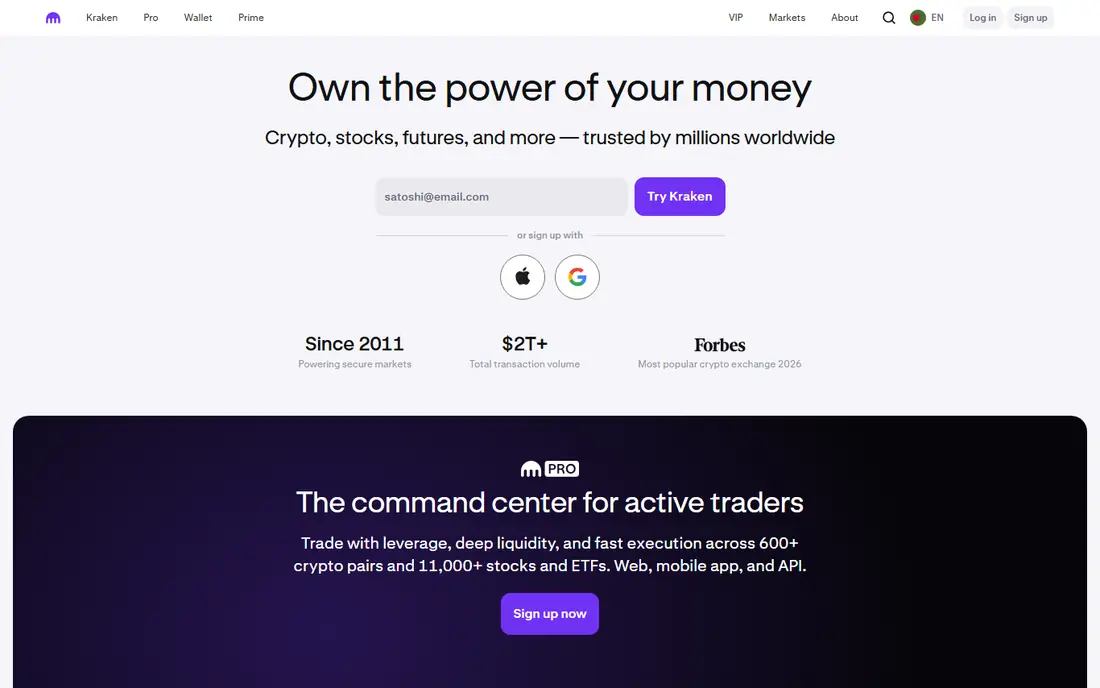
Kraken has operated since 2011 and is often cited for its security record, which matters when you hold volatile assets on an exchange. US dollar funding, spot trading, and a Pro trading interface cover most meme coin needs without pushing beginners toward borrowed-funds trading. Fee tiers reward higher volume, so active traders pay less per trade.
Kraken lists fewer meme coins than Bitget, MEXC, or KuCoin, so it is a poor hunting ground for brand-new tokens. It is a better home base for established coins you plan to hold or trade in size, where security and a clean exit matter more than being first to a listing.
- Long security track record
- Clear fee tiers
- Strong fiat support for US users
- Smaller meme coin selection than rivals
- Interface has a learning curve
- Advanced fees need the Pro product
Bitget is a strong pick for traders who want meme coin action beyond the largest coins. It lists many newer tokens earlier than Coinbase or Kraken, and its spot fees are commonly cited near 0.1 percent, with discounts for its own token in some cases. That breadth makes it popular for active meme trading in 2026 comparisons.
Breadth is also the warning. Early listings can have thin liquidity, sharp price swings, and sudden delistings. Futures and copy trading add further risk, since borrowed-funds trading can turn a small move into a large loss. Check Bitget availability for your country, start with spot trades, and keep position sizes small enough that a total loss does not hurt your finances.
- Broad meme coin listings
- Active spot and futures markets
- Copy trading features for learning
- Availability varies by country
- Futures and borrowed-funds trading raise risk fast
- Newer listings can be thin and volatile
OKX suits traders who have moved past a simple buy-and-sell app. Spot fees are commonly cited near 0.08 percent maker and 0.10 percent taker, and the platform offers advanced orders, futures, and a wallet for on-chain activity. That range covers both established meme coins and more active strategies in one account.
Beginners should treat OKX as a second step, not a first app. The interface assumes trading knowledge, and derivatives can liquidate positions quickly in a volatile meme market. Use spot trading, set limit orders where you can, and keep most funds in a wallet or account you control if you plan to hold for weeks.
- Broad spot and derivatives coverage
- Advanced order types
- Wallet and Web3 tools in the same ecosystem
- Advanced interface for beginners
- Availability varies by region
- Derivatives risk is high for new traders
Bybit is built for active traders who want speed and a broad set of pairs. Spot fees are commonly cited near 0.10 percent, and futures markets offer very low maker and taker fees for high-volume traders. Meme coin pairs, including borrowed-funds products, are a core part of its appeal.
Borrowed-funds trading is the main danger here. A meme coin can move 20 percent in an hour, and a borrowed-funds position can be liquidated long before a trader can react. Bybit is best for experienced traders who use spot markets, strict position sizing, and stop losses, and who accept that most new meme coins fail.
- Fast execution for active traders
- Broad meme listings
- Deep derivatives markets
- Derivatives can wipe out capital fast
- Availability varies by country
- Newer coins still carry high risk
KuCoin has long been a hunting ground for smaller altcoins and meme coins that larger US exchanges do not list. Its breadth lets traders find early pairs, and its spot fees are commonly cited near 0.10 percent. Trading bots and other tools appeal to users who want automation, though automation never removes the risk of the underlying coin.
Small-coin markets on KuCoin can be thin, so slippage matters. A market order in a low-liquidity pair can fill far from the quoted price, so limit orders and small test trades help. Check KuCoin availability for your location, since access and fiat options vary, and withdraw larger holdings to a wallet you control where practical.
- Very broad altcoin and meme listings
- Trading bots and earn features
- Low spot fees in many comparisons
- Thinner markets on small coins
- Availability varies by region
- Bots do not remove market risk
MEXC is known for listing new meme coins early on a centralised exchange, which appeals to traders who do not want to trade on-chain. Spot trading is simple, and MEXC has run zero-fee spot promotions, though those offers change and should be confirmed on its site before you rely on them. For early centralised access, MEXC is a frequent pick in 2026 comparisons.
Early does not mean safe. New pairs can have low liquidity, high slippage, and price moves driven by a small number of holders. Treat every new MEXC listing as high-risk speculation, use small amounts, and do not assume a listing on MEXC means a coin has lasting value or a real project behind it.
- Early listings for new meme coins
- Zero-fee spot promotions in some periods
- Simple spot trading
- Thinner liquidity on new pairs
- Promotions change
- Risk of delisting and sharp drops is high
Uniswap is a decentralised exchange for Ethereum tokens, and it is the main route to a meme coin before any centralised exchange lists it. If a token has a liquidity pool, you can swap for it from your own wallet at once, without waiting for an exchange decision. That openness is why so many new coins appear there first.
Openness is also the risk. Anyone can create a token with a familiar name, and copycat contracts, honeypots, and rug pulls are common in meme markets. You pay network gas on top of the swap fee, and a mistaken trade cannot be reversed by support. Verify the exact contract address from a trusted source, check liquidity and holder distribution, and only risk money you can afford to lose completely.
- Trade any Ethereum token with liquidity at once
- Self-custody with your own wallet
- No exchange listing wait
- Gas fees vary and can be high
- Scam and copycat tokens are common
- No customer support to reverse a bad trade
How we picked these
We compared official fee pages, listing breadth, liquidity, and trading features for centralised exchanges and one leading decentralised exchange that are live in October 2026. We favoured platforms with real meme coin volume and clear fee pages, and we included both beginner-friendly US options and earlier-listing venues, with risk warnings attached. We did not list Telegram bots or small unregulated venues as main picks, since custody, fee, and support risks are higher there.
How to trade meme coins with less risk
Start with established coins on a large exchange, and treat new launches as a separate, small, high-risk bucket. Use limit orders where possible, check liquidity and slippage before a market order, and test withdrawals with a small amount before you deposit more. Never use borrowed funds to trade until you can explain liquidation in plain terms, and never borrow money to buy a meme coin.
Red flags to check before you buy
Check the contract address, liquidity lock or burn status where available, holder concentration, and whether the team is anonymous with no working product. Be wary of coins promoted only through influencer posts, paid groups, or promises of guaranteed gains. If you cannot find a clear reason the coin should hold value beyond hype, assume it may not, and size the trade accordingly. This is not financial advice, and past hype is not a guide to future price.
Frequently asked questions
What is the best meme coin trading app?
For established coins, Binance, Coinbase, and Kraken are strong and liquid. For earlier listings, Bitget, MEXC, and KuCoin offer broader coverage, while Uniswap covers new Ethereum tokens on-chain. The best app depends on your location, experience, and risk tolerance.
What is the best app for trading meme coins as a beginner?
Coinbase is the simplest beginner app for established meme coins in the US, with Kraken as a security-focused alternative. Beginners should avoid borrowed-funds trading, new launches, and Telegram bots until they understand wallet security and slippage.
Are meme coins a good investment?
Meme coins are highly speculative and can lose most or all of their value quickly, even after a large rise. They are not a sound long-term investment for most people, and no platform can promise returns. Only use money you can afford to lose completely.
Can I trade meme coins on Uniswap?
Yes, you can trade any Ethereum token with a liquidity pool on Uniswap from a self-custody wallet. Check the exact contract address, gas cost, and slippage first, since scam tokens and copycats are common and trades cannot be reversed.
Do meme coin platforms charge fees?
Yes. Centralised exchanges charge spot trading fees that vary by volume and pair, and decentralised swaps add network gas fees. Check the fee page and the trade preview before you confirm, since the total cost includes fees, spread, and slippage.
Which platform lists new meme coins first?
New coins usually appear on-chain first through Uniswap or a Solana venue, then on early-listing centralised exchanges such as MEXC, Bitget, and KuCoin. Centralised listings on Coinbase and Kraken usually come later, after a coin has established volume.
Sources
See where you really rank - block by block
ProMapRanker scans Google Maps across a grid of your service area. Simple monthly plans from $19, white-label on every plan.
Start freeKeep reading
 zscaler alternatives
Best Zscaler Alternatives in 2026
Looking for zscaler alternatives? We compare 9 SASE and zero trust platforms on architecture, data protection, pricing, and fit for your network and team.
Read → zapier alternatives free
Best Zapier Alternatives Free in 2026
Nine automation tools for zapier alternatives free in 2026, all with genuinely free tiers, plus free plan limits, starting prices and upgrade paths explained.
Read → which platform is best for online reputation
Which Platform Is Best for Online Reputation in 2026
Wondering which platform is best for online reputation? We compare 8 review, listing, and response tools for small and multi-location businesses and agencies.
Read →