 ProMapRanker
Best Meditation Apps for Beginners in 2026

Key takeaways
- Headspace gives the clearest step by step path for a complete beginner, while Insight Timer gives the largest free library for people who want to explore.
- Medito and Smiling Mind cost nothing, which makes them strong first choices if you are unsure whether meditation will stick.
- Short sessions of five to ten minutes are easier to keep than long sessions, so look for an app with short guided options and a simple timer.
- Calm suits people who also want sleep stories and relaxing sounds, while Balance suits people who like a plan that changes with their progress.
- This is general wellbeing information only, not medical advice. If anxiety, low mood or sleep problems persist, speak with a clinician.
Quick comparison
| Pick | Great for | Pricing starts at | Free tier | |
|---|---|---|---|---|
 Headspace | Structured beginner courses | $12.99 per month | Free trial | Visit |
 Calm | Sleep stories and relaxing sounds | $14.99 per month | Yes | Visit |
 Insight Timer | Large free library | Free | Yes | Visit |
 Balance | Personalised daily plans | $11.99 per month | Free trial | Visit |
 Happier | Sceptical beginners who want clear teaching | $14.99 per month | Free trial | Visit |
 Medito | Completely free guided meditation | Free | Yes | Visit |
 Smiling Mind | Free programs for adults and children | Free | Yes | Visit |
 Aura | Short sessions matched to your mood | $11.99 per month | Yes | Visit |
 Waking Up | Deeper teaching for curious beginners | $14.99 per month | Free trial | Visit |
The best meditation apps for beginners
We compared official pricing pages, app store listings and published course descriptions, and we focused on how easy each app is to start, how much it costs, and how much free content you can use before paying. The apps below cover structured courses, free libraries, sleep support and short daily sessions.
Headspace is our pick for most people who have never meditated. Its Basics course teaches one idea at a time, in short sessions, and it tells you what to do next instead of leaving you to browse a huge library. That structure matters in the first two weeks, when many beginners stop because they do not know where to begin. The app also covers sleep, focus and stress, so it can grow with you after the beginner course ends. The catch is price and the limited free tier. You get a useful trial, but most of the library needs a subscription, so try the trial with a daily reminder set before you commit.
- Clear Basics course
- Short sessions
- Sleep and focus content included
- Little free content after the trial
- Annual price is higher than some rivals

Calm works best if sleep is your main goal and meditation is a second goal. Its sleep stories, soundscapes and short breathing tools are easy to use at night, and the Daily Calm gives you a simple ten minute habit in the morning. Beginners who like a calm voice and a gentle pace will feel at home here. The trade off is focus. Calm holds a lot of content, and a beginner who wants a strict course may find Headspace easier to follow. The free tier also covers only a small part of the library, so check the free sessions first and see if the style suits you before paying.
- Large sleep story library
- Daily Calm sessions
- Relaxing soundscapes
- Meditation can feel buried among sleep and music content
- Free tier is limited
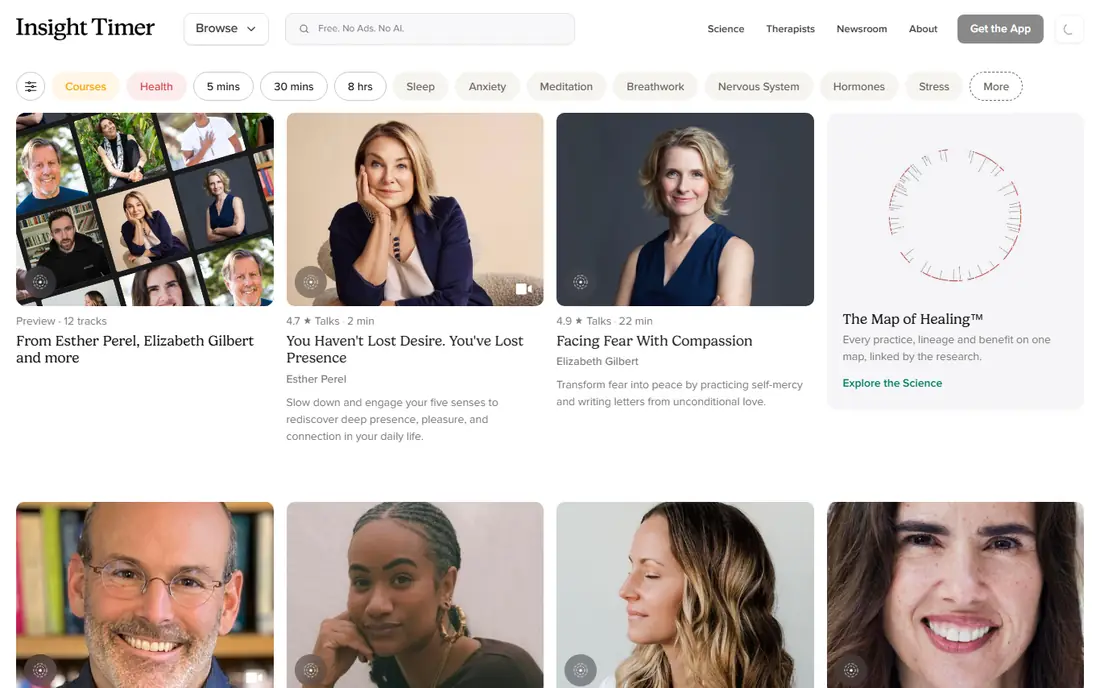
Insight Timer is the best free starting point for most beginners. Its free library covers guided meditations, talks and music, and its simple timer lets you sit in silence once you know the basics. You can try many teachers and styles without paying, which helps you learn what kind of voice and pace you like. Choice is also the weakness. With so much content, a beginner can spend more time choosing than meditating. A good fix is to pick one short course, follow it to the end, and use the timer for the rest of the week. Paid Member Plus costs $9.99 per month or $59.99 per year and adds offline listening and extra courses.
- Very large free guided library
- Timer for unguided practice
- Many teachers
- Quality varies between teachers
- Paid Member Plus adds courses and offline use
Balance asks about your goals, experience and available time, then builds a daily plan around your answers. For a beginner, that personal plan removes the hardest decision, which is what to do today. Sessions stay short, and the app revisits skills over time instead of moving on too fast. The main risk is cost after an introductory offer. Balance has offered a free first year in the past, and the regular price is $69.99 per year, so check the price shown at sign up before you assume the first year price will continue. If you like a plan that changes with you, it is worth the trial.
- Plan adapts to your goals and progress
- Clear beginner foundations
- Short daily sessions
- Smaller teacher library than Insight Timer
- Full price applies after the first year offer
Happier, formerly Ten Percent Happier, suits people who feel unsure about meditation and want a straight explanation of what it does and what it does not do. Its courses use plain language, short videos and guided sessions, and they explain the idea behind each practice before asking you to try it. That teaching style makes it a strong second choice after Headspace for a doubtful beginner. The cost is higher than Headspace or Calm on an annual plan, and sleep content is thinner, so it fits best if learning the skill matters more to you than falling asleep to a story.
- Plain language teaching
- Well known teachers
- Practical courses for stress and focus
- Higher annual price at $99.99 per year
- Less sleep content than Calm
Medito is a nonprofit app, and that shows in its price, which is zero. You get guided courses, sleep stories, breathing sessions and a timer without a subscription, an account wall or a trial countdown. For a beginner on a tight budget, it removes every financial reason to delay starting. The library is smaller than Insight Timer, and it does not offer the same range of teachers or music. Still, the beginner course is clear and the sessions are short, so Medito works well as a first app. If you later want more variety, you can move to a paid app without having lost anything.
- No subscription and no paywall
- Beginner courses
- Sleep and stress packs
- Smaller library than paid rivals
- English only content in the main app
Smiling Mind is a free nonprofit program built with psychologists, and it covers adults, children, teenagers and workplaces. Its programs are short and structured, which makes it a good choice for a family that wants to start together, or for a beginner who wants a calm, no pressure path. It does not try to match Calm for sleep stories or Headspace for polished production, and that is fine. The strength here is access. You can use the full program without paying, and you can repeat a program until the habit feels steady. For schools and families, that free access is a clear advantage.
- Completely free
- Programs for adults, children and schools
- Short structured sessions
- Less sleep and music content than paid apps
- Design is simpler than Calm or Headspace
Aura starts with a short check in about how you feel, then suggests a session to match that mood. That small step helps a beginner who opens the app feeling stressed and does not know what to choose. Sessions are short, and the app also offers stories, music and coaching material for days when sitting still feels hard. The free tier gives you a taste rather than a full library, so expect a subscription if you use it daily. Prices vary by plan and store, and the monthly price is around $11.99, so check the checkout page before subscribing. Aura suits people who want a quick, personal suggestion rather than a long course.
- Daily check in that shapes the session
- Short meditations
- Stories and coaching content
- Free sessions are limited
- Some content sits behind a subscription
Waking Up is the pick for a beginner who wants to understand meditation, not just follow a voice. Its 28 day introductory course pairs guided sessions with short lessons on attention, awareness and the mind, and it draws on several meditation traditions. The teaching is calm and precise, and it avoids vague promises. That depth is also the drawback. If you want a five minute stress reset, the theory sections can feel slow, and the price is at the higher end. The app does offer free access to people who cannot afford a subscription, which is worth knowing if cost is a barrier. Start with the trial and see if the teaching style holds your attention.
- 28 day introductory course
- Clear theory lessons
- Free access for people who cannot afford it
- Theory heavy style may feel slow
- Higher annual price than most rivals
How we picked these
We compared official pricing pages, app store listings and published course descriptions for each app, and we checked that each one still offers a beginner course or short guided sessions in October 2026. We favoured apps with a clear starting point, honest pricing and a free tier or trial, and we included free nonprofit options so cost alone would not block a beginner. We did not claim hands on testing, and we did not count awards, download totals or star ratings as proof of quality. We also weighed the honest catch for each app. A huge library helps once you know what you like, but it can overwhelm a first timer. A strict course helps at the start, but it can feel narrow later. The list mixes both kinds, so you can start strict and move to a wider library, or start free and pay later only if you want more.
Choosing the right beginner app
Start with time, not with features
Pick a session length you can keep on a busy day. Five minutes most days builds a habit faster than a 30 minute session you skip. Look for an app with a streak or reminder you can set, and put the session at the same time each day, such as after waking or before bed.
Match the app to your main goal
If sleep is the goal, Calm or a sleep pack in Medito or Headspace will serve you better than a theory heavy app. If learning the skill is the goal, Headspace, Happier or Waking Up will teach more. If cost is the main limit, start with Medito, Smiling Mind or the free part of Insight Timer, and only pay when you know you will use the app daily.
Check the price before the trial ends
Set a reminder two days before any trial ends, and check the monthly and annual price in the app store or on the vendor site. Annual plans look cheaper per month, but they lock in a full year, so a monthly plan is safer for your first month. Cancel in the app store settings if you decide not to continue, and keep the free app as a backup.
Frequently asked questions
What is the best meditation app for beginners?
Headspace is the safest first pick because its Basics course teaches one skill at a time and tells you what to do next. If you want a free start, Insight Timer or Medito are strong choices, and Calm is better if sleep is your main goal.
Is there a best beginner meditation app that is completely free?
Yes. Medito and Smiling Mind are free, with no subscription needed for their core programs. Insight Timer also offers a large free library, with a paid tier for extra courses and offline listening.
How long should a beginner meditate each day?
Five to ten minutes a day is a good start. Short daily sessions build a habit, and you can add time later when sitting still feels easier. Longer sessions are not better if they make you skip the next day.
Do I need to pay for a meditation app to learn properly?
No. Free apps cover the core skills, including breath awareness, body scans and short guided sessions. Paying helps if you want more teachers, sleep stories, offline listening or a structured course, but it is not required to learn the basics.
Can meditation apps help with anxiety or sleep?
Guided sessions and sleep stories can support relaxation and a calmer bedtime routine for many people. They are not a substitute for medical care, and you should speak with a clinician if anxiety, low mood or sleep problems persist or get worse.
What is the best meditation app for beginners who dislike sitting still?
Aura and Headspace both offer short sessions, and Insight Timer offers movement friendly practices and short talks. Try a three to five minute session first, and use a timer for unguided practice once you feel comfortable.
Sources
See where you really rank - block by block
ProMapRanker scans Google Maps across a grid of your service area. Simple monthly plans from $19, white-label on every plan.
Start freeKeep reading
 zscaler alternatives
Best Zscaler Alternatives in 2026
Looking for zscaler alternatives? We compare 9 SASE and zero trust platforms on architecture, data protection, pricing, and fit for your network and team.
Read → zapier alternatives free
Best Zapier Alternatives Free in 2026
Nine automation tools for zapier alternatives free in 2026, all with genuinely free tiers, plus free plan limits, starting prices and upgrade paths explained.
Read → which platform is best for online reputation
Which Platform Is Best for Online Reputation in 2026
Wondering which platform is best for online reputation? We compare 8 review, listing, and response tools for small and multi-location businesses and agencies.
Read →