 ProMapRanker
Best MDM for Tech Companies in 2026

Microsoft 365 shops · Pricing starts at: $8 per user per month
Key takeaways
- Microsoft Intune is the natural pick for tech companies already on Microsoft 365, while Jamf and Iru lead for Apple-heavy teams.
- Hexnode and Scalefusion offer the best value for mixed fleets, with published starting prices near $2 per device per month.
- Mosyle and Miradore give small teams a genuine free start, up to 30 and 50 devices respectively in published 2026 comparisons.
- Pricing units differ, so compare per user against per device carefully, and check minimum device counts before comparing headline rates.
- We compared vendor-published pricing from 2026 coverage, operating system coverage, and identity and enrolment features, not review scores alone.
Quick comparison
| Pick | Great for | Pricing starts at | Free tier | |
|---|---|---|---|---|
| Microsoft Intune | Microsoft 365 shops | $8 per user per month | Free trial | Visit |
 Jamf | Apple fleets at scale | See website | Free trial | Visit |
 Iru | Automated Apple compliance | See website | No | Visit |
 Hexnode UEM | Mixed fleets on a budget | $2.20 per device per month | Free trial | Visit |
 Scalefusion | Android, kiosk, and frontline fleets | $2 per device per month | Free trial | Visit |
 Mosyle | Low-cost Apple management | $1 per device per month | Yes | Visit |
 ManageEngine Mobile Device Manager Plus | On-premises or free small fleets | See website | Yes | Visit |
 Miradore | Free mixed fleets up to 50 devices | $2.75 per device per month | Yes | Visit |
 JumpCloud | Identity-led device management | $9 per user per month | Free trial | Visit |
The best MDM for tech companies
We shortlisted tools that manage modern tech fleets, meaning a mix of Macs, Windows PCs, iPhones, and Android devices, with zero-touch enrolment, policy enforcement, and remote wipe. The nine tools below cover Apple-only depth, cross-platform breadth, and identity-led management.
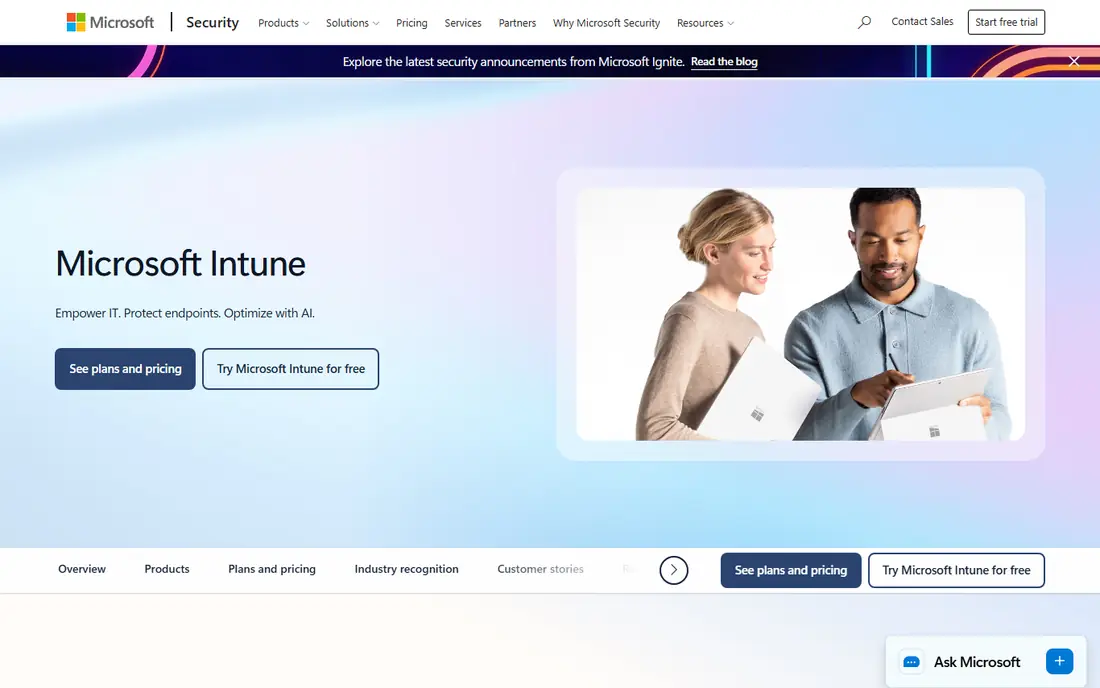
Intune makes the most sense when your company already lives in Microsoft 365. Published 2026 coverage puts Intune Plan 1 at $8 per user per month, and notes it is included in Business Premium, E3, and E5, which means many tech companies already pay for it without realising it. Device compliance, app deployment, and Conditional Access tie directly into Entra ID, so a device that falls out of compliance can lose access to company data automatically.
The trade-off is that Intune is a platform, not a simple app. Policy design, app packaging, and Autopilot enrolment take real planning, and Apple management, while capable, does not match the depth of a dedicated Apple tool. We would pick Intune first for Microsoft-centric tech teams, and pair it with a dedicated Apple tool only if Mac management becomes a bottleneck.
- Included in Microsoft 365 Business Premium, E3, and E5 in published coverage
- Deep Windows and identity integration
- Broad OS coverage
- Per-user pricing can be costly for shared devices
- Setup complexity grows with Conditional Access policies
- Apple depth is thinner than Jamf
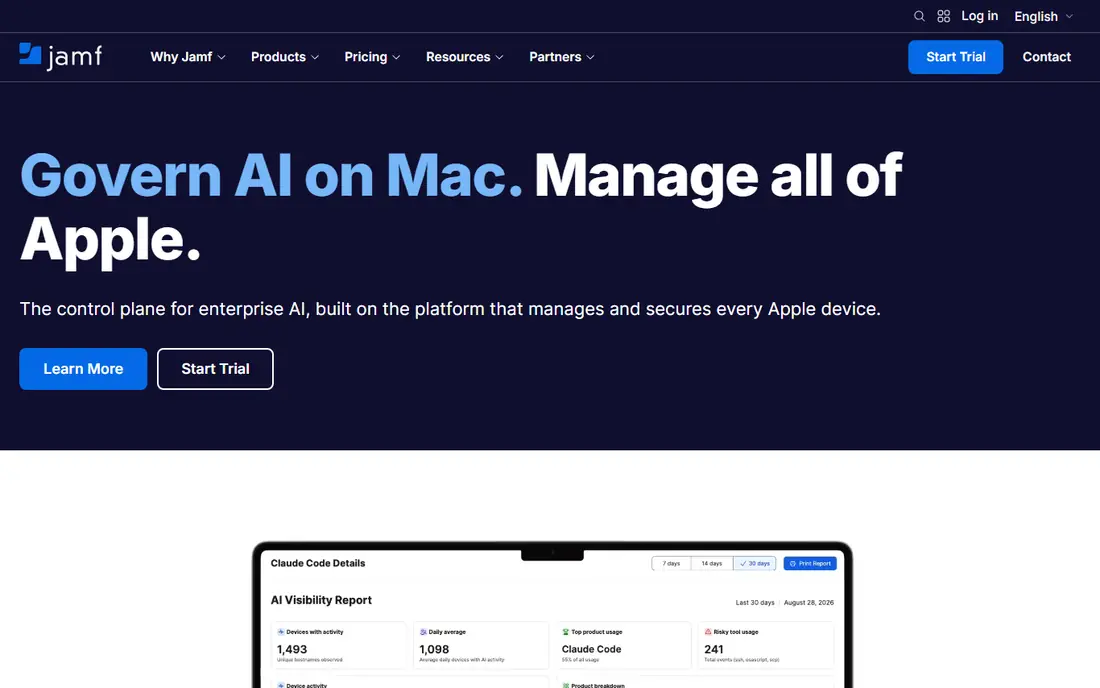
Jamf is the standard answer for an Apple-heavy tech company, and the reason is depth. It manages Macs, iPhones, iPads, and Apple TV with policies, app deployment, patching, and automation built around how Apple devices actually work, including zero-touch enrolment through Apple Business Manager. Published coverage describes Jamf Now from about $4 per device per month with the first three devices free, and Jamf for Mac near $12.50 per device per month, though larger plans are quote-based.
That depth comes with a boundary. Jamf does not manage Windows or Android devices, so a mixed fleet needs a second tool or a different primary platform. Cost also rises quickly at scale, and the full enterprise feature set can overwhelm a team that only needs basic policy enforcement. We would pick Jamf when Apple devices dominate and IT wants the deepest macOS and iOS control available.
- Deepest Apple management depth in this list
- Strong automation and Apple Business Manager integration
- Jamf Now covers small fleets
- No Windows or Android management
- Pricing is quote-based for larger plans in 2026 coverage
- Enterprise depth can be overkill for tiny teams
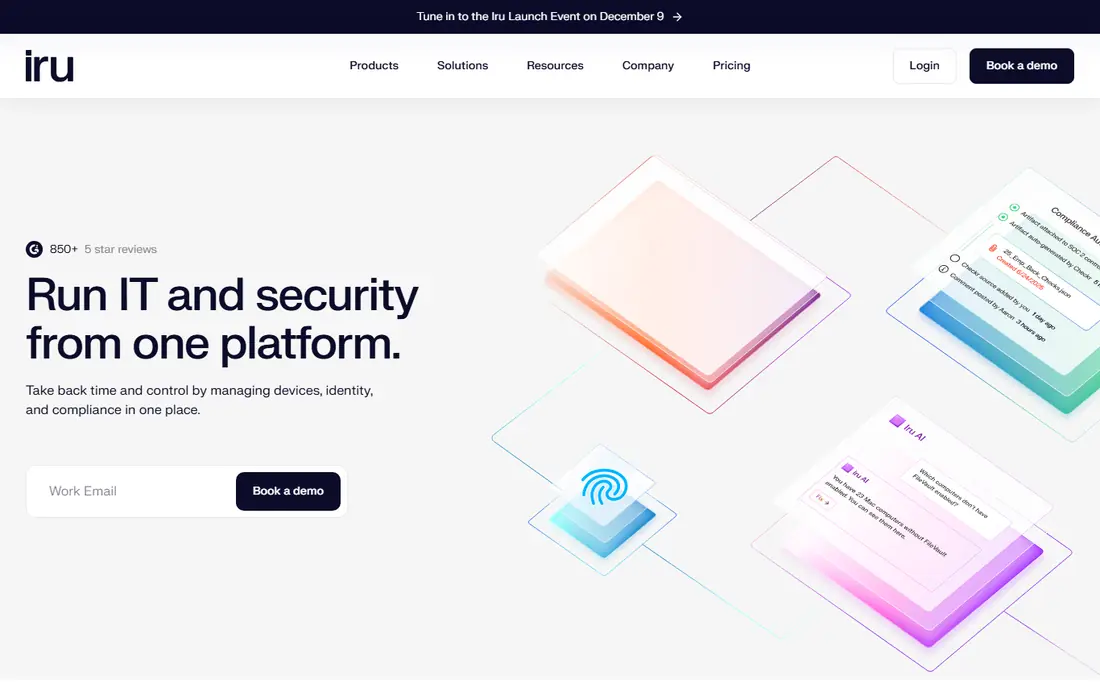
Iru is the new name for Kandji, and the rebrand matters for buyers who remember the old product. Published 2026 coverage describes Iru as an automation-first Apple management platform with a strong compliance focus, including device posture checks and automated remediation. For a fast-growing tech company that needs audit-ready Apple fleets without hiring a large IT team, that automation is the selling point.
The honest catch is price and positioning. Iru quotes on request and is described in 2026 coverage as upmarket, with higher device minimums than a small-team tool, so it is not a casual pick for a ten-device startup. Its broader endpoint security and identity features also mean you should compare it against a full security stack, not just an MDM. We would pick Iru when Apple compliance automation is the priority and the budget fits an enterprise-grade tool.
- Automation-first Apple management
- Compliance and endpoint security focus in 2026 coverage
- Modern interface
- Pricing is quote-based
- Positioned upmarket in 2026 coverage
- Windows and Android coverage is newer than Apple depth
Hexnode is the value pick for a tech company with a genuinely mixed fleet. Published 2026 coverage puts its starting price at $2.20 per device per month on annual billing, with support for Windows, macOS, iOS, Android, and Linux, plus kiosk and app management features. That breadth at that price is hard to beat, especially for a team that needs one console for laptops, phones, and tablets without paying enterprise rates.
The limits are tiering and minimums. Coverage describes a 15-device minimum, and the most advanced features require higher plans, so the entry price is a starting point, not the full cost for a complex fleet. Some platform features are also deeper than others, so test your least common device type during the trial. We would pick Hexnode when budget and breadth matter most, and you are willing to map features to tiers before committing.
- Cross-platform coverage including Windows, macOS, iOS, Android, and Linux in coverage
- Low published starting price
- 14-day trial in coverage
- 15-device minimum described in coverage
- Interface depth varies by platform
- Advanced features sit on higher tiers
Scalefusion stands out where other MDM tools treat Android and frontline devices as an afterthought. Published 2026 coverage puts its Essential plan at $2 per device per month on annual billing, with support for Windows, macOS, iOS, Android, Linux, and ChromeOS, plus kiosk mode, geofencing, and app controls. For tech companies with field devices, shared tablets, point-of-sale hardware, or rugged handsets, those features are central, not extras.
The entry terms need reading. Coverage describes annual billing only and a 10-device minimum, so a very small team cannot pay month to month at the entry rate. Apple management is capable but not as deep as a dedicated Apple tool, so an Apple-heavy team should test macOS policies closely. We would pick Scalefusion when Android, kiosk, or frontline devices dominate the fleet.
- Broad OS coverage including ChromeOS in coverage
- Strong kiosk and frontline features
- Low published starting price
- Annual billing only on the entry tier in coverage
- 10-device minimum in coverage
- Apple depth is thinner than Jamf or Iru
Mosyle is the budget answer for an Apple-only tech team. Published 2026 coverage puts its free tier at up to 30 devices and its Business Premium tier at $1 per device per month, which makes it one of the cheapest ways to manage Macs and iPhones properly. For a startup that has standardised on Apple hardware, Mosyle covers enrolment, policies, app deployment, and security basics without a sales call.
The boundary is absolute: Mosyle does not manage Windows, Android, or Linux, so any non-Apple device needs another tool. Paid tiers also carry a 30-licence minimum in coverage, which can surprise a team growing from 20 to 30 devices, and free-tier support is thin. We would pick Mosyle when the fleet is Apple-only, the budget is tight, and the team is comfortable with a more hands-on setup.
- Free tier up to 30 devices in 2026 coverage
- Paid Business Premium from $1 per device per month in coverage
- Apple-only focus keeps setup simple
- No Windows, Android, or Linux support
- Paid tiers carry a 30-licence minimum in coverage
- Support on the free tier is limited
ManageEngine Mobile Device Manager Plus
Great for: On-premises or free small fleets
ManageEngine is the pick for teams that want an on-premises option or a free start for a small fleet. Published 2026 coverage puts its free tier at up to 25 devices, with paid cloud bundles starting near $495 to $645 a year for 25 devices depending on edition and source. It covers Windows, macOS, iOS, Android, and related platforms, with app management, security policies, and remote actions from one console.
The pricing model needs care. Bundles step up at device-count boundaries, so growing past a tier can raise costs more than a simple per-device rate would suggest. The interface also reflects its enterprise heritage, which can feel heavy for a small team. We would pick ManageEngine when on-premises deployment or a free 25-device start matters, and you are comfortable with tiered pricing.
- Free tier up to 25 devices in 2026 coverage
- On-premises option, rare in this list
- Broad OS coverage
- Tiered bundle pricing can jump at boundaries
- Interface feels enterprise-heavy
- Cloud pricing varies by device count
Miradore gives a small tech team the widest free start in this list. Published 2026 coverage puts its free tier at up to 50 devices and its Premium plan at $2.75 per device per month on annual billing, with support for Windows, macOS, iOS, and Android. For a startup with a mixed fleet that cannot yet justify paid MDM, Miradore lets you enforce passcodes, deploy apps, and wipe lost devices without spending anything.
The free tier is intentionally basic, so features such as advanced automation, deeper reporting, and some security controls sit behind Premium. Miradore is also a smaller vendor than Microsoft or Jamf, which matters if you need extensive integrations or enterprise support. We would pick Miradore when a free, cross-platform start for up to 50 devices is the priority, with a clear upgrade path to Premium.
- Free tier up to 50 devices in 2026 coverage
- Cross-platform coverage
- Low Premium starting price in coverage
- Advanced features require Premium
- Smaller vendor footprint than Microsoft or Jamf
- Support depth varies by plan
JumpCloud flips the usual MDM logic by starting with identity. Published 2026 coverage puts its Device Management plan at $9 per user per month on annual billing, with directory services, single sign-on, and device policies in the same platform. For a tech company where access control matters as much as device control, that combination reduces the systems IT must maintain.
Per-user pricing is both the strength and the catch. A staff member with three devices costs the same as one with a single device, which is good for multi-device teams, but shared devices and frontline fleets can become expensive quickly. Device policy depth also varies by operating system, so test your full OS mix. We would pick JumpCloud when identity and access are the organising principle for IT, and devices are managed as part of that system.
- Directory, identity, and device management in one platform
- Per-user pricing suits multi-device staff
- Broad OS coverage
- Per-user pricing penalises shared devices
- Device management depth varies by OS
- $9 entry is per user, not per device
How we picked these
We compared vendor-published pricing from 2026 coverage, operating system coverage, enrolment methods, and identity features, and we kept only tools that are live and actively sold in 2026. We favoured tools with published pricing or a clear free tier, broad OS coverage, and zero-touch enrolment through Apple Business Manager, Android Enterprise, or Windows Autopilot. We excluded tools that are maintenance-only, discontinued, or sold only as part of a wider suite without a standalone MDM offer. Pricing units differ across vendors, so we state the unit for every price and note minimums where published coverage reports them.
How to choose for your fleet shape
Start by counting devices by operating system, not by headcount. An Apple-only fleet points to Jamf, Iru, or Mosyle, while a mixed fleet points to Intune, Hexnode, Scalefusion, or ManageEngine, and an identity-led team points to JumpCloud. Next, decide whether devices are assigned to one person or shared, since per-user pricing favours the first case and per-device pricing favours the second. Shared tablets, kiosks, and frontline handsets can quietly double a per-user bill.
Then trial your hardest enrolment, not the demo path. Enrol a Mac through Apple Business Manager, a Windows PC through Autopilot, and an Android device through Android Enterprise, and test a lost-device wipe, a policy change, and an offboarding flow. A tool that passes the demo but fails enrolment will cost far more in IT time than a slightly higher monthly rate.
Frequently asked questions
What is MDM, in plain terms?
MDM stands for mobile device management, though modern tools manage laptops and desktops as well as phones and tablets. An MDM platform enrols devices, enforces policies such as passcodes and encryption, deploys apps, and lets IT lock or wipe a lost device remotely. For tech companies, it is the control layer that keeps company data safe on hardware the company may not physically hold.
Is MDM the same as unified endpoint management?
Unified endpoint management, or UEM, is the broader term, covering desktops, laptops, phones, tablets, and sometimes IoT devices from one console. Many tools in this list are UEM platforms that include MDM features, while Apple-only tools focus more narrowly on Apple endpoints. The label matters less than whether the tool covers every operating system in your fleet.
How much should a tech company budget for MDM?
Published 2026 starting prices in this list run from free for small fleets to about $9 per user per month, with most cross-platform tools near $2 to $3 per device per month. Your actual cost depends on device count, pricing unit, tier, and whether identity or security features are bundled. Model the cost at your current fleet size and at double that size before signing.
Do employees need to accept MDM on personal devices?
For company-owned devices, enrolment is usually mandatory and managed by IT. For personal devices under a bring-your-own-device policy, MDM should use a work profile or container that separates company data from personal data, and the company should explain in writing what it can and cannot see. Never enrol a personal device in full-device management without a clear, written policy.
Can one MDM tool manage Apple, Windows, and Android?
Yes, several tools here do, including Intune, Hexnode, Scalefusion, ManageEngine, Miradore, and JumpCloud. Apple depth varies, so an Apple-heavy team may still prefer Jamf or Iru for Macs and iPhones, even if a second tool handles the rest. Test each operating system in your fleet before committing to a single console.
What happens when an employee leaves?
A good MDM offboarding flow removes company apps and data, revokes access, and either wipes a company-owned device or removes only the work profile from a personal device. Identity-led tools such as JumpCloud and Intune can tie this to account deactivation, so access ends even if the device is not immediately returned. Test the full offboarding flow during the trial, not after the first departure.
Sources
See where you really rank - block by block
ProMapRanker scans Google Maps across a grid of your service area. Simple monthly plans from $19, white-label on every plan.
Start freeKeep reading
 worlds best local seo company
8 Worlds Best Local SEO Companies for Map Pack Growth in 2026
Compare the worlds best local seo company options for Google Business Profile work, citations, reviews, and multi-location rankings and reporting in 2026.
Read → world's best web hosting company
World's Best Web Hosting Company in 2026
Searching for the world's best web hosting company? We compared 10 hosts on price, renewal rates, speed, and support to help you choose well today in 2026.
Read → who's got the best nanny tax services
Who's Got the Best Nanny Tax Services in 2026
We answer who's got the best nanny tax services, comparing full filing, back taxes, software, and pricing so families can handle nanny taxes correctly.
Read →