 ProMapRanker
Best Master Data Management Tools in 2026


Large multi-domain enterprises · Pricing starts at: See website
Key takeaways
- Informatica and Reltio suit large enterprises that need multi-domain mastering at scale, with strong matching and governance controls.
- Profisee and Semarchy are strong options for Microsoft-centred and mid-market teams that want faster implementation and stewardship tools.
- Ataccama suits teams that want data quality and mastering in one platform rather than buying two separate products.
- Almost all enterprise MDM pricing is by quote, so budget on implementation, integration and stewardship time, not just licence cost.
Quick comparison
| Pick | Great for | Pricing starts at | Free tier | |
|---|---|---|---|---|
| Informatica MDM | Large multi-domain enterprises | See website | No | Visit |
 Reltio | Cloud-native customer data | See website | No | Visit |
 Profisee | Microsoft-centred teams | See website | Free trial | Visit |
 Semarchy | Multi-domain DataOps | See website | Free trial | Visit |
 Ataccama | Unified quality and mastering | See website | Free trial | Visit |
 Stibo Systems | Product data at scale | See website | No | Visit |
 SAP Master Data Governance | SAP S/4HANA estates | See website | No | Visit |
 IBM InfoSphere MDM | Regulated hybrid estates | See website | No | Visit |
 Precisely | Product, supplier and location data | See website | No | Visit |
The best master data management tools
Master data management tools create one trusted record for customers, products, suppliers and locations, then share that record across systems. The best choice depends on your domains, your existing stack and how much stewardship your team can run.
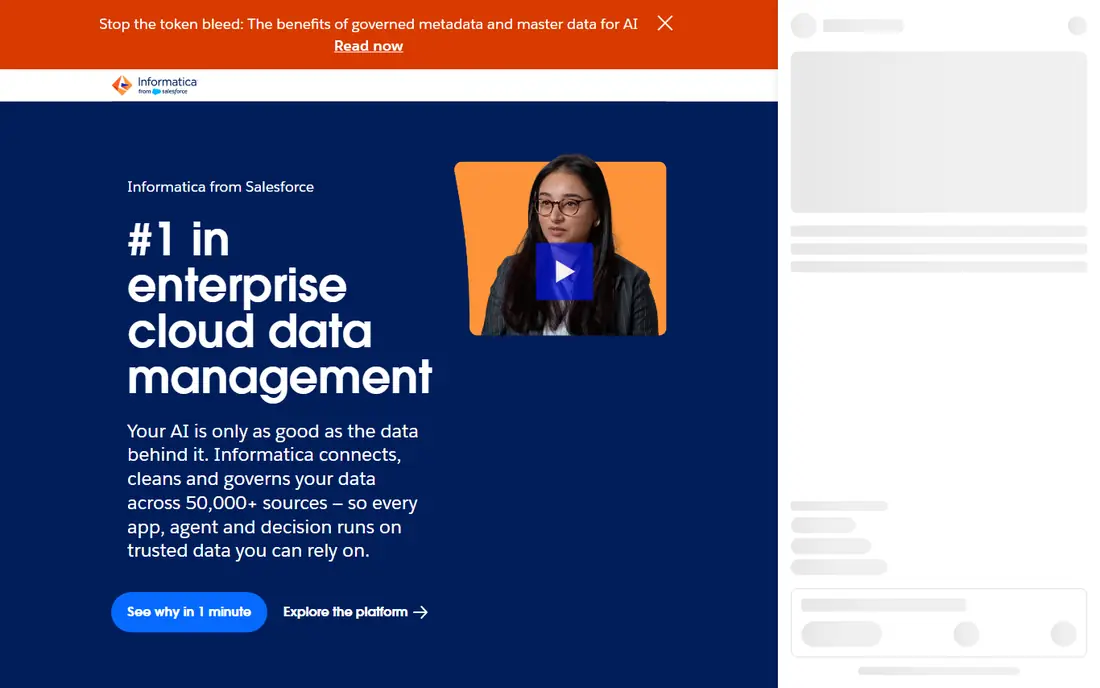
Informatica MDM sits inside the Intelligent Data Management Cloud, which means mastering can sit alongside data quality, integration and governance in one platform. For a large enterprise with customer, product and supplier domains, that breadth matters, because the same team can govern matching rules, data quality and distribution without stitching many tools together.
Salesforce completed its acquisition of Informatica in late 2025, so buyers should confirm roadmap and channel details during procurement. Pricing is not published and is consumption-based in many cases, and implementation is a programme, not a quick install. Informatica suits organisations that already run Informatica or Salesforce and need enterprise scale.
- Multi-domain mastering
- AI-assisted matching and cleansing
- Large connector estate
- Quote-based pricing
- Heavy implementation for smaller teams

Reltio is a cloud-native data platform built for real-time, multi-domain mastering, with a strong focus on customer data and operational use. Its graph-based model helps teams see relationships between people, organisations and locations, and its APIs serve golden records to CRM, marketing and service systems as they change.
That API-first design is the main reason to pick Reltio over a batch-only hub. The trade-off is that a hub only delivers value once matching, stewardship and governance processes are running well, and pricing is by quote. Reltio suits cloud-first enterprises that need trusted customer records available in real time, not only in nightly batches.
- Cloud-native multi-domain hub
- Real-time APIs
- Graph-based data model
- Quote-based pricing
- Hub scope needs stewardship investment
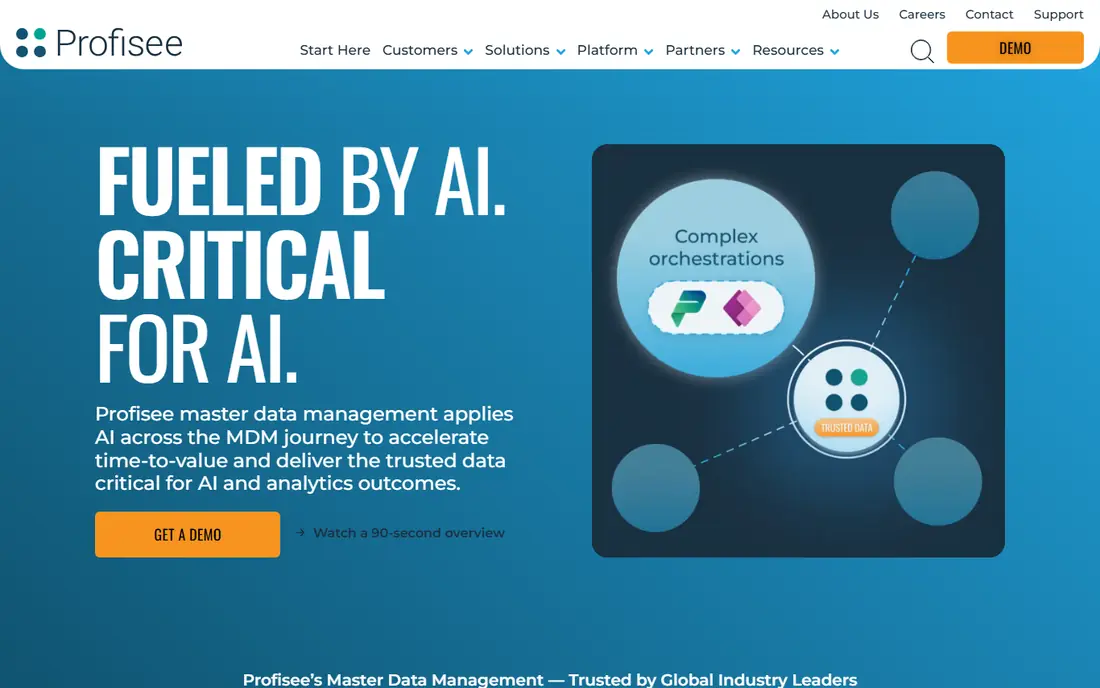
Profisee is an MDM platform with a strong Microsoft alignment, running natively on Azure and fitting well with Microsoft data tools. Its stewardship interface is designed for business users, not only data engineers, which helps when product or customer teams must review matches and fix records themselves. That usability is often cited as a reason for faster adoption.
Implementation reputation is stronger than for heavier enterprise hubs, though pricing is still by quote and the full value depends on clean source data and agreed matching rules. Profisee suits mid-size to large organisations on Microsoft infrastructure that want multi-domain mastering without a multi-year programme.
- Azure-native design
- Business-user stewardship interface
- Fast implementation reputation
- Quote-based pricing
- Microsoft focus may matter less for other stacks
Semarchy xDM combines multi-domain MDM, governance and integration, with DataOps practices such as version control and deployment pipelines built in. That approach appeals to teams that want to treat master data models like software: versioned, reviewed and deployed in a controlled way. Deployment options include SaaS, cloud, Snowflake-native and on-premises setups.
The flexibility needs skill. Advanced workflows reward teams with data engineering capacity, while smaller teams may need partner help to get started. Semarchy suits organisations that want one platform for several domains and value governance and integration alongside mastering itself.
- Multi-domain mastering
- DataOps with version control
- Flexible deployment
- Quote-based pricing
- Needs data engineering skill for advanced workflows
Ataccama ONE unifies data quality, governance and MDM, so teams do not need separate tools for cleansing, matching and policy controls. AI-assisted matching and automation help stewards handle larger volumes, and the unified interface reduces the need to move between products for a single record problem.
Consolidation is still a project. Source systems, matching rules and stewardship roles must be agreed before the platform can deliver trusted records, and pricing is by quote. Ataccama suits teams that are currently buying quality and mastering separately and want one vendor, one model and one stewardship workflow.
- MDM, data quality and governance in one platform
- AI automation
- Unified interface
- Quote-based pricing
- Consolidation project still needs planning
Stibo Systems is best known for product information management, and its MDM platform extends that strength across customer, supplier and location domains. Retail, manufacturing and distribution companies with large product catalogues, complex hierarchies and channel requirements often find its product modelling and syndication depth hard to match.
That depth comes with enterprise cost and implementation effort, and pricing is by quote. A company with a modest product catalogue and one domain may not need this level of product tooling. For large product estates where accurate, governed product data drives sales channels, Stibo is a leading candidate.
- Multi-domain MDM with deep product capabilities
- Strong for retail and manufacturing
- Governance controls
- Enterprise pricing and implementation
- Product focus may exceed simpler needs
SAP Master Data Governance, known as SAP MDG, governs master data inside the SAP ecosystem, with workflows, approvals and replication to SAP systems. For a company already running S/4HANA, that native fit reduces integration work and keeps governance close to the business processes that create and change master data.
Outside SAP, the case weakens. SAP MDG is designed around SAP data models and processes, so a multi-vendor estate may prefer a neutral hub such as Informatica, Reltio or Semarchy. Pricing is tied to SAP licensing and is not published as a simple monthly figure. SAP MDG is the natural pick for SAP-centric enterprises, and a niche pick for everyone else.
- Native SAP governance
- Built for S/4HANA processes
- Strong workflow and approvals
- SAP-centric by design
- Less attractive outside SAP estates
IBM InfoSphere MDM, now part of IBM's broader data portfolio, offers enterprise matching, stewardship and governance for customer, product and other domains, with deployment across cloud, on-premises and hybrid estates. Regulated industries value its compliance controls and its ability to run where data must stay in a particular environment.
Setup is heavier than for cloud-native rivals, and the product rewards organisations with established data governance teams. Pricing is by quote. IBM suits large, regulated enterprises with hybrid estates and long-standing IBM infrastructure, rather than a mid-market team seeking a fast SaaS start.
- Enterprise-grade matching
- Hybrid and cloud deployment
- Compliance tooling
- Quote-based pricing
- Mature product with heavier setup
Precisely combines MDM with data quality, governance and location intelligence, which helps for supplier, product and location-heavy use cases. Address and location data quality, in particular, is a practical strength when master records must support logistics, stores or service territories. The platform covers several domains, so teams can start with one and extend.
Portfolio breadth is also a scoping risk. Buyers should define which domains, which quality rules and which downstream systems are in scope before signing, or the project can grow quickly. Pricing is by quote. Precisely suits enterprises where location and supplier data quality matter as much as customer mastering.
- MDM plus data quality and location data
- Strong for supplier and location domains
- Enterprise governance
- Quote-based pricing
- Portfolio breadth needs careful scoping
How we picked these
We compared vendor product pages, analyst-recognised MDM lists and public pricing information in October 2026. We favoured tools with real multi-domain mastering, matching, stewardship and governance, and we included SAP and IBM options for estates where the existing stack decides the shortlist. Where pricing was not published, we wrote See website rather than presenting a third-party estimate as a vendor price.
Choosing an MDM tool
Start with domains and downstream systems, not with a vendor shortlist. List the master data you must govern, the systems that create it, and the systems that must consume the golden record. That list decides whether you need real-time APIs, product modelling, SAP-native governance or simple batch mastering.
Prove matching on your own data
Vendor demos use clean sample data. Run a proof of concept on your own customer or product records, including duplicates, messy addresses and incomplete fields, and measure match accuracy and steward effort. A tool that looks strong on a demo can still need heavy rule tuning on real data.
Plan stewardship before you buy licences
MDM fails when no one owns the golden record. Assign stewards, approval workflows and data quality rules before implementation, and budget for ongoing steward time. A simpler tool with active stewards will outperform a powerful hub that no one maintains.
Budget the full programme cost
Licence cost is only part of the total. Add implementation, integration, data cleansing, training and stewardship time, and ask vendors for a written total for your volumes and domains. Quote-based pricing makes this step essential, and it prevents a low licence quote from hiding a large services bill.
Frequently asked questions
What is the best master data management software for most companies?
There is no single winner. Informatica and Reltio suit large multi-domain enterprises, Profisee suits Microsoft-centred teams, and Semarchy suits teams that want DataOps practices. Shortlist by your domains, stack and stewardship capacity, then prove matching on your own data.
What are the best MDM tools for customer data?
Reltio, Informatica and Ataccama are strong customer-data choices, with Reltio standing out for real-time API delivery. For customer-only mastering, check whether a lighter customer data platform would meet the need before buying a full multi-domain hub.
How much do MDM tools cost?
Most enterprise MDM tools price by quote, based on domains, volumes, deployment and services. Smaller teams should expect a programme cost well above licence fees alone, and should request a written quote that includes implementation and stewardship support.
Do MDM tools include data quality features?
Many do, and Ataccama and Informatica in particular combine quality with mastering. Even so, source data cleansing, matching rules and stewardship remain project work. Confirm which quality rules are built in and which need custom configuration.
What is the difference between MDM and a data warehouse?
A data warehouse stores data for analysis, while MDM creates and governs one trusted master record that operational systems can use. Warehouses can consume golden records from MDM, but they do not replace the governance, matching and stewardship that MDM provides.
Sources
See where you really rank - block by block
ProMapRanker scans Google Maps across a grid of your service area. Simple monthly plans from $19, white-label on every plan.
Start freeKeep reading
 zoho inventory alternatives
6 Alternatives to Zoho Inventory, Compared on Price and Fit
Zoho Inventory alternatives: 6 tools compared on price, free plans and fit. Katana leads the list for manufacturers. Fit and flaws are laid out for each entry.
Read → zoho crm alternatives
Best Zoho CRM Alternatives (2026)
Need Zoho CRM alternatives? We compare 7 tools on cost, free access and who each suits. Every pick gets a straight assessment. Built for quick decisions.
Read → zelle alternatives
Best Zelle Alternatives in 2026
Compare the best Zelle alternatives for sending money to friends, paying sellers and moving funds abroad, with honest notes on fees, speed and safety in 2026.
Read →