 ProMapRanker
Best Marketing Strategy Company in 2026

Key takeaways
- This article compares companies known for strong marketing strategies, not marketing agencies, so you can learn from brands that sell directly to consumers.
- Apple and Nike lead on product-led storytelling, where the product, design and message reinforce each other in every channel.
- Coca-Cola, McDonald's and Disney show how consistency over decades builds recognition that a single campaign cannot buy.
- The best strategies share clear habits: a simple core message, consistent visuals, a focus on one audience need and proof in the product itself.
Quick comparison
| Pick | Great for | Pricing starts at | Free tier | |
|---|---|---|---|---|
 Apple | Product-led simplicity | See website | No | Visit |
 Nike | Emotional sports storytelling | See website | No | Visit |
 Coca-Cola | Global brand consistency | See website | No | Visit |
 Amazon | Convenience and customer focus | See website | No | Visit |
 Disney | Story and family trust | See website | No | Visit |
 McDonald's | Local consistency at scale | See website | No | Visit |
 Spotify | Personalisation and playlists | See website | No | Visit |
 Airbnb | Community and belonging | See website | No | Visit |
 LEGO | Play, creativity and community | See website | No | Visit |
 Netflix | Content-led brand growth | See website | No | Visit |
The best marketing strategy companies
We compared public brand, product and advertising work for companies widely cited for strong marketing strategies. These are companies with the best marketing strategies in their own markets, not agencies for hire. Prices are listed as See website because these are brand examples, not services for sale.
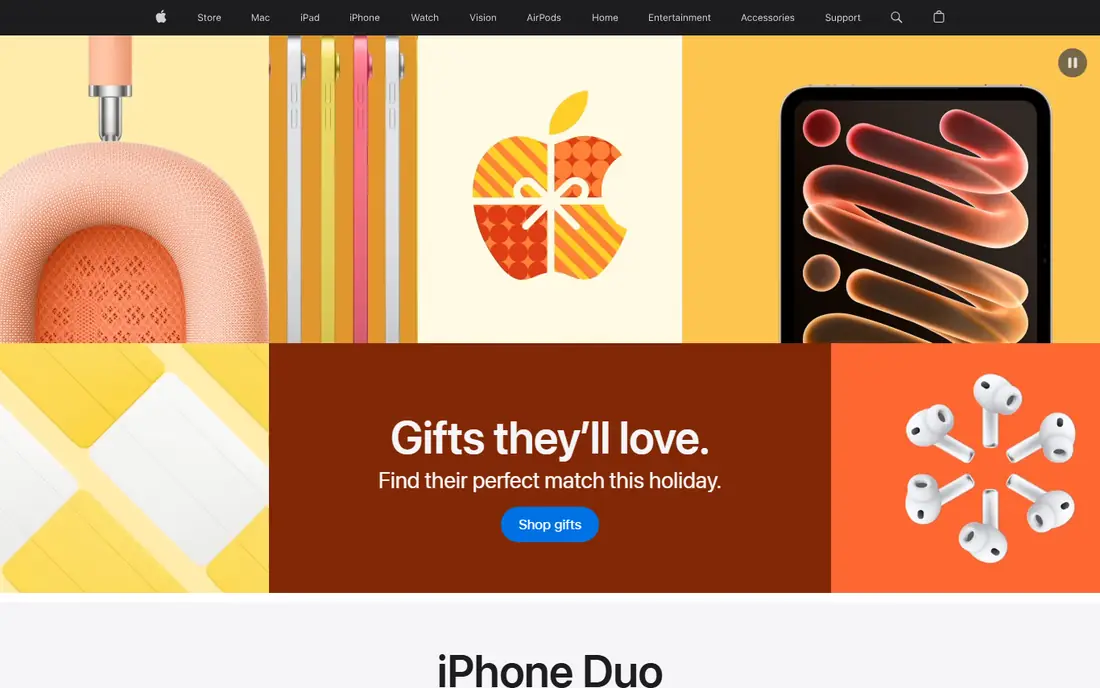
Apple's marketing strategy is built on simplicity. Product names are short, launch events are focused, advertising shows the product in use, and stores, packaging and online pages share the same clean look. That consistency means a customer recognises Apple work in seconds, without needing a slogan to explain it.
The strategy works because the product supports the message. Design, ease of use and ecosystem links give customers a reason to stay, not just a reason to notice an advert. The limit is price and reach. Apple targets premium buyers, so its model does not transfer directly to a low-price mass market. We would study Apple for message discipline and product-led storytelling.
- Simple, consistent product message
- Design-led launches and stores
- Strong ecosystem that keeps customers returning
- Premium pricing limits reach
- Marketing relies heavily on product launches and brand loyalty
Nike sells effort, identity and aspiration as much as shoes and apparel. Its campaigns feature elite athletes and everyday runners side by side, with a short, durable message that has lasted for decades. Direct channels, apps, events and community runs extend that story beyond advertising, so customers join a training culture, not just a shop.
The risk is visibility. Bold campaigns attract attention and criticism in equal measure, and a misjudged message is hard to hide at Nike's scale. Still, the core lesson holds: a clear emotional idea, repeated with discipline, beats a new slogan every season. We would study Nike for storytelling and community building.
- Powerful athlete and everyday-athlete storytelling
- Consistent Just Do It message
- Strong direct and community channels
- Campaigns can divide opinion
- Premium pricing and brand reliance make missteps visible

Coca-Cola is a masterclass in consistency. Its red colour, bottle shape, logo and core themes are recognised worldwide, yet local campaigns adapt food, language and culture market by market. That balance of global identity and local relevance is why Coca-Cola can run a Christmas campaign in one country and a summer sharing campaign in another without losing its identity.
Health trends are the long-term challenge. Sugary drinks face scrutiny, and Coca-Cola has expanded into low-sugar, water and other drinks to answer it. As a strategy example, Coca-Cola shows how consistency, distribution and local adaptation together build a brand that outlasts any single advert.
- Instantly recognised packaging and colour
- Consistent happiness and togetherness themes
- Strong local adaptation worldwide
- Health concerns around sugary drinks challenge the brand
- Large scale makes local change slow
Amazon's marketing strategy is less about slogans and more about experience. Fast delivery, wide choice, easy returns and Prime benefits form the message, and advertising mostly points back to that experience. Reviews, recommendations and personalised pages then help customers choose, which keeps the focus on convenience rather than brand theatre.
The trade-off is emotional distance. Amazon is trusted for convenience, but few customers feel the attachment they feel for Nike or Disney. Its scale also brings seller, pricing and trust questions that marketing alone cannot solve. We would study Amazon for customer experience as marketing, where the service itself is the main promise.
- Convenience, choice and fast delivery as the core message
- Prime bundles many services
- Reviews and recommendations aid choice
- Scale raises trust and seller issues
- Marketing is functional rather than emotional for many buyers
Disney's strategy rests on story and trust. Characters, films, parks and streaming share worlds that parents know and children love, so a new film, park land or series builds on decades of familiarity. That trust lets Disney sell toys, travel, streaming and merchandise from the same story, without starting from scratch each time.
Managing such a large portfolio is complex, and pricing, streaming and park changes can frustrate loyal fans. Still, the lesson is clear: a story that customers carry across products is more valuable than a single campaign. We would study Disney for long-term brand building and cross-product storytelling.
- Story-led brands across film, parks and streaming
- Family trust built over decades
- Characters and worlds that travel across products
- Large portfolio needs careful brand management
- Pricing and streaming changes can frustrate loyal customers
McDonald's succeeds by being predictable. A customer knows roughly what to expect in price, speed and menu in almost any country, while local menus add items that fit local tastes. Value messaging, family focus and familiar branding reinforce that predictability, which is exactly what a fast-food customer wants.
Health perceptions and franchise variation are the limits. Not every restaurant experience matches the brand promise, and menu health debates continue. As a strategy model, McDonald's shows how consistency plus local adaptation can scale a simple idea across thousands of locations.
- Consistent menu, price and experience worldwide
- Strong local menu adaptation
- Memorable branding and value messaging
- Health and quality perceptions remain a challenge
- Franchise variation can affect experience
Spotify turned personalisation into marketing. Features such as Discover Weekly, daily mixes and the annual Wrapped review give each listener a personal story to share, and sharing turns listeners into marketers. A free tier lowers the barrier to trial, while premium removes ads and adds offline listening for paying users.
The model has limits. Free users face ads and limits, and artist payment debates can colour brand perception. Even so, Spotify shows how product data, when used in a fun and personal way, can create marketing that customers want to share. We would study Spotify for personalisation and shareable product moments.
- Personalised playlists and year-in-review features
- Free tier that drives trial
- Social sharing built into listening
- Free tier limits features
- Artist payment debates affect brand perception
Airbnb built its brand on belonging and living like a local, rather than staying in a standard hotel room. Host and guest stories, neighbourhood guides and review systems support that idea, and search tools help travellers find homes that fit group size, budget and location. The story works because it matches the product: a home stay really does feel different from a hotel stay.
Regulation, host quality and pricing variation are real challenges, and trust depends on reviews and support when a stay goes wrong. As a strategy example, Airbnb shows how a community idea, backed by trust systems, can turn customers and hosts into the main marketing channel.
- Belonging and local living as a core idea
- Host and guest stories in marketing
- Strong search and review trust systems
- Local regulation and host quality vary
- Trust issues can affect brand perception in some cities
LEGO's marketing strategy is built on creativity. Brick building, fan creations, licensed themes such as Star Wars and Harry Potter, and adult fan communities all point to the same idea: build something of your own. That message works for children, parents and adult fans at the same time, which is rare for a toy brand.
Large sets carry premium prices, and licensed themes depend on partner brands staying popular. Even with those limits, LEGO shows how a simple, timeless idea can grow across ages and cultures without losing its core. We would study LEGO for community, creativity and cross-age branding.
- Creativity and play as a timeless message
- Adult fan community alongside children
- Licensed themes that expand reach
- Premium pricing for large sets
- Licensed themes depend on partner brands
Netflix markets through content itself. A hit series, film or documentary creates conversation, memes and press coverage that paid advertising alone cannot buy. Personalised recommendations then keep viewers watching, while local productions in many countries give Netflix relevance beyond Hollywood.
The risk is hit dependence. Not every original title succeeds, and price rises test loyalty when rivals offer cheaper options. Still, Netflix shows how a product that creates culture can become its own marketing engine. We would study Netflix for content-led growth and personalisation.
- Original content as the main marketing asset
- Personalised recommendations
- Global reach with local productions
- Subscription price rises can frustrate users
- Content hits are unpredictable
How we picked these
We compared public brand work, product experience and long-term consistency for companies widely cited for strong marketing strategies. We favoured companies whose strategy is visible in product, pricing, channels and advertising together, not just in one famous campaign. We did not use invented scores, because a strategy that works for Apple or Nike may not work for a small firm in a different market.
What to learn from these strategies
Start with one clear idea that your product can prove. Apple proves simplicity in its products, Nike proves effort in its stories, Amazon proves convenience in delivery, and LEGO proves creativity in play. A strategy fails when the advert promises something the product does not deliver.
Consistency over campaigns
A single campaign can win attention, but consistency builds a brand. Use the same core message, visual style and tone across your website, packaging, social channels and customer service, and adapt only the details for each market or audience. Change campaigns often, but change the core idea rarely.
Audience, proof and channel
Know who your strategy is for, what proof they need and where they will see it. A premium buyer needs design and quality proof, a value buyer needs price and convenience proof, and a community buyer needs stories from people like them. Choose channels that match that audience, and measure whether the strategy drives sales, retention or referrals, not just attention.
Small-firm lessons
A small firm cannot copy Apple or Disney budgets, but it can copy their discipline. Pick one message, repeat it everywhere, show real customer proof, and make the product experience match the promise. A local firm with a clear message and consistent service will beat a larger rival with a confused message.
Frequently asked questions
What is the best marketing strategy company?
Apple and Nike are strong overall examples, for product simplicity and emotional storytelling respectively. The best example for you depends on your market, because a convenience strategy like Amazon suits a different firm than a story strategy like Disney.
Which companies have the best marketing strategies?
Companies with the best marketing strategies in this list include Apple, Nike, Coca-Cola, Amazon, Disney and McDonald's, each for a different reason. Their common habit is consistency: a clear idea, repeated across products and channels over many years.
Which companies have the best advertising?
Nike, Coca-Cola, Apple and Disney are often cited for advertising, because their campaigns build on a clear brand idea rather than a one-off joke or offer. Good advertising works when it reinforces a strategy customers already understand from the product.
What makes a good marketing strategy?
A good marketing strategy starts with a clear audience and a simple core message, proves that message in the product, and repeats it consistently across channels. It also sets a measurable goal, such as sales, retention or referrals, so success can be judged.
Should a small business copy Apple or Nike?
Copy the discipline, not the budget. A small business should pick one clear message, use it everywhere, show real customer proof and match service to promise. Large campaigns and celebrity deals are not required for a clear, consistent strategy.
How do I choose a marketing strategy for my company?
Start with your audience, your main advantage and the proof customers need to believe it. Test one message and one main channel first, measure leads, sales or retention, and expand only when the first approach works.
Sources
See where you really rank - block by block
ProMapRanker scans Google Maps across a grid of your service area. Simple monthly plans from $19, white-label on every plan.
Start freeKeep reading
 zscaler alternatives
Best Zscaler Alternatives in 2026
Looking for zscaler alternatives? We compare 9 SASE and zero trust platforms on architecture, data protection, pricing, and fit for your network and team.
Read → zapier alternatives free
Best Zapier Alternatives Free in 2026
Nine automation tools for zapier alternatives free in 2026, all with genuinely free tiers, plus free plan limits, starting prices and upgrade paths explained.
Read → which platform is best for online reputation
Which Platform Is Best for Online Reputation in 2026
Wondering which platform is best for online reputation? We compare 8 review, listing, and response tools for small and multi-location businesses and agencies.
Read →