 ProMapRanker
Best Marathon Training App in 2026
Key takeaways
- Runna is the strongest adaptive marathon plan app, with plans that adjust to your fitness and schedule.
- Nike Run Club is the best free marathon training app, with guided runs and plans at no cost.
- Strava is the best community companion, while TrainingPeaks suits runners working with a coach or digging into data.
- Garmin owners should check Garmin Coach first, since it is free with a compatible watch and sends workouts to the wrist.
Quick comparison
| Pick | Great for | Pricing starts at | Free tier | |
|---|---|---|---|---|
 Runna | Adaptive marathon plans | $19.99 per month | Free trial | Visit |
 Nike Run Club | Free guided marathon training | Free | Yes | Visit |
 Strava | Community and tracking | $11.99 per month | Yes | Visit |
 TrainingPeaks | Coach-led data and planning | See website | Yes | Visit |
 Garmin Connect | Garmin watch training | Free | Yes | Visit |
 Runkeeper | Goal-based running plans | See website | Yes | Visit |
 Final Surge | Budget coach-delivered plans | Free | Yes | Visit |
 MapMyRun | Route tracking and plans | See website | Yes | Visit |
 COROS | Watch-based training | Free | Yes | Visit |
The best marathon training apps
This guide is general information, not medical advice. Marathon training is a large jump in volume, so build mileage gradually, rest when injured, and talk to a clinician if you have a health condition or persistent pain. The apps below were compared on official pricing pages and app store listings, and only live apps with marathon plans or strong marathon training support are listed.
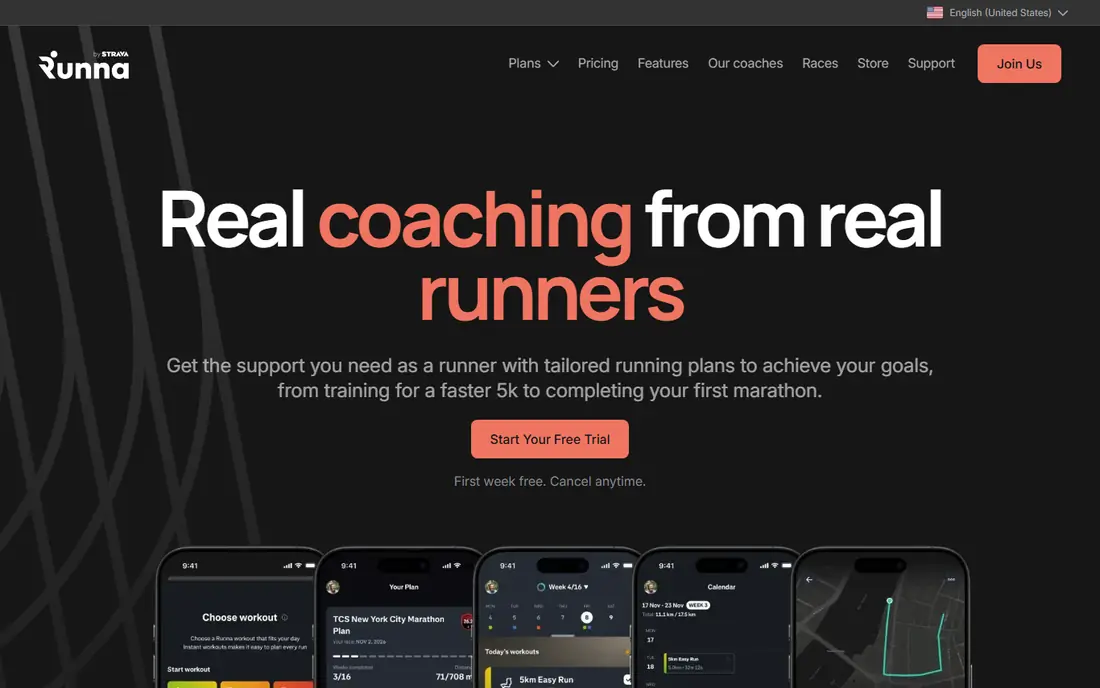
Runna builds a personalised marathon plan from your goal time, current fitness, and weekly availability, then adjusts pace targets as you complete sessions. That adaptive approach is why many runners pick it over a fixed PDF plan. Strength and mobility sessions are included, which helps first-timers who might otherwise skip that work.
Runna is now part of Strava, and pricing in recent listings is $19.99 per month or $99.99 to $119.99 per year depending on the store listing, so check the current listing before subscribing. There is no lasting free plan, only a trial and sample workouts. If you want a coach-style plan that adapts week by week, Runna is the strongest pick here.
- Plans adapt to fitness and availability
- Strength and mobility included
- Syncs with Garmin, Apple Watch, and Strava
- No lasting free plan
- Price is higher than free rivals
Nike Run Club is the best free marathon training app, and it is genuinely free, with no subscription for its plans or guided runs. It offers guided runs with audio coaching, personalised plans from 5K through marathon, and GPS tracking, all without a paywall. That makes it the best starting point for a first marathon on a budget.
The trade is depth. Analytics and social features are simpler than Strava, and there is no adaptive plan engine of the kind Runna offers. For a first marathon, though, a clear plan, guided runs, and consistent tracking matter more than advanced charts. Start here, and only pay for another app if you hit a specific limit.
- Entirely free
- Guided runs with coaching cues
- Marathon plans included
- Less detailed analytics than Strava or TrainingPeaks
- Social features are simpler
Strava is less a marathon plan app and more a training companion, and that is why so many runners use it alongside another app. It tracks runs reliably, syncs with Garmin, Apple Watch, COROS, and other devices, and adds community features such as segments, clubs, and kudos that help motivation during a long build. The free version covers tracking and social features.
A subscription at $11.99 per month in recent listings adds training plans, advanced analytics, and safety features. Even with a subscription, Strava plans are less detailed than Runna. Use Strava for tracking and community, and pair it with Runna, Nike Run Club, or a coach plan for the actual marathon schedule.
- Strong community and segments
- Reliable tracking
- Syncs with most watches
- Advanced training features need a subscription
- Plans are less detailed than Runna
TrainingPeaks is a workbench for serious runners and coaches, not a simple coaching app. It offers drag-and-drop scheduling, performance management charts, fitness and fatigue tracking, and a large library of training plans from coaches. If you work with a coach, they will often deliver your plan through TrainingPeaks, which makes it the natural home for your season.
The Basic tier is free and covers logging, syncing, following plans, and working with a coach. Premium pricing has varied across listings, with recent reports around $19.95 per month or $134.99 per year, plus bundled offers, so we list it as See website. Beginners may find the interface complex, but data-focused runners will appreciate the depth.
- Deep analytics and performance charts
- Coach delivery
- Huge plan library
- Complex for beginners
- Premium price has varied across listings
Garmin Connect is the companion app for Garmin watches, and it is free. Garmin Coach plans for marathon and other distances send structured workouts directly to a compatible watch, so you do not need to carry a phone for pace cues. The app also offers VO2 max estimates, race predictions, and recovery advice based on watch data.
The main limit is hardware. Without a Garmin watch, Garmin Connect offers little for marathon training, and its social features are weaker than Strava. If you already own a Garmin, check Garmin Coach before paying for another app, since you have effectively already paid for it through the watch.
- Free with a Garmin watch
- Garmin Coach plans on the wrist
- Race predictor and recovery tools
- Needs a Garmin watch for full value
- Social features are weaker than Strava
Runkeeper, from ASICS, offers GPS tracking, goal-based training plans, and audio cues for pace, distance, and intervals. That makes it a solid free starting point for runners who want a plan without the complexity of TrainingPeaks. It also syncs with Apple Watch and Wear OS, and it integrates with common health apps.
The free version covers core tracking, while Runkeeper Go adds advanced plans and insights. Pricing for Go has varied, with recent listings around $9.99 per month, so check the current store listing. Runkeeper suits runners who want a simple, goal-focused app rather than a community platform or a deep analytics tool.
- Simple tracking and goal plans
- Audio cues
- Works with Apple Watch and Wear OS
- Premium features need a subscription
- Upsell prompts in the free version
Final Surge is a low-cost platform built for coach-athlete relationships, and it is a good budget option for marathon training. The free tier covers core logging and plan access, while Athlete Premium adds readiness, route building, and weather forecasts. Training plans from coaches, including well-known running coaches, are delivered through the platform.
The interface feels dated next to Runna or Nike Run Club, and the mobile experience is simpler. That matters less if your coach delivers the plan and you mainly need a calendar, logging, and watch sync. For runners who want a coach plan without a high monthly fee, Final Surge is worth a look.
- Free core logging and plan access
- Coach-delivered plans
- Affordable premium tier
- Interface feels dated
- Mobile app is simpler than rivals
MapMyRun, from Under Armour, offers GPS tracking, route discovery, and training plans, with a large library of routes shared by other runners. That route focus helps marathon runners who need new long-run routes, especially when travelling or training in an unfamiliar area. The free version covers core tracking and some plans.
Premium access adds advanced plans, audio coaching, and ad removal, with pricing varying by store listing, so check the current listing. MapMyRun is less adaptive than Runna and less community-focused than Strava, but it is a solid all-round tracker with useful route tools for a long marathon build.
- Route discovery and tracking
- Training plans
- Large route library
- Premium features need a subscription
- Interface includes ads on the free plan
COROS is the companion app for COROS watches, and it is free with a compatible watch. It offers structured training plans, workout sync to the wrist, and detailed run data, with a focus on endurance athletes. COROS watches are known for long battery life, which helps on very long runs and ultramarathon training.
Like Garmin Connect, COROS offers little without its own hardware, and its community is smaller than Strava. If you already own a COROS watch, the app is the natural home for your marathon plan. If you do not own a watch, start with Nike Run Club or Runna on your phone instead.
- Free training app with a COROS watch
- Structured workouts on the wrist
- Long battery life on watches
- Needs a COROS watch for full value
- Smaller community than Strava
How we picked these
We compared official pricing pages and app store listings for apps that offer marathon plans, structured workouts, or strong marathon training support. We favoured apps with adaptive plans, guided runs, or coach delivery, and we kept only live apps in October 2026. Where prices differed across store listings, we wrote See website rather than publishing a figure we could not confirm.
Choosing a marathon training app
Pick the plan style first, then the tracker. First-timers should start with Nike Run Club, since it is free and includes a full marathon plan. Runners who want an adaptive plan should try Runna. Runners with a coach should ask which platform their coach uses, since that decides the app.
Build mileage gradually and protect recovery
A marathon plan usually lasts 16 to 20 weeks, with a long run that builds slowly and a taper before race day. Do not jump mileage by large amounts week to week, and keep most running at an easy effort. Use the app's recovery and readiness cues as a guide, but rest when you feel pain, and seek advice if pain persists.
Check watch sync and offline use
Confirm the app syncs with your watch, since carrying a phone for every run is not practical for long runs. Check whether workouts download to the watch for offline use, and whether completed runs sync back to the app and to Strava if you use both. A plan that does not reach your wrist is easy to ignore.
Compare the true cost over a full plan
A marathon plan lasts months, so a monthly price adds up. Compare the cost over 16 to 20 weeks, not just one month, and check whether an annual plan is cheaper if you plan to train for more than one race. Free apps such as Nike Run Club and Garmin Coach remove that cost entirely for many runners.
Frequently asked questions
What is the best marathon training app?
Runna is the best marathon training app for most runners who want an adaptive plan, while Nike Run Club is the best free marathon training app. Runna adapts to your fitness and schedule, while Nike Run Club offers guided runs and plans at no cost.
What is the best free marathon training app?
Nike Run Club is the best free marathon training app, since it offers guided runs and marathon plans with no subscription. Garmin Coach is also free if you own a compatible Garmin watch, and Final Surge offers free core logging and plan access.
What is the best app for marathon training for beginners?
Nike Run Club is the best app for marathon training for beginners, because it is free, it explains sessions clearly, and it includes a full marathon plan. First-timers should also build base mileage gradually and follow a plan that includes rest days and easy weeks.
Is Runna worth it for marathon training?
Runna is worth it if you want an adaptive plan that adjusts to your fitness, schedule, and completed sessions. It costs $19.99 per month in recent listings, with annual options available. If you are happy with a fixed plan, Nike Run Club offers a strong free alternative.
Do I need a watch for marathon training apps?
No, most marathon training apps work with a phone GPS alone. A watch adds convenience, wrist-based pace cues, and heart rate data, and it helps on long runs. Garmin, COROS, and Apple Watch owners should check their watch app first, since training plans are often included free.
How long is a typical marathon training plan?
A typical marathon training plan lasts 16 to 20 weeks, with a gradual build in weekly mileage and long runs, followed by a taper before race day. Some plans are shorter for experienced runners, while first-timers benefit from a longer, more gradual build.
Sources
See where you really rank - block by block
ProMapRanker scans Google Maps across a grid of your service area. Simple monthly plans from $19, white-label on every plan.
Start freeKeep reading
 who has the best home internet service
Who Has the Best Home Internet Service in 2026
Who has the best home internet service in 2026? Compare fiber, cable, and 5G providers on speed, price, data caps, and availability at your address today.
Read → visio alternatives
Best Visio Alternatives in 2026
Compare 9 Visio alternatives for flowcharts, org charts, and network diagrams, with free plans, pricing, and the best pick for teams and solo users in 2026.
Read → top 10 logistics software
Top 10 Logistics Software in 2026
We compared the top 10 logistics software tools for transport, warehousing, visibility and shipping, for shippers, carriers and 3PL teams in 2026 today.
Read →