 ProMapRanker
Best Local Rank Tracking Tools for Architects in 2026

Grid rank tracking around the studio · Pricing starts at: See website
Direct answer
Local Viking is my first pick for architects because it tracks Google Maps rankings on a grid around a studio address, which matches how clients search for an architect near a specific site or neighbourhood. It has no free plan stated, so check its pricing page. Local Falcon suits wide grid scans across a metro area, and Moz Local fits architects who want rank checks and directory accuracy in one place.
I put this comparison together from vendor documentation and public sources, not from hands-on testing. I looked at what each tool says it tracks, how it handles multiple map points, and whether the workflow suits a small architecture practice rather than a large agency.
Key takeaways
- Architects are searched by location plus project type, so a grid view of rankings around the studio tells you more than one city-level number.
- Rank tracking only shows position; Google Business Profile categories, photos of completed work and review replies do most of the work.
- A tool that tracks several map points around a suburb helps you see which areas you actually appear in for searches like "architect near me".
- Review signals matter for architecture firms because homeowners and developers read reviews before making an enquiry.
- Check that the tool lets you track more than one location if your practice has more than one studio or serves several towns.
Quick comparison
| Pick | Great for | Pricing starts at | Free tier | |
|---|---|---|---|---|
| Local Viking | Grid rank tracking around the studio | See website | Not stated | Visit |
 Local Falcon | Wide map scans across a metro | See website | Not stated | Visit |
 Moz Local | Listings plus local rank checks | See website | Not stated | Visit |
 BrightLocal | Client-ready local SEO reports | See website | Free trial | Visit |
 Whitespark | Citation and local search data | See website | Not stated | Visit |
 GatherUp | Review requests and monitoring | See website | Free trial | Visit |
 CallTrackingMetrics | Tracking calls from Maps and ads | See website | Free trial | Visit |
The best local rank tracking tools for architects compared
Local Viking is a Google Business Profile and local rank tracking tool built around geo-grids. You enter the studio address, set a keyword like "residential architect" and it checks where you rank at points across a map. For an architect whose enquiries come from a few nearby towns, that is more useful than a single position number.
The workflow fits a practice that wants to see which suburbs it appears in for searches such as "architect near me" or "extension architect". You can also audit profile completeness and schedule geo-tagged photos of completed projects, which supports the visual side of an architecture listing. I would treat the grid as a diagnostic, not a target to chase.
The limits are practical. Grid scans use credits, so tracking many keywords across a wide area gets expensive, and the tool is aimed at people who already understand local SEO. If you want a simple one-number report, this is more than you need.
- Grid heatmaps around a set address
- Google Business Profile audit checks
- geo-tagged photo scheduling
- Grid scans consume credits
- interface assumes some local SEO knowledge
Local Falcon specialises in map grid scans. It shows your position at many points across a city, which helps an architect understand whether visibility is concentrated near the studio or spread across the metro. It also compares your positions with competitors on the same grid.
For architects bidding on projects across a region, this is a useful way to see where you are invisible. A firm based in one district may rank well locally but not appear in searches from a neighbouring town. The scan reports are easy to share with a partner or marketing helper.
The trade-off is cost. Each scan uses credits, so frequent tracking of many keywords adds up. It also does less on the profile management side, so you still need to handle categories, photos and reviews elsewhere.
- Large grid scans
- competitor comparison on the map
- shareable scan reports
- Credit-based scan costs
- less focus on profile management
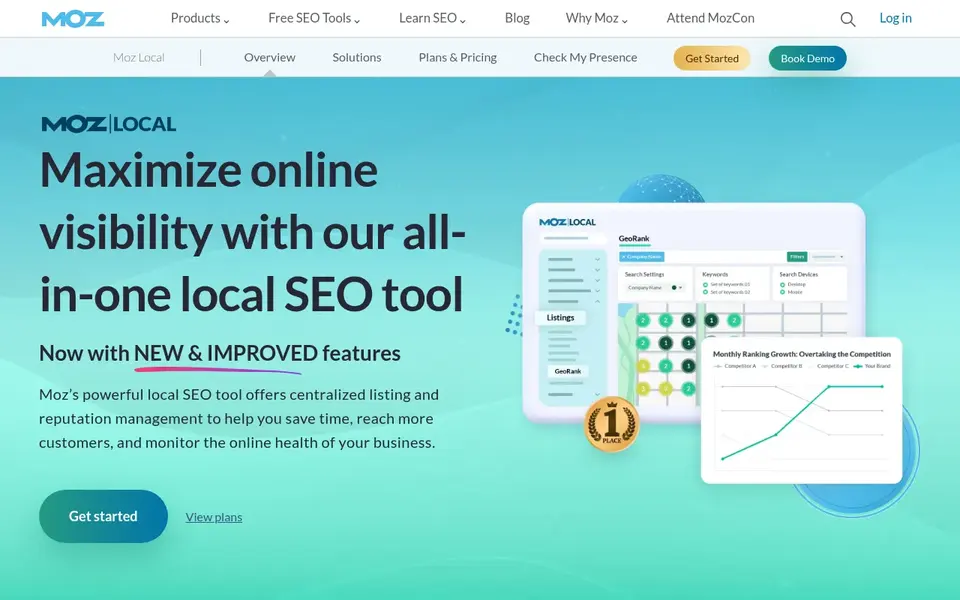
Moz Local combines business listing management with local rank tracking and review monitoring. For an architecture practice, the listing side matters because inconsistent name, address and phone data across directories confuses both clients and search engines.
The rank tracking here is simpler than a grid scan. It shows how you perform for local searches, which is enough for a studio that wants a steady overview rather than point-by-point map data. The review monitoring is handy because a single negative review can affect enquiries for a small firm.
The limitation is granularity. If you want to know your position at twenty points around a city, a dedicated grid tool does that better. Listing coverage also varies by country, so check your region before committing.
- Directory listing management
- local rank tracking
- review monitoring in one dashboard
- Rank tracking is less granular than grid tools
- listing coverage varies by country
BrightLocal is a local SEO platform with rank tracking, citation tools and review monitoring. It is widely used by agencies, which makes it a reasonable choice if an architect works with a marketing consultant who already uses it.
For a practice, the value is in the reporting. You can track local search positions, check citation consistency and monitor reviews in one place, then export a report for a partner meeting. The citation audit helps catch wrong addresses on directory sites.
One limitation is that the strongest features sit in higher tiers, and the interface assumes agency workflows. A solo architect may find it heavier than needed, while a firm with a marketing helper will get more from it.
- Local rank tracking with reports
- citation building and audit tools
- review monitoring
- Best features sit in higher tiers
- interface is built for agencies
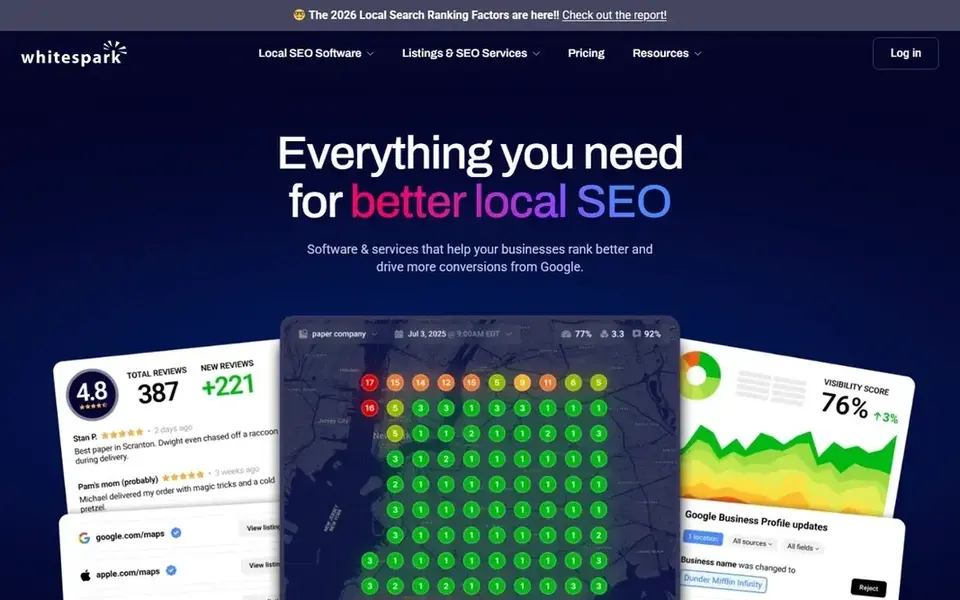
Whitespark is known for citation building and local search research, and it includes rank tracking as part of its platform. For architects, the citation tools help get consistent listings on directories that matter for local searches.
The rank tracking gives a view of local positions, and the research tools help you see which directories and local sites appear for your target searches. That is useful when you want to understand why a competing firm ranks where it does.
The platform is broad, and rank tracking is only one piece. Pricing and feature depth are aimed more at agencies and consultants than a single studio, so a small practice should check whether it needs the full set.
- Citation finder and building tools
- local rank tracking
- local search research
- Rank tracking is one part of a broader platform
- pricing suits agencies more than solo firms
GatherUp focuses on getting and managing customer reviews. For architects, reviews are a strong trust signal, and a steady flow of them supports local visibility even though the tool does not track map positions itself.
The workflow is straightforward. You send review requests after a project completes, monitor new reviews across sites and respond from one place. For a practice that finishes a handful of projects a month, that is a manageable rhythm.
The limit is obvious: it is not a rank tracker. If your main question is where you appear on the map, pair it with a grid tool. Review volume also depends on how many clients you can ask, so small firms see slower growth.
- Automated review requests
- review monitoring across sites
- simple customer feedback flow
- Not a dedicated rank tracker
- review volume depends on your client base
CallTrackingMetrics tracks phone calls and shows where they came from, including Google Business Profile and paid campaigns. For architects, enquiries often start with a call, so knowing which channel produced it helps you judge whether local visibility is turning into work.
The setup takes some planning. You assign tracking numbers to channels, then review call reports alongside your rank data. That combination tells you whether a rise in map position actually produced enquiries.
It is not a rank tracking tool, so it belongs next to one rather than instead of one. Practices that get most enquiries through email or a contact form will get less from it.
- Call tracking with source attribution
- number pools for multiple channels
- reporting on call outcomes
- Not a rank tracker
- setup requires planning
How I chose
I compared these tools using vendor documentation and public sources. I did not run hands-on tests, so my judgments rest on what each vendor publishes about features, tracking methods and limits, plus how those features line up with how an architecture practice actually gets enquiries.
My main filter was fit. An architect needs to know whether the studio appears for location-based searches, whether the profile is accurate and whether reviews support trust. Tools that only report a single city-level position were ranked lower than those showing map-level detail or profile health.
I also weighed limits honestly. Credit-based scanning, agency-oriented pricing and features that sit outside rank tracking all affect whether a small practice gets value. Where a tool does one job well but not another, I said so rather than presenting it as a complete solution.
What to check before you buy
- Confirm the tool tracks Google Maps grid positions around a specific address, not just a city-level ranking.
- Check how many locations and keywords your plan allows, since a practice with two studios needs more than one.
- Ask whether scans use credits and how quickly a regular tracking schedule consumes them.
- Make sure the tool can monitor Google Business Profile details such as categories, hours and photos.
- Check whether review monitoring is included, because reviews influence enquiries for architecture firms.
- Confirm the reporting is readable for a non-specialist, since many studios share results with a partner or office manager.
Frequently asked questions
Do architects need a local rank tracking tool?
Only if local searches matter to your enquiries. Most residential and small commercial work starts with a location-based search, so tracking where the studio appears for terms like "architect near me" helps you see whether profile changes are working. A simple rank check plus review monitoring is enough for many small practices.
What is a map grid scan and why does it matter for a studio?
A grid scan checks your ranking at many points around an address and shows the results as a heatmap. For an architect, this reveals whether visibility is limited to the immediate neighbourhood or spreads across nearby towns. That matters when your projects come from a wider area than your office postcode suggests.
Can rank tracking replace Google Business Profile work?
No. Rank tracking measures position but does not improve it. Profile categories, accurate hours, photos of completed work and replies to reviews do the actual work. Use tracking to check whether those changes moved anything, not as a substitute for maintaining the profile.
How often should I check local rankings?
For most small practices, a weekly or fortnightly check is enough. Rankings move slowly and fluctuate day to day, so daily checks mostly add noise. If you have just changed categories or added photos, check more often for a few weeks to see the effect.
Are review tools worth it for an architecture firm?
They can be, because clients read reviews before making contact. A tool that sends requests after project completion keeps the flow steady without manual chasing. Pair it with rank tracking so you can see whether more reviews line up with better local visibility over time.
Sources
See where you really rank - block by block
ProMapRanker scans Google Maps across a grid of your service area. Simple monthly plans from $19, white-label on every plan.
Start freeBrowse all guides
← Best Listing Management Software for Waterproofing Companies (2026)Best Local Rank Tracking Tools for Boat Dealers in 2026 →
 best listing management software for security companies
Best Listing Management Software for Security Companies in 2026
A guide to the best listing management software for security companies in 2026, covering accuracy, service areas, multi-location control and review tools.
Read → best listing management software for pilates studios
Best Listing Management Software for Pilates Studios in 2026
A practical guide to the best listing management software for pilates studios in 2026, covering Google Business Profile, citations and review requests.
Read → best listing management software for oil change shops
Best Listing Management Software for Oil Change Shops in 2026
A practical guide to the best listing management software for oil change shops in 2026, covering listings, Google Business Profile, reviews and local search.
Read → best local seo tools for agencies
Best Local SEO Tools for Agencies in 2026
The best local SEO tools for agencies in 2026, from rank tracking to listings and reviews.
Read → how to optimize google business profile
How to Optimize Your Google Business Profile Step by Step
Step-by-step instructions to fully optimize your Google Business Profile for more visibility and calls.
Read → best tool to check perplexity rankings
Best Tool to Check Perplexity Rankings in 2026
Best tool to check Perplexity rankings compared: nine AI visibility tools that track citations, mentions and prompts across many answer engines today.
Read →More in Local SEO & Google Maps · All guides A to Z by date · Latest guides