 ProMapRanker
Best LLM Visibility Tracking Software in 2026


Small teams needing affordable daily tracking · Pricing starts at: $29 per month
Key takeaways
- Otterly AI is the lowest-cost daily tracker, while LLMrefs offers the most prompts per dollar on a weekly cycle.
- Rankscale suits teams that want flexible, credit-based tracking across many models.
- Profound and Scrunch AI remain the deep options when engine breadth and crawler data matter most.
- Weekly tracking is fine for monthly reports, but daily tracking is better when you are actively changing pages.
Quick comparison
| Pick | Great for | Pricing starts at | Free tier | |
|---|---|---|---|---|
| Otterly AI | Small teams needing affordable daily tracking | $29 per month | No | Visit |
 Peec AI | Agencies tracking many clients and markets | $95 per month | No | Visit |
 Profound | Enterprise brands needing many models | See website | No | Visit |
 Scrunch AI | Tracking plus AI-readable site audits | $250 per month | No | Visit |
 Rankscale | Flexible tracking across many models | $17 per month | No | Visit |
 LLMrefs | Many prompts on a weekly cycle | $79 per month | No | Visit |
 AthenaHQ | Testing with credits before a paid plan | $295 per month | Yes | Visit |
 ZipTie | Occasional checks and usage-based tracking | See website | No | Visit |
The best LLM visibility tracking software
LLM visibility tracking software runs your prompts through large language models, records whether your brand is mentioned, and shows which sources the model cites. The tools below are judged here on tracking quality, prompt limits, model coverage, and refresh speed, rather than on content writing features.
Otterly AI is the simplest daily tracker for a small brand. You add prompts, and the system checks them each day across ChatGPT, Google AI Overviews, Perplexity, and Copilot, then shows mention share, cited sources, and competitor comparisons. The Lite plan at $29 per month, or $25 per month billed annually, is enough to learn whether LLM tracking changes any decisions.
The limits are prompt count and add-on engines. Teams that need Gemini, AI Mode, or Claude as standard coverage, or that need API exports, will pay more. A seven-day trial lets you test real prompts first. For a first LLM tracker, Otterly AI gives daily data at a price that is easy to justify.
- Daily tracking at the lowest dedicated price
- Simple dashboards
- Unlimited seats
- Lite plan covers only 15 prompts
- Gemini, AI Mode, and Claude are add-ons
- API access needs a higher plan
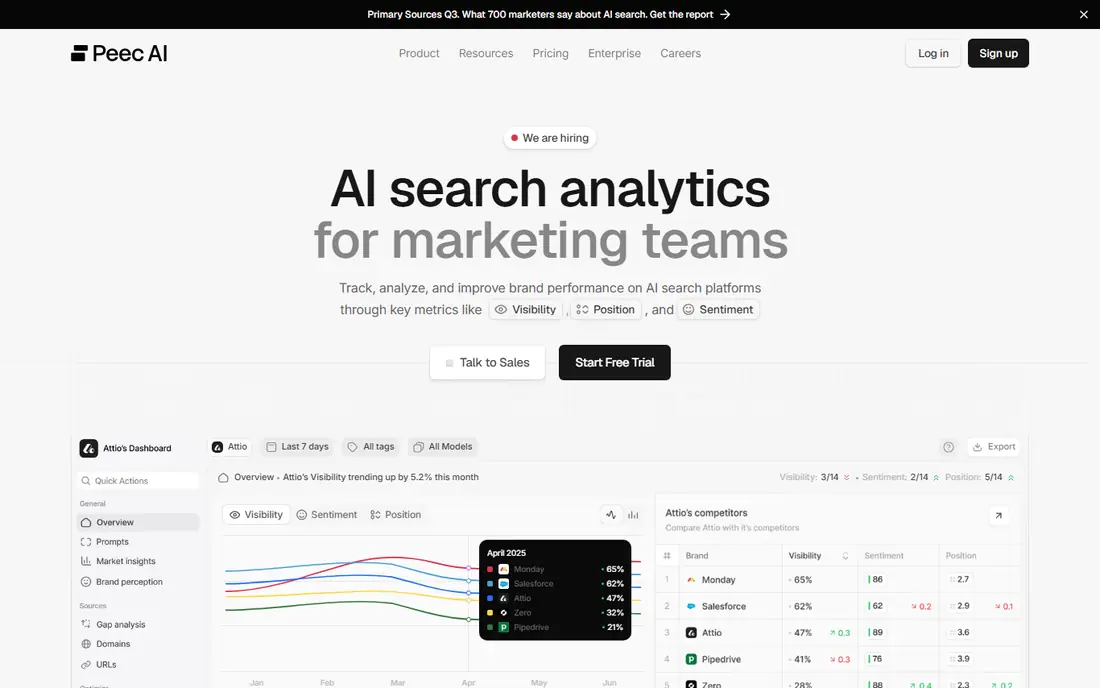
Peec AI works well when one account must serve many clients. Unlimited seats mean account managers, writers, and clients can view the same data without per-seat math, and country breakdowns help teams that sell across markets. Daily tracking across a chosen set of models keeps reports current enough for weekly client calls.
Starter limits still apply: 50 prompts and three of six models, with the full set on enterprise tiers. Confirm currency on the vendor page, since listings have shown both dollars and euros. For agencies that need consistent, client-ready LLM reports, Peec AI is a steady middle option between budget trackers and enterprise platforms.
- Daily tracking with unlimited seats
- Competitor and country breakdowns
- Clean client-ready reports
- Entry plan covers three of six models
- Claude sits on higher tiers
- Pricing appears in euros on some pages
Profound is the enterprise tracker for brands that cannot accept narrow model coverage. Its enterprise tiers track ChatGPT, Perplexity, Google AI Overviews, Google AI Mode, Gemini, Claude, Copilot, Grok, and DeepSeek, and it adds prompt volume data that shows which questions people actually ask. Crawler integrations link AI bot activity to your own analytics, which helps large sites separate real traffic effects from mention changes.
That depth comes with a sales-led process and quoted pricing, and the free trial covers a smaller engine set. Small teams will find cheaper trackers sufficient, but a large brand with compliance needs, many markets, or agency clients will use the breadth. Start with a trial and a fixed prompt list to test whether the extra engines change any decision.
- Up to nine engines on enterprise tiers
- Prompt volume data
- Crawler attribution through integrations
- Quoted enterprise pricing
- Trial covers fewer engines
- Needs analyst time to use well
Scrunch AI pairs LLM mention tracking with a check of how AI systems read your site. If a page renders price, stock, or key facts in a way crawlers cannot parse, the audit flags it, and the tracking shows whether fixes change mentions over time. That pairing suits technical teams that suspect infrastructure, not just copy, is behind missing mentions.
Starter pricing is $250 per month billed annually on recent listings, with a seven-day trial. Some engines and API access sit on enterprise tiers, so confirm coverage for the models your customers actually use. Choose Scrunch AI when you need both a mention dashboard and a site audit, rather than a mention count alone.
- Brand tracking with crawler analytics
- Audits for AI readability
- Competitor benchmarking
- Higher entry price
- Enterprise-only coverage for some engines
- Prompt limits need checking per plan
Rankscale suits power users who want many models without an enterprise contract. Its plans cover ChatGPT, Gemini, Perplexity, Claude, DeepSeek, Mistral, Grok, Copilot, and more, and higher tiers add API and MCP access for teams that want to pull data into their own reports. The Essentials plan is listed at $204 per year, which works out to $17 per month on annual billing, with a Pro plan at $99 per month for larger credit allowances.
Credits are the thing to watch. Your real cost depends on prompts, models, and refresh frequency, so a large prompt list across many models can use credits faster than expected. A seven-day Pro trial and a free no-registration analysis tool let you test before paying. For teams that value model breadth and flexible billing, Rankscale is a strong alternative to flat monthly trackers.
- Wide model coverage including Claude, DeepSeek, and Grok
- Credit-based plans
- API and MCP support on higher tiers
- Credit math needs care
- Entry plan has limited credits
- Free analysis tool is not a full tracker
LLMrefs takes a different approach: one plan, many prompts, and a weekly refresh. At $79 per month, it covers 500 prompts across ChatGPT, AI Overviews, AI Mode, Gemini, Perplexity, Claude, Grok, Copilot, Meta AI, and DeepSeek, with unlimited projects and team members and CSV and API export. For a small brand that needs a monthly report, that prompt volume per dollar is hard to match.
Weekly refresh is the trade-off. If you change a page on Tuesday, you will not see the effect in LLMrefs until the next weekly cycle, so it suits reporting better than rapid testing. A seven-day trial is available. Choose LLMrefs when prompt breadth and a simple monthly story matter more than daily movement.
- Single plan with 500 prompts
- Unlimited projects and seats
- All supported engines included
- Reports refresh weekly, not daily
- Simpler metrics than enterprise tools
- Less useful for fast page-change tests
AthenaHQ is useful because you can test with your own brand before committing to a large plan. The free Essential plan gives a limited credit balance, and Starter at $295 per month provides 3,600 credits across 11 models on recent listings. Content agents can draft fixes for gaps the tracker finds, which helps teams that need action, not only a dashboard.
The credit model needs planning. One credit equals one answer, so daily tracking of many prompts across many models uses credits quickly. Ecommerce teams gain extra value from revenue attribution, while other teams should judge AthenaHQ mainly on tracking and fix suggestions. Use the free credits to narrow your prompt list, then decide whether Starter fits.
- Free Essential plan
- Broad engine coverage on paid plans
- Content agents suggest fixes
- Starter price is high for small teams
- Credit model burns fast on daily multi-model tracking
- Revenue attribution fits stores best
ZipTie suits teams that do not need a large monthly tracker. Instead of a fixed prompt bundle, you pay for what you track, choose your models, and set refresh frequency to daily, weekly, or monthly. Recent listings put entry pricing around $42.75 per month on a usage basis, but the total depends on your choices, so confirm the current calculator before budgeting.
That flexibility is also the limit. Usage-based totals can rise with prompt count and frequency, and ZipTie gives less crawler and audit depth than Scrunch AI or Profound. For occasional checks, a small brand audit, or a team testing LLM tracking for the first time, ZipTie is a low-commitment way to start. For daily agency reporting, a flat plan may be easier to budget.
- Usage-based pricing for occasional tracking
- Daily, weekly, or monthly refresh options
- Up to seven models priced by choice
- Pricing varies with models and frequency, so totals are hard to predict
- Less depth than enterprise trackers
- No free plan
How we picked these
We compared recent October 2026 listings for dedicated LLM trackers, focusing on model coverage, prompt limits, refresh speed, and pricing transparency. We favored tools that are still sold and that track at least the core models customers use, and we noted where pricing is quoted, credit-based, or usage-based. We treated mention scores as directional, because models, sources, and prompt wording all shift results over time.
How to set up tracking that means something
Write prompts the way customers write them, not the way your marketing team writes them. Include brand questions, comparison questions, and problem questions, and add competitor names so you can see when a rival is cited instead of you. Keep the list stable for at least a month, or trend data will reflect prompt changes rather than real movement.
Daily, weekly, or monthly checks
Daily tracking suits active optimization, weekly tracking suits monthly reporting, and monthly checks suit a one-off audit. If you use a weekly tool such as LLMrefs, do not judge a page change after two days. If you use a daily tool, ignore single-day swings and look at two to four week trends before changing content or structure.
Frequently asked questions
What does LLM visibility tracking software measure?
It measures whether a large language model names your brand in its answer to a prompt, where your brand ranks among cited sources, and how that share changes over time. It also shows competitor mentions and cited pages, so you can see which sources models trust for a topic.
Which models should I track?
Start with ChatGPT, Google AI Overviews, Perplexity, and Gemini, since those cover the most common AI search behavior. Add Claude, Copilot, or AI Mode if your customers use those systems or if your category shows different results there. Tracking every model at once is rarely worth the cost for a small brand.
Is daily tracking better than weekly tracking?
Daily tracking reacts faster to page changes and news, while weekly tracking is cheaper per prompt and fine for monthly reports. Choose daily when you are actively testing fixes, and weekly when you only need a regular trend line. Either way, judge trends over weeks, not single days.
How many prompts do I need?
A small brand can start with 15 to 50 prompts, while a larger brand or agency may need 200 to 500. LLMrefs covers 500 prompts on one plan, while Otterly AI starts at 15. Begin small, keep prompts stable, and expand only for questions that drive traffic, leads, or sales.
Can LLM tracking replace classic rank tracking?
No. Classic rank tracking shows search results page positions, while LLM tracking shows mentions inside generated answers. The two overlap but answer different questions, so most teams need both, or a suite that covers both, to judge search performance fully.
Sources
See where you really rank - block by block
ProMapRanker scans Google Maps across a grid of your service area. Simple monthly plans from $19, white-label on every plan.
Start freeKeep reading
 zscaler alternatives
Best Zscaler Alternatives in 2026
Looking for zscaler alternatives? We compare 9 SASE and zero trust platforms on architecture, data protection, pricing, and fit for your network and team.
Read → zapier alternatives free
Best Zapier Alternatives Free in 2026
Nine automation tools for zapier alternatives free in 2026, all with genuinely free tiers, plus free plan limits, starting prices and upgrade paths explained.
Read → which platform is best for online reputation
Which Platform Is Best for Online Reputation in 2026
Wondering which platform is best for online reputation? We compare 8 review, listing, and response tools for small and multi-location businesses and agencies.
Read →