 ProMapRanker
Best LLM Visibility Tools in 2026


clean prompt tracking for marketing teams · Pricing starts at: $95 per month
Key takeaways
- Peec AI is our pick for most marketing teams because pricing is clear and prompt tracking is easy to read.
- Profound suits larger teams that need deep analytics and many engines, but pricing is custom and the sales process is longer.
- Otterly.AI and Rankscale give smaller teams a low-cost start, while AthenaHQ gives a free tier to test real tracking before paying.
- Engine coverage, prompt limits, and seat limits matter more than a headline score, so compare plans on those three numbers first.
Quick comparison
| Pick | Great for | Pricing starts at | Free tier | |
|---|---|---|---|---|
| Peec AI | clean prompt tracking for marketing teams | $95 per month | Free trial | Visit |
 Profound | enterprise depth and analytics | See website | Free trial | Visit |
 Otterly.AI | low-cost starter monitoring | $29 per month | Free trial | Visit |
 Scrunch | brand presence plus crawler insight | $250 per month | Free trial | Visit |
 AthenaHQ | free start with broad engine coverage | Free | Yes | Visit |
 Semrush AI Visibility Toolkit | teams already on Semrush | $99 per month | Free trial | Visit |
 Ahrefs Brand Radar | teams already on Ahrefs | $199 per month | No | Visit |
 SE Ranking AI Visibility Tracker | SEO and AI tracking in one suite | $99 per month | Free trial | Visit |
 Rankscale | low-cost credit-based tracking | $17 per month | Free trial | Visit |
The best LLM visibility tools
LLM visibility tools track how often a brand appears, is cited, or is recommended in answers from AI systems such as ChatGPT, Gemini, Perplexity, and Google AI Overviews. We compared official pricing pages, published engine lists, and product docs for tools that are live in October 2026. The list covers standalone trackers and add-ons inside larger SEO suites.
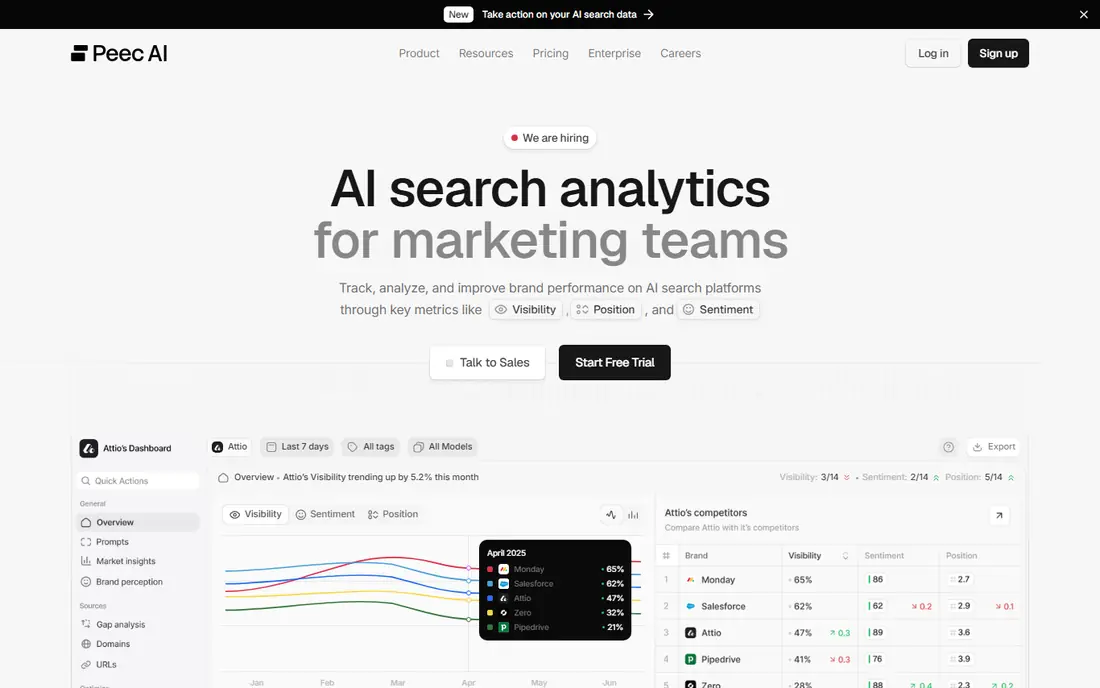
Peec AI is our pick for most teams because the product is easy to explain to a non-technical stakeholder. You add prompts that buyers actually ask, pick engines, and watch brand mentions, citations, and competitor positions over time. The dashboard reads like an SEO rank tracker, which helps teams that already think in prompts and positions.
The entry plan starts at $95 per month and covers 50 prompts with a choice of engines. That prompt cap is the main limit: a team tracking many products, locations, or languages will need a higher tier quickly. If your prompt set is focused, Peec AI gives a clean, well-priced start.
- Clear published pricing
- Prompt-level tracking across several engines
- Clean analytics and competitor views
- Entry plan covers 50 prompts and a limited engine set
- Higher tiers needed for larger prompt sets
- No permanent free plan
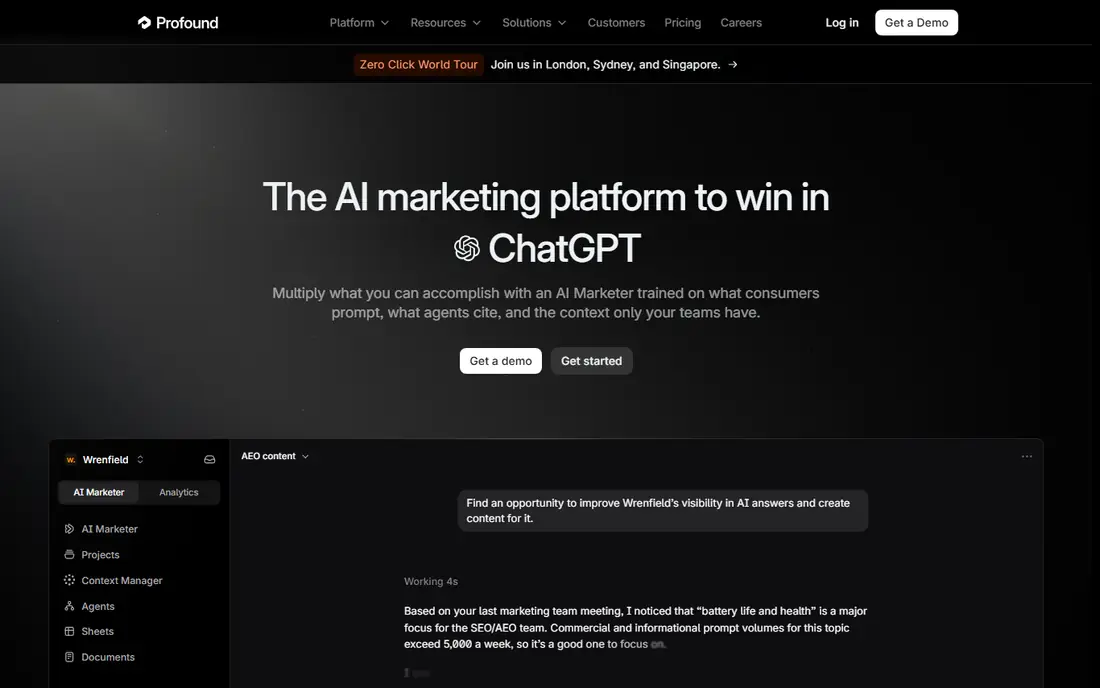
Profound is the enterprise answer in this category. It tracks brand presence across many AI engines, surfaces the conversations behind the scores, and gives larger teams the analytics and API access they need to feed reporting systems. For a brand with many products and markets, that depth matters more than a low entry price.
The catch is access. Enterprise pricing is custom, so you need a sales conversation to get a firm quote, though a trial is available. Smaller teams may find the process slow and the platform larger than they need. Choose Profound when you have budget, a large prompt set, and a reporting need that a simple tracker cannot meet.
- Deep analytics across many engines
- Conversation-level insight
- Built for larger programs and APIs
- Pricing is custom on enterprise plans
- Longer sales process
- Overkill for a solo marketer
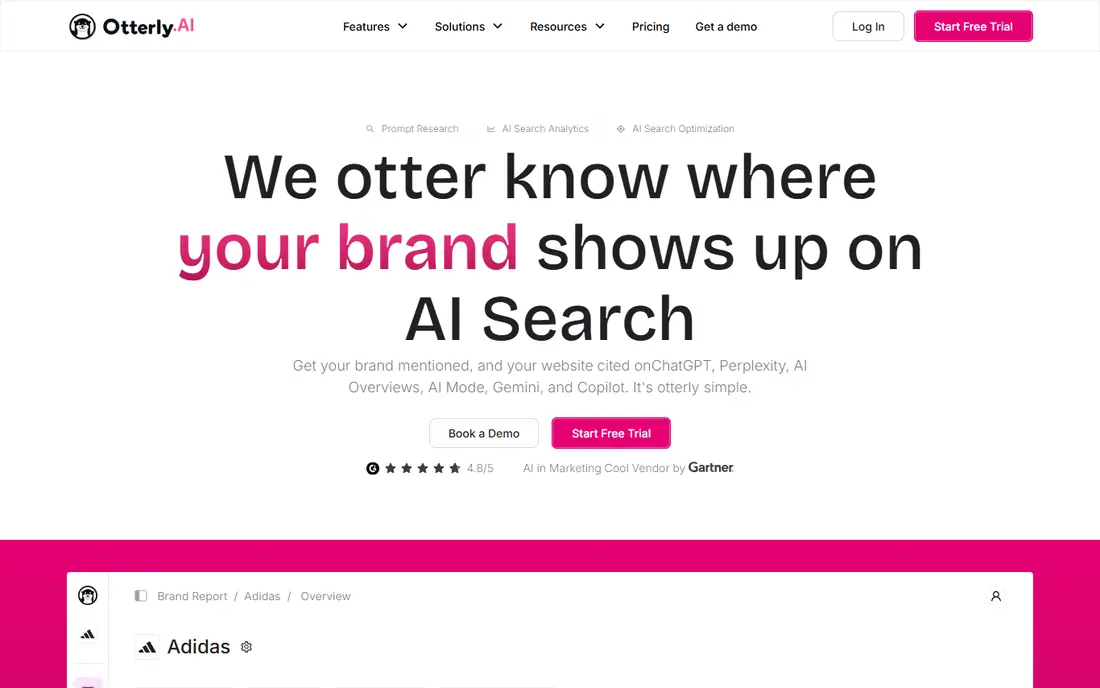
Otterly.AI is the best low-cost way to find out if LLM tracking is worth paying for. Lite starts at $29 per month billed annually, with a 7-day trial, and covers a small prompt set across several engines. For a solo marketer or a small business, that is enough to see if AI answers mention the brand at all.
The limit is scale. Fifteen prompts on the entry plan will not cover a full product catalog, and some engines sit outside the base plan. Treat Otterly.AI as a first step: prove value on your most important prompts, then move up a tier or switch tools when the prompt list grows.
- Low entry price
- Covers ChatGPT, Perplexity, Google AI surfaces, and more
- Simple setup
- Entry plan covers 15 prompts
- Some engines are add-ons
- Reporting is lighter than enterprise tools
Scrunch stands out because it pairs brand monitoring with crawler insight. Beyond tracking mentions, it helps teams see how AI crawlers parse their site, which can explain why a brand is missing from answers even when its web pages rank well. That technical angle suits SaaS and B2B teams with content-heavy sites.
Starter is $250 per month billed annually, with a 7-day trial. That price puts Scrunch above starter tools, and entry plans cover fewer engines than enterprise tiers. Choose Scrunch when crawler and content insight matters as much as the mention score itself.
- Prompt-level monitoring across engines
- Insight into how AI crawlers read your site
- Agency-friendly reporting
- Entry price is high for small teams
- Prompt limits vary by plan
- Full engine coverage needs higher tiers
AthenaHQ is the only tool here with a genuinely free starting tier. The Essential plan gives a small credit allowance to run real tracking before you pay, which is useful when you are still convincing a team that AI visibility matters. Paid plans cover many engines and add content and outreach layers for teams that want actions, not just scores.
Starter starts at $295 per month, so the jump from free to paid is large. The credit model also needs attention: each answer consumes credits, so a large prompt set can burn through an allowance faster than a flat prompt plan. Test the free tier first, measure credit use, and only then commit.
- Free Essential plan with credits
- Broad engine coverage on paid plans
- Content and outreach features
- Paid Starter is $295 per month
- Credit model needs careful tracking
- Free plan is limited
Semrush AI Visibility Toolkit makes sense only if your team already pays for Semrush. It adds AI visibility tracking to keyword, traffic, and content data you already use, so you can compare AI mentions with search performance in one place. That context is valuable for SEO teams that report on both channels.
The Toolkit costs $99 per month per domain on top of a Semrush plan, and the entry plan covers 25 prompts. Teams tracking many domains will see costs stack up. If you are not already a Semrush user, a standalone tracker above will usually cost less for the same prompt count.
- Sits inside a familiar SEO suite
- Tracks prompts per domain
- Useful alongside keyword and traffic data
- Costs $99 per month per domain
- Entry plan covers 25 prompts
- No Claude or Copilot on some plans per vendor docs
Ahrefs Brand Radar suits teams that already live in Ahrefs. It surfaces how a brand appears in AI answers and pairs that view with the keyword and link data Ahrefs is known for. For an SEO team that already reports from Ahrefs, that single reporting home is a real convenience.
The cost is the catch. Brand Radar starts at $199 per month per platform index, with full coverage costing more, and it sits on top of a base Ahrefs plan. There is a free checker for a quick look, but no free plan for ongoing tracking. Non-Ahrefs teams should compare standalone tools first.
- Brand insights from a large AI index
- Useful alongside backlink and keyword data
- Clear brand-centric views
- $199 per month per platform index
- Full coverage costs more
- No free plan or trial for the add-on
SE Ranking, sold in some places as SE Visible, gives mid-market teams a strong bundle. The entry plan starts at $99 per month billed annually and covers 200 prompts across 3 projects, which is more prompts per dollar than several rivals. A 10-day trial lets you test the setup before paying.
The trade-off is engine breadth. The entry set covers the major engines, but it does not match the widest standalone tools on every model. If your buyers ask questions mainly on ChatGPT and Google AI surfaces, SE Ranking is good value. If you need every engine, check the plan list carefully.
- AI tracking inside a full SEO suite
- 200 prompts on the entry plan
- Multiple projects
- Entry engine set is narrower than some rivals
- Higher tiers needed for deeper features
- Add-on pricing can confuse
Rankscale appeals to agencies and power users who want white-label reports without an enterprise contract. Essentials is $204 per year, which works out to $17 per month billed annually, with a 7-day Pro trial. The credit model lets small teams pay for what they use, rather than a flat prompt bundle.
The catch is the same as with any credit model: you need to watch usage, because a growing prompt set or frequent refreshes can consume credits faster than expected. Rankscale is a good low-cost pick for a focused prompt set, but larger programs should compare flat prompt plans from Peec AI or SE Ranking.
- Low entry price billed annually
- Credit model can suit small prompt sets
- White-label reports for agencies
- Credit limits need careful tracking
- Features vary by tier
- Smaller vendor than Profound or Semrush
How we picked these
We compared official pricing pages, published engine lists, and product documentation for tools that track brand mentions in AI answers in October 2026. We required a live product, a published prompt or credit limit, and coverage of at least the major AI engines or Google AI surfaces. We did not claim hands-on testing. We weighed entry price, prompt and credit limits, engine coverage, reporting depth, and fit for standalone use versus use inside a larger SEO suite, and we left out tools that were invite-only or priced only on request.
What to check before you choose
Start with your prompt list, not the tool. Write the 20 to 50 questions buyers actually ask about your product, your competitors, and your category. That list decides your plan, because prompt caps and credit limits are the real cost driver in this category. A tool with a low headline price can become expensive once your prompt list grows.
Check engine coverage next. A tool that watches three engines samples only part of where buyers ask questions. Check which engines sit on the entry plan and which need a higher tier, and check refresh frequency, because weekly data suits a monthly report while daily data suits a fast-moving launch. Finally, check export and reporting: if you need to share results with clients or leadership, white-label reports and CSV exports matter more than a pretty dashboard.
Prompt limits and credits
Flat prompt plans are easier to budget: you know how many prompts you can track. Credit plans are flexible, but each answer consumes credits, so refresh frequency and prompt count both affect cost. Ask the vendor how credits are counted before you buy, and run a trial with your full prompt list to see real usage.
Scores are not sales
A visibility score is a signal, not a sales result. Pair it with traffic, leads, and branded search data before you judge a campaign. If a tool shows a citation gap, fix the underlying content first: clear product pages, FAQs that answer real questions, and structured facts that AI systems can cite. Tracking without content fixes will not move the score for long.
Frequently asked questions
What is the best LLM visibility tool for most teams?
Peec AI is our pick for most marketing teams because pricing is clear at $95 per month and prompt tracking is easy to read. Otterly.AI suits smaller budgets at $29 per month, while Profound suits larger programs that need deep analytics. Choose by prompt count and engine coverage, not by score alone.
What is the best tool for LLM visibility on a small budget?
Otterly.AI at $29 per month and Rankscale at $17 per month billed annually are the lowest-cost paid starts here, and AthenaHQ offers a free tier to test real tracking. Check prompt limits first: a low price with a tiny prompt cap can cost more once you add prompts. Start with your most important 15 to 50 prompts.
What is the best LLM visibility software for agencies?
Peec AI, Scrunch, and Rankscale all suit agencies, with Peec AI for clean client analytics, Scrunch for crawler insight, and Rankscale for white-label reports at a lower price. SE Ranking also suits agencies that want SEO and AI tracking in one suite. Check seat limits and report branding before you pick.
How many engines should a tool cover?
Cover the engines your buyers actually use, at minimum ChatGPT and Google AI surfaces, plus Gemini or Perplexity where relevant. More engines help, but only if those engines appear on your plan without a large price jump. A tool watching three relevant engines beats a tool watching ten engines you never report on.
Do I need a standalone tool or an SEO suite add-on?
Pick a standalone tool if AI visibility is your main need and you want the best prompt value. Pick a suite add-on such as Semrush AI Visibility Toolkit or Ahrefs Brand Radar if you already pay for that suite and want AI data beside keyword and traffic data. Suite add-ons cost more per prompt, so compare the total bill, not just the add-on price.
How often should I check LLM visibility?
Monthly checks suit most brands, with weekly checks during a launch or a content push. Daily checks can create noise, because AI answers change with small prompt wording changes. Track the same prompts over time, note content changes beside score changes, and judge trends over months, not days.
Sources
See where you really rank - block by block
ProMapRanker scans Google Maps across a grid of your service area. Simple monthly plans from $19, white-label on every plan.
Start freeKeep reading
 youtube alternatives
Best YouTube Alternatives in 2026
Looking for youtube alternatives in 2026? We compare Vimeo, Dailymotion, Twitch, Rumble, and more on price, audience, monetization, control and privacy.
Read → what's the best ai tool for photo editing
What Is the Best AI Tool for Photo Editing in 2026
What is the best AI tool for photo editing? We compare ten tools for 2026, from Photoshop and Lightroom to Luminar, Topaz, Canva and mobile editors today.
Read → twitter alternatives
Best Twitter Alternatives in 2026
Compare the best twitter alternatives for 2026, from Bluesky, Threads, and Mastodon to Reddit, Tumblr, and Micro.blog, with free plans and audience notes.
Read →