 ProMapRanker
Best LLM Visibility Optimization Tools in 2026


Enterprise optimization workflows · Pricing starts at: See website
Key takeaways
- Profound is our pick for larger brands that need deep prompt data plus optimization workflows, including agent and crawler insights.
- Scrunch AI is the strongest optimization-first choice for mid-market teams, because it pairs visibility tracking with site audits and content recommendations.
- AthenaHQ is the best low-risk start, with a free Essential tier and paid plans that turn findings into prioritized fixes.
- Otterly.AI and Peec AI give smaller teams affordable tracking with audits and competitor context, though optimization actions are lighter than in enterprise tools.
- Optimization means more than a score, so favor tools that name the page to fix, the citation to earn, and the prompt to recheck.
Quick comparison
| Pick | Great for | Pricing starts at | Free tier | |
|---|---|---|---|---|
| Profound | Enterprise optimization workflows | See website | Free trial | Visit |
 Scrunch AI | Audits plus content recommendations | $250 per month | Free trial | Visit |
 Goodie | Tracking wired to optimization actions | See website | Free trial | Visit |
 AthenaHQ | Testing optimization before paying much | $295 per month | Yes | Visit |
 Peec AI | Competitor-aware optimization | $95 per month | Free trial | Visit |
 Otterly.AI | Small-team audits and tracking | $29 per month | Free trial | Visit |
 Rankability | Tracking bundled with content work | $97 per month | Free trial | Visit |
 Promptwatch | Prompt monitoring plus content credits | $95 per month | Free trial | Visit |
The best LLM visibility optimization tools
LLM visibility optimization is the work that happens after you learn that an AI answer mentions you, or does not. A tracking-only tool shows a chart. An optimization tool should tell you which pages AI engines cite, which prompts you lose to competitors, what to change on a page, and whether the next check improved. The tools below all track large language model answers, but we ranked them on how clearly they turn that data into fixes.
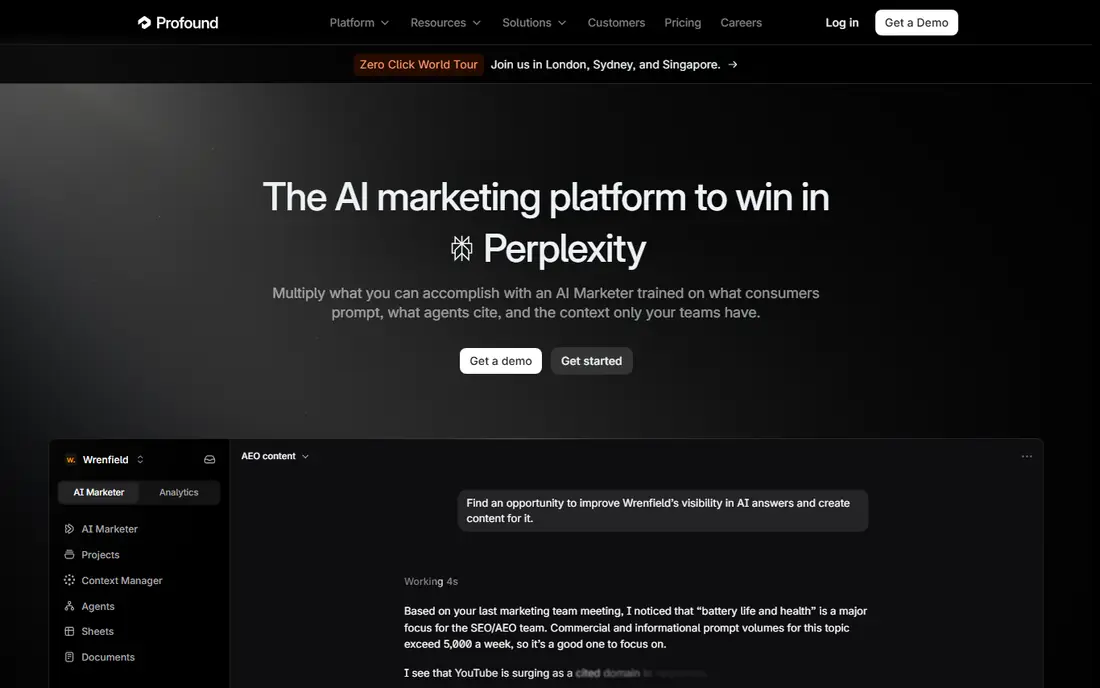
Profound started as a visibility tracker and has grown into an optimization platform for larger brands. It tracks prompts across ChatGPT, Perplexity, Gemini, Copilot, Google AI Overviews, Google AI Mode, and other engines on higher tiers, and it shows which sources those answers cite. That citation view is the optimization starting point, because it names the third-party pages and owned pages that shape an answer.
Profound also adds agent analytics that trace AI crawler behavior, which helps technical teams see whether AI systems can reach and read key pages. The trade-off is complexity and cost. Small teams may find the dashboard heavy and the sales-led pricing slow to evaluate, while larger teams with a dedicated analyst will get more from the depth. For enterprise optimization programs, Profound is the most complete platform in this list.
- Broad answer engine coverage on higher tiers
- Prompt-level analytics
- Crawler and agent insights that show how AI systems reach your site
- Enterprise pricing is sales-led and can be hard to compare
- Interface is data dense for small teams
- Entry trial limits custom prompts
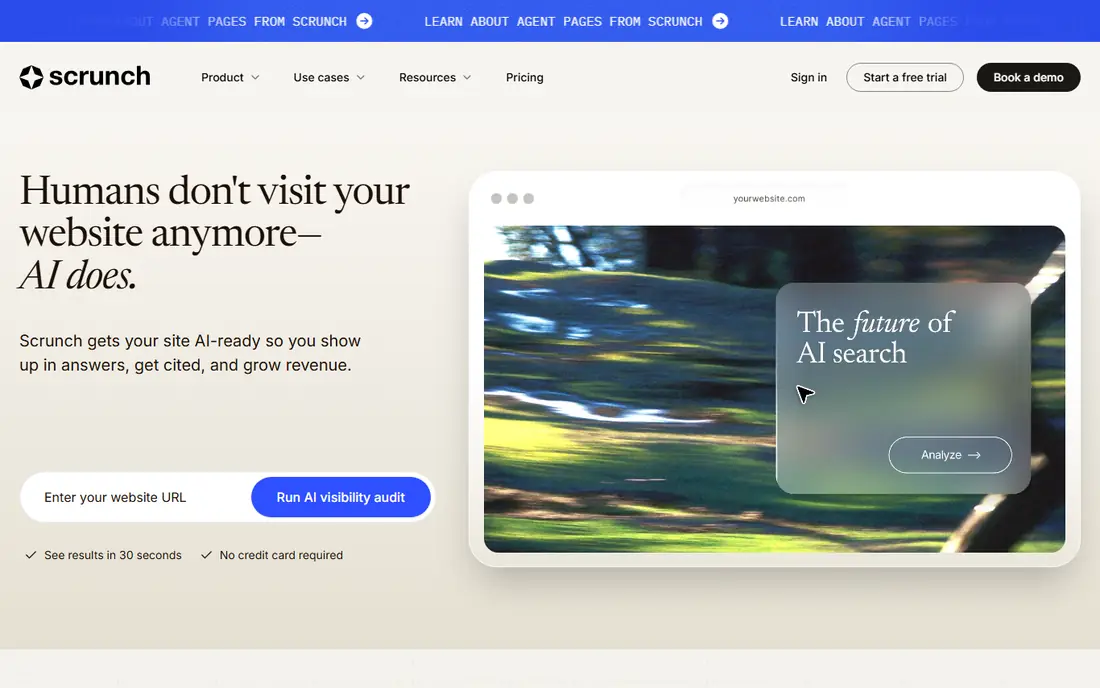
Scrunch AI frames optimization as a site problem, not just a prompt problem. Its Core plan, listed at $250 per month in recent pricing guides, tracks prompts across ChatGPT, Perplexity, Google AI Overviews, and Copilot, and adds audits that check how AI systems parse your pages. From there, it surfaces content recommendations, such as clearer facts, better structure, or missing coverage for prompts you lose.
That audit-to-action loop is why Scrunch ranks high for optimization, rather than tracking alone. The limit is price and scope: smaller teams may struggle to justify $250 per month before they see movement, and expanded engine coverage sits on Enterprise. If you have a content team ready to act on audit findings each week, Scrunch gives that team a clear queue.
- Site audits for AI readiness
- Content recommendations tied to prompts
- Sentiment and citation tracking
- Entry price is high for small teams
- Full engine coverage needs Enterprise
- Recommendations still need human editing before publishing
Goodie positions itself as a bridge between measurement and action. It monitors how models describe a brand across ChatGPT, Claude, Perplexity, Gemini, Copilot, and other engines, then connects those findings to optimization work, including content updates and citation targets. For teams that have tried a tracker and then stalled, that action link is the main selling point.
The drawback is transparency. Goodie does not always publish a simple entry price, so buyers need a demo or sales conversation to confirm prompt limits and plan details. That is common in this category, but it makes budgeting slower. If you want a tool that pushes you toward fixes rather than only charts, Goodie deserves a trial alongside Scrunch and Profound.
- Visibility monitoring across major models
- Optimization actions linked to tracked prompts
- Agency-friendly reporting
- Public pricing is limited, so comparison shopping is harder
- Optimization depth varies by plan
- Smaller teams may need onboarding help
AthenaHQ is notable for letting teams test with real data before committing to a large plan. Its free Essential tier offers limited credits, while Starter, listed at $295 per month in recent guides, adds more credits, more models, and unlimited members on published plans. The platform tracks brand visibility, analyzes sources and responses, and turns findings into prioritized content and technical fixes.
That free start is useful, but credits are the constraint. A broad prompt set with daily checks can use credits fast, so teams should start with a tight list of buyer prompts and expand only after they see which fixes matter. For B2B SaaS teams and lean marketing teams that want analysis rather than a mention log, AthenaHQ is a strong optimization entry point.
- Free Essential tier with limited credits
- Prompt, source, and response analytics
- Content and citation recommendations
- Credits can burn quickly on broad prompt sets
- API access is often an add-on on Starter
- Paid Starter price is high for very small teams
Peec AI helps optimization teams answer a specific question: are we cited because the model retrieved our page, or because it mentioned us without citing us. That distinction matters, because a retrieval problem needs technical or content structure fixes, while a citation problem may need stronger third-party coverage. Peec tracks selectable models, including ChatGPT, Google AI Mode, AI Overviews, Gemini, and Copilot, with add-ons for more engines.
Starter, listed at $95 per month in recent US pricing guides, includes 50 prompts and three selected models, with unlimited users, which suits agencies and mid-market teams. Optimization support is more analytical than prescriptive: Peec shows where you lose and to whom, but your team still writes the fix. For competitor-aware programs, that clarity is valuable.
- Clear separation of citation rate and retrieval rate
- Competitor tracking
- Multi-country reporting and Looker Studio connector
- Starter limits models and prompts
- Optimization actions are lighter than Scrunch or Goodie
- Prices are often shown in euros for EU buyers
Otterly.AI is the most accessible optimization starting point. Lite, at $29 per month, tracks a small prompt set daily across ChatGPT, Google AI Overviews, Perplexity, and Copilot, and includes a GEO audit that checks whether a page is ready to be cited. That audit gives small teams a concrete fix list without paying for an enterprise platform.
The limits are prompt count and engine add-ons. Fifteen prompts cover a core category, but not a full product line, and adding Gemini or AI Mode costs more. Otterly is best for a pilot: pick your most important buyer questions, fix the pages the audit flags, and recheck daily to see if mentions improve. If the pilot works, upgrade or move to a larger optimization platform.
- Lowest entry price in this list
- Built-in GEO audit for page readiness
- Daily prompt tracking on core engines
- Lite plan limits prompts to 15
- Gemini, AI Mode, and Claude are add-ons on Lite
- No API on Lite
Rankability appeals to agencies and teams that want tracking and content help in one place. Starter, listed at $97 per month, includes a large daily query allowance across many platforms in recent pricing comparisons, which is generous for the price. That volume lets a team track core prompts, competitor prompts, and pricing questions without trimming the list to fit a tiny plan.
The trade-off is maturity. Rankability is less established in independent lists than Profound, Peec, or Otterly, so buyers should trial it with real prompts and check whether its content recommendations fit their editorial standards. For teams that will act on content weekly, the bundle can be more useful than a tracker alone.
- Starter includes many tracked queries across many platforms
- Tracking bundled with content support
- Self-serve pricing
- Less well known than Profound or Peec
- Content workflow quality depends on the plan and team
- Enterprise features are thinner
Promptwatch combines prompt monitoring with a path to content action. Essential, at $95 per month, includes 50 prompts and a large response allowance, with daily tracking and API access, while higher plans add AEO article credits that help teams turn tracked gaps into published pages. That structure suits teams that want to measure, then publish, without buying a separate content tool.
The limit is model choice. Each plan covers four models from a larger catalog, so you must choose which engines matter most for your buyers. Essential also lacks AEO articles, so content work on that tier is manual. For teams with a clear engine priority and a publishing cadence, Promptwatch is a practical optimization bridge.
- Public monthly plans
- API and MCP access
- AEO article credits on higher plans for turning findings into content
- Model selection is capped at four per plan
- Essential plan has no AEO articles
- Daily prompt allowance is modest on entry tier
How we picked these
We compared vendor pricing pages, feature lists, and independent pricing comparisons for tools that track LLM answers and offer optimization features in October 2026. We required more than a visibility score: each tool had to offer audits, recommendations, citation analysis, or content workflows that help a team change an answer. We excluded pure rank trackers and pure writing tools, and we used See website where public pricing was sales-led or inconsistent across sources.
How to run LLM visibility optimization in practice
Start with prompts buyers actually ask, not keywords you wish they asked. Pull questions from sales calls, support tickets, search console queries, and competitor pages, then group them by buying stage, such as comparison, pricing, and use case. A tight list of 30 to 50 prompts will teach you more than 500 generic prompts, because you can fix the pages behind each one and recheck the result.
Fix pages in priority order
Work from citations outward. First, fix owned pages that AI engines already cite but describe poorly, since clearer facts, tables, and direct answers can improve how those pages are quoted. Next, fix owned pages that should be cited but are not, by improving structure, headings, and factual coverage. Finally, earn third-party citations through reviews, directories, and expert content, since many AI answers cite sources other than your own site.
Measure change, not just presence
AI answers vary from day to day, so judge optimization over weeks, not a single check. Track mention rate, citation rate, and competitor share for the same prompt set, and log each content change with a date. If a fix does not move a prompt after several checks, revisit the prompt wording and the cited sources before spending more time on the same page.
Frequently asked questions
What is the best LLM visibility optimization tool?
Profound is the best choice for larger brands with an enterprise budget and a dedicated analyst, while Scrunch AI is the best optimization-first pick for mid-market teams that will act on audits. AthenaHQ is the best low-risk start thanks to its free tier, and Otterly.AI is the best budget pilot at $29 per month.
What is the best LLM visibility analysis tool?
An analysis tool should separate mentions, citations, and retrieval, and show which pages and competitors appear for each prompt. Peec AI does this clearly with citation versus retrieval rates, Profound adds deep prompt analytics, and AthenaHQ adds source and response analysis. Choose based on prompt volume and whether you need enterprise controls.
How is LLM visibility optimization different from SEO?
Traditional SEO aims to rank a page in search results. LLM visibility optimization aims to be mentioned and cited inside an AI-generated answer, which may draw on your page, a review site, or a competitor page. The work overlaps, including clear facts and good structure, but the measurement is prompt-based and answer-based rather than ranking-based alone.
How long does LLM visibility optimization take?
Tracking data usually appears within a day or two of setup, but movement in share of voice takes weeks to months of consistent content and citation work. AI answers change with model updates and competitor publishing, so treat optimization as an ongoing program, not a one-time fix.
Do I need an optimization tool if I already track LLM visibility?
Not always. If your tracker already shows which pages to fix and your team acts on that data, you may not need a separate optimization platform. An optimization tool earns its price when it adds audits, prioritized recommendations, or content workflows that turn tracking data into published fixes faster than manual work.
What should I check before buying an LLM visibility tool?
Check engine coverage on the plan you will buy, prompt limits, check frequency, citation data, and whether recommendations are specific enough to act on. Trial the tool with your real prompts, confirm whether prices are monthly or annual, and check credit or prompt overage rules before signing a longer term.
Sources
See where you really rank - block by block
ProMapRanker scans Google Maps across a grid of your service area. Simple monthly plans from $19, white-label on every plan.
Start freeKeep reading
 zendesk alternatives
Best Zendesk Alternatives in 2026
Compare the best Zendesk alternatives in 2026, from budget help desks to AI-first support tools, with current pricing, free plans, and honest trade-offs.
Read → wordpress alternatives
Best WordPress Alternatives in 2026
Looking for the best WordPress alternatives? We compare 8 free and paid options for blogs, business sites, stores, and developer-led projects in 2026.
Read → which real estate company has the best training
Best Real Estate Company Training in 2026
Compare which real estate company has the best training, from Keller Williams and eXp to Compass and Coldwell Banker, by program, mentor, and fit in 2026.
Read →