 ProMapRanker
Best LLM Rank Tracking Tool in 2026

Key takeaways
- LLM rank tracking measures whether large language models mention, cite, or recommend your brand in generated answers, not your position on a classic results page.
- Otterly and Rankscale give the cheapest credible start, Peec AI gives the cleanest mid-market view, and Profound and Scrunch serve larger programs with deeper data.
- Prompt choice matters more than tool choice at first: track buying questions, comparisons, and use cases, not only prompts that name your brand.
- Visibility scores are directional trends, not exact measurements, since answers vary by wording, model version, and timing, so judge movement over weeks.
Quick comparison
| Pick | Great for | Pricing starts at | Free tier | |
|---|---|---|---|---|
 Otterly | Cheapest credible LLM tracking | $29 per month | Free trial | Visit |
 Peec AI | Clean daily LLM visibility number | $95 per month | Free trial | Visit |
 Profound | Enterprise LLM answer analytics | See website | Free trial | Visit |
 Scrunch | LLM tracking plus crawler audits | $300 per month | Free trial | Visit |
 AthenaHQ | Free plan before paid tracking | Free | Yes | Visit |
 Rankscale | Credit-based LLM tracking | $20 per month | Free trial | Visit |
 LLMrefs | Many prompts on a budget | $79 per month | Free trial | Visit |
 ZipTie | Simple usage-based tracking | See website | Free trial | Visit |
 SE Ranking | LLM tracking inside an SEO suite | $129 per month | Free trial | Visit |
 Nightwatch | Classic plus LLM tracking | See website | Free trial | Visit |
The best LLM rank tracking tools
An LLM rank tracking tool watches what ChatGPT, Gemini, Perplexity, Claude, Copilot, and Google AI Overviews say about your brand when users ask relevant questions. It tracks mentions, citations, sentiment, and share of voice against competitors over time, so you can see whether content changes move the answers.
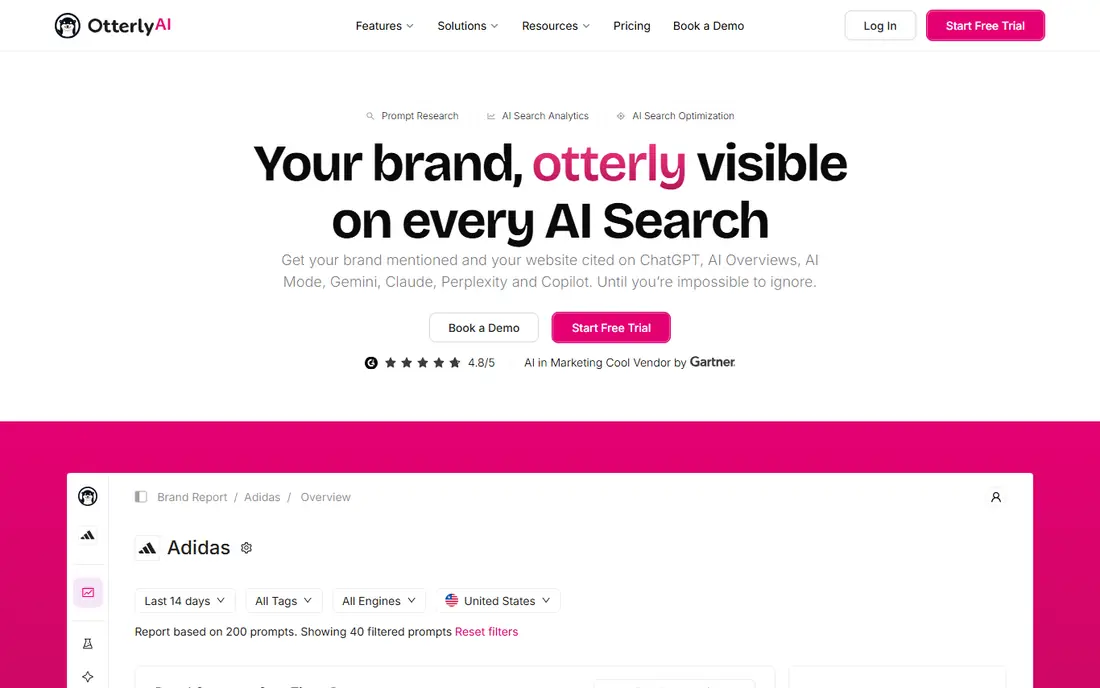
Otterly is the floor for credible LLM tracking, with a Lite plan listed at $29 per month for 15 prompts. It tracks inclusion, links, and position across ChatGPT, Google AI Overviews, Perplexity, and Copilot, with add-ons for AI Mode and Gemini, and it presents results in reports a small team can read without an analyst. For a brand testing whether LLM answers matter at all, that low entry price removes the excuse to guess.
Fifteen prompts will not cover a large catalog or many buying questions, and higher plans at $189 and $489 per month are needed for larger sets. Otterly also measures more than it fixes, so your team still needs to improve the pages and sources that AI systems cite. Otterly suits solo marketers, startups, and small teams that want a real, affordable start in LLM tracking.
- Low entry price
- Tracking across ChatGPT, AI Overviews, Perplexity, and Copilot
- Simple reports for small teams
- Entry plan covers only 15 prompts
- Some engines are paid add-ons
- Limited guidance on content fixes
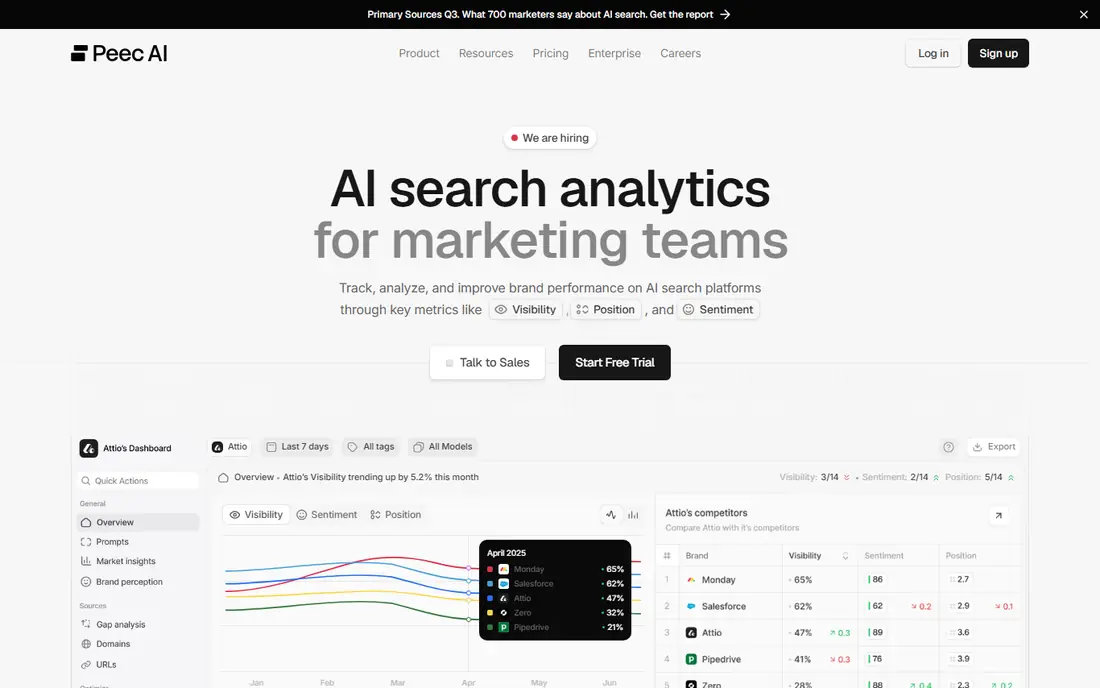
Peec AI gives mid-market teams one clean daily view of LLM visibility. It tracks prompts across ChatGPT, Perplexity, and Google AI Overviews, with add-ons for Gemini, Claude, DeepSeek, and others, and it reports visibility, citations, and competitor share at prompt level. Published pricing lists the entry plan at $95 per month, with Pro and Advanced plans for more prompts and models. Agencies value the straightforward reporting, since clients can see movement without a long explanation.
Peec AI does not fix the underlying content: if your product pages lack clear claims, structured data, and third-party support, the tool will show the gap but cannot close it. Prompt limits also matter for catalogs with many products or markets. Peec AI suits SEO teams, agencies, and mid-market brands that want reliable daily tracking without enterprise sales cycles.
- Prompt-level visibility and citation data
- Competitor benchmarking
- Clean interface for agencies and mid-market teams
- Entry plan prompt limits bind large catalogs
- Engine choice varies by plan
- Fixes remain your content team's job
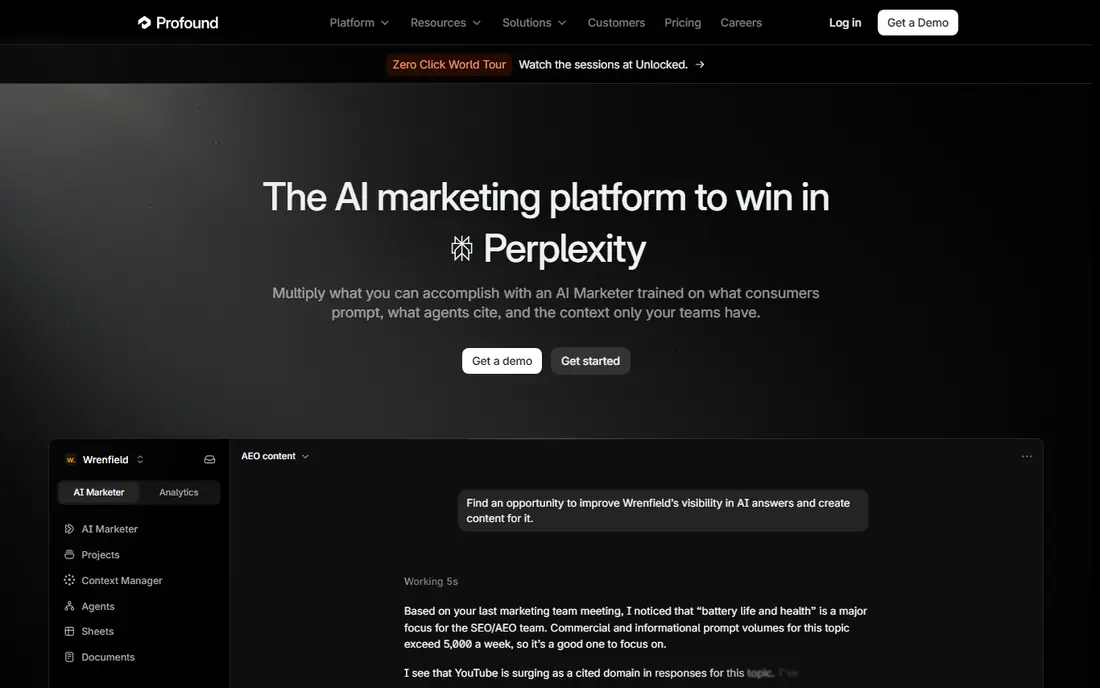
Profound is the enterprise pick for LLM tracking, with coverage across ChatGPT, Perplexity, Gemini, Claude, Copilot, Google AI Overviews, and other engines. It reports answer inclusion, citation patterns, and prompt demand, and it adds agent analytics that show how AI agents, not only chat users, interact with brand content. Security features such as SOC 2 compliance and single sign-on help it pass enterprise reviews that smaller tools may not.
Recent listings show Profound moving to custom enterprise pricing after earlier published plans, with a free trial, so budget teams should request a quote rather than assume a self-serve rate. Profound also focuses on measurement, leaving content fixes to your team. Profound suits large brands, regulated firms, and agencies running LLM visibility as a formal program.
- Deep analytics across up to nine engines
- Citation patterns and prompt demand data
- Enterprise security and compliance features
- Custom enterprise pricing in recent listings
- Measurement-heavy
- Overkill for small prompt sets
Scrunch pairs LLM tracking with insight into how AI crawlers read your site, which is a useful combination. It monitors prompts across ChatGPT, Perplexity, Claude, Gemini, and Google AI Overviews, reports share of voice, and audits crawler access, site structure, and content that can block AI systems from citing your pages well. Published pricing lists the Starter plan at $300 per month, or $250 per month on annual billing, with Growth and Pro plans above it.
The price puts Scrunch out of reach for many small brands, and audit findings still need content and development work to act on. A blocked crawler or missing structured data will not fix itself because a dashboard flagged it. Scrunch suits mid-size brands and agencies that want tracking plus a technical audit, and that have someone to implement the fixes.
- Prompt monitoring and share of voice
- AI crawler analytics and site audits
- Agency workflows
- High entry price for small teams
- Annual billing changes the monthly rate
- Audit fixes need development time
AthenaHQ lets you test LLM tracking with your own data before paying, through a free Essential plan with a limited credit allowance. Paid plans start at $295 per month for the Starter plan, with coverage across up to eleven models, sentiment tracking, and action tooling that links visibility gaps to suggested next steps. That free start helps a team prove internal value before requesting budget, and broad model coverage suits brands whose buyers use several AI systems.
The jump from free to paid is steep, and free credits will not sustain a large or daily prompt set for long. Action features also only help if someone owns the content work that follows. AthenaHQ suits mid-market teams that want to test first, and brands that value sentiment and perception data alongside mention counts.
- Free Essential plan with limited credits
- Broad model coverage on paid plans
- Sentiment and action tooling
- Paid Starter plan is $295 per month
- Free credits run out fast on large prompt sets
- Action features need an owner
Rankscale uses credits to keep LLM tracking flexible and cheap, with an Essentials plan listed at $17 to $20 per month depending on billing. You choose which engines and prompts to spend credits on, rather than buying a fixed bundle, and white-label reports help agencies share results with clients. That model suits freelancers and agencies with uneven client needs, since a quiet client need not consume the same checks as an active one.
Credit models punish careless setup: daily checks across many prompts consume credits faster than a monthly plan suggests, so budget by checks per month. Rankscale is also a smaller brand, so guides and community help are thinner than for larger rivals, and it measures more than it fixes. Rankscale suits startups, freelancers, and agencies that want low-cost, flexible LLM tracking.
- Low entry price
- Credit flexibility across engines
- White-label reports for agencies
- Credit budgeting needs care
- Smaller brand with thinner documentation
- Limited fix guidance
LLMrefs stands out for prompt volume: published comparisons list a plan at $79 per month for 500 prompts across ten listed models, with unlimited seats. That allowance suits teams with many products, locations, or buying questions that would exceed the prompt caps on entry plans elsewhere. Weekly checks are the trade-off in some listings, which suits trend tracking but not daily reaction to a sudden answer change.
LLMrefs is a smaller brand, so documentation, support depth, and long-term roadmap deserve a check during the trial. Reporting is functional rather than lavish, and optimization guidance is limited. LLMrefs suits developers, agencies, and product teams that need many prompts tracked cheaply and can live with weekly refreshes.
- Large prompt allowance for the price
- Coverage across ten listed models
- Unlimited seats in published comparisons
- Weekly checks rather than daily on some plans
- Smaller brand
- Interface and reporting depth vary by plan
ZipTie takes a usage-based approach to LLM and AI Overview tracking, with published starting prices around $42 to $69 per month depending on plan and usage in comparisons. You choose the prompts and engines you track, and you can choose daily, weekly, or monthly check frequency, which helps control cost for a small prompt set. Coverage includes Google AI Overviews, ChatGPT, and Perplexity, with additional engines on higher tiers, and its interface focuses on simple setup rather than enterprise analytics.
Usage pricing makes exact comparison harder, since two teams with different prompt counts will pay different amounts, so get a quote at your real prompt count. ZipTie is also a smaller brand, so support and documentation should be tested in the trial. ZipTie suits small teams that want simple setup and pay-for-what-you-track pricing, and that track a focused prompt set.
- Usage-based pricing so you pay for what you track
- Tracking across AI Overviews, ChatGPT, and Perplexity
- Choice of check frequency
- Pricing varies by usage and plan, so quotes differ
- Smaller brand
- Depth varies by tier
SE Ranking adds AI search tracking to its classic SEO suite, which suits teams that already use it for ranks, audits, and research. The Core plan is listed at $129 per month, or $103.20 per month on annual billing, for 2,000 daily classic keywords, with AI visibility features on suitable plans and add-ons covering AI Overviews, AI Mode, ChatGPT, Gemini, and Perplexity. Keeping classic and LLM tracking in one project helps teams show how both channels move together for the same pages.
SE Ranking is a suite purchase, so a team that only needs LLM tracking pays for audit and research tools too, and AI prompt allowances vary by plan. The suite angle is a strength for SEO teams and a cost for LLM-only buyers. SE Ranking suits SEO agencies and in-house teams that want classic and AI tracking together without a second vendor.
- Classic rank tracking plus AI search tracking in one project
- Site audit and research tools included
- Familiar agency reporting
- LLM tracking is part of a larger suite cost
- AI surface depth varies by plan
- Entry keyword and prompt limits apply
Nightwatch now covers both classic rank tracking and LLM tracking, which appeals to agencies that report both to clients. It offers daily and on-demand classic checks, ZIP-level local tracking, and unlimited seats on suitable plans, plus LLM tracking across ChatGPT, AI Overviews, and AI Mode on current plans. That combination lets a local SEO agency show a client where they rank in Google and whether AI answers mention them, in one dashboard.
Nightwatch pricing appears in euros on some pages, which complicates dollar comparison, and its LLM depth is thinner than dedicated tools such as Profound or Peec AI. Entry keyword counts are also modest for the price. Nightwatch suits local agencies and multi-location brands that need classic plus LLM tracking together, with many seats.
- Daily and on-demand classic tracking
- LLM tracking on current plans
- Local precision and unlimited seats on suitable plans
- Pricing in euros on some pages
- Entry keyword counts are modest
- LLM depth is thinner than dedicated LLM tools
How we picked these
We compared official pricing pages, vendor documentation, and published LLM tracking comparisons checked in October 2026, and we kept only tools that track brand or product visibility in LLM answers over time and that are live now. We favored a mix of budget, mid-market, and enterprise tools, plus suite options for teams that already pay for SEO software. We left out one-off checkers that give a single reading without ongoing tracking, and tools with no usable published pricing or product page. Prices change fast in this category, so confirm the current plan on the vendor site before you buy.
How to set up LLM tracking that actually helps
Start with prompts grouped by intent: buying questions, product comparisons, problem questions, and brand questions, with buying questions weighted most heavily. Add two or three real competitors to every prompt set, since share of voice only means something against rivals your buyers actually consider. Run the first month as a baseline without changing content, so later movement can be tied to real actions rather than normal answer variation.
Frequently asked questions
What is an LLM rank tracking tool?
It is software that tracks whether large language models mention, cite, or recommend your brand in generated answers to chosen prompts, over time. Unlike classic rank tracking, which records a position on a results page, LLM tracking records inclusion, citation, sentiment, and share of voice in answers from tools such as ChatGPT, Gemini, Perplexity, and Claude.
How is LLM tracking different from classic SEO rank tracking?
Classic tracking measures where your pages sit in search results for a keyword. LLM tracking measures whether you appear inside a generated answer, what claim is made about you, and which sources are cited.
Which LLM models should I track?
Track the models your buyers actually use, which usually means ChatGPT first, plus Google AI Overviews and AI Mode, Perplexity, and Gemini, with Claude and Copilot added for business or technical audiences. Tracking every model for every prompt wastes budget, so start with three or four core models and expand only where a model drives real traffic or sales questions.
How accurate are LLM visibility scores?
Scores are directional, not exact, since AI answers vary by prompt wording, model version, location, and timing. Two runs of the same prompt can differ, so treat a single reading with caution and judge trends over weeks.
How many prompts do I need to track?
Start with 20 to 50 prompts per brand or flagship product, covering buying questions, comparisons, use cases, and brand questions. Small teams can start with 15 prompts on Otterly and expand as trends emerge, while agencies with many clients may need hundreds of prompts and a volume tool such as LLMrefs.
Can LLM tracking improve my visibility on its own?
No. Tracking shows where you are absent, which competitors win answers, and which sources get cited, but visibility improves only when you act: clearer product pages, direct FAQ answers, structured data, and credible third-party coverage.
Sources
- https://www.otterly.ai
- https://peec.ai
- https://www.tryprofound.com
- https://www.scrunch.com
- https://www.athenahq.ai
- https://www.rankscale.ai
- https://llmrefs.com
- https://www.ziptie.ai
- https://seranking.com
- https://www.nightwatch.io
- https://www.rankability.com/blog/best-ai-search-visibility-tracking-tools/
- https://www.frase.io/blog/llm-visibility-tools
See where you really rank - block by block
ProMapRanker scans Google Maps across a grid of your service area. Simple monthly plans from $19, white-label on every plan.
Start freeKeep reading
 zoho inventory alternatives
6 Alternatives to Zoho Inventory, Compared on Price and Fit
Zoho Inventory alternatives: 6 tools compared on price, free plans and fit. Katana leads the list for manufacturers. Fit and flaws are laid out for each entry.
Read → zoho crm alternatives
Best Zoho CRM Alternatives (2026)
Need Zoho CRM alternatives? We compare 7 tools on cost, free access and who each suits. Every pick gets a straight assessment. Built for quick decisions.
Read → zelle alternatives
Best Zelle Alternatives in 2026
Compare the best Zelle alternatives for sending money to friends, paying sellers and moving funds abroad, with honest notes on fees, speed and safety in 2026.
Read →