 ProMapRanker
Best LLM Optimization Tools for AI Visibility in 2026

Key takeaways
- LLM optimization tools track how brands appear in AI answers, which prompts mention them, and which sources those answers cite.
- Profound and Goodie suit larger brands that need enterprise reporting and broad engine coverage.
- Otterly AI and Rankscale AI suit smaller teams that want affordable tracking with clear next steps.
- Peec AI and Writesonic suit teams that want competitor comparison plus content fixes in the same workflow.
- No tool can guarantee a mention in an AI answer, so judge them on tracking quality, prompt coverage, and actionable fixes.
Quick comparison
| Pick | Great for | Pricing starts at | Free tier | |
|---|---|---|---|---|
 Profound | Enterprise AI visibility | See website | No | Visit |
 Peec AI | Competitor benchmarking | See website | No | Visit |
 Otterly AI | Affordable tracking | See website | No | Visit |
 Goodie AI | End to end GEO | See website | No | Visit |
 Writesonic | Visibility plus content | See website | No | Visit |
 SE Ranking | SEO plus GEO in one dashboard | See website | No | Visit |
 Ahrefs Brand Radar | Existing Ahrefs users | See website | No | Visit |
 Rankscale AI | Single visibility score | See website | No | Visit |
The best LLM optimization tools for AI visibility
These tools, often called GEO or AI visibility tools, monitor how large language models and AI search surfaces answer prompts about your brand, your competitors, and your topics. They track mentions, citations, sentiment, and share of voice, then suggest content and technical fixes to improve how AI systems describe you.
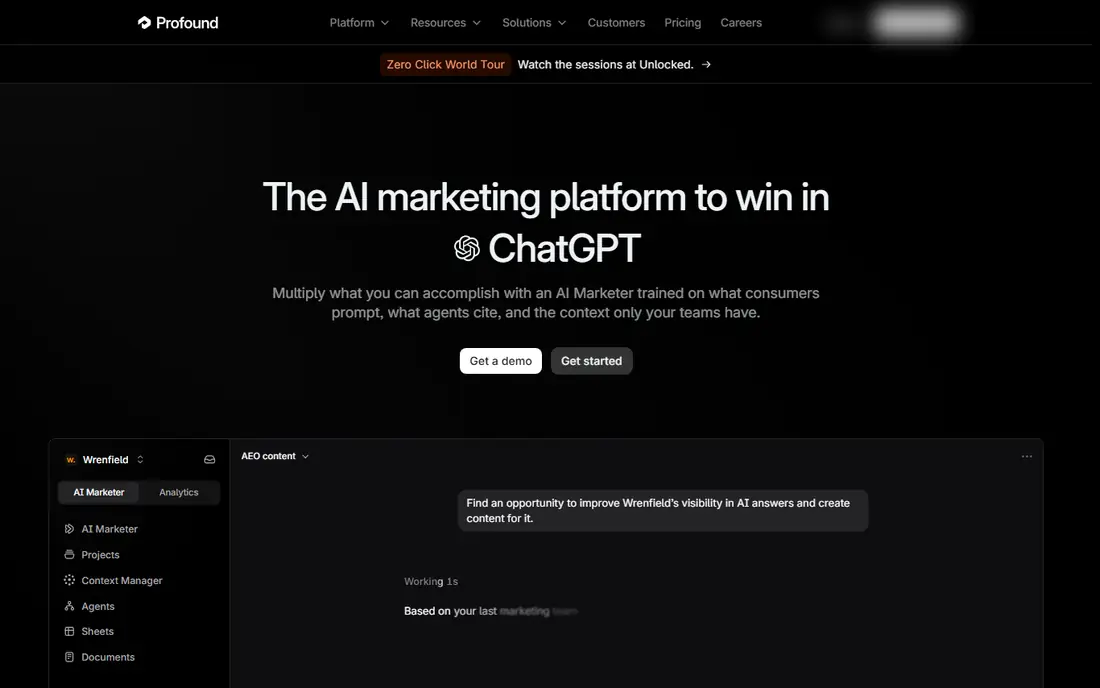
Profound is built for large brands that need a clear, auditable view of AI visibility. It tracks how models describe a brand, which prompts trigger mentions, and how sentiment and framing change over time. Its enterprise features, including security and compliance controls, suit firms where AI answers carry reputational risk.
The trade off is cost and complexity. A small business with a handful of prompts will not need Profound's depth, and its pricing reflects an enterprise audience. For a global brand, though, its reporting and governance features are a strong reason to shortlist it.
- Broad enterprise reporting
- Brand perception and framing analysis
- Prompt level tracking
- Security and compliance features for large brands
- Pricing is enterprise leaning
- Smaller teams may find it more than they need
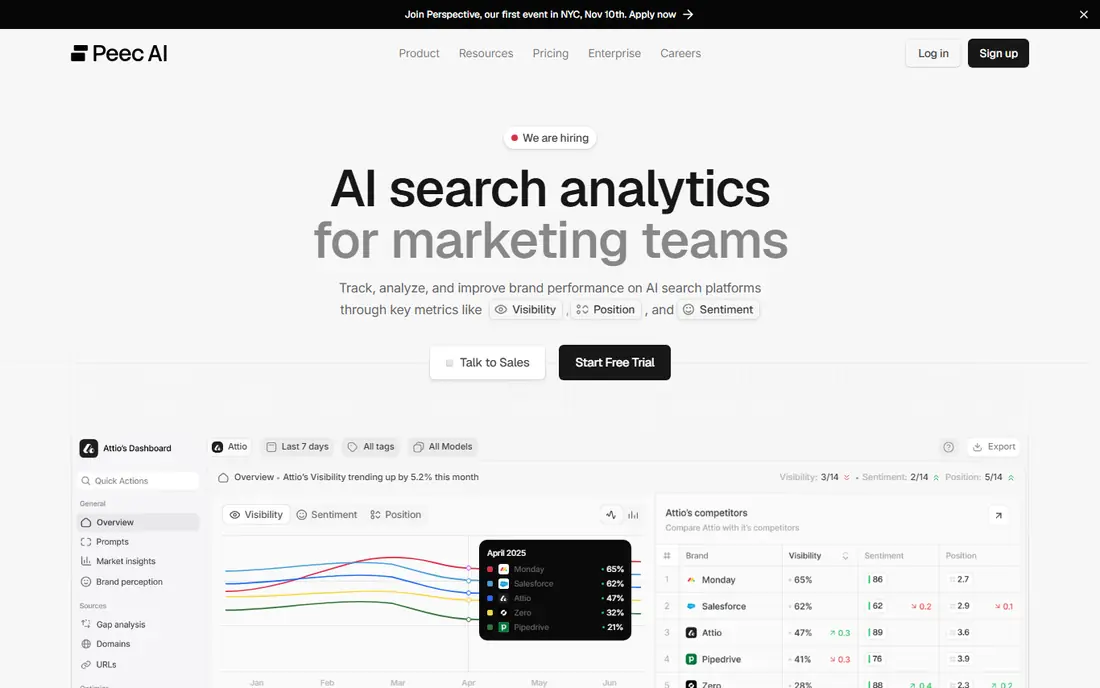
Peec AI focuses on how your brand competes in AI answers. It tracks prompts daily, compares your mentions and citations with competitors, and shows which sources AI systems cite for each answer. That source view is useful, because improving citations often means improving the pages those systems pull from.
Its dashboard also prioritizes actions, which helps a team decide what to fix first. For in house marketing teams that want a clear competitor picture without an enterprise contract, Peec is a practical choice.
- Prompt management and competitor source analysis
- Daily tracking
- Prioritized actions in the dashboard
- Product level tracking on higher plans
- Country coverage per project can be limited on lower plans
- Pricing rises with prompt volume
Otterly AI is a good starting point for solo marketers and small teams. It tracks prompts across ChatGPT, Google AI Overviews, Perplexity, and Copilot, with sentiment and competitor comparison, at a lower entry price than many rivals. Its recommendations point to content gaps rather than leaving you with a dashboard alone.
Larger teams may outgrow its reporting depth, and prompt limits mean you must choose prompts carefully. For a first AI visibility tool, Otterly offers a clear balance of price and coverage.
- Affordable entry price
- Multi engine prompt tracking
- Sentiment and competitor views
- Recommendations for closing visibility gaps
- Prompt limits rise with plan
- Enterprise reporting is lighter than Profound or Goodie
Goodie AI aims to cover the full GEO loop: track mentions, recommend optimizations, and link visibility to traffic and revenue where possible. It tracks across many engines, including ChatGPT, Gemini, Claude, and Copilot, with topic exploration for prompt gaps. Its optimization hub suggests schema, entity, and content changes.
Custom pricing means you need a demo or quote to judge cost, which is a barrier for small teams. For scaling teams that want monitoring, optimization, and attribution in one platform, Goodie is a strong contender.
- Real time tracking across many AI engines
- Optimization hub with content and schema recommendations
- Attribution workflows
- Multilingual and regional tracking
- Pricing is custom for many teams
- Setup needs a clear prompt strategy to get full value
Writesonic pairs AI visibility tracking with content production, which suits teams where creating or fixing pages is the bottleneck. Its action center flags citation gaps, and its writing tools help produce question focused content to close them. AI crawler analytics show which pages attract AI crawlers, which adds a useful technical view.
The breadth can feel like two tools in one, so teams that only want tracking may prefer a simpler dashboard. If your team needs to both monitor and publish fixes quickly, Writesonic is a good fit.
- AI visibility and citation tracking
- Action center for citation gaps
- AI writing tools to create or fix content
- Crawler analytics for AI traffic
- Content and visibility features can feel like two products in one
- Pricing rises with usage
SE Ranking suits SEO teams that want AI visibility inside a dashboard they already use. It correlates AI visibility with rankings and backlinks, which helps explain whether an AI mention lines up with search performance. Prompt tracking covers major engines, including ChatGPT, Gemini, AI Overviews, and Perplexity.
Its GEO tools are newer than its SEO core, so a dedicated GEO platform may offer deeper prompt analysis. For a team that wants one dashboard for both search and AI visibility, SE Ranking is a practical choice.
- AI visibility correlated with rankings and backlinks
- Familiar SEO dashboard
- Prompt tracking across major engines
- 14 day trial reported
- GEO features are newer than its core SEO tools
- Depth varies by plan
Ahrefs Brand Radar adds AI visibility tracking to the Ahrefs platform, with citation tracking, visibility and sentiment views, and share of voice metrics. For teams already using Ahrefs for backlinks, keywords, and content, it avoids adding a new platform and a new login.
The catch is cost structure. Brand Radar is an add on to paid Ahrefs plans, so the total price is higher than the add on figure alone. If you do not use Ahrefs already, a standalone GEO tool will usually be cheaper and simpler.
- Citation tracking layered onto Ahrefs data
- Brand visibility and sentiment views
- Share of voice metrics
- Familiar interface for SEO teams
- Available as an add on to paid Ahrefs plans, so total cost is higher
- Not a standalone tool for non Ahrefs users
Rankscale AI suits teams that want a single score to benchmark AI visibility, plus citation mapping and sentiment analysis to explain it. Its AI readiness audits flag pages and technical issues that may limit how AI systems cite a site. A low entry price makes it easy to try.
As a smaller vendor, its support and enterprise features may not match the largest platforms. For a small or mid sized team that wants a clear score and a short fix list, Rankscale is a useful starting point.
- Single visibility score for quick benchmarking
- Citation source mapping
- Sentiment analysis
- AI readiness audits
- Low entry price reported
- Smaller vendor than Profound or Ahrefs, so enterprise support depth may differ
- Trial terms vary by plan
How we picked these
We compared official feature and pricing pages, vendor comparisons, and current roundups of LLM visibility and GEO tools, and we kept only tools that track prompts across major AI surfaces and offer more than a single metric. Tools that only write content, without tracking how AI answers mention a brand, were left out. Where a vendor price could not be confirmed from its own pricing page at the time of writing, we wrote See website rather than repeating a roundup figure that may have changed.
How to choose the right tool
Start with your prompt list, not the dashboard. Write down the questions your buyers actually ask AI tools, including brand, competitor, and category prompts, and check how many prompts each plan covers. A tool with a low price but a small prompt limit can cost more once you add the prompts you need.
Next, check engine coverage and citation detail. You need tracking across the engines your buyers use, usually ChatGPT, Gemini, Perplexity, and Google AI Overviews at minimum, plus a view of which sources are cited. A mention without a citation view tells you that you appeared, but not why, or what to fix.
Finally, judge the fix loop. The best tools do more than report a score: they suggest content changes, schema fixes, and source improvements, and they let you retest prompts after a fix. Run a trial with a real prompt set, make one fix, and see whether the next report shows a change. That cycle is the real value.
Frequently asked questions
What are LLM optimization tools for AI visibility?
They are tools that track how large language models and AI search surfaces mention, describe, and cite your brand in answers to user prompts. They show mentions, citations, sentiment, and share of voice across engines such as ChatGPT, Gemini, Perplexity, and Google AI Overviews, and they suggest content and technical fixes.
Can these tools guarantee my brand appears in AI answers?
No. No tool can guarantee a mention, citation, or ranking in an AI answer, because model outputs depend on training data, cited sources, prompt wording, and engine changes. A good tool improves your chances by showing where you appear, which sources are cited, and what to fix, but it cannot promise a result.
Which tool is best for a small team?
Otterly AI and Rankscale AI are strong starting points for small teams, with lower entry prices and clear tracking. Peec AI suits teams that want deeper competitor comparison. Start with a small prompt set, test the fix loop, and expand only when the reports guide real content changes.
What is GEO, and how is it different from SEO?
GEO, or generative engine optimization, focuses on how AI systems generate answers and cite sources, while SEO focuses on ranking in traditional search results. The two overlap, since clear, well structured, authoritative pages help in both, but GEO adds prompt tracking, citation analysis, and sentiment across AI engines.
How many prompts do I need to track?
Start with 20 to 50 prompts that cover your brand, your main competitors, and the category questions buyers ask. That set is enough to spot gaps without paying for hundreds of prompts you never act on. Expand the list once you have a routine for fixing the gaps the first set reveals.
Do I still need SEO tools if I buy a GEO tool?
Yes, for most teams. GEO tools track AI answers, but SEO tools still handle keyword research, rankings, backlinks, technical audits, and content planning for traditional search. SE Ranking and Ahrefs Brand Radar bridge the two, but a dedicated GEO tool rarely replaces a full SEO suite.
Sources
- https://www.tryprofound.com
- https://peec.ai
- https://www.otterly.ai
- https://www.goodie.ai
- https://writesonic.com
- https://seranking.com
- https://ahrefs.com
- https://www.rankscale.ai
- https://cloro.dev/blog/llm-visibility-tracking-tools/
- https://visible.seranking.com/blog/best-generative-engine-optimization-tools/
See where you really rank - block by block
ProMapRanker scans Google Maps across a grid of your service area. Simple monthly plans from $19, white-label on every plan.
Start freeKeep reading
 outreach alternatives
Outreach Alternatives in 2026
Compare outreach alternatives for 2026, from Salesloft and Apollo to HubSpot and Lemlist, with pricing, channels, features, limits, and honest trade-offs.
Read → best web conference tools
Best Web Conference Tools in 2026
Compare the best web conference tools for meetings, webinars and team calls, with current pricing, free plans and honest limits for each option here today.
Read → best voice cloning tools
Best Voice Cloning Tools in 2026
Compare the best voice cloning tools in 2026, from ElevenLabs and Descript to Resemble and Cartesia, with consent rules, pricing, licenses, and limits.
Read →