 ProMapRanker
Best LLM Keyword Rank Tracker Software in 2026

Key takeaways
- Otterly.AI is the lowest-cost entry point for tracking a small prompt set, while Profound and Scrunch suit larger brands that need depth and crawler data.
- Prompt counts, engine coverage, and check frequency matter more than a single visibility score, since AI answers change from day to day.
- Treat visibility scores as trends over weeks, not exact rankings, and pair them with citation and traffic data before changing content.
- Several tools in this list overlap in engines, so pick by prompt volume, seat needs, and whether you also need optimization help.
Quick comparison
| Pick | Great for | Pricing starts at | Free tier | |
|---|---|---|---|---|
 Profound | Enterprise AI search depth | See website | Free trial | Visit |
 Peec AI | Agencies and prompt analytics | $95 per month | Free trial | Visit |
 Scrunch | Monitoring plus crawler analytics | $250 per month | Free trial | Visit |
 Otterly.AI | Lowest-cost monitoring | $29 per month | Free trial | Visit |
 Goodie | Tracking tied to revenue actions | $399 per month | Free trial | Visit |
 Rankscale | Budget multi-engine tracking | $17 per month | Free trial | Visit |
 AthenaHQ | Testing with credits first | $295 per month | Yes | Visit |
 Semrush AI Visibility Toolkit | Semrush users adding AI tracking | $99 per month | Free trial | Visit |
 Writesonic GEO | Tracking plus AI writing | $79 per month | Free trial | Visit |
The best LLM keyword rank tracker software
LLM keyword rank trackers run your prompts through AI assistants such as ChatGPT, Gemini, Perplexity, and Google AI Overviews, then report when your brand appears, where it ranks among cited sources, and how answers change. The tools below differ in engine coverage, prompt limits, and how much help they give you to fix what you find.
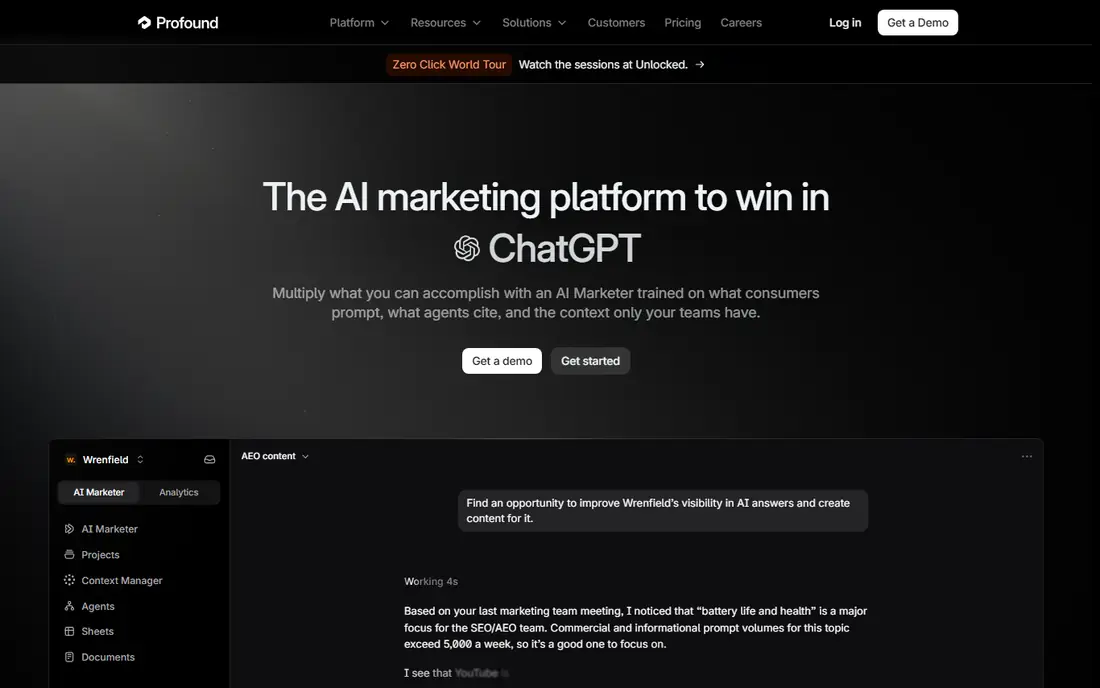
Profound is the deepest tool in this list for large brands. It tracks visibility across many answer engines, connects prompt demand to what people actually ask, and adds agents that can draft content changes for review. That combination suits a team that must report AI visibility to leadership and act on it in the same platform.
The drawback is access. Pricing is quote-based for many plans, and lower tiers cover fewer engines than the enterprise tier, so the homepage engine list is not the entry-plan list. Small teams should trial it only if they have the budget to grow into it. Large teams with many brands will get the most from its depth.
- Broad engine coverage on enterprise plans
- Real prompt demand data
- Content agents that draft fixes
- Pricing is quote-based for many plans
- Entry tiers cover fewer engines than enterprise tiers
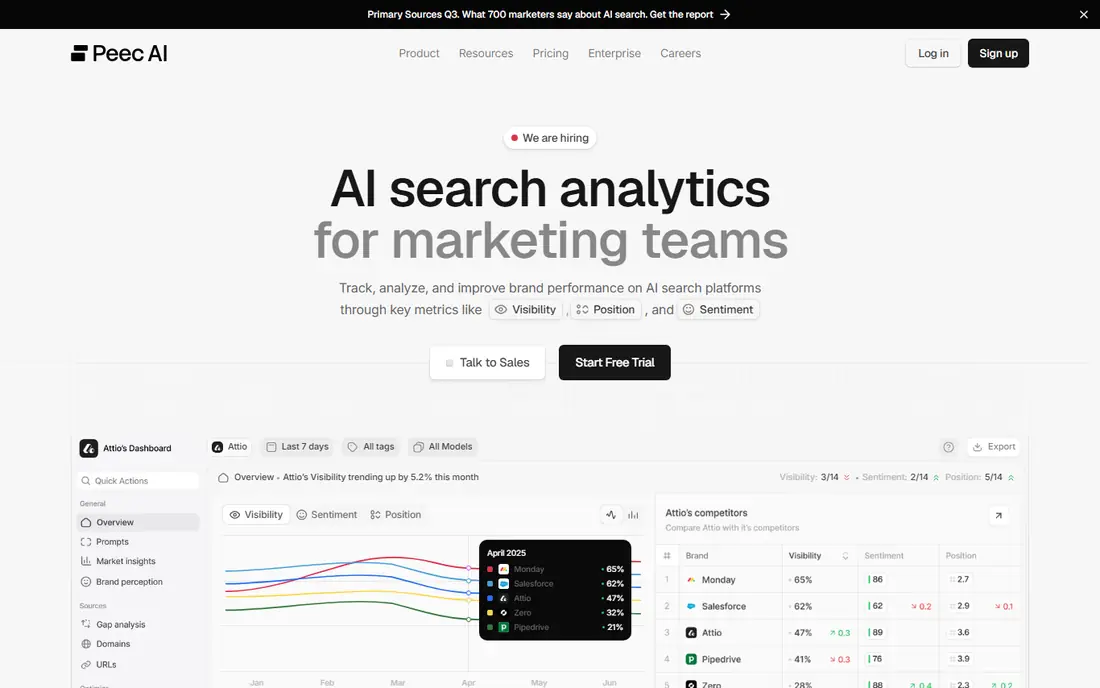
Peec AI suits agencies and SEO teams that manage several brands. Its prompt-level analytics show which questions surface your brand, which competitors appear, and how answers shift over time, and unlimited seats make it easy to give clients or teammates access without extra per-seat fees. Daily tracking keeps trends fresh enough for weekly reporting.
Entry coverage is the limit. The starter plan covers only a subset of models, with full coverage on higher tiers, so check the exact model list before you buy. API access also sits higher, which matters if you want to pipe results into your own dashboards. For agency reporting on a defined prompt set, Peec AI is a solid mid-market pick.
- Prompt-level analytics
- Unlimited seats on many plans
- Agency-friendly workspaces
- Entry plan covers only some models
- API access sits on higher plans
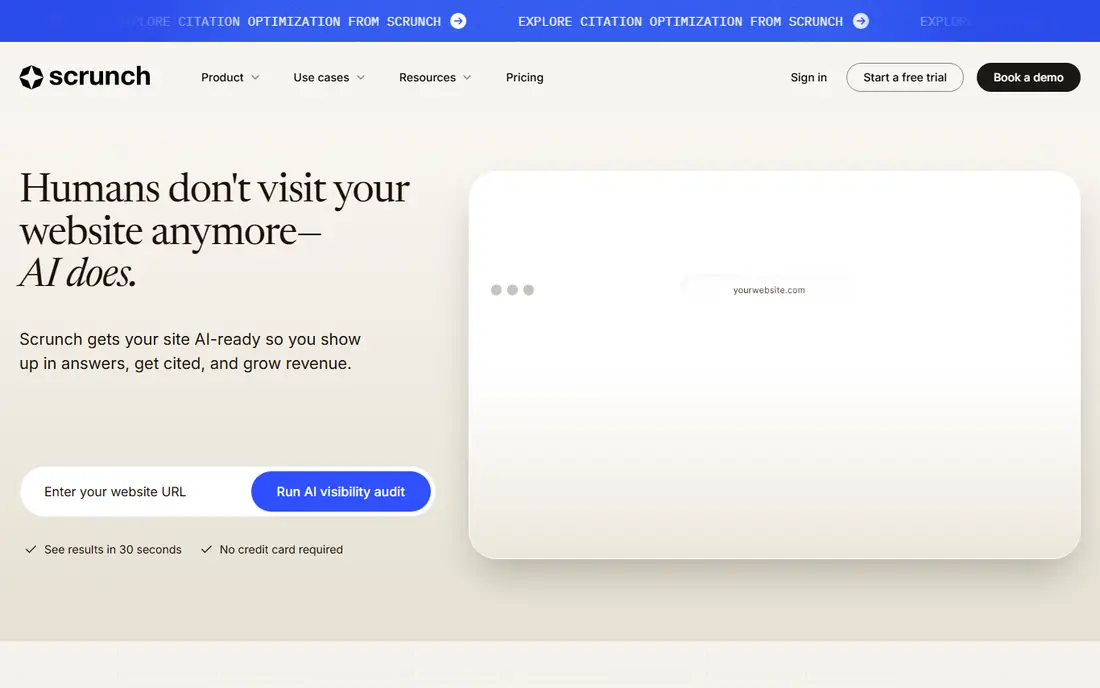
Scrunch stands out because it looks at both sides of AI search: what assistants say, and whether their crawlers can read your site. Its crawler analytics and agent experience checks help technical teams find pages that AI systems cannot parse, which is a common reason a brand is missing from answers. Custom prompts let you track the exact questions your buyers ask.
The entry price is high for a small team, and some deeper features sit on higher tiers. It is best for mid-size and larger brands that already have content and technical resources to act on findings. If you only need a weekly visibility score, a cheaper tracker will do the same job for less.
- Prompt tracking plus AI crawler data
- Site delivery checks for AI agents
- Custom prompts
- High entry price
- Some features need higher tiers
Otterly.AI is our pick for a first LLM tracker. At $29 per month, Lite covers 15 prompts across core engines such as ChatGPT, AI Overviews, Perplexity, and Copilot, with unlimited seats. That is enough to track a core product, a few competitor names, and the main questions in your category, and the dashboard is easy to read without training.
The limits are prompt count and engine add-ons. Gemini, AI Mode, and Claude may cost extra, and 15 prompts will feel small once you add locations or product lines. Treat Otterly.AI as a starting point: prove that AI tracking changes decisions, then move to a larger plan or a deeper tool when prompt volume grows.
- Lowest entry price in this list
- Simple dashboard
- Unlimited seats
- Small prompt allowance on Lite
- Some engines cost extra as add-ons
Goodie, formerly Goodie AI, tries to close the gap between tracking and results. It monitors brand visibility across ChatGPT, AI Overviews, Perplexity, AI Mode, and Copilot, then links findings to optimization actions and, on its framing, to revenue outcomes. For a brand team that must justify AI spend in business terms, that framing helps.
The price is the hurdle. At $399 per month for 120 prompts, it costs far more than Otterly.AI or Rankscale, and the prompt allowance is not huge for that price. It fits brands that already invest in content and want tracking, optimization, and reporting in one workflow. Small teams should start cheaper and revisit Goodie when AI traffic matters to revenue.
- Revenue attribution focus
- Optimization actions tied to tracked prompts
- Broad engine list
- High entry price
- Prompt allowance is modest for the price
Rankscale is the budget multi-engine option. Its Essentials plan costs $17 per month when billed yearly, and its engine list spans ChatGPT, Gemini, Perplexity, Claude, DeepSeek, Mistral, Grok, Copilot, and more. Credit-based tracking suits teams that want to control how many checks they run.
Two details need care. The low entry price is yearly only, so the upfront commitment is higher than the monthly figure suggests, and per-plan engine coverage is not always spelled out on the pricing page. Confirm the exact engines and credit rules for your plan before paying. For a small team that wants broad coverage on a tight budget, Rankscale is worth a trial.
- Low yearly-only entry price
- Wide engine list
- Credit-based tracking
- Entry plan is yearly only
- Per-plan engine coverage is not always clear
AthenaHQ lets you test with your own data before paying. Its free Essential plan includes a credit allowance, and Starter covers many engines, including ChatGPT, Claude, Gemini, Perplexity, Copilot, Grok, and DeepSeek, with a citation engine that flags which sources an answer used. That makes it easier to see not just whether you appear, but why.
Starter at $295 per month is a jump from the free tier, and API access is a paid add-on on Starter, which limits dashboard exports for some teams. It suits growth-stage teams that want to test, then pay for broad coverage and optimization help. Solo users should use the free credits first and only upgrade when the prompt volume justifies it.
- Free Essential plan with credits
- Broad engine coverage
- Citation and optimization agent
- Starter price is high
- API is a paid add-on on Starter
Semrush AI Visibility Toolkit makes sense only if you already use Semrush. It adds AI tracking for ChatGPT, Google AI, Gemini, and Perplexity to a suite that already covers keyword research, rank tracking, and site audits, so your team does not need another login for basic AI reporting. Competitor benchmarking helps put your visibility in context.
The entry tier is narrow: $99 per month per domain for 25 prompts, billed annually, which adds up fast for agencies with many domains. Teams that do not use Semrush for other work should pick a standalone tracker instead. Semrush users, by contrast, get AI visibility without rebuilding their reporting stack.
- Fits inside a familiar SEO suite
- Real-prompt data
- Competitor benchmarking
- Priced per domain
- Prompt allowance is small on the entry tier
Writesonic GEO bundles AI visibility tracking with the content tools Writesonic is known for. It tracks ChatGPT, Gemini, and AI Overviews, then offers an action center and article drafting to help you close the gaps it finds. That bundle suits content teams that want to move from a missed prompt to a new page without switching tools.
The prompt allowance is modest for the price, and teams that only need tracking will pay for writing features they may not use. It is best for content-led teams that publish often and want tracking tied to drafting. Pure tracking buyers should compare Otterly.AI and Rankscale first.
- Tracking plus content drafting
- Action center for fixes
- Familiar content platform
- Prompt allowance is modest
- GEO features are bundled with a writing platform
How we picked these
We compared official pricing pages, feature pages, and public comparisons for tools that track keywords or prompts in AI answers. We favored tools with published entry prices, a clear prompt allowance, and named engine coverage, and we excluded rank trackers that only cover classic search results. We marked any price we could not firmly verify as See website, and we did not list our own rank tracker, since this is a roundup of other tools.
What to check before you buy
Start with your prompt list, not the tool. Write the 20 to 50 questions your buyers actually ask, including brand, comparison, and problem questions, and check how many prompts each plan allows. Then confirm which engines matter for your buyers: ChatGPT and Google AI surfaces cover many cases, but Perplexity, Claude, and Copilot matter in some niches. Check frequency too, since daily checks catch shifts faster than weekly checks.
Next, look at citations and sources, not just a visibility score. A tool that shows which pages an answer cited helps you fix content, while a score alone only tells you that something changed. Finally, test the export and reporting flow. If you must show results to clients or leadership, confirm that seats, exports, and scheduled reports are included on the plan you intend to buy.
A simple buying checklist
- List your core prompts and count them before choosing a plan.
- Confirm engine coverage on the exact entry plan, not the homepage.
- Check check frequency, prompt allowance, and seat limits.
- Favor tools that show citations and source URLs.
- Run a four-week trial and judge trends, not single-day scores.
Frequently asked questions
What is an LLM keyword rank tracker?
It is a tool that runs prompts through AI assistants and reports how often your brand appears, which sources are cited, and how answers change over time. It is different from a classic rank tracker, which checks where a web page ranks in a search results page.
How many prompts do I need to track?
Start with 20 to 50 prompts covering your brand, your main products, comparison questions, and the problems your buyers try to solve. Add locations or product lines only after the core set proves useful, since prompt count drives price.
Why do AI visibility scores change daily?
AI answers are generated, not fixed, so the same prompt can produce different wording, citations, and brand mentions on different days. Track trends over weeks and look for sustained moves, not single-day jumps.
Can an LLM tracker replace classic rank tracking?
No. Classic rank tracking still matters for web search traffic, while LLM tracking covers AI answers. Most teams need both, since buyers may find you through either route, and the two data sets answer different questions.
Do I need to fix content to improve AI visibility?
Often yes. Clear, factual pages that directly answer common questions, with structured headings and sourced claims, are easier for AI systems to cite. A tracker shows the gaps, but content and technical fixes are what close them.
Sources
See where you really rank - block by block
ProMapRanker scans Google Maps across a grid of your service area. Simple monthly plans from $19, white-label on every plan.
Start freeKeep reading
 zoho inventory alternatives
6 Alternatives to Zoho Inventory, Compared on Price and Fit
Zoho Inventory alternatives: 6 tools compared on price, free plans and fit. Katana leads the list for manufacturers. Fit and flaws are laid out for each entry.
Read → zoho crm alternatives
Best Zoho CRM Alternatives (2026)
Need Zoho CRM alternatives? We compare 7 tools on cost, free access and who each suits. Every pick gets a straight assessment. Built for quick decisions.
Read → zelle alternatives
Best Zelle Alternatives in 2026
Compare the best Zelle alternatives for sending money to friends, paying sellers and moving funds abroad, with honest notes on fees, speed and safety in 2026.
Read →