 ProMapRanker
Best Last Mile Delivery Software in 2026

Key takeaways
- Routific and Shipday are the cheapest starting points for small teams, with free tiers that cover low monthly order volumes.
- Onfleet suits high-volume local delivery operations that need polished driver apps and customer tracking, but its task-based pricing rises fast with volume.
- Per-driver pricing from OptimoRoute, Detrack, and Track-POD is easier to budget when order counts swing by season.
- Route4Me and Bringg suit teams with complex routing rules or multi-carrier needs, and both require a quote to compare properly.
Quick comparison
| Pick | Great for | Pricing starts at | Free tier | |
|---|---|---|---|---|
 Onfleet | High-volume local delivery | $619 per month | No | Visit |
 Routific | Small teams starting with routing | Free | Yes | Visit |
 OptimoRoute | Multi-day route planning | $35.10 per driver per month | Free trial | Visit |
 Route4Me | Complex multi-stop routing | See website | Free trial | Visit |
 Detrack | Budget dispatch with proof of delivery | $29 per driver per month | Free trial | Visit |
 Track-POD | Proof-of-delivery focused fleets | $49 per driver per month | Free trial | Visit |
 Spoke Dispatch | Courier companies with many clients | $125 per month | Free trial | Visit |
 Shipday | Restaurants and on-demand delivery | Free | Yes | Visit |
 Bringg | Enterprise delivery orchestration | See website | No | Visit |
The best last mile delivery software
Last mile software covers the final step from depot or store to the customer door. Some tools here focus on routing alone, while others add dispatch, driver apps, customer tracking, and proof of delivery. We compared vendor pricing pages and recent independent comparisons, and we picked tools that cover different sizes and budgets rather than nine versions of the same product.

Onfleet is built for local delivery operations such as food, pharmacy, grocery, and retail fleets that run many tasks a day. Dispatchers assign tasks, drivers follow optimised routes in the app, and customers get tracking links with predicted arrival times. Photo and signature proof of delivery, barcode scanning, and integrations with Shopify and other ordering systems round out a package that feels complete for a delivery-first team.
The catch is the billing model. Plans are priced by monthly task volume, starting at 2,500 tasks on the entry tier, so a busy season changes the bill in a way per-driver pricing does not. Teams should model peak months, not average months, before signing. If your volume is steady and high, the polish is worth it. If volume swings wildly, a per-driver tool may be kinder to the budget.
- Polished driver app
- Live customer tracking links
- Route optimisation and dispatch in one place
- Price rises with task volume
- Advanced features sit on higher tiers
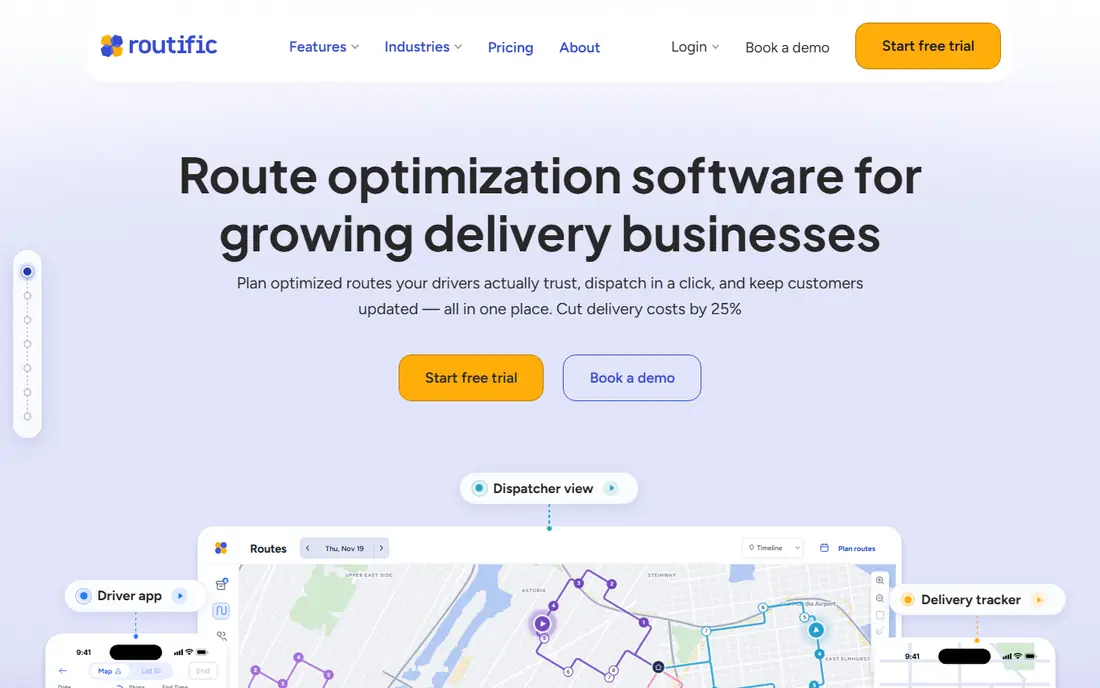
Routific focuses on the routing problem first and does it well for small fleets. Upload stops, set time windows and vehicle capacity, and the tool sequences routes that drivers can follow on a phone. It also captures photo and signature proof of delivery on every plan, including the free tier, which makes it a genuine starting point rather than a demo in disguise.
Small businesses, from bakeries to local couriers, can test it on real routes without paying, then move to a paid tier at up to 1,000 orders a month when volume grows. The limits matter: customer text updates are quoted separately, and there is no portal for business clients to track their own deliveries. For a team that mainly needs better routes, that trade is easy to accept.
- Free tier up to 100 orders a month
- Fast setup
- Unlimited drivers on paid plans
- SMS updates cost extra
- No client portal for shipper customers
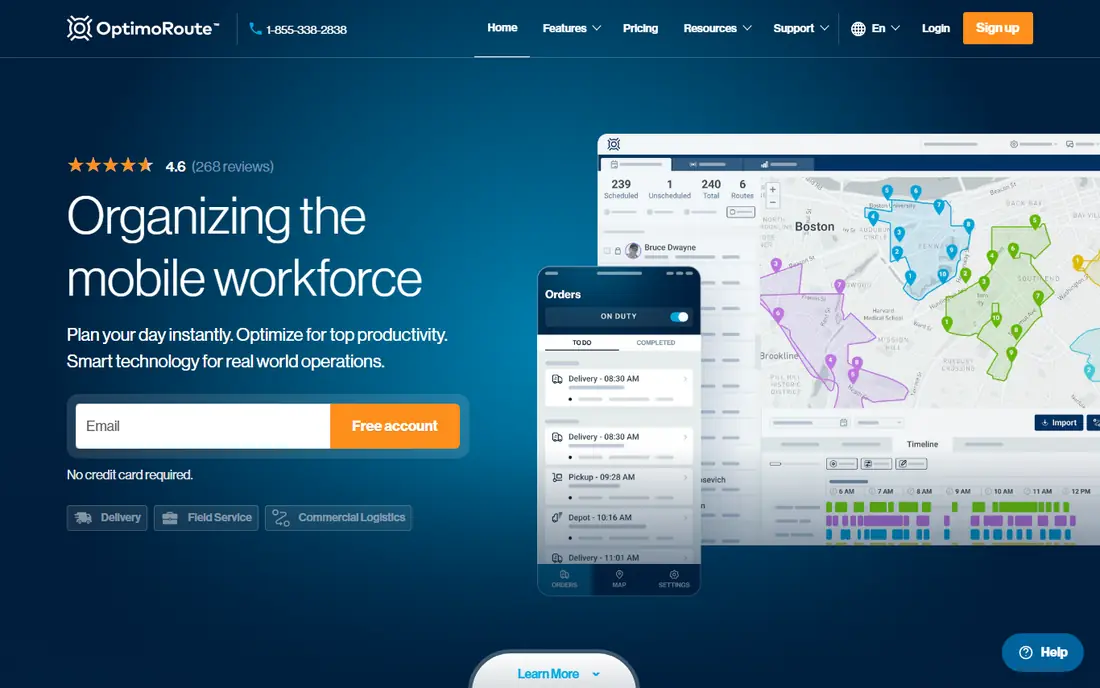
OptimoRoute suits route-heavy fleets that plan across days or weeks, not just one morning at a time. Dispatchers can build weekly schedules, balance workloads across drivers, and adjust routes when orders change. Drivers get sequenced stops with navigation, and dispatchers can see progress live and re-optimise when a job runs late.
Per-driver pricing, billed annually at the entry rate, makes budgeting simple when order counts rise but headcount stays flat. The honest catch is that signature, photo, and barcode proof of delivery only arrive on the Pro plan, so teams that need strong proof should price that tier, not the entry tier. For planning-first operations, though, the scheduling depth is the strongest reason to shortlist it.
- Weekly and multi-day planning
- Live tracking and re-optimisation
- Clear per-driver pricing
- Proof of delivery features need the Pro plan
- No client portal
Route4Me is the choice for teams whose routes have many constraints: time windows, vehicle capacity, driver territories, service times, and recurring schedules. Its planning engine handles those rules better than simpler tools, and driver apps run on phones and rugged Zebra devices used in field operations. An add-on marketplace extends it into territories, geofencing, and reporting.
The downside is pricing transparency. The vendor does not publish plan prices, so comparison requires a quote, and features such as text notifications and geofencing cost extra. Teams should ask for an all-in quote that includes the add-ons they actually need, and trial it on a real week of stops. If your routes are simple, a cheaper tool will do. If they are tangled, this depth earns its place.
- Deep multi-constraint routing
- Apps for iOS, Android, and Zebra devices
- Large add-on marketplace
- No published prices
- Notifications and geofencing are add-ons
Detrack is a strong pick for small courier teams moving from paper or spreadsheets to digital dispatch. The entry plan covers live driver tracking, proof of delivery with signatures, photos, location, and timestamps, plus branded customer notifications by SMS, email, or WhatsApp. Office users are unlimited, which helps small dispatch teams that share a screen.
Route optimisation sits on the Advanced tier at a higher per-vehicle rate, so teams that mainly need dispatch and proof can stay on the cheaper plan without paying for routing they will not use. That split is honest and useful. The limits are a missing client portal and simpler routing than the specialist tools, but at this price the value is hard to beat for a first system.
- Low per-driver price
- Signature and photo proof on all plans
- Branded tracking links
- Route optimisation needs the higher tier
- No client portal
Track-POD builds its whole pitch around proof of delivery, and it shows in the details. Dispatchers can design custom electronic proof templates, require PIN verification, and capture signatures and photos offline when drivers lose signal. That depth matters for fleets whose customers dispute deliveries or need strict records for invoicing and compliance.
The platform also covers route optimisation, live tracking, and analytics, so it works as a full last mile system rather than a proof add-on. Pricing starts higher than budget rivals, and a minimum driver count applies on some plans, so solo operators should check terms carefully. For fleets where proof quality protects revenue, the extra cost is easy to justify.
- Customisable proof-of-delivery templates
- Offline mode
- Deep analytics
- Higher starting price than Detrack
- Three-driver minimum on some plans
Spoke Dispatch is the successor to Circuit for Teams, rebranded in 2026 for courier companies. Its pricing model stands out: a monthly fee based on stops, with unlimited drivers, which suits courier firms that add drivers for peak work without adding licence costs. A client portal lets shipper customers track their deliveries, and proof of delivery covers signatures, photos, barcodes, timestamps, and geotags.
Live route editing, including adding stops mid-route, and SMS and email notifications on all plans make it a full courier platform rather than a route planner alone. The brand change may confuse buyers who knew Circuit, so confirm that existing guides and reviews refer to the same product. At very high stop volumes the per-stop bill still climbs, but for multi-client couriers the portal and driver model are genuine advantages.
- Per-stop pricing with unlimited drivers
- Client portal included
- Strong proof options
- Newer brand after the Circuit rebrand
- Per-stop costs rise at very high volumes
Shipday fits restaurants, grocers, and local retailers that need local delivery without building a courier operation from scratch. The free tier covers up to 300 orders a month, and paid plans add dispatch tools and integrations with ordering platforms. For a restaurant that already takes online orders, the path from order to driver assignment is short.
It also offers access to on-demand third-party drivers in some areas, which helps businesses that do not employ their own riders. The trade-off is scale and depth. Large fleets with complex routing, multi-depot work, or strict proof requirements will outgrow it, but as a first delivery tool for a food or retail business, the free tier makes it a low-risk trial.
- Free tier up to 300 orders a month
- On-demand driver options
- Quick setup
- Less suited to large fleets
- Advanced dispatch features are thinner
Bringg sits at the enterprise end of this list, and it solves a different problem from the route planners above. It orchestrates deliveries across owned fleets, third-party carriers, and gig drivers, applying business rules to choose the best fulfilment option for each order. Large retailers and logistics providers use it to manage complex networks, multiple warehouses, and high order volumes under one system.
That power comes with enterprise costs and implementation effort. Pricing is by quote, deployment takes weeks rather than days, and small teams will find most features unnecessary. Shortlist Bringg only when you run mixed fleets or multiple carriers and need one control layer over them all. For a single owned fleet, a cheaper tool on this list will serve you better and faster.
- Multi-carrier and multi-fleet orchestration
- Strong enterprise integrations
- Advanced automation
- Quote-only pricing
- Overkill and slow to deploy for small teams
How we picked these
We compared vendor pricing pages and recent independent comparisons of last mile tools, and we checked that each product still operates in 2026, including the Circuit to Spoke rebrand. We favoured tools with published prices where possible, and we marked quote-only tools clearly rather than repeating third-party estimates as vendor prices. The list mixes free starters, per-driver tools, per-task tools, and enterprise orchestration, so readers can match the billing model to their volume pattern.
How to choose the right billing model
Match the price meter to your volume pattern before you compare features. Per-order and per-task pricing suits small or seasonal teams, because the bill falls when orders fall. Per-driver pricing suits teams whose order counts grow faster than headcount, because the bill stays flat while each driver handles more stops. Flat monthly plans suit predictable operations with steady daily volumes.
Trial with real data, not a sample route. Upload a full week of stops with real addresses, time windows, and vehicle limits, then compare planned miles, on-time rates, and driver feedback. Check what counts as a billable driver, task, or stop, and ask what happens to pricing at peak volume. A tool that looks cheap at average volume can become expensive in your busiest month, and that month is the one that matters.
Frequently asked questions
What is the best software for last mile delivery?
There is no single winner, because the best tool depends on fleet size and volume pattern. Small teams should start with Routific or Shipday for free tiers, high-volume local fleets should trial Onfleet, and courier companies with many clients should look at Spoke Dispatch. Enterprise teams with mixed carriers should shortlist Bringg.
What is the best route optimisation software for small delivery teams?
Routific and OptimoRoute are strong starting points for small teams. Routific offers a free tier and simple setup, while OptimoRoute adds multi-day planning at a clear per-driver price. Teams that need strong proof of delivery should also compare Detrack and Track-POD, which price proof features differently.
How much does last mile delivery software cost?
Prices here run from free tiers up to $619 a month for Onfleet at entry volume, with per-driver tools between $29 and $49 a month. Enterprise platforms such as Bringg and Route4Me are quote-only, so budget planning needs a vendor conversation. Always confirm what counts as a billable driver, task, or order before comparing totals.
What happened to Circuit route planner?
Circuit rebranded to Spoke in 2026, and Circuit for Teams became Spoke Dispatch for courier companies. The free Spoke Route Planner for solo drivers continues the old Circuit planner with a limit on stops per route. Existing Circuit for Teams customers moved to the Spoke Dispatch platform, so older Circuit reviews should be read with that change in mind.
Do I need proof of delivery features?
Most delivery businesses do, because photo and signature proof settles disputes and protects invoicing. Track-POD and Detrack specialise in proof depth, while Onfleet, Routific, and Spoke Dispatch include proof on their plans. Check whether proof templates, offline capture, and storage limits match your customers requirements before choosing on routing alone.
Can last mile software integrate with my online store?
Most tools here integrate with Shopify, WooCommerce, or other ordering systems, either directly or through an API. Onfleet, Routific, Shipday, and Track-POD all list store integrations, while enterprise tools rely more on custom integrations. Test the integration with your real order flow during the trial, since a demo connection can hide problems with your product catalogue or order structure.
Sources
See where you really rank - block by block
ProMapRanker scans Google Maps across a grid of your service area. Simple monthly plans from $19, white-label on every plan.
Start freeKeep reading
 zscaler alternatives
Best Zscaler Alternatives in 2026
Looking for zscaler alternatives? We compare 9 SASE and zero trust platforms on architecture, data protection, pricing, and fit for your network and team.
Read → zapier alternatives free
Best Zapier Alternatives Free in 2026
Nine automation tools for zapier alternatives free in 2026, all with genuinely free tiers, plus free plan limits, starting prices and upgrade paths explained.
Read → which platform is best for online reputation
Which Platform Is Best for Online Reputation in 2026
Wondering which platform is best for online reputation? We compare 8 review, listing, and response tools for small and multi-location businesses and agencies.
Read →