 ProMapRanker
Best Kilimanjaro Tour Companies in 2026


Group departures with clear schedules · Pricing starts at: From $3,299 per person
Key takeaways
- Route length matters more than brand size, because extra days on the mountain give your body more time to adjust to altitude.
- Published trek prices usually exclude flights, visas, gear rental, insurance and crew tips, so budget for those items separately.
- Ask every company about guide training, oxygen and health checks, porter pay and load limits, and what is included in the quoted price.
- Group climbs cost less than private climbs, but private climbs give you control over pace, dates and group size.
- Book early for dry-season dates, and confirm the exact departure, inclusions and cancellation terms in writing before you pay a deposit.
Quick comparison
| Pick | Great for | Pricing starts at | Free tier | |
|---|---|---|---|---|
| Ultimate Kilimanjaro | Group departures with clear schedules | From $3,299 per person | No | Visit |
 Climbing Kilimanjaro | First-time climbers who want longer routes | From $2,890 per person | No | Visit |
 Altezza Travel | Large, locally based operations | From $2,557 per person | No | Visit |
 Thomson Safaris | Premium climbs with safari options | See website | No | Visit |
 Kandoo Adventures | Mid-market group climbs | See website | No | Visit |
 Follow Alice | Small groups with a clear ethics focus | See website | No | Visit |
 Tusker Trail | Guided climbs with Western guides | See website | No | Visit |
 Duma Explorer | Small private groups | From $2,399 per person | No | Visit |
 Intrepid Travel | Climbs combined with wider Tanzania trips | See website | No | Visit |
The best kilimanjaro tour companies
These companies all run guided Kilimanjaro climbs, but they differ in group size, route choice, service level and price. We compared official route pages, published prices and inclusions, and public safety and porter information.
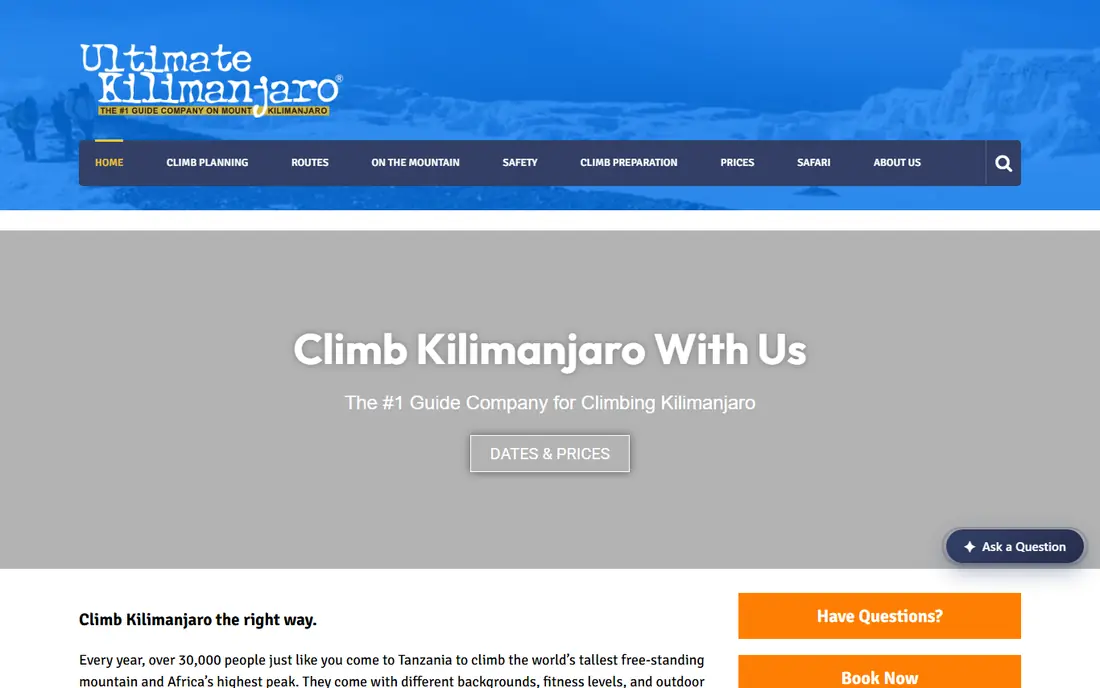
Ultimate Kilimanjaro suits climbers who want a fixed group date and a straightforward booking path. Its published 2026 group schedule has included an eight-day Lemosho climb at $3,299, which gives a useful starting point for budgeting, even though the final price depends on date and group type. The company covers the main routes, including Machame, Lemosho, Rongai and the Northern Circuit, so you can compare a shorter, busier route with a longer, quieter one.
The honest catch is that a group price is not the whole trip cost. Flights, visas, gear, insurance and tips sit outside most trek quotes, and private climbs cost more. Read the inclusions list closely, check hotel nights before and after the climb, and confirm whether airport transfers are included for your flight times.
- Published group departure prices
- Wide route choice
- Detailed route and preparation guides
- Group size can vary
- Premium and private options cost more than the headline group price
Climbing Kilimanjaro
Great for: First-time climbers who want longer routes
Climbing Kilimanjaro is a good first look if you are new to high altitude and want time on the mountain rather than the shortest possible trip. Its published material points to an eight-day Lemosho climb from $2,890, which sits in the mid-market band for a longer route. Longer routes do not guarantee a summit, but they give most climbers a better chance to adjust than a rushed five-day plan.
Before you book, ask about daily health checks, oxygen availability, guide-to-climber ratios and porter standards. Also confirm what happens if you need to descend early, and what costs that change creates. Those answers tell you more than a headline price.
- Strong focus on longer acclimatisation routes
- In-house guide training described on its site
- Wide departure choice
- Price varies a lot by route and group type
- Success claims should be read alongside route length and fitness
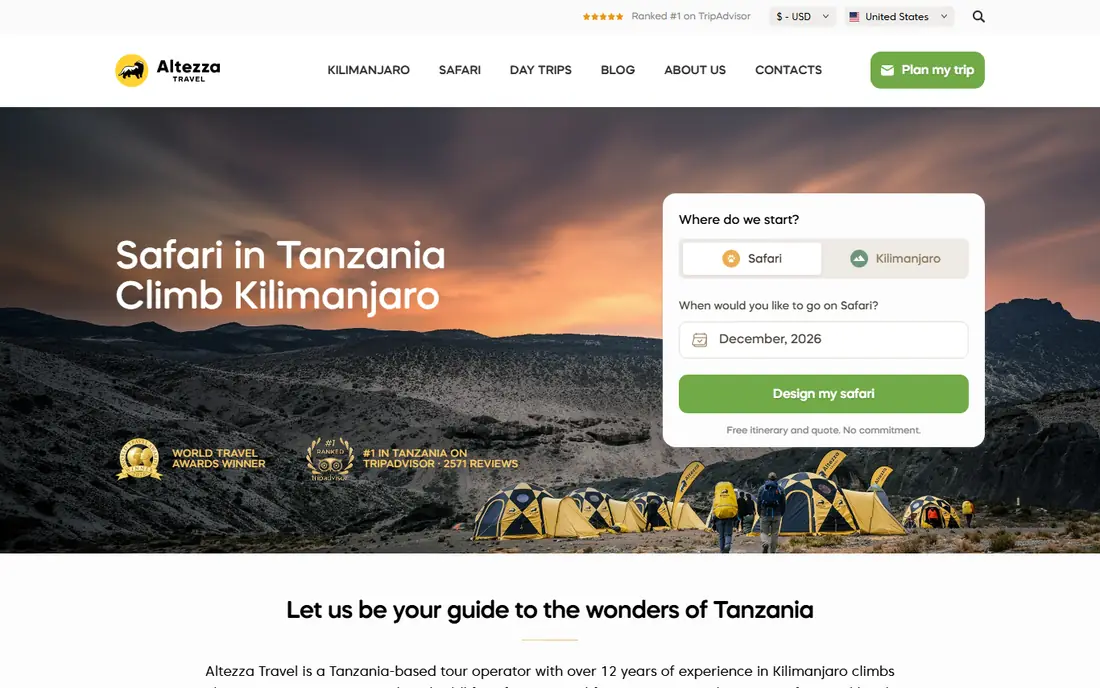
Altezza Travel is one of the largest Kilimanjaro operators, with a large local crew and a high volume of climbs each year. Its site has listed a standard seven-day Machame trek at $2,557, which makes it a useful price comparison for a popular route. If you want frequent departure dates and a well-practised operation, scale can work in your favour.
Scale also has a trade-off. Larger groups can mean a less personal pace, especially on busy routes and at busy camps. Ask for the expected group size on your date, not just the maximum, and check whether you can pay for a smaller or private group if pace matters to you.
- Large Tanzania-based team
- Frequent departures
- Its own hotels in the Kilimanjaro region
- Larger groups are common
- The cheapest route may not be the best route for acclimatisation
Thomson Safaris fits climbers who want a premium, fully supported trip and who may want to add a safari before or after the climb. Its trips tend to sit at the higher end of the price range, with published comparison material placing its climbs in a premium band. That premium buys planning support, established logistics and a more complete package, but it is not the right choice if price is your main filter.
Get a dated, itemised quote and compare it line by line with a mid-market operator. Check hotel nights, transfers, park fees, meals, gear and tips, because two quotes can look far apart until you see what each one includes.
- Long-established US-based operator
- Safari and climb combinations
- Detailed trip planning support
- Premium pricing
- Kilimanjaro-only pricing is harder to compare without a dated quote
Kandoo Adventures is a solid mid-market choice for climbers who want a guided group climb without paying a luxury price. Published comparison material has placed its seven-day climbs in a mid-market band, which puts it in the same conversation as several other established operators. The company runs the main routes, so route choice, rather than brand alone, should drive your decision.
Ask about guide qualifications, safety equipment and the crew welfare policy on your specific climb. Also confirm the deposit, balance and cancellation terms, since those terms vary and matter more once you have booked flights.
- Clear mid-market positioning
- Group and private options
- Experienced Kilimanjaro focus
- Prices vary by route and season
- Group size can reach about 12 on some departures
Follow Alice appeals to climbers who care about how a climb is run, not just whether they reach the summit. Its material stresses fair treatment of crew and a smaller group feel, with published comparison material placing its seven-day climbs in a mid to upper mid-market band. If you want a company that talks openly about porter standards, this is a good operator to question closely.
Do not take ethics claims at face value. Ask whether the company is on the current Partner for Responsible Travel roster, how porter loads are checked, and what crew are paid. A good operator will answer those questions directly.
- Ethics and porter welfare messaging
- Smaller group focus
- Strong storytelling and trip detail
- Prices sit in the mid to upper mid-market band
- Availability on popular dates can be limited
Tusker Trail suits climbers who want a Western guide leading the climb alongside local guides, and who are willing to pay more for that model. Its positioning is premium rather than budget, and its groups tend to be smaller than those of high-volume operators. That combination can suit first-time climbers who want extra reassurance and a steady, managed pace.
The trade-off is price and route flexibility. Compare Tusker Trail with a reputable local operator on the same route length, and weigh whether guide leadership, group size and inclusions justify the difference for you.
- Western guide leadership on many climbs
- Strong safety messaging
- Smaller group positioning
- Premium pricing
- Fewer budget options than large local operators
Duma Explorer is worth a close look if you want a small group and direct contact with the people running your climb. Its own comparison material lists a seven-day price band from $2,399 to $2,999 per person, with a maximum of eight climbers. That size keeps the pace more personal than a large group climb, and the company stresses porter standards and guide training.
A smaller operator may have fewer fixed dates, so flexibility helps. Confirm your route, group size, guide team and inclusions in writing, and check current responsible-travel partner status rather than relying on older claims.
- Maximum group size of 8 on its climbs
- Founding partner history in responsible travel
- Owner-accessible operation
- Smaller operator with fewer departure dates
- Price band still varies by route and season
Intrepid Travel fits travellers who want Kilimanjaro as part of a wider Tanzania trip, rather than a climb-only booking. Its scale brings clear booking systems, customer support and a range of trip styles, which can help if you are combining a climb with a safari or a longer holiday. The climb itself is still a guided group trek, so the same route and safety questions apply.
Check the exact itinerary, group size, inclusions and fitness guidance for the departure you choose. A general brand reputation does not replace a route-specific check, especially on acclimatisation time and what happens if weather or health forces a change of plan.
- Large, well-known travel company
- Kilimanjaro climbs can pair with safaris and cultural trips
- Clear booking terms
- Climbing is one product among many
- Group composition and pace vary by departure
How we picked these
We compared official route and pricing pages, published price bands for comparable routes, and public information on guide training, group size and porter standards. We left out operators with no clear Kilimanjaro programme, no published route detail, or prices that looked too low to cover park fees and fair crew pay. Prices change by season, group size and route, so we used published starting points where we found them and wrote See website where a dated quote is the only fair comparison.
What to check before you book a Kilimanjaro climb
Route first, brand second
Choose route length before you choose a company. Lemosho and the Northern Circuit give more acclimatisation time than a short Marangu or Machame plan, and that time is often worth the extra cost. A scenic route also spreads camps differently, so ask about daily walking times and altitude gains, not just total days.
Safety questions to ask in writing
Ask who leads the climb, what first-aid training guides hold, how often health checks happen, and what oxygen and evacuation cover is carried. Ask what happens if you must descend, who pays for extra costs, and whether your travel insurance covers high-altitude trekking and evacuation. Get the answers in writing.
The full budget, not just the trek price
Add flights, visa fees, vaccinations and travel medicine, insurance, gear rental or purchase, extra hotel nights, transfers outside the package, and crew tips. Tips alone often run to several hundred dollars per climber for a week-long trek. A cheap trek quote can become an expensive trip once those items are added.
Porter and crew standards
Ask about porter load limits, pay, food, shelter and gear, and whether an independent body monitors the climb. Responsible-travel partner status should be checked on the current roster, not assumed from an old badge. If a company will not answer, treat that as useful information.
Frequently asked questions
What is the best company to climb Kilimanjaro?
There is no single best company for every climber, because the right choice depends on route, group size, budget and service level. For a first climb, we would start with a longer route from a company that publishes its inclusions, safety cover and group size clearly. Compare at least three dated quotes on the same route length before you decide.
How much does a Kilimanjaro climb cost?
Most reputable seven to eight-day climbs fall in a broad mid-market band, with premium and private climbs costing more. Park fees, crew pay, food, camping gear and transfers make up a large share of the price, which is why very cheap quotes deserve careful checking. Add flights, insurance, gear and tips to the trek price for a realistic total.
Which Kilimanjaro route is best for beginners?
Lemosho is a strong beginner choice because it is scenic and gives good acclimatisation time over seven or eight days. Machame is popular and also works well over seven days, while Marangu is shorter and uses huts, but its faster pace gives less adjustment time. Talk to the operator about your fitness and any prior altitude experience before you pick.
When is the best time to climb Kilimanjaro?
The dry seasons, roughly January to March and June to October, are the most popular times for clear skies and drier trails. Those months also book up early and cost more on some departures. The rainy seasons can still work, but trails are muddier and views are less reliable, so check route conditions for your dates.
Do I need to be very fit to climb Kilimanjaro?
You need good general fitness, steady walking stamina and preparation for long days at altitude, but you do not need technical climbing skills on the main routes. Train with loaded walks, hills and back-to-back walking days, and discuss any health conditions with a clinician before you book. Altitude affects fit climbers too, so pace and acclimatisation matter as much as fitness.
How far ahead should I book?
Book several months ahead for dry-season dates, especially if you want a small group or a private climb. Early booking also gives you time to train, sort gear, arrange insurance and confirm flights. If your dates are flexible, ask about shoulder-season departures, which can cost less and feel quieter on the trail.
Sources
- https://www.dumaexplorer.com/blog/best-kilimanjaro-tour-operators
- https://www.africatouroperators.org/tanzania/kilimanjaro-trekking-tanzania/
- https://www.altezzatravel.com/articles/best-kilimanjaro-tour-operators
- https://www.thomsonsafaris.com
- https://www.kandooadventures.com
- https://www.followalice.com
- https://www.tuskertrail.com
- https://www.intrepidtravel.com
- https://www.ultimatekilimanjaro.com
- https://www.climbingkilimanjaro.com
See where you really rank - block by block
ProMapRanker scans Google Maps across a grid of your service area. Simple monthly plans from $19, white-label on every plan.
Start freeKeep reading
 zscaler alternatives
Best Zscaler Alternatives in 2026
Looking for zscaler alternatives? We compare 9 SASE and zero trust platforms on architecture, data protection, pricing, and fit for your network and team.
Read → zapier alternatives free
Best Zapier Alternatives Free in 2026
Nine automation tools for zapier alternatives free in 2026, all with genuinely free tiers, plus free plan limits, starting prices and upgrade paths explained.
Read → which platform is best for online reputation
Which Platform Is Best for Online Reputation in 2026
Wondering which platform is best for online reputation? We compare 8 review, listing, and response tools for small and multi-location businesses and agencies.
Read →