 ProMapRanker
Best Keyword Tracking Software for SEO Agencies in 2026


Agencies that want value across many client projects · Pricing starts at: See website
Key takeaways
- For agencies, keyword limits, seats and white-label reporting matter more than a low entry price, because those costs repeat for every client.
- SE Ranking offers strong value for multi-client tracking, while AccuRanker leads on refresh speed and large keyword sets.
- Semrush and Ahrefs cost more, but they add research, audits and backlink data that a pure tracker does not include.
- AI search visibility, including AI Overviews and chatbot answers, is now a real tracking need, so check it before you renew.
Quick comparison
| Pick | Great for | Pricing starts at | Free tier | |
|---|---|---|---|---|
| SE Ranking | Agencies that want value across many client projects | See website | Free trial | Visit |
 AccuRanker | Agencies that need fast, on-demand rank data at volume | See website | Free trial | Visit |
 Semrush | Agencies that want tracking inside a full SEO suite | See website | Free trial | Visit |
 Ahrefs | Agencies that already use Ahrefs for research and backlinks | See website | No | Visit |
 Moz Pro | Smaller agencies that want a friendly, complete suite | See website | Free trial | Visit |
 Mangools | Small agencies and freelancers that want a low-cost suite | See website | Free trial | Visit |
 Wincher | Small agencies that want simple daily tracking across many sites | See website | Free trial | Visit |
 Nightwatch | Agencies that need local and AI search tracking | See website | Free trial | Visit |
 Advanced Web Ranking | Agencies tracking thousands of keywords with unlimited seats | See website | Free trial | Visit |
The best keyword tracking software for seo agencies
Keyword tracking software for agencies must handle many clients, many locations and many keywords without turning reporting into a weekly chore. It should track desktop and mobile rankings, local results where relevant, SERP features, and increasingly AI search visibility. We compared official pricing pages as reported in October 2026 comparisons, plus vendor feature pages, for the tools below.
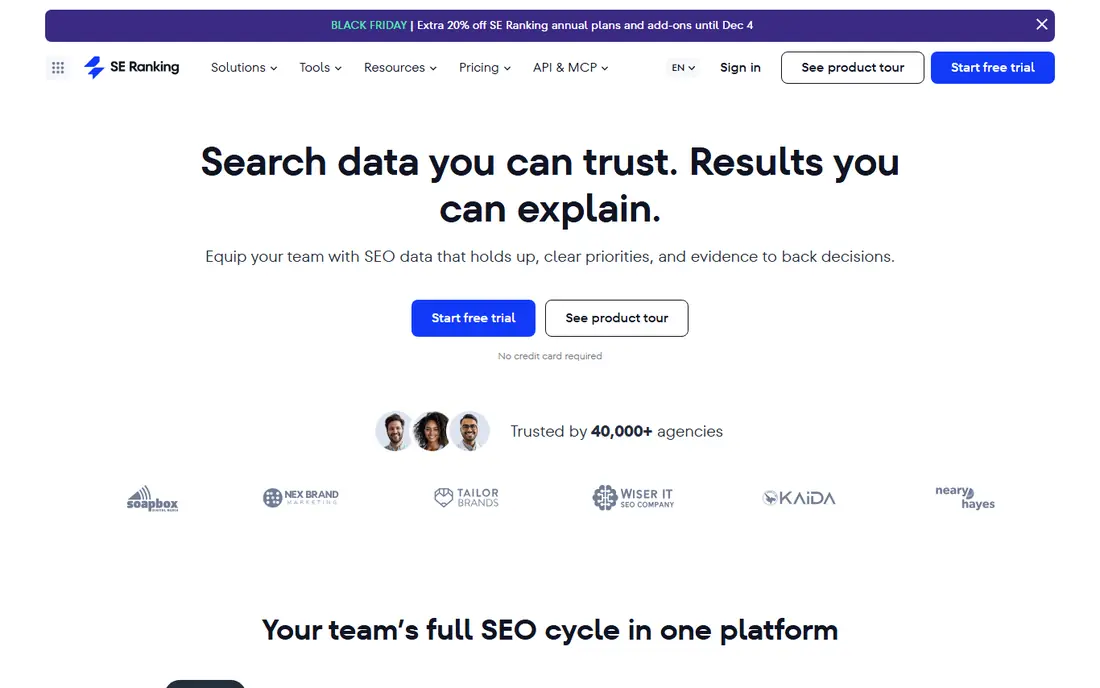
SE Ranking is the value pick for most agencies in this list. Its plans combine rank tracking with site audits, keyword research and backlink checks, and its agency add-on covers white-label reports, which is essential when clients expect branded dashboards. Public October 2026 comparisons put its Core plan at a lower cost than comparable Semrush and Ahrefs tiers for a similar or larger keyword allowance.
The limit is tiering. As client counts grow, keyword limits and seat costs push agencies to higher plans, so model your total keywords across all clients before you choose a tier. For a small to midsize agency that wants one suite for most client work, SE Ranking is hard to beat on value.
- Strong keyword value per dollar in public comparisons
- White-label reporting options
- Audits and research in the same suite
- Entry plans limit keywords, so growing agencies must step up tiers
- Some advanced features need higher plans
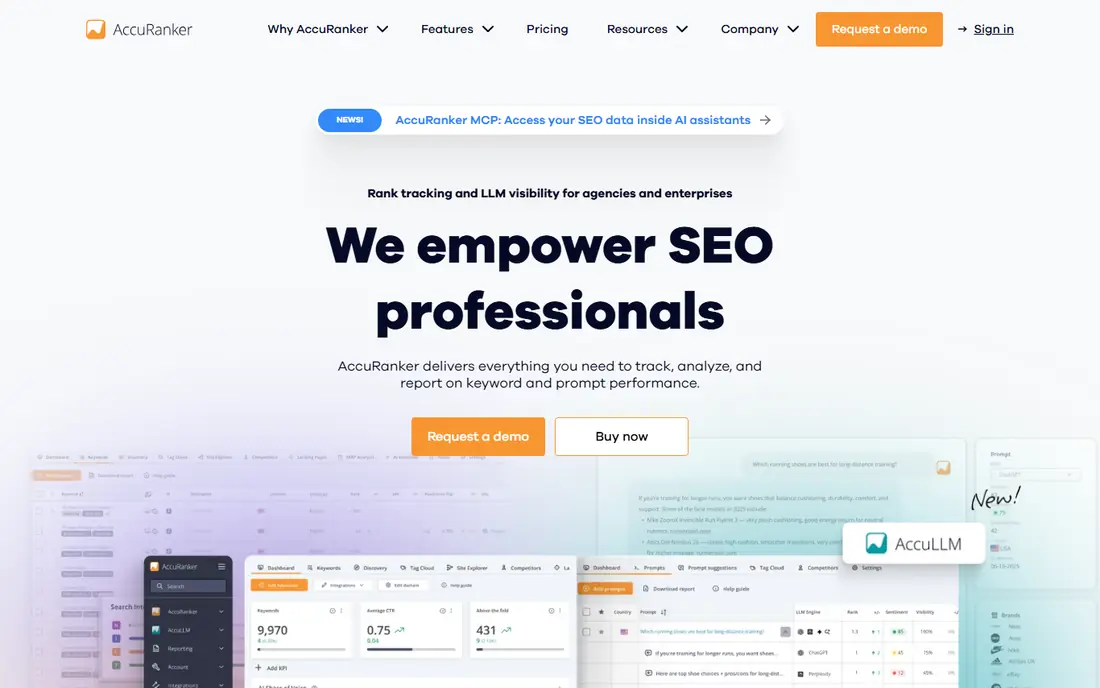
AccuRanker is built for agencies where rank data speed and accuracy are the job. It refreshes rankings on demand rather than only on a daily schedule, which helps when a client launches a page and wants to see movement the same day. Tagging, segmentation and API access help large agencies organize thousands of keywords by client, location and intent.
The trade-off is price and scope. AccuRanker costs more at entry than SE Ranking, and it is a tracker first, not a full research suite. Agencies that also need deep keyword research and audits will pair it with another tool, or choose a suite instead. For tracking-led agencies, its speed justifies the cost.
- On-demand rank refreshes
- Strong API and tagging for large keyword sets
- Unlimited users in vendor descriptions
- Higher entry price than SE Ranking
- Tracking-first, so research tools are thinner

Semrush suits agencies that want one login for research, audits, tracking and reporting. Its Position Tracking tool covers daily rankings, SERP features and local tracking, while the wider suite adds keyword research, site audits, backlink analysis and competitive intelligence. White-label reporting, including paid report options in public comparisons, helps agencies present results under their own brand.
Cost is the honest catch. Semrush entry pricing is higher than a pure tracker, and extra users add cost, so a growing agency should model seats and projects together. If your agency already sells research and audits alongside tracking, Semrush consolidates that work well.
- Position tracking plus research, audits and competitive data
- White-label report options
- Large keyword database
- Higher cost as seats and projects grow
- Interface can feel large for tracking-only users
Ahrefs is the natural choice for agencies whose work centers on backlinks, content gaps and keyword research. Its Rank Tracker sits inside that suite, so a team can move from a ranking drop to the pages, links and competitors behind it without switching tools. That workflow is valuable for agencies that sell content and link building alongside tracking.
The limit for tracking-only buyers is update frequency. Public comparisons note weekly updates on standard Ahrefs plans, while SE Ranking, Semrush and AccuRanker offer daily tracking. If clients expect daily rank reports, check the plan tier carefully, and consider a dedicated tracker for daily data.
- Deep keyword and backlink data
- Rank tracker inside a respected suite
- Useful for content and link work
- Rank updates are weekly on standard plans in public comparisons
- Extra users cost more
Moz Pro suits smaller agencies and in-house teams that want a complete, friendly suite without a steep learning curve. It covers rank tracking, keyword research, site audits and link data in one place, with reporting that clients can understand without SEO training. For a team moving from free tools to its first paid suite, Moz Pro is an easy step.
The catch is scale. Entry keyword allowances are smaller than SE Ranking or AccuRanker in public comparisons, so an agency with many clients may outgrow the entry tier fast. Price the tier that covers your total tracked keywords, not the tier that looks cheapest on the pricing page.
- Approachable interface for newer SEO teams
- Rank tracking plus research and audits
- Clear reporting
- Smaller keyword allowance at entry than some rivals
- Less agency white-label depth than SE Ranking
Mangools, through SERPWatcher, is the lowest-cost suite on this list, which makes it a good fit for freelancers and very small agencies. Its tools are simple to learn, its reports are clean, and its price leaves room for other tools in the stack. For a solo consultant tracking a handful of clients, that simplicity matters more than enterprise features.
The limit is tracking frequency and scale. Basic plans track weekly in public comparisons, with daily tracking on higher agency tiers, and keyword limits are smaller than AccuRanker or SE Ranking. If clients expect daily updates or you track thousands of keywords, Mangools will feel tight.
- Low entry cost in public comparisons
- Simple interface
- SERPWatcher for rank tracking plus research tools
- Weekly tracking on basic plans in public comparisons
- Smaller keyword limits than agency trackers
Wincher
Great for: Small agencies that want simple daily tracking across many sites
Wincher is a focused tracker that does one job well: daily rankings across many websites, without suite bloat. Small agencies like its simplicity, because adding a site and a keyword set takes minutes, and reports are easy to share with clients. It suits teams that already have research tools elsewhere and only need reliable tracking.
The trade-off is breadth. Wincher does not replace a full SEO suite, so agencies that need audits, content research and backlink data will need another tool. For tracking-led work with many small clients, Wincher is a clean, affordable choice.
- Simple daily tracking
- Unlimited websites on entry descriptions
- Clear, focused reports
- Tracking-focused, so research and audit tools are thinner
- AI tracking varies by plan
Nightwatch suits agencies with local clients, because it tracks rankings by location, including ZIP-level data in vendor descriptions, alongside classic desktop and mobile results. It also covers AI search visibility, which matters as more users get answers from AI Overviews and chatbots. Unlimited seats in vendor descriptions help agencies where many staff need access.
Pricing needs care, because Nightwatch lists some plans in euros and tiers vary by keyword count. Confirm the currency, keyword allowance and AI tracking included in your plan before you compare it with dollar-priced rivals. For local and AI tracking, Nightwatch earns its place.
- Local tracking down to ZIP level in vendor descriptions
- AI search tracking
- Unlimited seats in vendor descriptions
- Pricing varies and is listed in euros on some plans
- Smaller research suite than Semrush or Ahrefs
Advanced Web Ranking
Great for: Agencies tracking thousands of keywords with unlimited seats
Advanced Web Ranking is built for scale. Public comparisons put its entry plan at thousands of keyword units, with unlimited seats, which suits agencies that track large keyword sets across many clients and locations. Flexible update schedules let an agency choose daily tracking for priority keywords and weekly tracking for the rest, which controls cost.
The interface is the main complaint, with some users finding it less modern than SE Ranking or Semrush. That matters less if your team values data exports, white-label reports and API access over polish. For high-volume tracking, Advanced Web Ranking remains a strong, often overlooked option.
- Large keyword capacity in public comparisons
- Unlimited seats
- Flexible daily, weekly or on-demand updates
- Interface feels dated to some users
- Research tools are thinner than full suites
How we picked these
We compared official pricing pages as reported in October 2026 comparisons, vendor feature pages and public reviews for rank trackers that serve agencies. We favored tools with multi-client support, location tracking, reporting or API options, and we wrote See website where pricing varies by tier, currency or plan, rather than repeating a single figure that may not match your keyword count. We did not list our own site tool in this article, as the topic requires independent options.
What to check before you buy keyword tracking software
Count keywords the way the vendor counts them, because desktop plus mobile plus multiple locations can multiply one keyword into several tracked units. Then check white-label reporting, seat costs and API access, since those three items decide whether a tracker scales with your agency or becomes a bottleneck. Run a trial with two real clients, including one local client, before you migrate a full book of business.
Classic rankings, local results and AI visibility
Confirm that your tracker covers classic rankings, local pack results and AI surfaces your clients care about, and that reports separate those results clearly. A tracker that mixes AI citations with classic positions in one number will confuse clients, so ask for a sample report before you buy.
Frequently asked questions
What is the best keyword tracking software for a small SEO agency?
SE Ranking is a strong default for small agencies, because it combines tracking, audits and research at a lower cost than Semrush or Ahrefs. Wincher and Mangools suit even smaller teams, while AccuRanker suits agencies that need fast, high-volume tracking.
How many keywords do agencies need to track?
It depends on client count, locations and services. A small agency may track 500 to 2,000 keywords in total, while a larger agency can track tens of thousands once locations and devices are counted. Count desktop, mobile and local variants separately when you compare plans.
Do agencies need daily rank tracking?
Daily tracking helps for active campaigns, local clients and pages that change often. Weekly tracking can be enough for stable, long-term clients, but most agencies prefer daily data so they can spot drops early and explain them to clients.
What is white-label reporting, and why does it matter?
White-label reporting lets an agency present rank reports under its own brand, with its own logo and domain, instead of the software vendor brand. Clients see your agency as the source of insight, which helps retention and perceived value.
Should agencies track AI search results too?
Yes, if your clients get traffic or leads from AI Overviews, AI Mode or chatbots. Tools such as SE Ranking, Nightwatch and AccuRanker now cover AI surfaces, but coverage varies by plan, so confirm which AI engines and result types are included.
Sources
See where you really rank - block by block
ProMapRanker scans Google Maps across a grid of your service area. Simple monthly plans from $19, white-label on every plan.
Start freeKeep reading
 zscaler alternatives
Best Zscaler Alternatives in 2026
Looking for zscaler alternatives? We compare 9 SASE and zero trust platforms on architecture, data protection, pricing, and fit for your network and team.
Read → zapier alternatives free
Best Zapier Alternatives Free in 2026
Nine automation tools for zapier alternatives free in 2026, all with genuinely free tiers, plus free plan limits, starting prices and upgrade paths explained.
Read → which platform is best for online reputation
Which Platform Is Best for Online Reputation in 2026
Wondering which platform is best for online reputation? We compare 8 review, listing, and response tools for small and multi-location businesses and agencies.
Read →