 ProMapRanker
Best ITDR Tools in 2026: 9 Tools Compared


CrowdStrike customers · Pricing starts at: See website
Key takeaways
- ITDR is not the same as identity management: it detects attacks on accounts that are already in use.
- The best tool often follows your existing platform, with Defender for Microsoft shops and Falcon Identity for CrowdStrike shops.
- Silverfort, Semperis, and Huntress suit mixed environments where no single vendor covers every identity system.
- Pricing is almost always quote based, so pilot on your real directory before judging detection quality.
Quick comparison
| Pick | Great for | Pricing starts at | Free tier | |
|---|---|---|---|---|
| CrowdStrike Falcon Identity Protection | CrowdStrike customers | See website | Free trial | Visit |
 Microsoft Defender for Identity | Microsoft identity estates | See website | Free trial | Visit |
 SentinelOne Singularity Identity | Deception led defense | See website | Free trial | Visit |
 Silverfort | Legacy and mixed identity | See website | Free trial | Visit |
 Semperis | Active Directory resilience | See website | Free trial | Visit |
 Okta Identity Threat Protection | Okta centered workforces | See website | Free trial | Visit |
 Huntress Managed ITDR | Small teams and MSPs | $4.80 per identity per month | Free trial | Visit |
 Proofpoint Identity Threat Defense | Attack path cleanup | See website | Free trial | Visit |
 CyberArk | Privileged identity defense | See website | Free trial | Visit |
The best ITDR tools
Identity threat detection and response tools watch for stolen credentials, session theft, privilege escalation, and lateral movement, then help teams contain the attack.
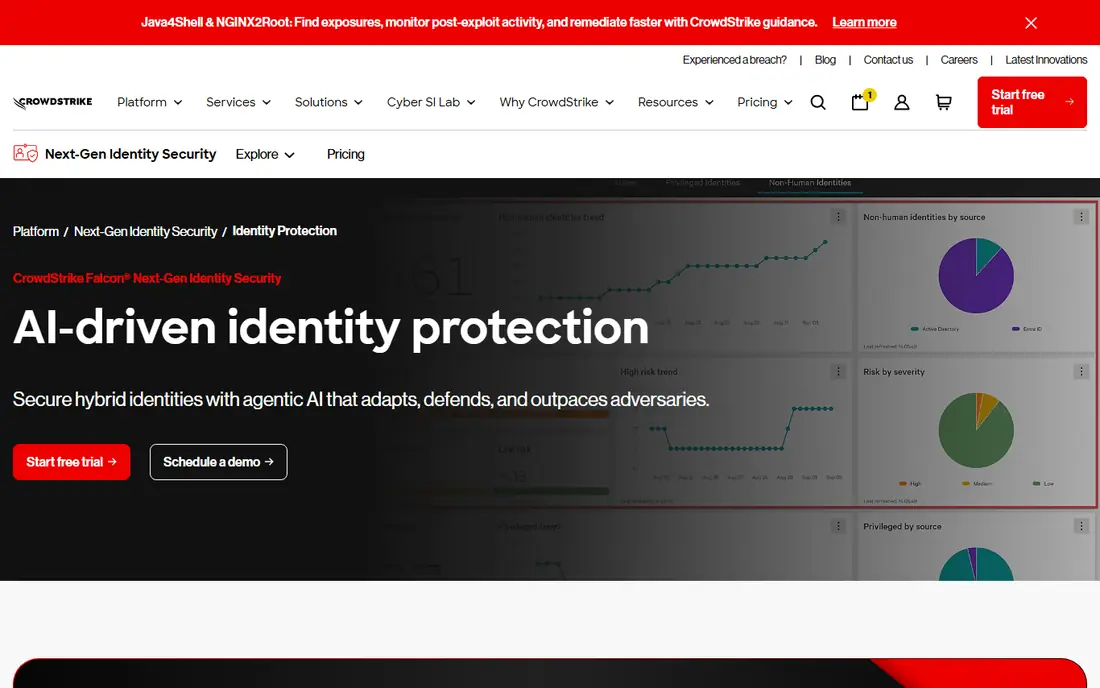
CrowdStrike Falcon Identity Protection suits companies already running Falcon on endpoints, since identity signals join endpoint telemetry in one console. It watches Active Directory, cloud identity, and related accounts for credential abuse, privilege escalation, and lateral movement, and it can trigger containment actions tied to the affected host or user. That combined view helps a security operations team see an identity attack as part of a wider incident, not as an isolated alert.
The limit is platform fit and price. Companies without Falcon get less benefit, and the identity module is priced by quote, so a standalone comparison with a pure ITDR vendor needs careful scoping. For a Falcon shop with a mixed identity estate, it is the most natural first choice, and it avoids adding another console to an already busy operations workflow.
- Identity plus endpoint signals in one console
- Real-time risk scoring
- Broad directory coverage
- Best value inside Falcon
- Module pricing needs a quote
Microsoft Defender for Identity is the default answer for organizations built on Active Directory and Entra ID. Sensors on domain controllers collect detailed authentication signals, and the tool detects known attack techniques such as pass-the-hash, Kerberoasting, and suspicious lateral movement. Findings flow into Defender XDR, where identity alerts can be investigated beside endpoint and email signals.
Licensing is tied to Microsoft plans, and it is often included in higher Microsoft 365 or security bundles, which makes the marginal cost low for existing customers. The trade is breadth: teams with large Okta, Google, or cloud-only estates may need another tool beside it. For a Microsoft centered company, start here and only add a second tool if a gap shows up in a pilot.
- Deep Active Directory and Entra ID telemetry
- Defender XDR integration
- Familiar Microsoft licensing
- Deepest for Microsoft directories
- Non-Microsoft identity coverage is thinner

SentinelOne Singularity Identity takes a deception led approach, planting decoy credentials and lures that attackers touch when they try to move through a network. When a decoy is used, the team gets a high confidence alert, which helps lean teams avoid chasing low quality signals. It also protects real credentials on endpoints and works beside Singularity endpoint detection.
As with other platform modules, the strongest case is for existing SentinelOne customers, and pricing is quote based. Companies that do not run Singularity should compare the standalone value carefully against Silverfort or Semperis. For a SentinelOne shop defending a legacy Active Directory estate, the deception angle can cut alert fatigue in a useful way.
- Deception decoys for credential theft
- Endpoint credential defense
- Low noise approach
- Best inside Singularity
- Identity module pricing needs a quote
Silverfort suits companies with a messy identity estate, including legacy systems that cannot support modern multi-factor authentication on their own. Its agentless approach applies authentication and access policies across Active Directory, cloud directories, and on-premises resources, including service accounts and command line access that many tools miss. That breadth makes it a strong unified platform for hybrid networks.
Deployment in a complex estate needs planning, since policy changes can affect logins if they are rolled out too fast. Pricing is quote based, so scope the number of users, service accounts, and resources before comparing costs. For a company that cannot simply replace old systems, Silverfort offers protection that a directory native tool alone cannot provide.
- Agentless protection across directories
- MFA on legacy systems
- Service account coverage
- Quote based pricing
- Deployment planning matters for complex estates
Semperis stands out for Active Directory resilience, not just detection. Directory Services Protector tracks changes, flags suspicious activity, and helps teams roll back harmful changes, while its recovery tools can restore a forest after a serious attack. That recovery depth is rare, and it matters because directory damage can shut down logins across a whole company.
The scope is directory centered, so companies with mainly cloud or SaaS identities will need other coverage beside it. Pricing is quote based and enterprise oriented. For an organization where Active Directory remains the core identity system, Semperis offers a safety net that detection-only tools do not match.
- Attack detection plus forest recovery
- Change tracking and rollback
- Directory focus
- Directory centered scope
- Quote based pricing
Okta Identity Threat Protection watches risk signals inside Okta sessions and can step up authentication or revoke a session when risk rises. That session level response matters for token theft and session hijacking, where a stolen session can bypass a normal login check. It ties closely to Okta's identity, access, and governance tools, giving Okta customers a coherent workflow.
The obvious limit is fit. Companies that sign in mainly through Entra ID or another provider will get less value, and Active Directory coverage depends on how Okta connects to that directory. For an Okta centered workforce, it is the natural ITDR layer. For a mixed estate, pair it with a broader tool or choose a platform neutral option.
- Continuous risk inside Okta sessions
- Session revocation
- Okta ecosystem links
- Best for Okta customers
- Active Directory depth depends on integration
Huntress Managed ITDR suits small businesses and managed service providers that lack a security team watching alerts around the clock. A human team monitors Microsoft 365 identities for suspicious sign-ins, privilege changes, and attack patterns, and it can guide response when something looks wrong. The list price of $4.80 per identity per month gives small buyers a rare clear number in a quote heavy market.
Enterprise security teams may want deeper control, custom detection rules, and wider directory coverage than a managed service offers. For a small company, though, managed monitoring is often more useful than a powerful console nobody watches. If your team cannot staff identity monitoring, Huntress turns ITDR from a tool purchase into a service.
- Managed monitoring by a human team
- Published per identity price
- Suits Microsoft 365
- Managed scope is narrower than enterprise platforms
- Less control for large SOC teams
Proofpoint Identity Threat Defense, built from the Illusive line, focuses on removing the paths attackers use before an attack starts. It discovers exposed credentials, stale privileges, and misconfigurations that create attack paths, and it plants decoys that reveal an intruder who tries to use them. That combination of cleanup plus deception suits enterprises that want to reduce identity risk, not just alert on it.
Pricing and access are enterprise oriented, so small teams should expect a sales process rather than a quick signup. The platform also works best when a team commits to the cleanup work it recommends, since findings without fixes do not reduce risk. For a larger company with a sprawling directory, Proofpoint offers a practical way to shrink the attack surface.
- Attack path discovery and cleanup
- Deception decoys
- Credential exposure removal
- Quote based pricing
- Enterprise sales process
CyberArk suits companies where privileged accounts are the main risk, including admin accounts, service accounts, and cloud credentials with wide access. Its identity security platform covers vaulting, session management, privilege controls, and threat detection for those high value accounts, and it integrates with wider security operations workflows. For regulated companies, that privileged focus aligns well with audit and compliance needs.
The breadth can also be a drawback. CyberArk is a suite, not a single narrow tool, and scoping the right modules takes time. Smaller teams may find a simpler ITDR tool faster to run. For a company that must protect privileged access first and prove it to auditors, CyberArk remains a leading choice, and its ITDR features sit naturally beside its vaulting strengths.
- Strong privileged access controls
- Session protection
- Broad identity security suite
- Broad suite can be complex
- Pricing needs scoping by module
How we picked these
We compared official product pages, vendor documentation, and 2026 ITDR guides, and we focused on tools that detect and respond to identity attacks in October 2026. We mixed platform modules, standalone vendors, directory specialists, and a managed service, so readers can match a tool to their existing stack and team size. We used published pricing only where a vendor lists it, and we marked other tools as quote based rather than inventing prices.
What to check before you buy
Start by mapping your identity estate: Active Directory, Entra ID, Okta, Google, cloud providers, and SaaS apps, plus service accounts and legacy systems. Remove any tool that cannot see the identities you actually use. Then pilot on a real directory with real attack simulations, such as a suspicious sign-in, a privilege change, and a session token reuse, and judge alert quality and response speed.
Next, check response actions, not just detection. Can the tool revoke a session, force re-authentication, disable an account, or isolate a host, and who approves that action? Confirm logging, ticketing, and audit exports, and ask how long deployment takes for your directory size. Finally, agree on who watches alerts at night and on weekends, since an identity alert that waits until Monday may already be too late.
Frequently asked questions
What is an ITDR tool?
An identity threat detection and response tool detects attacks on identities that are already in use, such as stolen passwords, session theft, privilege escalation, and lateral movement. It differs from identity management, which creates and governs accounts in the first place.
What is the best ITDR platform?
The best choice usually follows your existing stack: Defender for Identity for Microsoft shops, Falcon Identity Protection for CrowdStrike shops, and Singularity Identity for SentinelOne shops. Standalone options like Silverfort, Semperis, and Huntress suit mixed or smaller environments.
How much do ITDR tools cost?
Most enterprise ITDR tools are quote based, priced by users, identities, or modules. Huntress lists $4.80 per identity per month, while other vendors require a scoped quote, so compare total cost for your identity count, not just a headline rate.
Do small businesses need ITDR?
Small businesses with cloud email and SaaS apps face credential theft and session attacks too, but they may not need an enterprise platform. A managed service like Huntress, or the identity features inside a Microsoft 365 plan, can give useful coverage without a dedicated security team.
Can ITDR replace multi-factor authentication?
No, ITDR complements multi-factor authentication, it does not replace it. Strong authentication reduces account takeover risk, while ITDR catches attacks that bypass or abuse a valid login, such as session theft and privilege misuse.
How is ITDR different from EDR?
Endpoint detection and response watches devices for malware and suspicious process activity, while ITDR watches identities, sessions, and directory activity. The two work best together, since an identity attack often shows up on both an account and a host.
Sources
- https://www.crowdstrike.com/en-us/products/identity-protection/
- https://www.microsoft.com/en-us/security/business/identity-access/microsoft-defender-for-identity
- https://www.sentinelone.com/platform/singularity-identity/
- https://www.silverfort.com
- https://www.semperis.com
- https://www.okta.com/products/identity-threat-protection/
- https://huntress.com
- https://www.proofpoint.com/us/products/identity-threat-defense
- https://www.cyberark.com
See where you really rank - block by block
ProMapRanker scans Google Maps across a grid of your service area. Simple monthly plans from $19, white-label on every plan.
Start freeKeep reading
 zscaler alternatives
Best Zscaler Alternatives in 2026
Looking for zscaler alternatives? We compare 9 SASE and zero trust platforms on architecture, data protection, pricing, and fit for your network and team.
Read → zapier alternatives free
Best Zapier Alternatives Free in 2026
Nine automation tools for zapier alternatives free in 2026, all with genuinely free tiers, plus free plan limits, starting prices and upgrade paths explained.
Read → which platform is best for online reputation
Which Platform Is Best for Online Reputation in 2026
Wondering which platform is best for online reputation? We compare 8 review, listing, and response tools for small and multi-location businesses and agencies.
Read →