 ProMapRanker
IoT Management Platforms


Device fleets inside the Microsoft ecosystem · Pricing starts at: Pay-as-you-go (free tier available)
Key takeaways
- This list starts with Azure IoT Hub, which is built for device fleets inside the Microsoft ecosystem.
- Starting prices begin at $99/month with KaaIoT.
- KaaIoT fits budget-friendly enterprise-grade IoT without hyperscaler complexity.
- 5 of 6 tools offer a free plan: Azure IoT Hub, ThingsBoard, AWS IoT Core, Balena, Losant.
- One limit worth knowing about ThingsBoard: self-hosting needs DevOps effort.
Direct answer
Start with Azure IoT Hub if you need device fleets inside the Microsoft ecosystem. Alternatives: ThingsBoard for teams that want open-source control, and AWS IoT Core for device fleets inside the AWS ecosystem. The other 3 tools in the list cover narrower or pricier cases.
Quick comparison
| Pick | Great for | Pricing starts at | Free tier | |
|---|---|---|---|---|
| Azure IoT Hub | Device fleets inside the Microsoft ecosystem | Pay-as-you-go (free tier available) | Yes | Visit |
 ThingsBoard | Teams that want open-source control | Free (Community Edition); Cloud plans available | Yes | Visit |
 AWS IoT Core | Device fleets inside the AWS ecosystem | Pay-as-you-go (per million messages) | Yes | Visit |
 Balena | Managing Linux device fleets with containers | Free (first 10 devices); premium plans available | Yes | Visit |
 Losant | Building IoT applications with visual workflows | See website | Yes | Visit |
 KaaIoT | Low-cost enterprise-grade IoT without hyperscaler complexity | $99/month (Kaa Cloud, 100 endpoints) | Free trial | Visit |
Tool-by-tool breakdown
Choosing IoT management platforms usually comes down to price, fit and limits. This ProMapRanker guide sets 6 tools side by side on those three points, with the facts kept short and checkable.
Azure IoT Hub was built for device fleets inside the Microsoft ecosystem. Azure IoT Hub mirrors IoT Core's proposition for Microsoft-centric organizations. In practice, teams outside the Microsoft world will find the concepts heavier than alternatives.
In daily use, inside it, the integration story is compelling. Bi-directional messaging, device twins that track desired compared with reported state, and direct routes into Azure Stream Analytics and Digital Twins make it a natural hub for industrial scenarios. On cost, Azure IoT Hub starts like this: Pay-as-you-go. A free plan is available with Azure IoT Hub.
The main drawbacks: Pricing levels need study.
- Solid enterprise compliance
- Tight Azure and Dynamics integration
- Portal and SDKs feel heavyweight
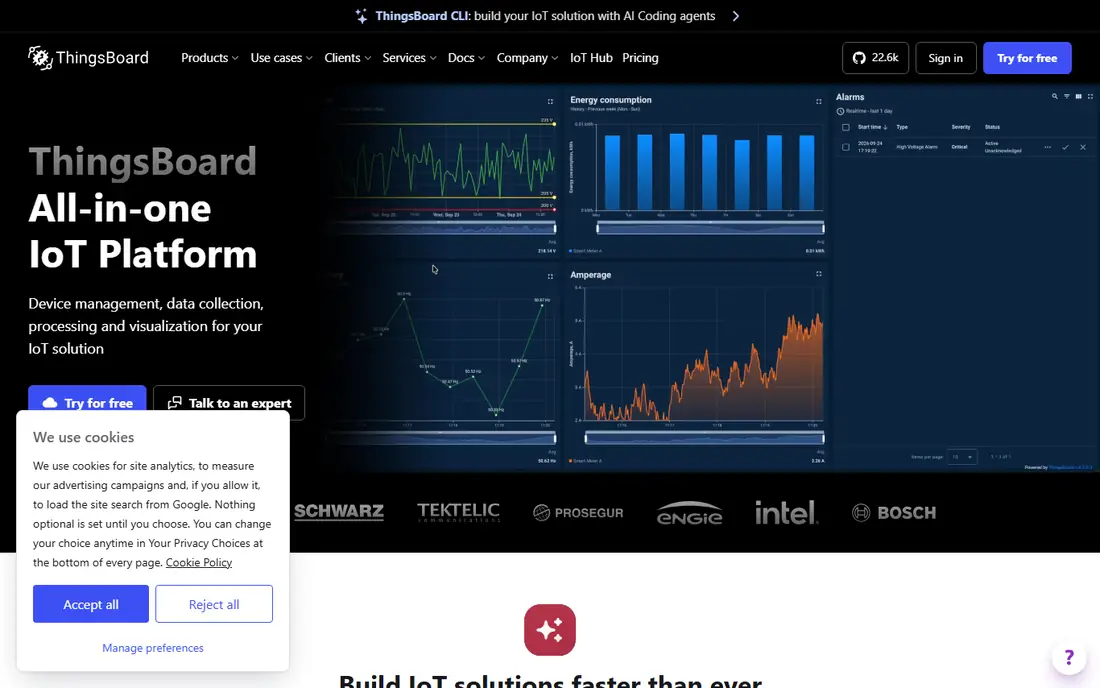
Think of ThingsBoard for teams that want open-source control. ThingsBoard packs device management, data collection, visualization and a rule engine into one open-source product you can run yourself. The premium cloud and professional editions remove that burden for a fee.
Where it is weaker: Self-hosting needs DevOps effort.
It is the pragmatic open-source choice in a category full of black boxes. In practice, running it in production is your job: databases, scaling, backups. On cost, ThingsBoard starts like this: Free. Free access exists with ThingsBoard. What ThingsBoard does well: Active community.
- Device management plus dashboards plus rule engine
- Full-featured open-source core
- Professional features sit behind premium levels
AWS IoT Core is aimed squarely at device fleets inside the AWS ecosystem. If your backend already runs on AWS, IoT Core is the path of least resistance. The metered pricing rewards careful architecture and punishes chatty devices, so model message volume early.
Devices link over MQTT, messages flow into Lambda, S3, analytics and machine learning services without custom plumbing. Security is handled through per-device certificates and fine-grained policies. AWS IoT Core cost at the entry level: Pay-as-you-go. AWS IoT Core has a free plan.
Where it falls short: Needs AWS expertise to operate well.
- Massive scale
- Deep integration with the AWS stack
- Pricing is complicated and metered
Balena works best for managing Linux device fleets with containers. Balena lets you handle device fleets the way you manage servers: push container updates, monitor health, SSH into misbehaving units.
The main drawbacks: Linux-focused.
Pricing beyond the free level scales per device. Price to start with Balena: Free. Balena includes a free tier.
- Solid fleet tooling
- First 10 devices free
- Costs grow with fleet size
Losant works best for building IoT applications with visual workflows. For application-centric IoT where time to demo matters, it is a productive choice.
As for the details, very large fleets may outgrow the model. In practice, Losant targets the application layer: link devices, build logic in a visual workflow editor, and ship dashboards without writing firmware. Pricing for Losant is not stated here, so ask the vendor for current figures. Losant includes a free tier.
Limits to weigh: Custom pricing lacks transparency.
- Decent dashboarding
- Visual workflow engine
- Less suited to massive fleets
KaaIoT is aimed squarely at low-cost enterprise-grade IoT without hyperscaler complexity. Kaa Cloud opens at $99 per month for 100 endpoints with published levels above, which is refreshingly transparent for the category.
Where it falls short: Brand less known.
Worth adding: the ecosystem and external integrations are thinner than AWS or Azure, and the brand carries less weight in procurement. Starting cost for KaaIoT: $99/month. Free plan details: Free trial.
- Published pricing from $99/month
- Device management plus analytics
- Smaller ecosystem than hyperscalers
How we built this list
Each tool was reviewed on what its vendor publishes: price, plan limits, core features and stated drawbacks. We did not run hands-on tests. Where a price is missing, the vendor does not list one publicly or ties it to a quote. Always confirm before budgeting. The order reflects how well each tool fits the most common buying scenario for IoT management platforms, then price clarity, then free plan access. It is a starting point, not a verdict.
Things to verify first
- Get a written quote from Losant; the list shows no starting price for them.
- Check what the free option really includes: Azure IoT Hub, ThingsBoard, AWS IoT Core and others offer a free plan, and usage caps differ.
- Take the trial from KaaIoT and push a live task through it before you pay.
- Read the limits listed for Azure IoT Hub first: portal and SDKs feel heavyweight.
- Confirm minimum seats and billing terms with Losant before you commit to an annual plan.
- Before you load data into Azure IoT Hub, check what an export looks like and who can run it.
Frequently asked questions
What does an IoT pilot generally cost?
A 50-device pilot on a SaaS product often runs under $500 per month including connectivity. The costly parts are hardware, installation and integration labor, which typically exceed software costs multiple times over.
Which options for IoT management platforms have a free plan?
Azure IoT Hub, ThingsBoard, AWS IoT Core, Balena and Losant offer a free plan in this list. Free plans usually cap users, projects or features, so check the limits on the vendor page. One other tool offers a trial instead.
Is Azure IoT Hub the right pick for everyone comparing IoT management platforms?
No single tool suits every team. Azure IoT Hub comes first because it fits device fleets inside the Microsoft ecosystem, while ThingsBoard suits teams that want open-source control and AWS IoT Core suits device fleets inside the AWS ecosystem. Match the tool to your own size, budget and workflow before deciding.
How many devices can these systems manage?
Hyperscaler systems handle millions of devices per deployment. Match the system's proven scale to your three-year fleet projection, not just today's pilot.
What protocols should the platform support?
MQTT is the standard for device messaging, with HTTP for straightforward integrations and CoAP or LoRaWAN for constrained devices. Confirm support for your specific hardware before committing.
Do these tools publish their prices?
Not all of them. Losant publishes no starting price, so expect a quote request for it. The rest, Azure IoT Hub included, show a starting price, though seats and billing terms still change the final cost.
Sources
See where you really rank - block by block
ProMapRanker scans Google Maps across a grid of your service area. Simple monthly plans from $19, white-label on every plan.
Start freeKeep reading
 zoho inventory alternatives
6 Alternatives to Zoho Inventory, Compared on Price and Fit
Zoho Inventory alternatives: 6 tools compared on price, free plans and fit. Katana leads the list for manufacturers. Fit and flaws are laid out for each entry.
Read → zoho crm alternatives
Best Zoho CRM Alternatives (2026)
Need Zoho CRM alternatives? We compare 7 tools on cost, free access and who each suits. Every pick gets a straight assessment. Built for quick decisions.
Read → zelle alternatives
Best Zelle Alternatives in 2026
Compare the best Zelle alternatives for sending money to friends, paying sellers and moving funds abroad, with honest notes on fees, speed and safety in 2026.
Read →