 ProMapRanker
IoT Device Management Platforms


Azure-based fleets and edge AI · Pricing starts at: See website
Direct answer
This list puts Azure IoT Hub first for Azure-based fleets and edge AI. For a different need, Balena covers Container-based Linux fleets and AWS IoT Device Management covers AWS-based fleets at scale. The remaining 4 options are covered below with prices and limits.
Key takeaways
- The list opens with Azure IoT Hub, aimed at Azure-based fleets and edge AI.
- For hardware plus connectivity plus cloud, Particle is worth a look.
- No starting price is published for Azure IoT Hub, Balena, AWS IoT Device Management and others; expect a quote.
- Only 3 of the 7 tools have a free plan (Balena, Datacake, ThingsBoard), so check the caps.
Quick comparison
| Pick | Great for | Pricing starts at | Free tier | |
|---|---|---|---|---|
| Azure IoT Hub | Azure-based fleets and edge AI | See website | No | Visit |
 Balena | Container-based Linux fleets | See website | Yes | Visit |
 AWS IoT Device Management | AWS-based fleets at scale | See website | No | Visit |
 Datacake | LoRaWAN sensor monitoring | Free | Yes | Visit |
 ThingsBoard | Open industrial dashboards and OTA | Free | Yes | Visit |
 Losant | Low-code industrial workflows | See website | No | Visit |
 Particle | Hardware plus connectivity plus cloud | See website | No | Visit |
The 7 tools in detail
Choosing IoT device management platforms usually comes down to price, fit and limits. This ProMapRanker guide sets 7 tools side by side on those three points, with the facts kept short and checkable.

Azure IoT Hub works best for Azure-based fleets and edge AI. Azure IoT Hub supplies a cloud-hosted back end to link virtually any device, with highly secure and steady two-way communication, built-in device management and scaled provisioning.
Honest limits: Azure skills required.
What Azure IoT Hub does well: Two-way communication with per-device authentication. This comparison lists no price for Azure IoT Hub; ask the vendor. There is no free plan with Azure IoT Hub.
- Zero-touch provisioning at scale
- IoT Edge modules distribute AI and analytics to devices
- Pricing is tiered by message volume and needs scoping
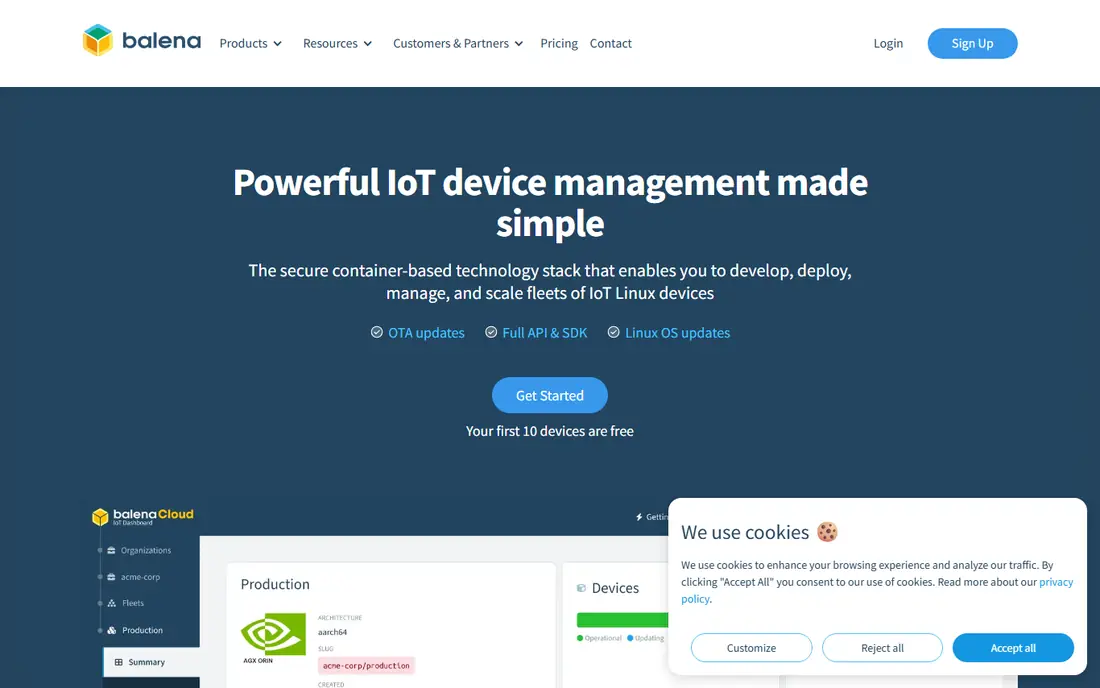
Balena was built for Container-based Linux fleets. Applications run on a container-optimized OS, updates ship as deltas to minimize bandwidth.
Limits to weigh: not a fit for microcontroller-only fleets; Linux-focused.
The balenaCloud dashboard watches fleet health, shows device logs, opens secure tunnels for troubleshooting and updates the OS remotely. A free trial lets teams test with an example application before committing. This comparison lists no price for Balena; ask the vendor. Free access exists with Balena.
- OTA updates with application deltas to cut bandwidth
- Container-based stack for developing
- Pricing scales with fleet size and needs a quote

AWS IoT Device Management was built for AWS-based fleets at scale. AWS IoT Device Management registers, organizes, watches and remotely handles connected devices at scale.
Where it falls short: AWS skills required to get full value.
For fleets already on AWS, it is the natural choice: device data flows into the rest of AWS without new integration work. In practice, teams can onboard devices into adaptable hierarchies, filter device search by attributes, monitor fleet health, troubleshoot remotely and push firmware updates and reboots in bulk, with continuous jobs for automatic updates and logical device groups for targeting. AWS IoT Device Management does not show a starting price in this comparison, so check the vendor site for current pricing. There is no free plan with AWS IoT Device Management.
- Onboard and organize devices into adaptable hierarchies
- Fleet health monitoring with policy alerts
- Pricing is usage-based and needs the AWS pricing page to scope
Datacake works best for LoRaWAN sensor monitoring. Datacake is the LoRaWAN monitoring system that turns sensors into live dashboards, alerts and reports, including cold-chain, air quality and environmental monitoring end to end.
Upsides: White-label and multi-tenancy for integrators.
With 400 plus device templates from 124 plus manufacturers, including Milesight, Dragino and TEKTELIC, and an AI assistant that answers plain-language questions about sensor data, Datacake is the fastest start for LoRaWAN monitoring projects. Starting cost for Datacake: Free. You can start on Datacake without paying.
Trade-offs to know: LoRaWAN focus means less for Wi-Fi or cellular fleets.
- Free plan with 5 devices forever and a free LoRaWAN Network Server
- AI assistant answers questions about sensor data
- AI assistant premium plan costs 20 euros per user a month
ThingsBoard makes the most sense for open industrial dashboards and OTA. ThingsBoard is an all-in-one IoT system handling device management, data collection, processing and visualization, with AI assistants that build options from plain-language prompts.
Downsides: Breadth means a longer setup than a narrow monitoring tool.
More specifically, teams link devices straight, through gateways, from LoRaWAN or NB-IoT networks or via product integrations, model assets and hierarchies as digital twins, and act on data with calculated fields, alarm rules and rule chains. ThingsBoard cost at the entry level: Free. Free access exists with ThingsBoard.
- Free cloud start or self-hosted on-premises
- Data collection
- Enterprise support needs a conversation
Losant is aimed squarely at low-code industrial workflows. The system takes care of millions of data points per second and contains a Connected Product Foundation template that cuts development time for connected products. On top of that, Losant is an enterprise IoT system whose low-code workflow engine freely collects, centralizes and integrates data from all connected devices and systems, turning products into intelligent assets with custom branding, API integration and easy multi-tenancy.
Honest limits: Losant is joining SUSE, so roadmap and support may change.
Its edge agent plugs into PLCs, CRMs and Azure or AWS, with automatic provisioning and digital twin capabilities. More specifically, note that Losant's homepage announces it is joining SUSE to build an open process automation system for industrial IoT, so buyers should confirm support, pricing and roadmap with the team before committing. This comparison lists no price for Losant; ask the vendor. There is no free plan with Losant.
- Multi-tenancy with custom branding
- Low-code workflow engine collects
- Enterprise focus means smaller teams should confirm fit
Particle makes the most sense for hardware plus connectivity plus cloud. Particle is an integrated IoT product as a service built to ship software to hardware, with developer productivity, observability and reliability as its stated goals. Teams with existing non-Particle hardware should confirm compatibility in a demo, and pricing needs a conversation with Particle's team.
Points against: Fits best with Particle hardware.
Where Particle stands out: 60 billion messages and 12 million OTA updates a month. For everyday use, the console watches and runs every device, every bit of software and every ounce of data through a single portal, with software releases, security and compliance controls and device vitals for fleet health. For teams building connected products on Particle hardware, the integrated stack removes the work of stitching connectivity, cloud and updates together. This comparison lists no price for Particle; ask the vendor. Particle does not include a free plan.
- Software releases and device vitals built in
- Integrated product including hardware
- Pricing not published on the homepage
Selection criteria
Pricing pages, product documentation and feature lists were the main sources, and every entry carries at least one honest drawback. Seat minimums, billing terms and add-ons can move the real cost, so the starting prices here are a guide and not a quote. The order reflects how well each tool fits the most common buying scenario for IoT device management platforms, then price clarity, then free plan access. It is a starting point, not a verdict.
Questions to settle before buying
- Confirm the entry price on the vendor page. For Azure IoT Hub, Balena, AWS IoT Device Management and others that means a quote rather than a fixed price.
- Look at free plan limits closely: Balena, Datacake and ThingsBoard have one, and the caps decide whether it is usable for real work.
- Read the limits listed for Azure IoT Hub first: pricing is tiered by message volume and needs scoping.
- Check whether the features you need in Azure IoT Hub sit on the entry plan or only on higher tiers.
- Ask Balena whether prices are locked for the first term and what happens at renewal.
Frequently asked questions
Is Azure IoT Hub the right pick for everyone comparing IoT device management platforms?
No single tool suits every team. Azure IoT Hub comes first because it fits Azure-based fleets and edge AI, while Balena suits Container-based Linux fleets and AWS IoT Device Management suits AWS-based fleets at scale. Match the tool to your own size, budget and workflow before deciding.
How are the tools for IoT device management platforms ordered?
Azure IoT Hub sits first and Particle last because the order follows typical fit for IoT device management platforms, then price clarity and free access. It is a judgement call, so read each profile for fit and limits.
Do these tools publish their prices?
Not all of them. Azure IoT Hub, Balena, AWS IoT Device Management and others publish no starting price, so expect a quote request for those. The rest, Datacake included, show a starting price, though seats and billing terms still change the final cost.
What is an IoT device management platform?
It is software that registers, organizes, watches and remotely handles connected devices at scale, including onboarding, grouping, health monitoring, configuration and over-the-air updates. So teams can run large fleets without touching each device.
Can I try these options before paying?
Often, yes. Balena, Datacake and ThingsBoard have a free plan. Use your own data and a real task during the test, and check what the free tier or trial limits before you rely on it.
Sources
See where you really rank - block by block
ProMapRanker scans Google Maps across a grid of your service area. Simple monthly plans from $19, white-label on every plan.
Start freeKeep reading
 zscaler alternatives
Best Zscaler Alternatives in 2026
Looking for zscaler alternatives? We compare 9 SASE and zero trust platforms on architecture, data protection, pricing, and fit for your network and team.
Read → zapier alternatives free
Best Zapier Alternatives Free in 2026
Nine automation tools for zapier alternatives free in 2026, all with genuinely free tiers, plus free plan limits, starting prices and upgrade paths explained.
Read → which platform is best for online reputation
Which Platform Is Best for Online Reputation in 2026
Wondering which platform is best for online reputation? We compare 8 review, listing, and response tools for small and multi-location businesses and agencies.
Read →