 ProMapRanker
7 Top IoT Connectivity Platforms Compared (2026)

Direct answer
If you need enterprise fleets with remote access, EMnify is the first tool to look at here. Alternatives: 1NCE for low-data devices with long lives, and Hologram for prototypes and US fleets. The full list of 7 tools follows, with prices and free plan facts.
Key takeaways
- Number one here is EMnify, a fit for enterprise fleets with remote access.
- KORE Super SIM suits global fleets needing fallback.
- Starting prices begin at $1 per SIM/month with Hologram.
- Only Particle offers a free plan among these 7 tools.
- One limit worth knowing about Onomondo: data rates vary and need a quote for exact levels.
Quick comparison
| Pick | Great for | Pricing starts at | Free tier | |
|---|---|---|---|---|
 EMnify | Enterprise fleets with remote access | See website | Free trial (60 days) | Visit |
 1NCE | Low-data devices with long lives | $14 one-time (10 years) | No | Visit |
 Hologram | Prototypes and US fleets | $1 per SIM/month | Free trial | Visit |
 Onomondo | Usage-based global fleets | See website | Free trial | Visit |
 Eseye | Managed global deployments | See website | No | Visit |
 Particle | Developer-led connected products | $299 a month | Yes | Visit |
 KORE Super SIM | Global fleets needing fallback | See website | Free trial | Visit |
IoT Connectivity Platforms profiles
ProMapRanker compared 7 IoT connectivity platforms. The goal is a practical shortlist: published prices, free plan facts, best-fit use cases and honest limits for every entry.
Think of EMnify for enterprise fleets with remote access. EMnify lists SIM costs from under 2 euros for commercial-grade cards in some materials, and offers a 60-day evaluation with three free SIMs, but full data tariffs depend on volume and use case. As for the details, pricing is the main drawback for buyers who want a fast comparison.
Drawbacks to consider: Published pricing is restricted.
EMnify targets companies running connected products at scale, from vehicles and meters to trackers and industrial equipment. Its SIMs reach more than 540 networks in over 180 countries, and its system layers on remote access, monitoring, and automation. That combination helps operations teams diagnose devices without sending staff on site. Treat the trial as the real test, and get a written tariff for your countries and data profile before rollout. Pricing for EMnify is not stated here, so ask the vendor for current figures. As for free access: Free trial (60 days).
- Remote device access tools
- API and portal management
- Best terms require a sales conversation
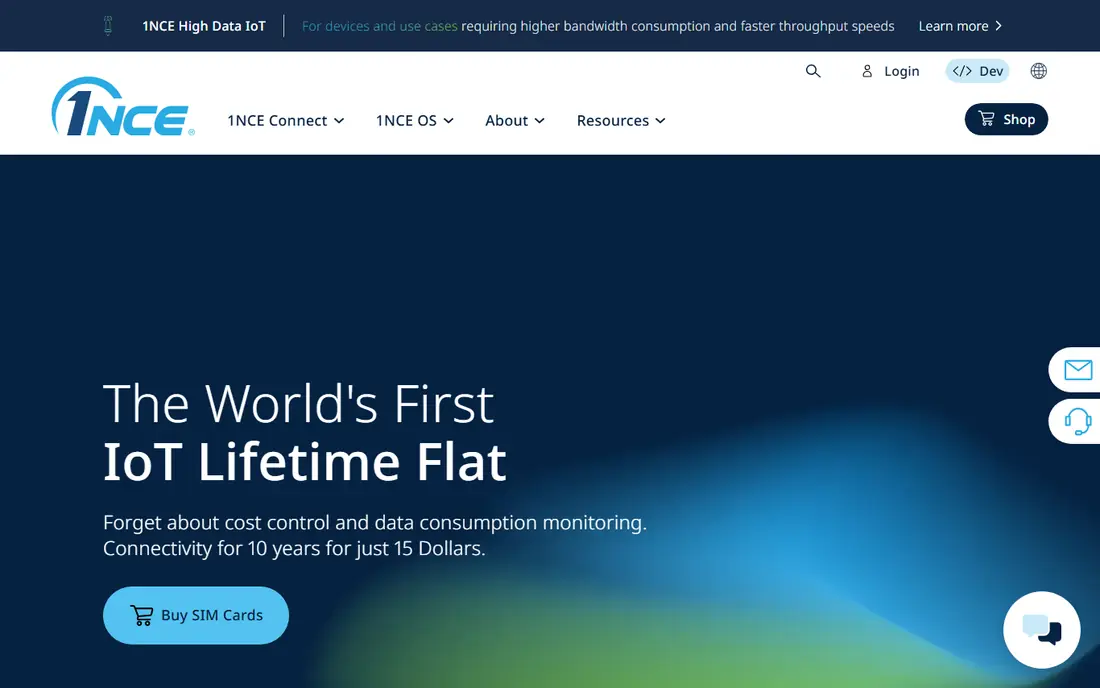
For low-data devices with long lives, 1NCE is a natural candidate. One payment includes 10 years of service with 500 MB of data and 250 SMS, plus portal and API management. That removes monthly billing work and makes unit cost simple to forecast for products shipped in volume.
As for the details, a device that streams video, sends frequent location updates, or needs regular firmware downloads will burn through 500 MB well before year ten. For low-data use, though, few choices match this simplicity. On cost, 1NCE starts like this: $14 one-time. No free plan comes with 1NCE.
Watch-outs: High-data devices need top-ups.
- No monthly bill for the base allowance
- Straightforward one-time price
- 500 MB and 250 SMS cap the base plan

Hologram is a good fit for prototypes and US fleets. Hologram does well for developers who want to start quick and pay only for what they use. Its pay-as-you-go plan charges $1 per SIM a month plus $0.03 per MB, with SIM hardware at $3 per SIM.
Drawbacks to consider: Enterprise terms are custom.
From a buyer's view, at $0.03 per MB, a fleet sending tens of megabytes per device each month will cost far more than a pooled or flat-rate plan. Hologram supplies custom Scale plans for bigger fleets, so expanding teams should ask for a volume quote before the pay-as-you-go bill becomes the default. From a buyer's view, for prototypes and small fleets, the clarity is hard to beat. The starting price for Hologram: $1 per SIM/month. As for free access: Free trial.
- Free developer account to start
- Clear pay-as-you-go pricing
- Data at $0.03 per MB layers on up for high-use devices
Onomondo is a good fit for usage-based global fleets. Onomondo stands out for teams that want network-level visibility. In practice, since it runs its own core network, it can present signaling and traffic detail that helps engineers find why a device failed to link.
Its pricing model charges for data used, with idle devices costing nothing in the base approach, which helps fleets with seasonal or stored stock. The free trial and sandbox choices let teams test coverage and diagnostics before committing. No starting price is listed for Onomondo here; confirm pricing on the vendor site. Free options: Free trial.
Where it falls short: Smaller brand than some rivals.
- No roaming surcharges in its model
- Pay for active data
- Data rates vary and need a quote for exact levels
In short, Eseye is for managed global deployments. Its AnyNet eSIM approach and Infinity management system aim to keep devices connected across networks and regions, with localization and failover handled behind the scenes. That matters for products for example EV chargers and payment devices where downtime has a direct cost.
Honest limits: No public pricing.
Eseye does not publish plan prices, so budget planning needs a quote based on fleet size, countries, and data use. Bigger teams that value managed support, compliance help, and a single invoice across markets will get more from this model. This comparison lists no price for Eseye; ask the vendor. Eseye has no free tier.
- Managed service with eSIM orchestration
- Single billing view
- Heavier fit for large enterprises than for hobby projects
Particle works best for developer-led connected products. The $299 monthly Basic block includes up to 100 devices, 720,000 data operations, and 540 MB of cellular usage, which is ample for some products and too much for others. In practice, teams with a handful of low-data sensors may find a pay-as-you-go SIM less expensive.
Points against: premium blocks can be expensive for very small fleets.
As for the details, the free plan helps early testing. The premium blocks add data operations, devices, and cellular usage in set amounts. Particle cost at the entry level: $299 per month. Particle offers a free plan.
- Device management
- Integrated hardware, cloud
- Cellular data limits need careful planning
In short, KORE Super SIM is for global fleets needing fallback. KORE Super SIM, which now contains the former Twilio Super SIM mobile core, provides fleets one global SIM with multi-IMSI fallback across networks.
Points against: Roaming model needs review for each market.
The free trial SIM helps with early testing, but production pricing is not published as a straightforward rate card. As for the details, devices can switch profiles when coverage drops, and teams run the fleet through the KORE console and APIs. This comparison lists no price for KORE Super SIM; ask the vendor. On free options: Free trial.
- Developer APIs
- Access to more than 400 networks on one SIM
- Pricing is quote-based for most fleets
How we chose
ProMapRanker looked at what each vendor publishes: pricing, plan limits, feature coverage for IoT connectivity platforms and stated drawbacks. No hands-on testing is claimed. Figures are shown as the vendors publish them. Billing terms, seat minimums and add-ons can change the real cost. The ranking is editorial: typical fit first, then clear pricing, then free access. If your needs are unusual, read the profiles rather than relying on position.
What to check before you buy
- Get a written quote from EMnify, Onomondo, Eseye and KORE Super SIM; the list shows no starting price for them.
- Look at the free plan from Particle closely: its caps decide whether it is usable for real work.
- Take the trial from EMnify, Hologram, Onomondo and KORE Super SIM and push a live task through it before you pay.
- Read the limits listed for EMnify first: published pricing is restricted.
- Check the support hours and onboarding help Eseye offers; smaller vendors vary a lot here.
- Check the integration list for Hologram against the tools you run today, and note which ones need a higher plan.
Frequently asked questions
Which options for IoT connectivity platforms have a free plan?
Particle is the only tool in this list with a free plan. Free plans usually cap users, projects or features, so check the limits on the vendor page. Several others offer a trial instead.
Can I try these options before paying?
Often, yes. Particle has a free plan and EMnify, Hologram, Onomondo and KORE Super SIM offer a free trial. Use your own data and a real task during the test, and check what the free tier or trial limits before you rely on it.
Do I need a global SIM for an US-only fleet?
Not always. A global SIM helps when devices cross borders, when you want one hardware design, or when fallback across carriers matters for uptime.
What is an IoT connectivity system?
It is a service that links cellular IoT devices through SIMs or eSIMs, runs those connections in a portal or API, and manages data routing, billing, and monitoring.
Is EMnify the right pick for everyone comparing IoT connectivity platforms?
No single tool suits every team. EMnify comes first because it fits enterprise fleets with remote access, while 1NCE suits low-data devices with long lives and Hologram suits prototypes and US fleets. Match the tool to your own size, budget and workflow before deciding.
Which product is best for a small prototype?
Start with EMnify if you need enterprise fleets with remote access. 1NCE is the better match for low-data devices with long lives, and Hologram for prototypes and US fleets. The best choice depends on budget, team size and workflow.
Sources
See where you really rank - block by block
ProMapRanker scans Google Maps across a grid of your service area. Simple monthly plans from $19, white-label on every plan.
Start freeKeep reading
 zscaler alternatives
Best Zscaler Alternatives in 2026
Looking for zscaler alternatives? We compare 9 SASE and zero trust platforms on architecture, data protection, pricing, and fit for your network and team.
Read → zapier alternatives free
Best Zapier Alternatives Free in 2026
Nine automation tools for zapier alternatives free in 2026, all with genuinely free tiers, plus free plan limits, starting prices and upgrade paths explained.
Read → which platform is best for online reputation
Which Platform Is Best for Online Reputation in 2026
Wondering which platform is best for online reputation? We compare 8 review, listing, and response tools for small and multi-location businesses and agencies.
Read →