 ProMapRanker
6 IoT Cloud Platforms, Compared by Cost and Features


Developers who want transparent pricing and a genuinely handy free level · Pricing starts at: $49/month (Starter plan)
Direct answer
This list puts TagoIO first for developers who want transparent pricing and a genuinely handy free level. Look at ThingsBoard for teams that want open-source flexibility with a managed cloud choice, and at Azure IoT Hub for Microsoft-centric organizations and industrial IoT deployments. All 6 tools are compared below on price, free plan and limits.
Key takeaways
- Number one here is TagoIO, a fit for developers who want transparent pricing and a genuinely handy free level.
- A free plan is available from 2 of the 6 tools: TagoIO, ThingsBoard.
- Before buying Blynk, weigh this: per-device pricing adds up at commercial scale.
- AWS IoT Core is the one to check for enterprises already on AWS connecting large device fleets.
- The cheapest monthly starting price in the list is $49/month, offered by TagoIO.
Quick comparison
| Pick | Great for | Pricing starts at | Free tier | |
|---|---|---|---|---|
| TagoIO | Developers who want transparent pricing and a genuinely handy free level | $49/month (Starter plan) | Yes | Visit |
 ThingsBoard | Teams that want open-source adaptability with a managed cloud choice | See website | Yes | Visit |
 Azure IoT Hub | Microsoft-centric organizations and industrial IoT deployments | See website (tiered, per-message pricing) | Not stated | Visit |
 Blynk | Makers and firms building mobile-first IoT apps rapidly | See website | Not stated | Visit |
 Losant | Enterprises building custom IoT applications with visual workflows | See website | Not stated | Visit |
 AWS IoT Core | Enterprises already on AWS connecting large device fleets | See website (pay-as-you-go, per-message pricing) | Not stated | Visit |
6 IoT cloud platforms in detail
Short on time? The summary and table above give the quick view of 6 IoT cloud platforms, and the profiles that follow give the detail behind each entry.
TagoIO
Great for: Developers who want transparent pricing and a genuinely handy free level
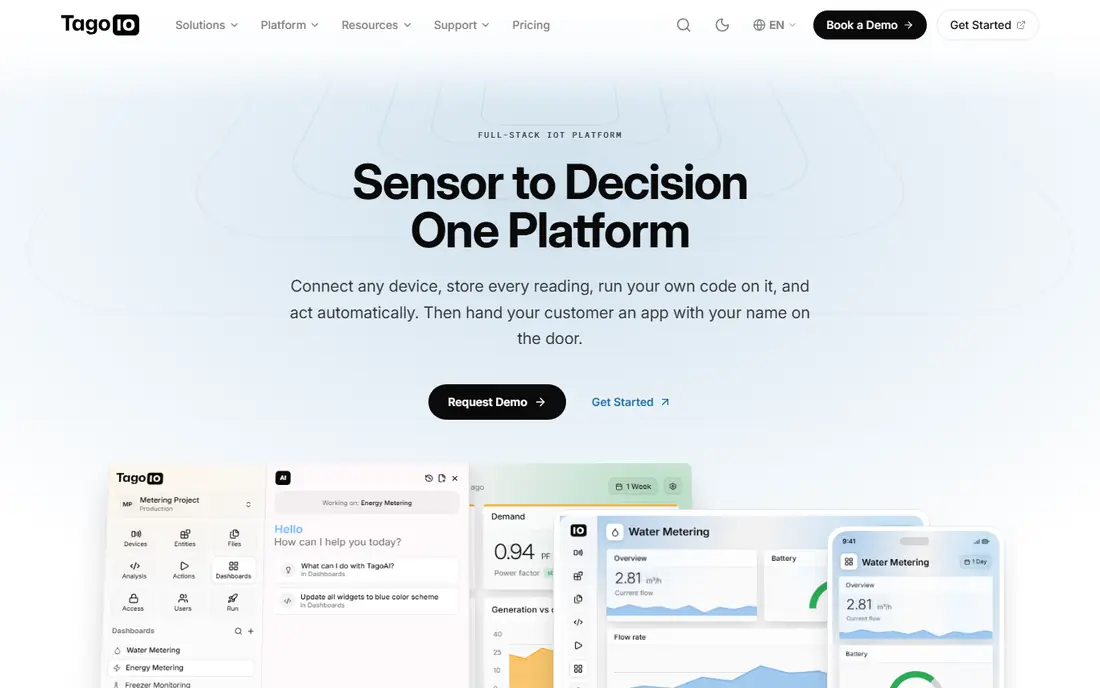
TagoIO makes the most sense for developers who want transparent pricing and a genuinely useful free level. TagoIO stands out by publishing its prices: free forever for 5 devices and 5 dashboards, Starter at $49 a month (100 devices per profile), Scale at $199, and TagoDeploy from $850 for dedicated enterprise instances, per its own pricing page.
Where it is weaker: Smaller ecosystem and community than AWS, Azure or ThingsBoard.
In daily use, the system spans device management, data storage, dashboards, analysis scripts, alerts and user management through a full REST API. Worth adding: the community is smaller, so expect fewer Stack Overflow answers than for AWS or ThingsBoard. Starting cost for TagoIO: $49/month. You can start on TagoIO without paying.
- Transparent published pricing
- Analysis scripts and white-label choices
- Scaling to very large fleets needs the enterprise TagoDeploy level
ThingsBoard
Great for: Teams that want open-source adaptability with a managed cloud choice
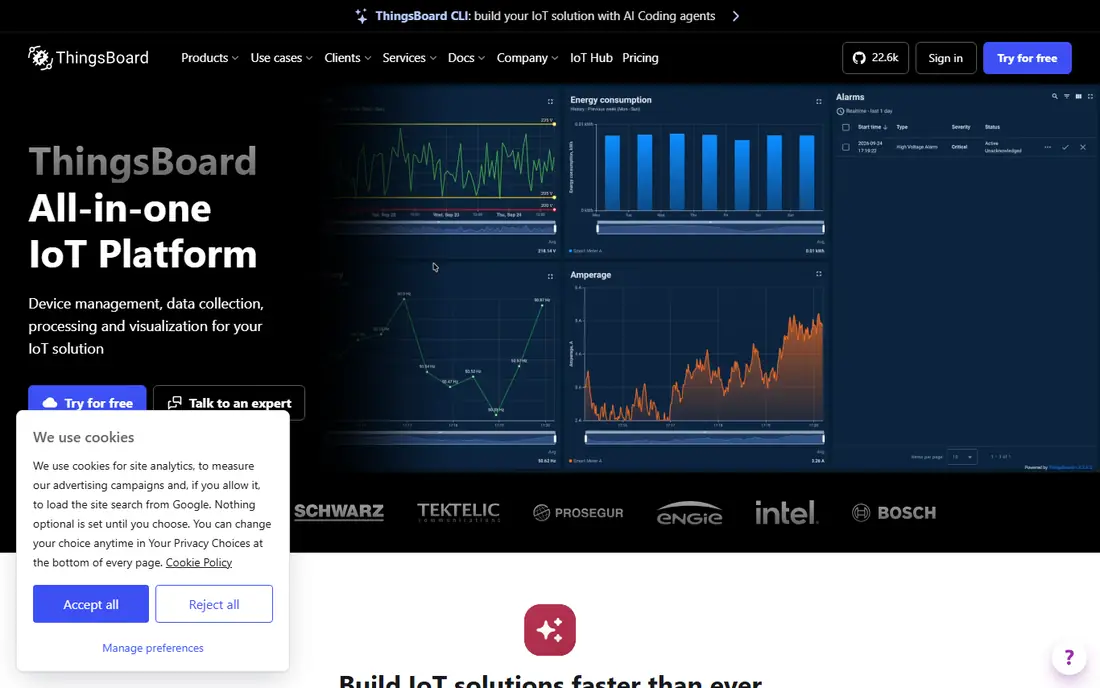
Choose ThingsBoard for teams that want open-source adaptability with a managed cloud choice. It speaks MQTT, CoAP and HTTP from day one.
What users get: Full-featured open-source core: device management.
Watch-outs: The professional managed cloud and advanced features cost additional.
From a buyer's view, running it yourself is the deal and the duty: no per-device fees. But you deal with scaling, backups and security. ThingsBoard does not show a starting price in this comparison, so check the vendor site for current pricing. A free plan is available with ThingsBoard.
- Dashboards and alarms
- Active community and broad documentation
- Self-hosting means you operate the infrastructure
Azure IoT Hub
Great for: Microsoft-centric organizations and industrial IoT deployments
Azure IoT Hub makes the most sense for Microsoft-centric organizations and industrial IoT deployments. Like AWS, pricing is metered and tiered, so model your message volume before committing.
Azure IoT Hub does not show a starting price in this comparison, so check the vendor site for current pricing. Trial and free access: Not stated.
Downsides: Level and message-metering complexity rivals AWS.
- Mature device management with device twins and direct methods
- Tight integration with Azure services (Stream Analytics, Digital Twins, Defender for IoT)
- Best value needs committing to the Azure ecosystem
For makers and firms building mobile-first IoT apps rapidly, Blynk is a natural candidate. Blynk pioneered no-code IoT apps: link your hardware, drag widgets onto a mobile dashboard, and control devices from your phone in an afternoon.
Drawbacks to consider: Per-device pricing layers on up at commercial scale.
It supports over 400 hardware models, deals with device provisioning and OTA updates, and gives you white-labeled apps for firms shipping connected products. Pricing for Blynk is not stated here, so ask the vendor for current figures. On free options: Not stated.
- Supports hundreds of hardware models through Blynk.Edgent libraries
- Drag-and-drop mobile and web app builder with no coding required
- The no-code approach limits deep customization for complicated products
Losant
Great for: Enterprises building custom IoT applications with visual workflows
Losant is a good fit for enterprises building custom IoT applications with visual workflows. Losant is an application enablement product: link devices over MQTT, HTTP or edge agents, process data in a drag-and-drop workflow engine, and build dashboards and branded end-user experiences on top.
Where it is weaker: Smaller teams may find it more product than they need.
Highlights: Visual workflow engine for device logic without heavy coding.
The product's strength is time-to-solution for custom applications: if you need bespoke dashboards and logic without building a backend team, Losant gives. Expect a sales conversation for pricing, which fits enterprise buyers and frustrates small teams. Pricing for Losant is not stated here, so ask the vendor for current figures. Free access: Not stated.
- Solid dashboards
- Alerting and end-user experience tooling
- Enterprise positioning means pricing is quote-driven
AWS IoT Core
Great for: Enterprises already on AWS connecting large device fleets
AWS IoT Core is built with enterprises already on AWS connecting large device fleets in mind. Per-message pricing looks cheap until millions of devices report every minute, and the bill has numerous line items.
Teams also need real AWS skills: this is infrastructure, not a dashboard product. AWS IoT Core does not show a starting price in this comparison, so check the vendor site for current pricing. Free access: Not stated.
Drawbacks to consider: Pricing is complex and message-based costs surprise teams at scale.
- HTTPS and LoRaWAN support
- Massive scale (billions of devices, trillions of messages) with deep AWS service integration
- The ramp-up time is steep and the console assumes cloud expertise
How we chose
Each tool was reviewed on what its vendor publishes: price, plan limits, core features and stated drawbacks. We did not run hands-on tests. Figures are shown as the vendors publish them. Billing terms, seat minimums and add-ons can change the real cost. Order on the page follows fit for the typical buyer first, then price transparency and free access. Your own requirements should decide the final pick.
Questions to settle before buying
- Get a written quote from ThingsBoard, Azure IoT Hub, Blynk and others; the list shows no starting price for them.
- Check what the free option really includes: TagoIO and ThingsBoard offer a free plan, and usage caps differ.
- Read the limits listed for TagoIO first: smaller ecosystem and community than AWS, Azure or ThingsBoard.
- The entry price of Blynk is only the starting point; model the full cost with seats and extras.
- Confirm minimum seats and billing terms with AWS IoT Core before you commit to an annual plan.
Frequently asked questions
Is there a free IoT product?
ThingsBoard's Community Edition is free and open source. TagoIO is free forever for up to 5 devices. Most commercial products also offer trials or developer sandboxes.
Is TagoIO the right pick for everyone comparing IoT cloud platforms?
No single tool suits every team. TagoIO comes first because it fits developers who want transparent pricing and a genuinely useful free tier, while ThingsBoard suits teams that want open-source flexibility with a managed cloud option and Azure IoT Hub suits Microsoft-centric organizations and industrial IoT deployments. Match the tool to your own size, budget and workflow before deciding.
Can I try these options before paying?
Often, yes. TagoIO and ThingsBoard have a free plan. Use your own data and a real task during the test, and check what the free tier or trial limits before you rely on it.
What is the cheapest option for IoT cloud platforms in this list?
On published monthly entry prices, TagoIO is the lowest here at $49/month. Entry price is only part of the cost, because seats, add-ons and billing terms can change the total.
How are the tools for IoT cloud platforms ordered?
The order follows typical fit for IoT cloud platforms, with TagoIO first and AWS IoT Core last, then price clarity and free access. It is editorial judgement, not a score, so another team could rank the tools differently.
What is an IoT cloud product?
It is the cloud backend your connected devices talk to. It manages device connectivity and identity, ingests telemetry data, runs rules and alerts, runs firmware updates, and serves dashboards.
Sources
See where you really rank - block by block
ProMapRanker scans Google Maps across a grid of your service area. Simple monthly plans from $19, white-label on every plan.
Start freeKeep reading
 zscaler alternatives
Best Zscaler Alternatives in 2026
Looking for zscaler alternatives? We compare 9 SASE and zero trust platforms on architecture, data protection, pricing, and fit for your network and team.
Read → zapier alternatives free
Best Zapier Alternatives Free in 2026
Nine automation tools for zapier alternatives free in 2026, all with genuinely free tiers, plus free plan limits, starting prices and upgrade paths explained.
Read → which platform is best for online reputation
Which Platform Is Best for Online Reputation in 2026
Wondering which platform is best for online reputation? We compare 8 review, listing, and response tools for small and multi-location businesses and agencies.
Read →