 ProMapRanker
Best Investor Portal Software in 2026

Key takeaways
- Institutional portals and real estate syndication portals solve different jobs, so shortlist within your own category first.
- Most institutional tools are quote-only, while several syndication tools publish monthly prices.
- Distribution waterfalls, K-1 handling, and accreditation checks separate serious portals from simple document sites.
- This is general information only, not financial advice, and no portal guarantees returns.
Quick comparison
| Pick | Great for | Pricing starts at | Free tier | |
|---|---|---|---|---|
 Juniper Square | Private markets GPs | See website | No | Visit |
 Carta | VC and PE fund admin plus portal | See website | No | Visit |
 Allvue | Alternative managers on Allvue accounting | See website | No | Visit |
 InvestNext | Real estate fundraising and distributions | See website | No | Visit |
 Altvia | PE and VC investor relations on Salesforce | See website | No | Visit |
 Agora | Real estate investment management | $749 per month | No | Visit |
 Cash Flow Portal | Smaller syndicators | $499 per month | No | Visit |
 SyndicationPro | Compliance-focused syndication portals | See website | No | Visit |
 Fundwave | Published-price fund portals | $400 per month | No | Visit |
The best investor portal software
An investor portal is the place investors check balances, documents, capital calls, and distributions. The best choice depends on fund type, size, and if you also need fund administration behind the portal.
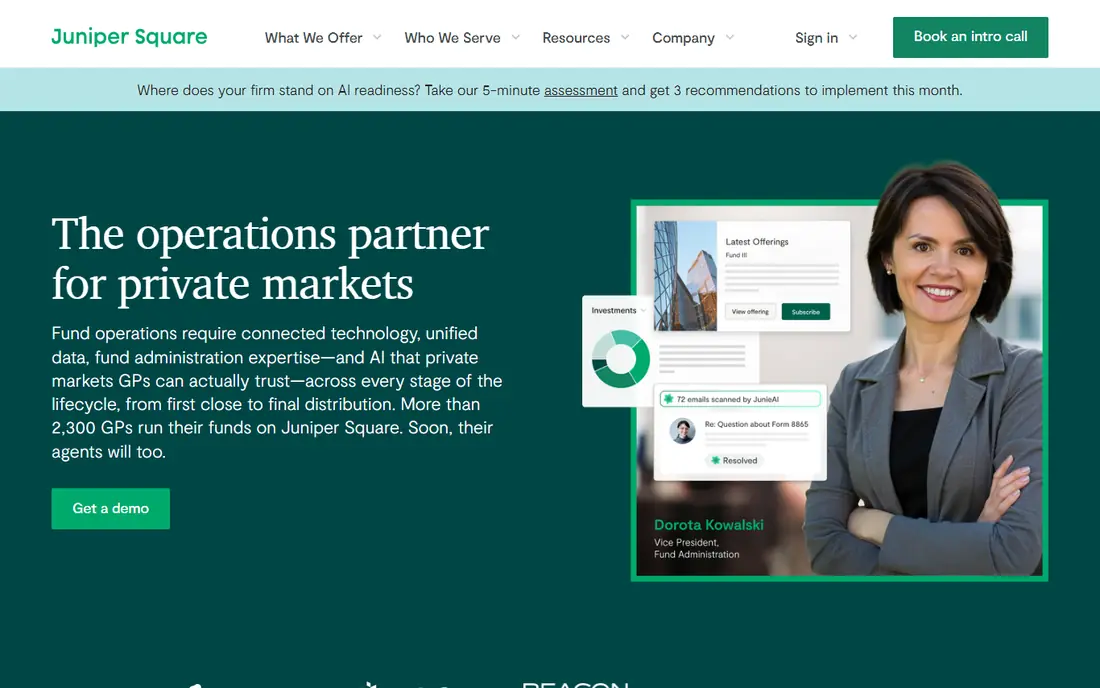
Juniper Square is the most widely known portal for private equity, real estate, venture, and private credit managers that want investor relations and administration from one vendor. Investors get statements, documents, and communications in one login, while managers get fundraising, capital call, and reporting workflows tied to the same data. That single record reduces the spreadsheet work that causes most investor queries.
The drawback is scale and price transparency. Pricing is quote-based, and a single small fund may find implementation heavier than needed. Ask whether the portal is priced separately from administration, and what happens to investor data if you later change administrator.
- Portal plus fund administration in one partner
- Broad private markets coverage
- Strong reporting tools
- Quote-only pricing
- Implementation can be heavy for a single small fund

Carta suits venture and private equity funds, especially where portfolio companies already manage equity on Carta. The investor portal sits alongside fund administration, valuations, and SPV management, so limited partners see consistent data rather than separate reports from separate vendors. That connection is valuable during a raise, when diligence questions arrive fast.
Pricing is quote-based, and several features are sold separately, so the headline quote may not cover everything you need. Smaller emerging managers should compare Carta's full quote, including add-ons, against a published-price syndication tool if their fund structure is simple.
- Connects equity, fund admin, and investor relations
- Valuations and SPV tools
- Large fund admin base
- Quote-only pricing
- Add-ons such as valuations are priced separately
Allvue serves alternative asset managers that want fund accounting and investor reporting in one system. The portal draws on accounting data, which helps managers publish consistent statements, capital activity, and performance information without rebuilding reports in spreadsheets. Private equity, venture, and private debt managers are its core audience.
The scope is also the weakness. A small fund may pay for modules it does not need, and pricing is quote-based, so comparison shopping takes sales calls rather than web pages. Shortlist Allvue when accounting accuracy and portal reporting must come from the same system.
- Fund accounting plus investor relations on one platform
- Suits private equity, venture, and private debt
- Quote-only pricing
- Broad scope can mean paying for modules a small fund does not use
InvestNext is built for real estate funds and syndicators that want a modern fundraising experience plus automated distributions. Investors can review offerings, sign documents, and track distributions in a portal designed for property deals, while sponsors manage fundraising pipelines and investor communications in one place. That real estate focus shows in deal structures and reporting templates.
Pricing is not published, so you need a demo and quote to judge value. Firms outside real estate should look at Juniper Square, Carta, or Allvue instead, since InvestNext's templates and workflows assume property deals.
- Modern fundraising flow
- Automated distributions
- Investor portal built for real estate
- Pricing not published
- Real estate focus limits use for other asset classes
Altvia gives private equity and venture firms a CRM, data room, and limited partner portal in one engagement platform built on Salesforce. That suits firms whose investor relations work is really a sales and communications job, with pipelines, meetings, and diligence documents to manage. The portal distributes what your administrator produces, rather than keeping the books itself.
That division of labour must be planned. Pair Altvia with an administrator or accounting system, and confirm how statements and capital activity flow into the portal. Pricing is quote-based, so budget for both Altvia and administration together, not Altvia alone.
- CRM, data room, and portal in one engagement platform
- Built on Salesforce
- Strong for fundraising
- Not fund accounting
- Quote-only pricing
- Needs an administrator or accounting system alongside
Agora covers fundraising, investor management, transactions, documents, and distributions for real estate firms and syndicators. Its branded portal, CRM, and automated waterfall calculations suit growing sponsors that want one platform rather than several disconnected tools. The Essential plan is listed from $749 per month, which gives a clear starting point compared with quote-only rivals.
The entry price still rules out very small sponsors doing a single small deal. Higher plans add advanced features, so confirm which plan includes the waterfall complexity, payment tools, and reporting depth your deals actually need before signing.
- End-to-end real estate platform
- Automated waterfalls
- Branded investor portal
- Entry price is high for a first deal
- Advanced plans cost more
Cash Flow Portal suits smaller real estate syndicators that want a published price and a portal without enterprise implementation. The starting price is listed from $499 per month billed yearly, and the platform covers fundraising, investor tracking, documents, and distributions for syndication deals. That clarity helps a first-time sponsor budget honestly.
Larger or institutional funds may outgrow it, since reporting depth and administration features are lighter than Juniper Square or Allvue. Check investor limits, deal limits, and distribution features on the plan you would actually buy, not the marketing overview.
- Published starting price
- Built for syndicators
- Simpler setup than enterprise platforms
- Less suited to large institutional funds
- Check limits on investors and deals per plan
SyndicationPro, also known through SponsorCloud, gives real estate syndicators a portal where investors can view offering documents, invest through multiple profiles, sign electronically, and track distributions. The built-in CRM helps sponsors manage investor relationships without a separate system, and the compliance focus suits sponsors that need careful accreditation and document handling.
Pricing is not published, so you need a quote to compare it with Agora and Cash Flow Portal. It is also real estate only, so private equity or venture managers should shortlist institutional portals instead.
- Compliance-focused portal with CRM built in
- Digital offering documents and e-signing
- Distribution updates
- Pricing not published
- Real estate only
Fundwave stands out for publishing its prices, which is rare in this category. The portal starts at $400 per month for funds up to $50 million with up to 100 investors, and $650 per month for larger funds, with a portal plus administration bundle from $1,000 per month. That transparency helps single-fund managers compare costs without a sales call.
The per-fund model is the catch. A three-vehicle structure means three subscriptions, and an onboarding fee from $2,000 applies. Still, for a single fund that wants a clear portal price, Fundwave is one of the easiest tools in this list to evaluate.
- Published per-fund portal pricing
- Portal plus admin bundle available
- Suits single funds
- Priced per fund, so multi-fund structures multiply cost
- Onboarding fee applies
How we picked these
We compared vendor product and pricing pages and recent fund portal comparisons, and we favoured tools with a real investor portal, not just a data room or a CRM. We covered both institutional private fund portals and real estate syndication portals, and we noted where pricing was published and where it was quote-only. We left out tools whose portal features were only a minor add-on to a broader product.
What to check before you choose a portal
Start with who will use the portal and what they need to see. Limited partners want statements, tax documents, capital calls, and distributions without emailing your team for every figure. Sponsors want fundraising pipelines, accreditation checks, and distribution calculations that do not rely on spreadsheets. Write those two lists before any demo, and score each vendor against them.
Next, confirm security, permissions, and data export. Ask who can see each document, how access is revoked when staff leave, and how you export investor data if you change vendors. This is general information only, not financial advice, and no portal guarantees returns, so treat performance figures in a portal as reporting, not as a promise.
Frequently asked questions
What is the difference between an investor portal and a data room?
A data room controls diligence documents during a raise, while a portal serves existing investors after they commit, with statements, distributions, and tax documents. Many platforms offer both, but the portal is the long-term investor relationship tool.
Do I need fund administration as well as a portal?
It depends on fund complexity. Some portals distribute administrator-produced statements, while others bundle administration. Confirm who keeps the books, who calculates distributions, and who prepares tax documents before you sign.
How much does investor portal software cost?
Syndication tools publish prices from about $400 to $749 per month, while institutional tools are usually quote-based and cost far more. Total cost depends on fund count, investor count, assets, and whether administration is included.
Can investors sign documents and pay through the portal?
Many syndication portals support e-signing, subscription documents, and payments, while institutional portals vary. Confirm accreditation checks, payment methods, and document workflows for your fund type during a demo.
Is portal performance data a guarantee of future returns?
No. Past performance shown in a portal does not guarantee future results, and distributions depend on deal performance, fees, and market conditions. This article is general information only and is not financial advice.
Sources
See where you really rank - block by block
ProMapRanker scans Google Maps across a grid of your service area. Simple monthly plans from $19, white-label on every plan.
Start freeKeep reading
 worlds best local seo company
8 Worlds Best Local SEO Companies for Map Pack Growth in 2026
Compare the worlds best local seo company options for Google Business Profile work, citations, reviews, and multi-location rankings and reporting in 2026.
Read → world's best web hosting company
World's Best Web Hosting Company in 2026
Searching for the world's best web hosting company? We compared 10 hosts on price, renewal rates, speed, and support to help you choose well today in 2026.
Read → who's got the best nanny tax services
Who's Got the Best Nanny Tax Services in 2026
We answer who's got the best nanny tax services, comparing full filing, back taxes, software, and pricing so families can handle nanny taxes correctly.
Read →