 ProMapRanker
Best Investment Apps in 2026: 9 Apps Compared

Key takeaways
- Fidelity is our overall pick for beginners, with $0 stock and ETF commissions, fractional shares from $1 and strong research and education.
- Charles Schwab is a close second for education and research, while Robinhood remains the simplest mobile start for small, casual investing.
- Robo-advisers such as Betterment and Acorns suit investors who want a managed portfolio and do not want to pick stocks themselves.
- Most major brokers now charge $0 for online stock and ETF trades, so the real differences are in account types, research, fractional shares and extra fees.
- Investing involves risk, including possible loss of money, and this guide is for information only and is not financial advice.
Quick comparison
| Pick | Great for | Pricing starts at | Free tier | |
|---|---|---|---|---|
 Fidelity | Overall beginners | Free | Yes | Visit |
 Charles Schwab | Education and research | Free | Yes | Visit |
 Robinhood | Simple mobile investing | Free | Yes | Visit |
 Vanguard | Long-term index investing | Free | Yes | Visit |
 E*TRADE | Active beginners | Free | Yes | Visit |
 Webull | Low-cost trading tools | Free | Yes | Visit |
 SoFi Invest | All-in-one finance app | Free | Yes | Visit |
 Acorns | Automatic small investing | See website | No | Visit |
 Betterment | Hands-off managed portfolios | See website | No | Visit |
The best investment apps
We compared investment apps on commissions, account types, fractional shares, research, education, ease of use and extra fees. The best investing apps for beginners are not only the cheapest, since a clear app with good education can help a new investor avoid costly mistakes. The best stock apps below cover self-directed brokers, a bank-linked app and two managed options, so you can match the app to how involved you want to be.
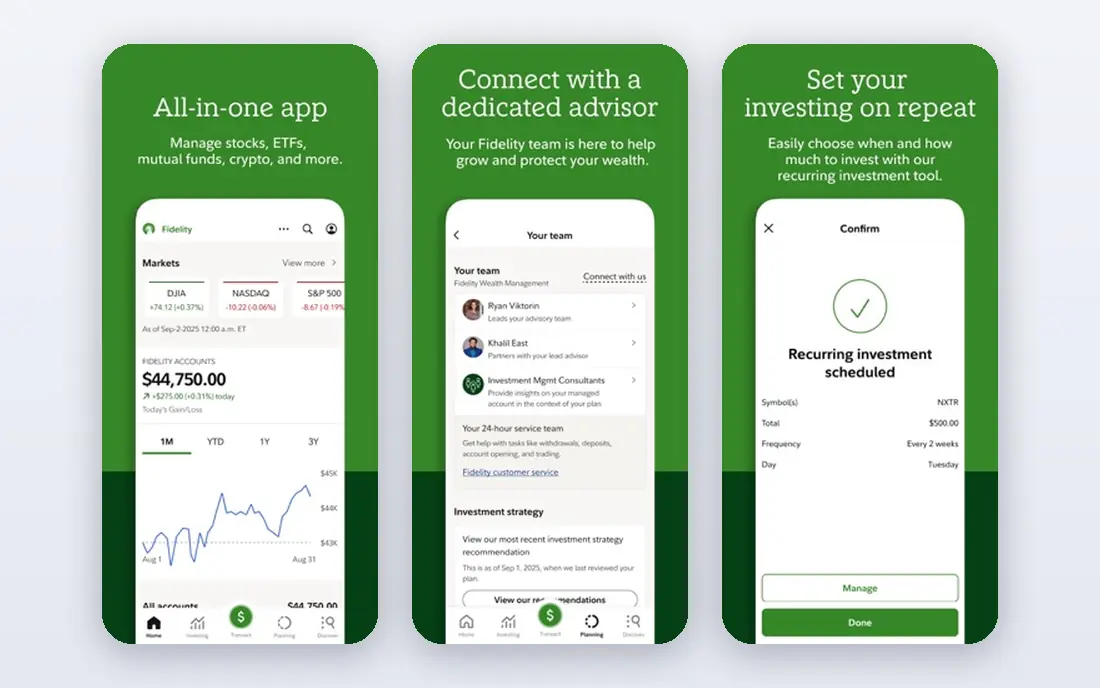
Fidelity is our pick for the best investment app for most beginners. The core offer is hard to beat: $0 commissions on online US stock and ETF trades, no account minimum for a standard brokerage account, and fractional shares from $1 on eligible stocks and ETFs. That combination lets a new investor start small, diversify across several funds or stocks, and learn without paying a commission on every trade. Retirement accounts, including traditional and Roth IRAs, sit in the same app, so long-term saving does not need a second provider.
Research and education are where Fidelity pulls ahead of simpler apps. Articles, videos, screeners and planning tools help beginners move from a first trade to a broader plan, and customer support is available around the clock in many cases. The catch is depth. The app packs many menus and tools into one place, so a first-time user may need a few sessions to find everything. Options traders should also note the $0.65 per contract fee. For a beginner who wants one app that can grow with them, Fidelity is the safest starting point on this list.
- $0 commissions on online US stocks and ETFs
- Fractional shares from $1 on eligible stocks and ETFs
- Strong research, education and customer support
- App menus can feel deep for absolute beginners
- Options cost $0.65 per contract
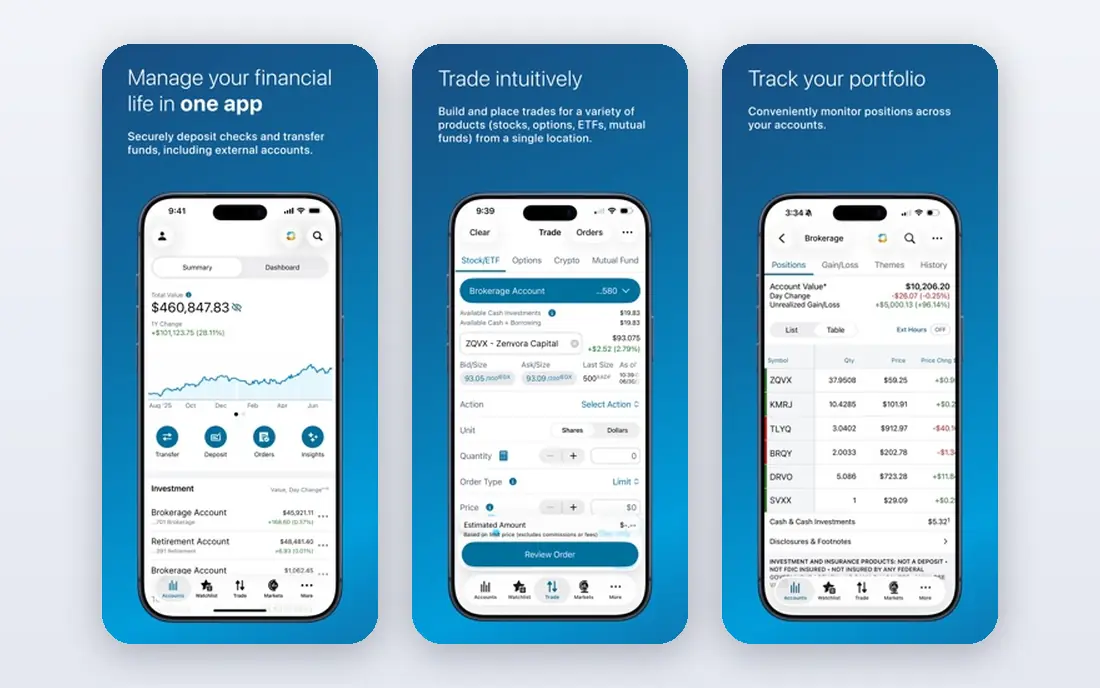
Charles Schwab is a strong alternative to Fidelity, especially for investors who want to learn as they go. The education library is broad, with courses, articles and webcasts that explain investing basics in plain terms. Research reports and screeners help investors compare funds and stocks without needing a separate service. Like Fidelity, Schwab charges $0 for online US stock and ETF trades, and it offers traditional and Roth IRAs alongside taxable accounts.
Schwab Stock Slices let investors buy fractional shares of eligible S&P 500 stocks from $5, which is useful for high-priced stocks, though the range is narrower than Fidelity fractional trading. The thinkorswim platform adds professional charting and trading tools, but it can feel like a second app with its own learning curve. For education-led investors, Schwab is one of the best beginner investing apps available.
- $0 commissions on online US stocks and ETFs
- Strong education library and research
- Stock Slices for fractional S&P 500 investing from $5
- Main app plus thinkorswim can feel like two apps
- Fractional shares focus on S&P 500 stocks
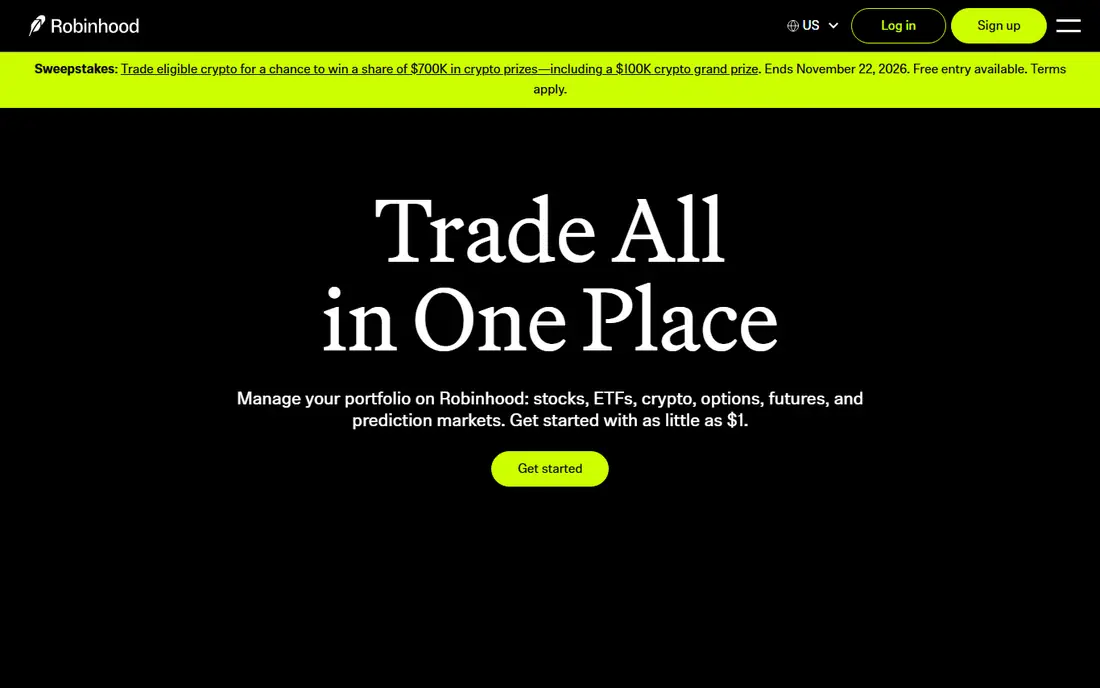
Robinhood remains the easiest investment app to start with. The interface is clean, trades take few taps, and fractional shares from $1 let small investors buy into expensive stocks and ETFs. Robinhood charges $0 for stock, ETF and options trades, and its IRA match can add 1% to 3% on eligible IRA contributions depending on the plan, which rewards steady retirement saving. Crypto trading is also available in the same app, though crypto carries its own risks and price swings.
The limits are clear. Robinhood does not offer mutual funds, so investors who want a broad mutual fund portfolio will need another broker. Research tools are also thinner than those at Fidelity or Schwab, with less depth on fund analysis and planning. Robinhood suits casual, mobile-first investors who want a simple start and are comfortable learning elsewhere. Investors who want deep research, mutual funds and planning tools should start with Fidelity or Schwab instead.
- Very simple mobile interface
- $0 commissions on stocks, ETFs and options
- Fractional shares from $1 and IRA match for eligible users
- No mutual funds
- Research is thinner than Fidelity or Schwab
Vanguard is built for long-term, low-cost investing rather than frequent trading. Its index funds and ETFs are among the lowest-cost in the industry, and that cost advantage compounds over decades in a retirement account. Online US stock and ETF trades carry $0 commission, and Vanguard offers traditional and Roth IRAs alongside taxable accounts. For an investor who wants to buy broad index funds, set up regular contributions and leave the portfolio alone, Vanguard is a natural fit.
The app and website are plainer than Fidelity or Robinhood, and active traders will find fewer charting and trading tools. Customer service hours and fund minimums also need a check, since some mutual funds still carry minimums even though ETF trades do not. If your plan is steady index investing for retirement, Vanguard deserves a place near the top of your shortlist.
- Low-cost index funds and ETFs
- $0 commissions on online US stocks and ETFs
- Strong fit for buy-and-hold retirement investing
- App and website feel plainer than rivals
- Less suited to frequent trading
E*TRADE, from Morgan Stanley, suits beginners who want to grow into active investing. The core offer matches the leaders: $0 commissions on online US stock and ETF trades, fractional shares in some cases, and traditional and Roth IRAs. Charting, screening and education tools are stronger than Robinhood, which helps investors who want to study a stock before buying. Daily market commentary and webcasts add context for new investors who follow news closely.
The brand structure can confuse at first, since some Morgan Stanley services sit alongside ETRADE tools. Options traders should note the $0.65 per contract fee, in line with Fidelity and Schwab. For a beginner who expects to trade more often and wants better tools than a simple app, ETRADE is a solid middle ground.
- $0 commissions on online US stocks and ETFs
- Good charting and screening tools
- Paper trading for practice in some accounts
- Owned by Morgan Stanley, so some features sit across brands
- Options cost $0.65 per contract
Webull appeals to cost-conscious investors who want strong trading tools without paying for them. The app offers $0 commissions on US stocks and ETFs, detailed charts, screeners and paper trading for practice. Fractional share trading on eligible stocks lets small investors start with modest amounts, and extended-hours trading is available for eligible users. For a beginner who wants to learn charting and practise before trading, Webull gives more tools than Robinhood at the same headline commission.
The gaps mirror Robinhood. Webull does not offer mutual funds, and retirement planning tools are thinner than at Fidelity, Schwab or Vanguard. Customer support is mainly online, which may frustrate investors who want phone help during market hours. Webull is best for self-directed investors who are comfortable learning from charts and community tools, and who do not need a full-service broker for retirement planning.
- $0 commissions on US stocks and ETFs
- Strong charts and paper trading
- Fractional shares on eligible stocks
- No mutual funds
- Research and retirement planning are thinner than full-service brokers
SoFi Invest suits investors who want banking and investing in one app. The platform charges $0 for stock and ETF trades and offers both self-directed investing and an automated portfolio option for investors who prefer not to pick stocks. That dual approach is useful for couples or households where one person wants control and the other wants automation. SoFi also offers banking, loans and other financial products, so cash, saving and investing can sit in one login.
Research depth is lighter than at Fidelity or Schwab, and the fractional share range is narrower than the broadest brokers. It is a good pick for a beginner who values simplicity, automation and having money products in one place, and who is happy to use outside sources for research.
- $0 commissions on stocks and ETFs
- Automated investing option in the same app
- Banking, lending and investing in one place
- Research is lighter than Fidelity or Schwab
- Fractional share range is narrower than some rivals
Acorns takes a different approach from the brokers above. Instead of asking you to pick stocks, it invests spare change from card purchases and recurring contributions into a managed portfolio based on your risk level. That automation helps beginners who struggle to invest regularly, since small amounts add up without a monthly decision. The app also offers banking and retirement features in higher tiers, which can suit users who want a single money app.
The cost model needs attention. Acorns charges a subscription fee, so on a very small balance the fee can take a larger share of returns than a $0 commission broker would. Acorns is best for habit building and for investors who know they will not invest without automation. Investors with larger balances or a wish to pick funds should compare Fidelity or Schwab first, since $0 trades and low-cost funds may cost less over time.
- Automatic round-ups and recurring investing
- Simple managed portfolios
- Good habit builder for new investors
- Subscription fee applies even on small balances
- Less control over individual stocks
Betterment is a robo-adviser, which means it builds and manages a diversified portfolio for you based on your goals and risk tolerance. Automatic rebalancing keeps the portfolio near its target mix, and goal tools help investors plan for retirement, a home deposit or another major goal. Tax-loss harvesting on eligible plans can help taxable accounts by selling losing positions to offset gains, subject to tax rules and account type. For investors who do not want to pick stocks or rebalance by hand, Betterment removes much of the ongoing work.
The trade is cost and control. Betterment charges an advisory fee as a percentage of assets, so it costs more than a $0 commission broker for a self-directed index portfolio. Betterment is best for hands-off investors who value planning, automation and a managed portfolio over stock picking.
- Managed portfolios with automatic rebalancing
- Goal-based planning for retirement and major goals
- Tax-loss harvesting on eligible plans
- Advisory fee applies as a percentage of assets
- Not suited to picking individual stocks
How we picked these
We compared official feature pages, pricing pages, app store listings, privacy policies and public reviews for investment apps that work in the United States in October 2026. We looked at commissions, account types, fractional shares, research, education, automation and extra fees, and we favoured apps with clear fee disclosure and strong security practices. We did not claim hands-on testing of trading or account servicing, and we did not rank on marketing claims alone.
This guide is for information only and is not financial advice. Investing involves risk, including possible loss of principal, and past performance does not guarantee future results. Check fees, tax treatment and account terms on the provider site before opening an account, and consider speaking to a qualified adviser about retirement and tax decisions.
Choosing between self-directed and managed investing
Self-directed apps such as Fidelity, Schwab, Robinhood and Webull let you pick stocks, ETFs and funds yourself. That control suits investors who want to learn, who have a clear plan and who will keep fees low by favouring broad, low-cost funds. Managed apps such as Betterment and Acorns pick and rebalance a portfolio for you. That automation suits investors who want to save regularly without making frequent decisions, and who are willing to pay a fee for that service.
Start small and keep fees in view
A good first step is to open one account, set up a small recurring contribution and favour broad index ETFs or funds while you learn. Fractional shares make it possible to start with modest amounts, but a small start does not remove risk. Check options fees, margin interest, transfer fees and advisory fees before you use those features, since headline $0 stock commissions do not cover every service. Avoid margin borrowing as a beginner, since borrowed money can increase losses as well as gains.
Accounts to consider first
For most beginners, a Roth IRA or traditional IRA deserves attention before a taxable account, since retirement accounts offer tax benefits that taxable accounts do not. A taxable brokerage account is useful for goals before retirement and for money you may need sooner, but gains in taxable accounts can create a tax bill. Keep an emergency fund separate from invested money, so market falls do not force you to sell at a loss.
Frequently asked questions
What is the best investment app for beginners?
Fidelity is our overall pick for beginners, with $0 stock and ETF commissions, fractional shares from $1, strong education and IRA options. Charles Schwab is a close second for education and research, while Robinhood suits investors who want the simplest mobile start.
What are the best stock apps for small amounts?
The best stock apps for small amounts are those with fractional shares and $0 commissions, such as Fidelity, Robinhood and Webull. Fractional shares let you invest a dollar amount rather than buying a full share, which helps when a single share costs hundreds of dollars.
What is the best app for stocks if you want managed investing?
Betterment and Acorns are the strongest managed choices here. Betterment builds goal-based portfolios with rebalancing and tax-loss harvesting on eligible plans, while Acorns automates round-ups and recurring investing for habit builders. Both charge fees, so compare them with a low-cost self-directed index portfolio.
What are the best investing apps for beginners who want retirement accounts?
Fidelity, Schwab, Vanguard and Robinhood all offer IRAs, with Fidelity and Schwab offering the broadest research and planning tools alongside them. Vanguard suits long-term index investors, while Robinhood IRA match may appeal to steady contributors who meet the plan terms.
Do the best investment apps charge for stock trades?
Most major apps on this list charge $0 for online US stock and ETF trades, but options, margin, transfers and advisory services can still carry fees. Check the full fee schedule on the provider site, since $0 commission does not mean every service is free.
Sources
See where you really rank - block by block
ProMapRanker scans Google Maps across a grid of your service area. Simple monthly plans from $19, white-label on every plan.
Start freeKeep reading
 youtube alternatives
Best YouTube Alternatives in 2026
Looking for youtube alternatives in 2026? We compare Vimeo, Dailymotion, Twitch, Rumble, and more on price, audience, monetization, control and privacy.
Read → what's the best ai tool for photo editing
What Is the Best AI Tool for Photo Editing in 2026
What is the best AI tool for photo editing? We compare ten tools for 2026, from Photoshop and Lightroom to Luminar, Topaz, Canva and mobile editors today.
Read → twitter alternatives
Best Twitter Alternatives in 2026
Compare the best twitter alternatives for 2026, from Bluesky, Threads, and Mastodon to Reddit, Tumblr, and Micro.blog, with free plans and audience notes.
Read →