 ProMapRanker
Best investing apps in 2026: 9 apps compared

Key takeaways
- Fidelity and Charles Schwab give beginners the widest mix of $0 stock and ETF trades, retirement accounts and learning material at no account minimum.
- Robinhood and Webull suit mobile-first traders, while Betterment and Wealthfront suit people who want a portfolio managed for them.
- Acorns works best for small, regular contributions, but a flat monthly fee can weigh heavily on a very small balance.
- Fractional shares from $1 at several brokers make it possible to start with a small amount and build a habit over time.
Quick comparison
| Pick | Great for | Pricing starts at | Free tier | |
|---|---|---|---|---|
 Fidelity | All-round beginners | Free | Yes | Visit |
 Charles Schwab | Support and retirement planning | Free | Yes | Visit |
 Robinhood | Simple mobile trading | Free | Yes | Visit |
 Webull | Active traders and practice trading | Free | Yes | Visit |
 SoFi Invest | Hands-off beginners | Free | Yes | Visit |
 Vanguard | Low-cost index investors | Free | Yes | Visit |
 Betterment | Goal-based automated investing | $5 per month | No | Visit |
 Wealthfront | Automated investing and tax planning | See website | No | Visit |
 Acorns | Round-ups and small contributions | $4 per month | No | Visit |
The best investing apps
We compared brokers and automated services on commissions, account minimums, fractional shares, retirement accounts and the clarity of their fee pages. The list below covers the best stock investment apps for different habits, from picking your own stocks to letting a service manage the portfolio.
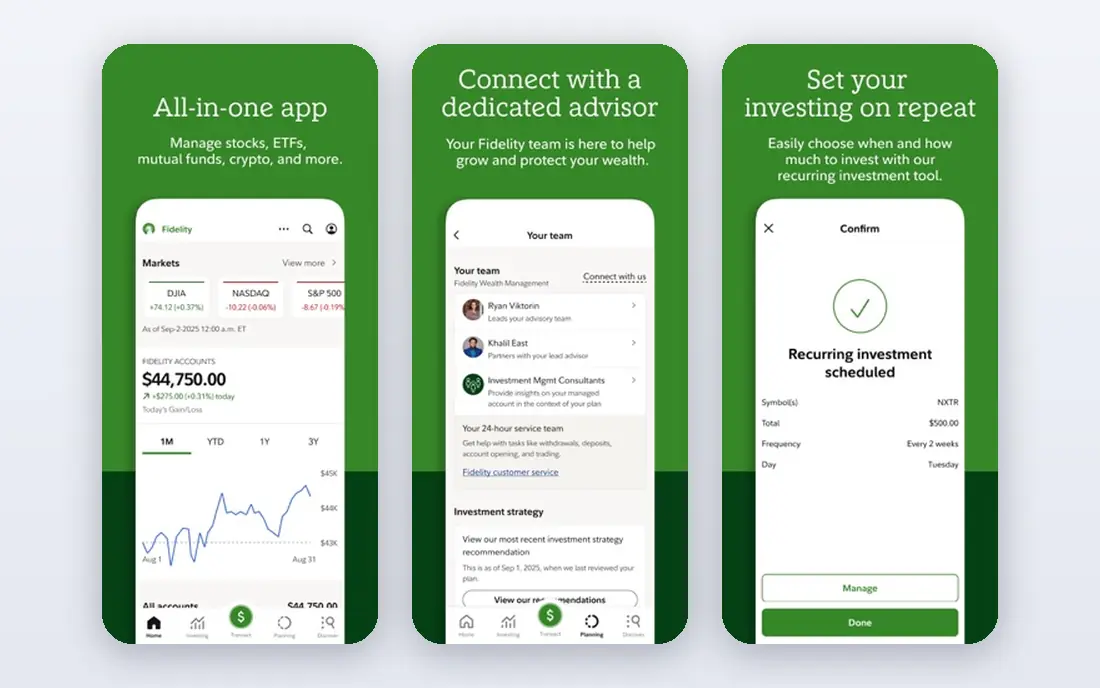
Fidelity is our pick for most new investors because it covers the basics so completely. You can open an account with no minimum, buy fractional shares from $1, and use the same app for a brokerage account, an IRA and a health savings account. The research and education material is deep, which helps when you move from a first ETF purchase to questions about asset allocation. The catch is mainly about expectations. Fidelity is not the flashiest app, and some features sit in a separate desktop platform for more active traders. That is a fair trade for most long-term investors, since the core app stays clear and the fee schedule stays easy to follow. Check the list of ETFs that carry a transaction fee before you buy a fund outside the commission-free range.
- $0 commissions on most online US stock and ETF trades
- Fractional shares from $1
- Wide range of retirement accounts and research
- Options carry a $0.65 per contract fee
- A small number of ETFs carry a transaction fee
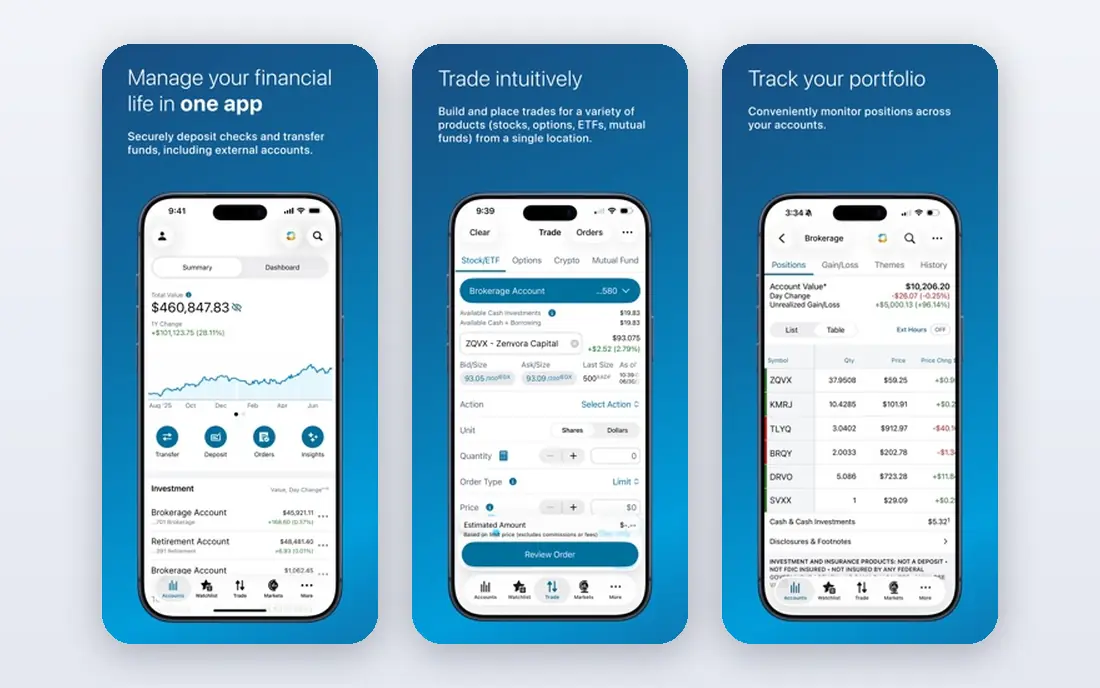
Schwab pairs $0 online equity trades with human support that many app-only brokers do not offer. Fractional share orders from $1 let you build positions in higher-priced stocks without waiting to save the full share price. Retirement accounts, education savings and banking sit alongside brokerage in one login, which keeps a household plan in one place. New users may find the range of platforms confusing, since Schwab offers a mobile app, a website and the thinkorswim platform for active traders. Start in the main app and move to the advanced tools only if you need them. Schwab also suits investors who want to talk through a rollover or a retirement question rather than rely only on chat support.
- $0 online stock and ETF commissions
- Fractional shares from $1
- Branch and phone support
- Options carry a $0.65 per contract fee
- The full platform can feel large at first
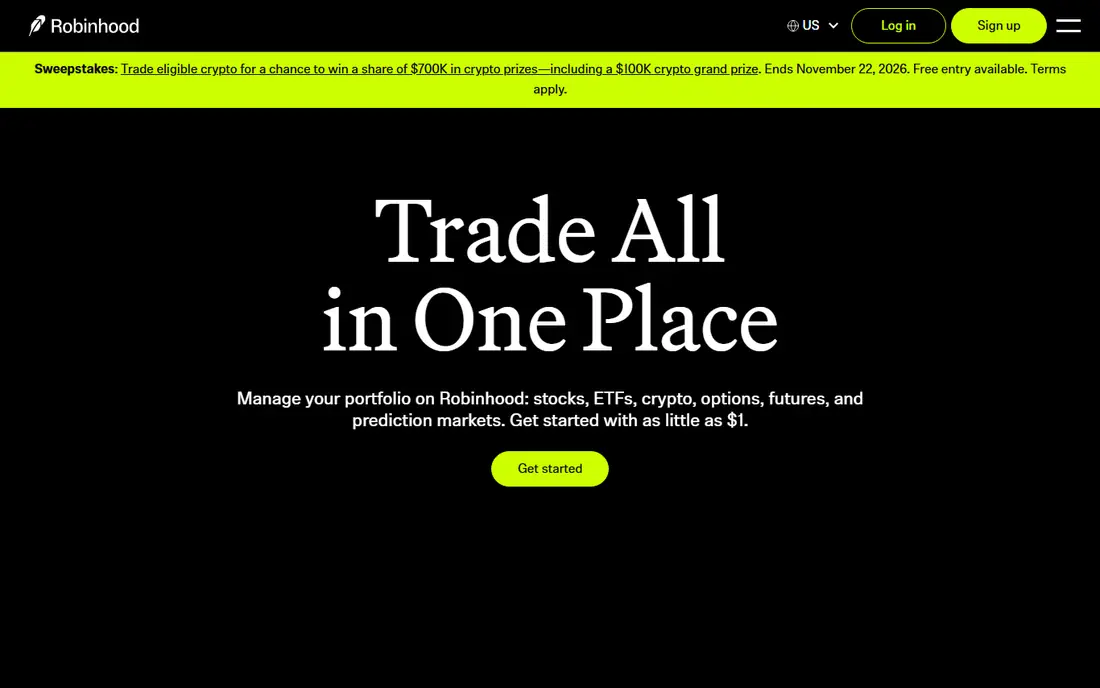
Robinhood remains the simplest way to place a first trade from a phone. The app keeps the order screen short, supports fractional shares from $1, and charges no contract fee on options trades. For people who already know what they want to buy, that simplicity is a real benefit, and the optional Gold plan adds research and a higher rate on uninvested cash for $5 per month. The trade-off is depth. Research, retirement planning tools and customer support are thinner than at the large full-service brokers. Robinhood also charges $100 for a full account transfer out, so think about whether you plan to stay before you build a large position there. It fits confident, mobile-first traders better than people who want guided planning.
- Clean mobile app
- $0 stock and ETF commissions
- $0 options contract fee
- Fractional shares from $1
- Limited research compared with Fidelity and Schwab
- Transfer-out fee applies to a full account transfer
Webull gives active beginners a middle path between a bare-bones trading app and a professional terminal. Paper trading lets you practise orders, test a chart setup and learn how a position moves without risking cash. The desktop and mobile apps include technical indicators, extended-hours trading and market data that Robinhood keeps simpler. That depth can also distract. Charts and news feeds make it easy to trade more often than a long-term plan requires, and frequent trading usually hurts returns. Use Webull if you want to learn charting and order types, and set a clear rule for how often you will trade. Investors who mainly want an IRA and automatic contributions will find Fidelity or Schwab calmer choices.
- $0 stock and ETF commissions
- Paper trading with virtual funds
- Detailed charts and market data
- Fewer retirement and planning tools than larger brokers
- Full transfer-out fee is $75
SoFi Invest suits people who want investing to sit next to their bank account and run with little attention. Active investing offers $0 commissions and fractional shares, while automated investing builds and rebalances a diversified portfolio for you. That combination works well for a first IRA or a regular contribution plan where the goal is steady saving rather than stock picking. SoFi is less suited to investors who want mutual funds or deep research tools. The app is built for simplicity, so advanced traders will miss the screeners and desktop platforms offered elsewhere. If you already use SoFi for banking or student loan refinancing, the shared login is a practical plus, but judge the investing service on its own merits first.
- $0 stock and ETF commissions
- Automated investing option
- Banking and lending in the same app
- No mutual fund trading in active investing
- Research is lighter than at Fidelity or Schwab
Vanguard is the natural pick for investors who plan to hold broad index funds for years and care most about keeping fund costs low. The brokerage offers $0 commissions on most online stock and ETF trades, and Vanguard funds are known for low expense ratios. Retirement accounts and target-date funds are easy to set up, which helps people who want a plan they can leave alone. The app will not excite anyone who wants fast charts, social features or crypto trading. Vanguard also limits its appeal for active traders, since its tools are built around long-term holding rather than frequent orders. For a buy-and-hold investor, that restraint is a feature, not a flaw, because it keeps attention on contributions and time in the market.
- $0 commissions on most online US stock and ETF trades
- Low-cost index funds
- Strong retirement focus
- App and website feel plain compared with newer brokers
- Fewer tools for active traders
Betterment builds a diversified portfolio from your goals, risk level and time horizon, then rebalances it and harvests tax losses in taxable accounts. That structure helps people who know they should invest but do not want to choose funds or watch the market. The planning tools let you set separate goals for retirement, a home deposit or a general nest egg, each with its own allocation. Pricing needs a close read. Digital costs $5 per month for smaller balances without a qualifying recurring deposit, and 0.25% per year once the balance or deposit condition is met. That flat fee can feel high on a tiny balance, so Betterment makes most sense once you contribute regularly. Premium, at a higher fee, adds unlimited access to certified financial planners.
- Automated rebalancing and tax-loss harvesting
- Goal-based planning
- No account minimum for Digital
- Small-balance pricing is $5 per month unless you meet the deposit or balance condition
- Human advice needs the Premium tier
Wealthfront takes a similar automated path to Betterment, with a strong focus on tax management and financial planning tools. The automated investing account charges 0.25% per year, rebalances for you, and includes tax-loss harvesting in taxable accounts. Direct indexing becomes available at higher balances, which can improve tax efficiency for larger taxable portfolios. The $500 minimum means Wealthfront is not the best first stop for someone starting with $20, and there is no human advisor to call for a complex question. People who are comfortable with a fully digital service and want tax-aware automation will get the most from it. Compare the total fee at your expected balance, since a percentage fee grows in dollar terms as the portfolio grows.
- Automated portfolio management
- Tax-loss harvesting in taxable accounts
- Cash account and planning tools
- $500 minimum for the automated investing account
- No human advisor access
Acorns turns spare change into an investing habit, which is its real strength. Round-ups move small amounts into a diversified portfolio automatically, and recurring deposits can add to that habit each week or month. The app also offers retirement accounts and, on higher tiers, accounts for children, so a family can keep several goals in one place. The fee structure is the honest catch. Bronze costs $4 per month for new customers, and that flat fee is a large percentage of a $100 balance, even though it becomes modest as the balance grows. Acorns is best for people who will use it as a main investing account with regular deposits, not only for occasional round-ups. If you want to pick individual stocks, choose a brokerage instead.
- Automatic round-ups from everyday spending
- Simple portfolios
- Retirement and family account options
- Flat monthly fee can be high relative to a small balance
- Limited control over individual holdings
How we picked these
We compared official feature pages, pricing pages and app store listings, and we read public reviews to check how each service presents fees, minimums and account types. We looked for services that are widely available in the United States, that publish clear commission and advisory fee information, and that cover a distinct investing style, from self-directed trading to fully automated portfolios. We did not claim hands-on testing, and prices in this guide reflect the vendor pages and reputable pricing summaries available in October 2026, so check the fee schedule before you open an account.
What to check before you pick an investing app
Start with how you will actually invest. If you want to pick stocks and ETFs yourself, a $0-commission brokerage with fractional shares and a good IRA option will serve you well. If you want to set a contribution and stop thinking about allocation, an automated service is worth its fee, provided you understand whether that fee is flat or percentage-based. Next, check the costs beyond the headline commission. Options contract fees, transfer-out fees, fund expense ratios and advisory fees all affect returns over time. A flat monthly fee hurts a small balance most, while a percentage fee hurts a large balance most in dollar terms, so run the numbers at the balance you expect in a year. Finally, check account types and safety features. Confirm the app offers the IRA or taxable account you need, two-factor authentication, and SIPC protection for brokerage accounts, and read the fee schedule for your account type. This guide is not financial advice, and investing carries risk, including the possible loss of money. Past performance does not guarantee future results, so consider speaking with a qualified adviser for a plan tied to your own situation.
Frequently asked questions
What is the best investment app for beginners?
Fidelity is a strong starting point for most beginners because it offers $0 commissions on most online US stock and ETF trades, fractional shares from $1, retirement accounts and broad learning material. Schwab is a close alternative if you value branch and phone support. Choose the app whose account types and fee schedule fit the way you plan to invest, not only the one with the cleanest home screen.
What is the best app for buying stock with a small amount?
The best app for buying stock with a small amount is one with $0 commissions and fractional shares from $1, such as Fidelity, Schwab, Robinhood or Webull. Fractional shares let you buy a slice of a higher-priced stock rather than waiting to afford a full share. Keep an eye on any flat monthly fee, since it can outweigh the benefit of starting small.
Are free investing apps really free?
Stock and ETF trades are $0 at the major brokers listed here, but free does not mean cost-free in every case. Options fees, transfer fees, fund expenses, advisory fees and spreads on some products still apply. Read the full fee schedule for the account you plan to open, and compare the total cost at your expected balance before you decide.
What is the best free investing app?
There is no single best free investing app, because the right choice depends on whether you want to trade yourself or have a portfolio managed for you. Fidelity and Schwab offer the broadest free brokerage features, Robinhood offers the simplest mobile experience, and SoFi suits people who want banking and investing together. For automated investing, a free brokerage alone will not manage the portfolio for you.
Should I choose a robo-advisor or pick my own investments?
Pick your own investments if you enjoy research, want control over individual holdings, and will keep contributions regular without prompting. Choose a robo-advisor such as Betterment or Wealthfront if you prefer automatic rebalancing and a portfolio built around your goals. The trade-off is cost and control, since automation charges a fee and limits your choice of holdings.
Is investing through an app safe?
Brokerage accounts at established US firms are generally protected by SIPC up to $500,000, including $250,000 in cash, if the firm fails, but SIPC does not protect against market losses. Use strong passwords, turn on two-factor authentication, and confirm the firm and account type before you transfer money. Investing always carries risk, and the value of stocks and ETFs can fall.
Sources
See where you really rank - block by block
ProMapRanker scans Google Maps across a grid of your service area. Simple monthly plans from $19, white-label on every plan.
Start freeKeep reading
 youtube alternatives
Best YouTube Alternatives in 2026
Looking for youtube alternatives in 2026? We compare Vimeo, Dailymotion, Twitch, Rumble, and more on price, audience, monetization, control and privacy.
Read → what's the best ai tool for photo editing
What Is the Best AI Tool for Photo Editing in 2026
What is the best AI tool for photo editing? We compare ten tools for 2026, from Photoshop and Lightroom to Luminar, Topaz, Canva and mobile editors today.
Read → twitter alternatives
Best Twitter Alternatives in 2026
Compare the best twitter alternatives for 2026, from Bluesky, Threads, and Mastodon to Reddit, Tumblr, and Micro.blog, with free plans and audience notes.
Read →