 ProMapRanker
Best Inventory Management Software for Small Business in 2026

Key takeaways
- Zoho Inventory is the best value starting point, with a free plan and paid plans from $29 per month.
- Cin7 Core at $349 per month suits multichannel sellers that need purchasing, manufacturing, and warehouse depth in one system.
- inFlow suits wholesale and B2B sellers, while Sortly suits teams that mainly need to know what is where.
- Square for Retail and Lightspeed suit shops that want inventory tied to the point of sale, not a separate system.
Quick comparison
| Pick | Great for | Pricing starts at | Free tier | |
|---|---|---|---|---|
 Zoho Inventory | Small sellers on a budget | $29 per month | Yes | Visit |
 Cin7 Core | Multichannel sellers | $349 per month | Free trial | Visit |
 inFlow | B2B and wholesale sellers | $99 per month | Free trial | Visit |
 Katana | Small manufacturers | $299 per month | Yes | Visit |
 Fishbowl | QuickBooks-centered warehouses | $229 per month | Free trial | Visit |
 Sortly | Simple visual tracking | $49 per month | Yes | Visit |
 Square for Retail | Shops already on Square | Free | Yes | Visit |
 Lightspeed Retail | Specialty retailers | See website | Free trial | Visit |
 Ordoro | Multichannel ecommerce sellers | $349 per month | Free trial | Visit |
The best inventory management software for small business
Small business inventory software should answer three questions fast: what do we have, where is it, and what needs ordering. The tools below differ in how they answer those questions, and in whether they also handle orders, manufacturing, or point of sale. We compared official pricing pages and current 2026 comparisons, and we kept only tools that are live and clearly suited to small businesses in October 2026.
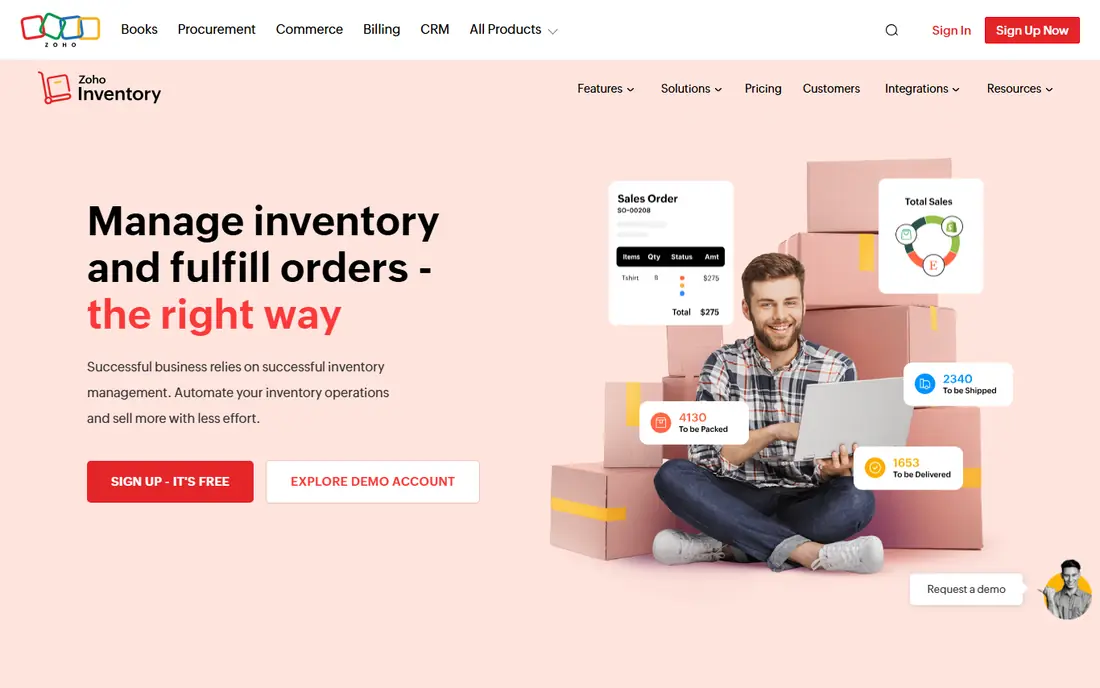
Zoho Inventory is our pick for most small businesses starting out, because it pairs a real free plan with paid plans from $29 per month and covers the core jobs well. It handles purchase orders, sales orders, multi-channel selling, and basic warehousing, plus batch and serial tracking for businesses that need to follow specific lots. For a small online seller, that is a lot of system for the price.
The limits to watch are order caps on lower tiers and the fact that deeper warehouse features sit on higher plans. Businesses already using Zoho Books or Zoho CRM will get extra value from the shared data. If you sell high volumes across many channels, you may outgrow Zoho faster than a Cin7 or inFlow, but for a first serious inventory system, Zoho is hard to beat on value.
- Genuine free plan
- Multi-channel order handling
- Batch and serial tracking
- Order caps on lower tiers
- Advanced warehousing costs more
- Best inside the Zoho ecosystem

Cin7 Core is built for product businesses that sell across several channels and need one system to keep stock, orders, purchasing, and production in sync. It covers multichannel sync, warehouse management, and demand forecasting, with a large integration library for marketplaces and carriers. That depth is why scaling brands choose it once spreadsheets and basic tools stop keeping up.
The price is the honest barrier: Core starts at $349 per month, with a 14-day free trial. That only makes sense once order volume and channel complexity justify it. Small sellers should start with Zoho or Sortly and move to Cin7 when stock errors, overselling, or manual order handling start costing real money. For that scaling stage, Cin7 is a strong, proven choice.
- Deep multichannel and warehouse coverage
- Purchasing and manufacturing in one system
- Many integrations
- High entry price for a small business
- Annual contract expectations
- Setup takes time
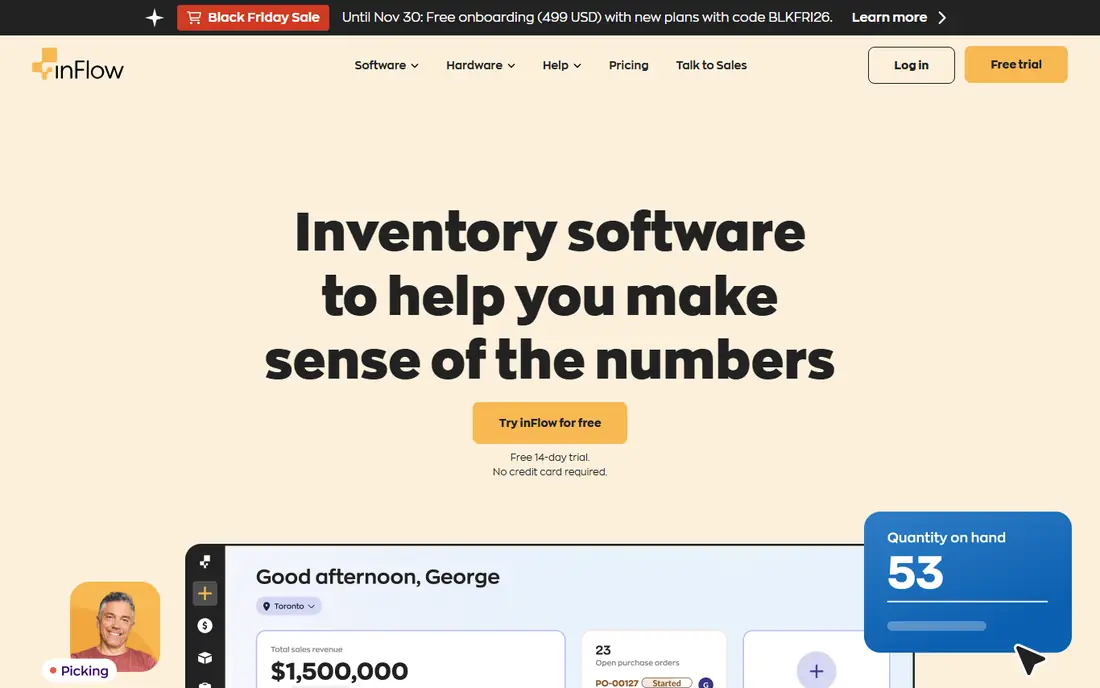
inFlow suits wholesale and B2B businesses that sell to other companies rather than only to consumers. Its B2B showroom lets trade customers browse and order, while built-in invoicing and order management keep the sales process in one place. Multi-level bills of material also help businesses that assemble products from components.
Pricing starts at $99 per month when billed annually, with a 14-day free trial and no permanent free plan. That puts inFlow above budget tools, but below Cin7, which matches its middle position on depth. If your business runs on wholesale orders, showrooms, and repeat trade customers, inFlow fits better than a retail-first tool. Pure retailers may prefer Square or Zoho.
- B2B showroom portal
- Strong order and invoicing tools
- Multi-level bills of material
- Higher entry cost than budget tools
- Wholesale focus may exceed simple retail needs
- Trial only, no free plan
Katana is built for small manufacturers and makers who need to track raw materials through production to finished goods. It handles bills of material, production planning, and stock levels for both ingredients and finished items, which a pure inventory tool often handles poorly. That makes it a natural fit for food producers, cosmetics makers, furniture builders, and other small production businesses.
Paid plans start at $299 per month, with a free plan available for smaller use, and manufacturing depth is sometimes an add-on depending on the plan. Pure resellers who never make anything should skip Katana, since they pay for production tools they will not use. For a business that makes what it sells, Katana connects the workshop and the warehouse in a way few rivals match.
- Raw material to finished goods tracking
- Production planning
- Unlimited users on paid plans
- High paid entry price
- Manufacturing features are the point, so pure resellers waste money
- Add-ons cost more
Fishbowl is the warehouse-heavy choice for businesses already running QuickBooks. It adds real-time inventory, assembly tracking, and warehouse management on top of QuickBooks accounting, so stock and books stay in sync without manual double entry. Manufacturers and distributors with a warehouse operation get the most from it.
Essentials starts at $229 per month billed annually, and advanced manufacturing sits on a higher tier. Businesses that do not use QuickBooks will gain less, since the integration is the core advantage. If QuickBooks is already your accounting system and your warehouse needs more than basic tracking, Fishbowl is a logical next step.
- Deep QuickBooks integration
- Real-time assembly tracking
- Warehouse depth
- Entry price is high for very small firms
- QuickBooks-centered, so non-QuickBooks users gain less
- Advanced manufacturing costs more
Sortly is the simplest tool in this list, and that is its strength. It tracks items visually, with photos, QR codes, and barcodes, from a phone, so a team can check items in and out and see what is where without learning a full ERP-style system. Equipment teams, supply rooms, and small shops that track gear and materials will find it refreshingly quick to adopt.
It is not built for high-volume order processing, and features such as purchase orders and stock counts vary by plan. Paid plans start at $49 per month, with a free plan for limited use. If your main problem is knowing what you own and where it sits, Sortly solves it. If your main problem is processing hundreds of orders across channels, choose Zoho or Cin7 instead.
- Photo-based mobile catalog
- QR and barcode scanning
- Fast to set up
- Less depth for high-volume sales
- Purchase orders and counts vary by plan
- Item caps on lower tiers
Square for Retail suits brick-and-mortar shops already running Square at the counter. Inventory lives inside the point-of-sale system, so a sale updates stock in real time and multi-location counts stay current without a separate sync step. The free tier covers basic POS inventory, which makes it a very low-risk start for a new shop.
Advanced warehouse and purchasing depth is limited compared with Cin7 or Fishbowl, and paid retail plans add per-location cost. Shops that sell mainly in person, with a modest online presence, will find Square enough. Shops that sell heavily across marketplaces should pair Square with a dedicated inventory tool, or choose a multichannel system from the start.
- Inventory tied to point of sale
- Free starting tier
- Real-time multi-location counts
- Limited advanced warehouse tools
- Paid retail plans cost more per location
- Best inside Square
Lightspeed Retail is the inventory-first point-of-sale choice for specialty retailers with complex variants, such as apparel sizes, bike parts, or pet supplies. It handles vendor catalogs, purchase orders, and analytics alongside the till, which helps shops that manage many suppliers and seasonal ranges. That retail depth is why specialty stores choose it over a generic POS.
Pricing has varied across sources in 2026, so we list it as See website and recommend confirming the current plan price before budgeting. Lightspeed is POS-led, so a pure warehouse or wholesale business will gain less from it. For a specialty shop that lives at the counter and needs serious variant and vendor handling, it remains a strong pick.
- Deep retail POS inventory
- Complex variants and vendor catalogs
- Analytics for specialty shops
- Pricing varies and should be confirmed
- POS-led, so pure warehouse users gain less
- Setup effort
Ordoro combines inventory, order management, and shipping for multichannel ecommerce sellers, with automated order forwarding and forecasting to reduce manual work. That combination suits brands that ship from their own warehouse and sell on several marketplaces, since stock, orders, and shipments stay linked. Dropshipping and supplier automation features add further value for brands that split fulfillment.
The inventory app starts at $349 per month, with a 15-day free trial, so it sits in the same price band as Cin7 Core. Single-channel shops will not need that depth. For a growing ecommerce brand that ships daily and struggles with stock accuracy across channels, Ordoro is a credible alternative to Cin7, and the choice often comes down to which shipping and automation workflow fits better.
- Automated order forwarding
- Forecasting
- Shipping and stock in one place
- High inventory plan price
- 15-day trial only
- Overkill for a single-channel shop
How we picked these
We compared official vendor pricing pages and current 2026 inventory comparisons, and we kept only tools that are live and clearly suited to small businesses in October 2026. We covered the main small-business models, budget sellers, multichannel brands, wholesalers, makers, warehouse teams, visual trackers, and POS-led retailers, rather than listing nine versions of the same tool. Where published prices conflicted across sources, we wrote See website rather than guessing.
How to choose inventory software for a small business
Start with how you sell. A single shop needs POS inventory, a multichannel brand needs channel sync, a wholesaler needs B2B ordering, and a maker needs production tracking. List your channels, your order volume, and your must-have features, such as barcode scanning, batch tracking, or multi-location stock, then shortlist only tools that cover those must-haves on their entry plan.
Mistakes to avoid
Do not buy warehouse depth you will not use for a year, and do not buy a visual tracker when your real problem is overselling across marketplaces. Check order caps, user limits, and per-location charges before signing, since the headline price often excludes them. Run a trial with real products, real barcodes, and a real order cycle, and confirm that stock updates correctly across every channel you use.
Frequently asked questions
What is the best inventory software for small business?
Zoho Inventory is the best all-round pick for most small businesses, thanks to its free plan and paid plans from $29 per month. Cin7 Core suits scaling multichannel brands, inFlow suits wholesalers, Katana suits makers, and Square for Retail suits shops already on Square. The best tool depends on how you sell.
What is the best free inventory software for small business?
Zoho Inventory, Sortly, Katana, and Square for Retail all offer free plans or free tiers, though each free plan has limits on orders, items, or features. Zoho gives the most complete free inventory system for small online sellers, while Sortly gives the simplest free visual tracker. Check the current limits on the vendor site before relying on a free plan.
What is the best inventory software for small business with multiple sales channels?
Cin7 Core and Ordoro are the strongest multichannel picks, with channel sync, warehouse handling, and forecasting at $349 per month each. Zoho Inventory covers multichannel selling at a much lower price for smaller volumes. Choose Cin7 or Ordoro when manual order handling and stock errors start costing real money.
Does QuickBooks include inventory tracking?
QuickBooks includes inventory tracking on its Plus plan and higher, but businesses with warehouse depth, assembly, or multichannel complexity often add Fishbowl for warehouse management on top of QuickBooks. If you already use QuickBooks and need deeper warehouse control, Fishbowl is the natural add-on.
How much does small business inventory software cost?
Entry prices in this list range from free for Square for Retail and Zoho free plans, through $29 per month for Zoho, $49 for Sortly, $99 for inFlow billed annually, and up to $349 per month for Cin7 Core and Ordoro. Quote-based and POS-led tools vary, so confirm per-location and per-user charges before budgeting.
Can inventory software track manufacturing?
Yes, but only some tools do it well. Katana is built for small manufacturers, with bills of material and production planning, while Fishbowl adds assembly tracking for QuickBooks users and Cin7 covers manufacturing for multichannel brands. Pure inventory trackers such as Sortly do not replace a production system.
Sources
See where you really rank - block by block
ProMapRanker scans Google Maps across a grid of your service area. Simple monthly plans from $19, white-label on every plan.
Start freeKeep reading
 zscaler alternatives
Best Zscaler Alternatives in 2026
Looking for zscaler alternatives? We compare 9 SASE and zero trust platforms on architecture, data protection, pricing, and fit for your network and team.
Read → zapier alternatives free
Best Zapier Alternatives Free in 2026
Nine automation tools for zapier alternatives free in 2026, all with genuinely free tiers, plus free plan limits, starting prices and upgrade paths explained.
Read → which platform is best for online reputation
Which Platform Is Best for Online Reputation in 2026
Wondering which platform is best for online reputation? We compare 8 review, listing, and response tools for small and multi-location businesses and agencies.
Read →