 ProMapRanker
5 Best Inventory Forecasting Software for Apparel Brands for 2026
Direct answer
Start with Netstock if you need mid-size brands that run an ERP. Listed starting prices: Netstock from $900 a month, Forecast Pro from $199 per user a month and Inventory Planner from $119.99 a month (Essentials). Alternatives: Forecast Pro for teams that build their own forecast models, and Inventory Planner for Shopify apparel brands starting with forecasting. Details, prices and limits for the rest of the 5 tools are below.
ProMapRanker compared 5 inventory forecasting software for apparel brands. The goal is a practical shortlist: published prices, free plan facts, best-fit use cases and honest limits for every entry.
Key takeaways
- Top of the list is Netstock, which targets mid-sized brands that run an ERP.
- A fair warning about Forecast Pro: needs a skilled planner to get value.
- Inventory Planner has the lowest monthly starting price in this list: $119.99 per month.
- For large brands with a planning team, Slimstock is worth a look.
Quick comparison
| Pick | Great for | Pricing starts at | Free tier | |
|---|---|---|---|---|
 Netstock | Mid-sized brands that run an ERP | $900 a month | No | Visit |
 Forecast Pro | Teams that build their own forecast models | $199 per user a month | No | Visit |
 Inventory Planner | Shopify apparel brands starting with forecasting | $119.99 a month (Essentials) | Free trial | Visit |
 Lokad | Brands that want probabilistic forecasting | $2,500 a month | No | Visit |
 Slimstock | Large brands with a planning team | Quote only | No | Visit |
Inventory Forecasting Software for Apparel Brands profiles
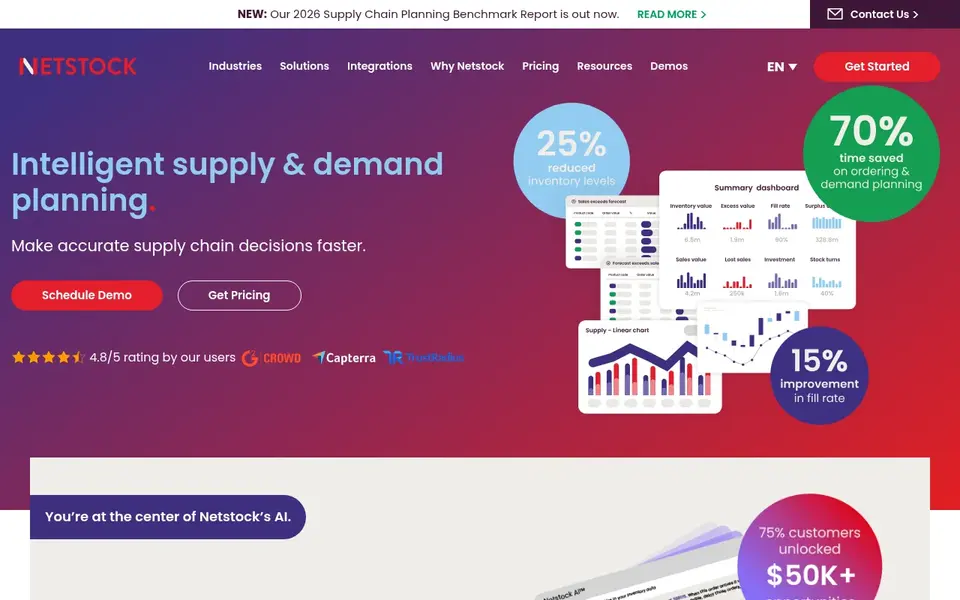
For mid-sized brands that run an ERP, Netstock is a natural candidate. Safety stock is set by service level, so a core style that must never stock out gets a higher target than a one-off seasonal piece.
A black tee that sells all year deserves a 98 percent service level and a deep safety stock, whereas a trend-led print that lives for one season deserves a lower target and a smaller buy. The starting price for Netstock: $900 per month. No free plan comes with Netstock.
Limits to weigh: no free trial.
- Service-level driven safety stock by SKU
- Published pricing from $900 per month
- Needs an ERP in place to use
Forecast Pro works best for teams that build their own forecast models. An apparel planner who knows that a trade display will move a style can build that event into the forecast. There is no free trial, and per-user pricing means a team of five planners pays just under $1,000 per month.
It also sits apart from your inventory system, so the forecast has to be handed over to purchasing. For everyday use, Forecast Pro assumes the person using it understands demand planning. A team without that skill will get less from it than from a guided tool like Inventory Planner. Price to start with Forecast Pro: $199 per user per month. Forecast Pro does not include a free plan.
Drawbacks to consider: no free trial.
- Manages seasonality, trends, promotions
- Full control over statistical models and overrides
- Per-user pricing brings up quick
Inventory Planner
Great for: Shopify apparel brands starting with forecasting
Inventory Planner is designed for Shopify apparel brands starting with forecasting. The Essentials plan costs $119.99 per month for a single Shopify store and one warehouse, and everything above that is quote-based and scales with your gross merchandise value and SKU count. Pick this if you sell on Shopify and you want forecasting without an ERP project.
Worth adding: the trade-off is the commercial model: only Essentials has a published price, and merchants have reported significant raises at renewal since the Sage acquisition. On top of that, the tool also flags dead stock so a brand can mark it down before it ties up cash for another season. In daily use, for apparel, the handy part is the variant-level view. Inventory Planner pricing: $119.99 per month. Free options: Free trial.
Downsides: only one published level.
- Purchase order suggestions with lead times
- Made for Shopify and ecommerce first
- Higher levels are quote-based
Lokad serves brands that want probabilistic forecasting. Pick this if your catalog is broad and your demand is spiky. That matters in apparel, where a style can sell steadily for months and then spike.
Lokad manages long-tail and intermittent demand well, which is the pattern of a slow size in a broad size curve. There is no free trial, and the evaluation runs through a sales conversation and a pilot. The starting price for Lokad: $2,500 per month. Lokad does not include a free plan.
Downsides: needs data science support to get full value.
- Probabilistic forecasts that present the range of outcomes
- Purpose-built for retail and apparel
- No free trial
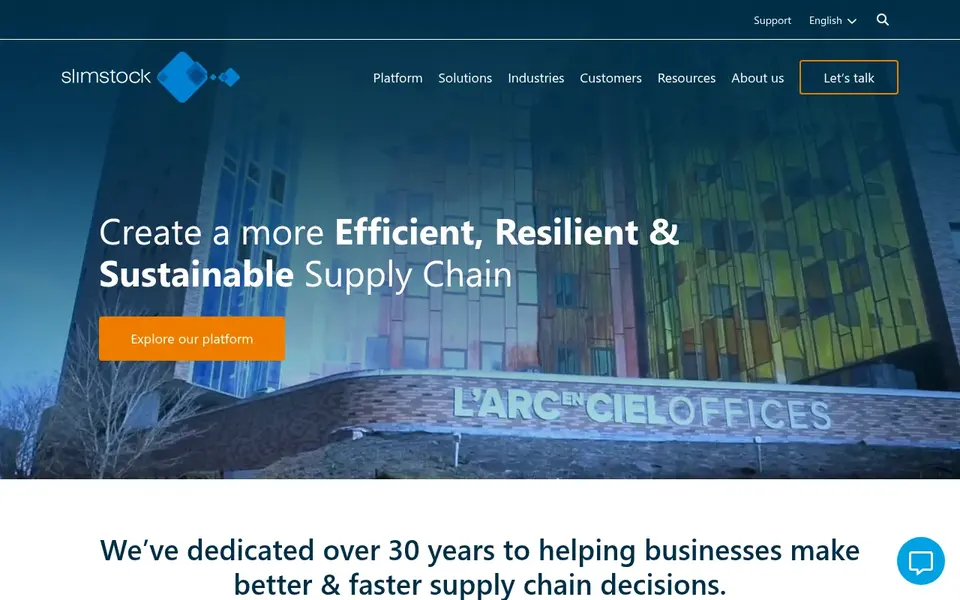
Slimstock works best for large brands with a planning team. Slimstock sells Slim4, a system that merges demand forecasting with inventory optimization, replenishment, and multi-echelon planning, and it is aimed at large firms with an in-house supply chain team. Its demand sensing reacts to live demand signals instead of relying only on historical patterns.
Downsides: implementation usually takes 6 to 10 weeks.
Worth adding: scenario planning lets a team model a promotion, an assortment change, or a supply disruption before committing to orders. Beyond that, for apparel, the scenario work is the most valuable piece: a buyer can test what happens to the buy if a drop ships two weeks late, or if a key size sells twice as fast as planned, and see the effect on stock and cash before the purchase order goes out. There is no fixed entry price for Slimstock; pricing comes through a quote. Slimstock has no permanent free option.
- Scenario planning for promotions and disruptions
- Shelf-life management for fresh categories
- Quote-only pricing with a long sales process
More on inventory forecasting software for apparel brands
Start with your size curve. Pull last season's sales by size for your top 20 styles, and check if your shortlist plans at that level: a tool that forecasts total units per style will keep ordering the sizes that do not sell. Also, then check the lead time math.
Worth adding: a forecaster that cannot read your Shopify or ERP sales data will need manual exports, and that weekly chore is where most forecasting projects quietly die.
How we compared the tools
We compared the tools on published pricing, free plan or trial availability, feature coverage for inventory forecasting software for apparel brands, and the limits each vendor documents. Figures are shown as the vendors publish them. Billing terms, seat minimums and add-ons can change the real cost. Order on the page follows fit for the typical buyer first, then price transparency and free access. Your own requirements should decide the final pick.
Things to verify first
- Confirm the entry price on the vendor page. For Slimstock that means a quote rather than a fixed price.
- Take the trial from Inventory Planner and push a live task through it before you pay.
- Read the limits listed for Netstock first: needs an ERP in place to use.
- Price Lokad for your actual team size; headline prices rarely include add-ons or overage.
- Before you load data into Inventory Planner, check what an export looks like and who can run it.
Frequently asked questions
Do these tools publish their prices?
Not all of them. Slimstock publishes no starting price, so expect a quote request for it. The rest, Netstock included, show a starting price, though seats and billing terms still change the final cost.
How do I forecast a brand-new style with no sales history?
Use a like-for-like style: pick a past style with a similar price, fabric, and silhouette, and copy its size curve and sell-through as the starting forecast. Then adjust for the differences, for example a new color or a higher price, and review the forecast weekly once real sales arrive.
How far ahead should an apparel brand forecast?
A tool that only forecasts four weeks ahead cannot support a seasonal buy. Check the horizon before you commit, and confirm the tool can model a new drop with no history.
Is Netstock the right pick for everyone comparing inventory forecasting software for apparel brands?
No single tool suits every team. Netstock comes first because it fits mid-size brands that run an ERP, while Forecast Pro suits teams that build their own forecast models and Inventory Planner suits Shopify apparel brands starting with forecasting. Match the tool to your own size, budget and workflow before deciding.
Can I try these tools before paying?
Often, yes. Inventory Planner offers a free trial. Use your own data and a real task during the test, and check what the free tier or trial limits before you rely on it.
Does any tool for inventory forecasting software for apparel brands here have a free plan?
A permanent free plan is not offered by Netstock, Slimstock or the other tools here. Inventory Planner offer a trial. Plan a short evaluation period instead.
Sources
See where you really rank - block by block
ProMapRanker scans Google Maps across a grid of your service area. Simple monthly plans from $19, white-label on every plan.
Start freeBrowse all guides
← 6 Best Ecommerce Returns Apps for Small Brands in 20266 Best Partner Management Software for Ecommerce Brands for 2026 →
 best content curation tools
Content Curation Tools in 2026: Top 6 Compared
6 best content curation tools, with entry costs, free tiers and the buyer each one serves. Every profile names its biggest catch. Reviewed in November 2026.
Read → best ai decisioning platforms for marketing
AI Decisioning Platforms for Marketing: Best Picks of 2026
Best AI Decisioning platforms for marketing, compared. 7 tools with published prices, free plans and limits. Details on cost, catches and fit. Decide faster.
Read → best workflow software for marketing teams
2026 Guide to the Best Workflow Software for Marketing Teams
Weighing the best workflow software for marketing teams? We lined up 7 products by cost, free access and fit. With pricing notes and limits. See which fits.
Read → best app marketing companies
Best App Marketing Companies in 2026
Compare the best app marketing companies for ASO, paid growth, creative and retention, with service scope and fit explained for app teams in this guide.
Read → best white label software
Best White Label Software in 2026
Compare the best white label software for agencies, with pricing, branding options, billing models, per-client costs, and honest trade-offs for resellers.
Read → best multifamily marketing platforms
Top 6 Multifamily Marketing Platforms for 2026, Compared
Searching for the best multifamily marketing platforms? Here are 6 options with prices and free plans. Each tool is judged on the same checks. Quick to scan.
Read →More in Marketing Software · All guides A to Z by date · Latest guides