 ProMapRanker
Best International Payroll Software for HR in 2026

Key takeaways
- The first choice is model, not brand: employer of record, owned-entity payroll, or payroll aggregation each suit a different hiring pattern.
- Deel and Remote lead for broad country coverage, while Papaya Global and CloudPay fit finance-led multi-country payroll.
- Pricing is mostly quoted, and per-employee fees, contractor fees, and payment fees should be compared together.
- This article is general information only, not tax or legal advice, and local rules should be checked with a qualified adviser before hiring.
Quick comparison
| Pick | Great for | Pricing starts at | Free tier | |
|---|---|---|---|---|
 Deel | Broad hiring with contractors and employees | See website | Free trial | Visit |
 Remote | Owned-entity hiring with one platform | See website | No | Visit |
 Papaya Global | Enterprise payroll and payments consolidation | See website | No | Visit |
 Rippling | US-first teams wanting HR, IT, and payroll | See website | No | Visit |
 ADP GlobalView | Large multinationals with complex payroll | See website | No | Visit |
 Oyster | First-time global hiring with guided support | $29 per contractor per month | No | Visit |
 Playroll | Mid-size teams wanting hands-on support | $10 per employee per month | No | Visit |
 Safeguard Global | Compliance-heavy global payroll | See website | No | Visit |
 CloudPay | Global payroll with treasury links | See website | No | Visit |
The best international payroll software for hr teams
We compared tools live in October 2026 that pay employees or contractors in more than one country, either as employer of record, through owned entities, or through local payroll partners. US-only payroll tools were left out.
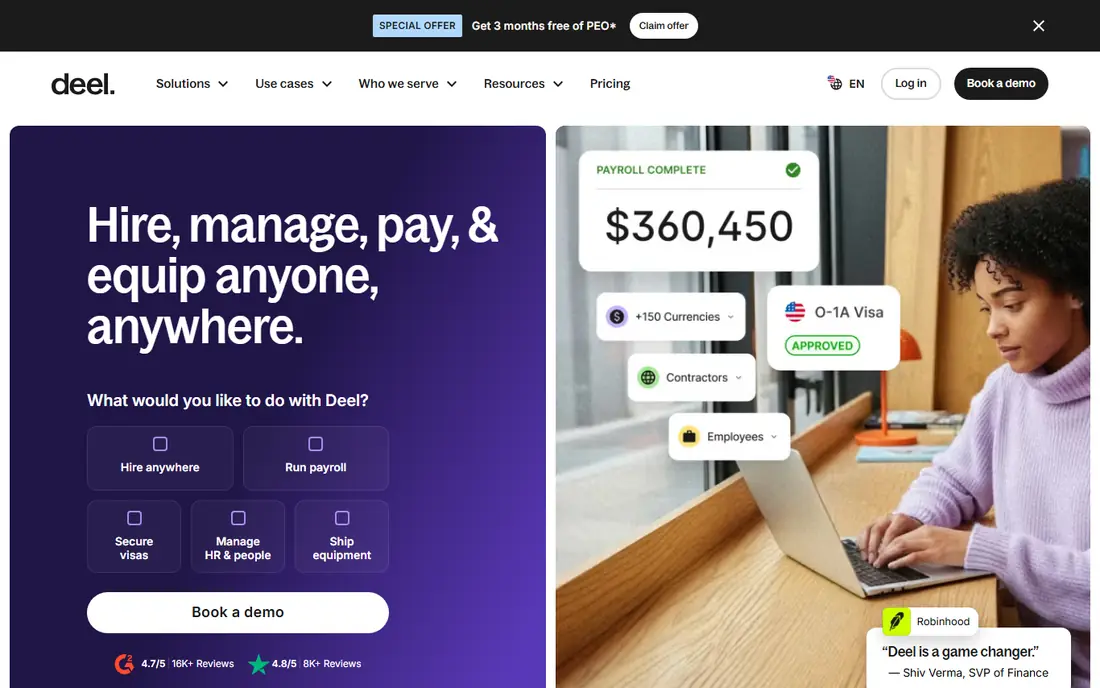
Deel is the broadest all-in-one choice for teams hiring across many countries. It covers employer of record services, contractor management, global payroll, HR records, and IT tools in one platform, with payment options in many currencies. Teams that hire both contractors and employees abroad can keep both groups in one system rather than running separate tools.
The cost is the catch, especially for employer of record seats, which are priced per employee per month at enterprise levels. Some prices are quoted rather than published, and the range of modules can feel heavy for a team with only a few hires abroad. For fast global growth, though, the breadth is hard to match.
- Very broad country coverage
- Contractor and employee workflows in one place
- Many integrations and payment options
- Employer of record pricing is high for small teams
- Some prices need a sales quote
- Many modules can feel complex
Remote runs global employment through its own entities in many countries, which its own comparisons present as a control and support advantage. The platform combines employer of record, global payroll, contractor management, and HR records, with payslips, time off, and expenses in self-service tools. Finance teams also get accounting links for common ledgers.
Coverage and pricing vary by country, and some services still rely on partners outside the owned network. Employer of record pricing is also at enterprise levels, so small teams should compare contractor-only costs first. For a company that wants one platform and a consistent hiring experience, Remote is a leading shortlist pick.
- Owned-entity model in many countries
- Unified employer of record, payroll, and HR records
- Clear self-service tools
- Pricing is mostly quoted
- Some country coverage uses partners
- Enterprise features sit on higher tiers

Papaya Global fits finance-led enterprises that need to consolidate payroll across many countries and pay through one set of rails. It aggregates local payroll data, manages payments, and gives finance a consolidated view of costs, liabilities, and payroll runs. That central view helps companies that now juggle many local vendors and spreadsheets.
It is built for enterprise scale, with custom pricing and a setup that assumes a finance team. Small teams hiring in a few countries will find simpler tools cheaper and faster. For a large company standardizing global payroll, Papaya Global is a strong candidate.
- Strong multi-country payroll aggregation
- Payment rails and liability coverage
- Finance reporting across countries
- Enterprise pricing and setup
- Best suited to larger teams
- Smaller teams may find it heavy
Rippling suits US-first companies that want HR, payroll, and IT in one system, with global payroll added as the team expands abroad. One employee record can drive payroll, benefits, app access, and device setup, which cuts duplicate entry. The integration library is broad, covering accounting, hiring, and expense tools.
Global coverage is narrower than Deel or Remote in direct payroll terms, and pricing depends on which modules a team buys. A company whose workforce is mostly abroad may prefer a global-first tool. A US-centered company adding international hires gradually will get more value from Rippling as a whole system.
- One data source for HR, IT, and payroll
- Many integrations
- Modular setup for growing teams
- Global payroll depth varies by country
- Pricing is modular and quoted
- International hiring is not its sole focus
ADP GlobalView, from ADP, serves large multinationals that need consolidated multi-country payroll with broad partner coverage. It handles complex payroll structures, statutory reporting, and integrations with human capital systems, and it benefits from ADP long history in payroll. Large finance and HR teams can standardize processes across many countries.
The system is enterprise in price, setup time, and complexity, and it is not aimed at startups or small teams. Implementation needs planning and often partner help. For a multinational with complex structures and a need for proven scale, ADP GlobalView remains a serious option.
- Long enterprise payroll history
- Broad country coverage through partners
- Deep compliance and reporting tools
- Enterprise pricing and long setup
- Interface can feel complex
- Smaller teams will find it heavy
Oyster fits remote-first teams hiring abroad for the first time, with guided contracts, compliant hiring support, and a human tone in its service. Contractor management starts at $29 per contractor per month in public listings, which makes contractor hiring easy to start. The platform covers a broad country range for employer of record hiring as well.
Employer of record pricing is much higher than contractor pricing, so teams should compare the two costs for their actual mix. Feature depth is narrower than Deel or Rippling, and some countries use partner models. For a first global hire with support needs, Oyster is a friendly starting point.
- Guided employer of record hiring
- Contractor management from $29 per contractor per month
- Human support focus
- Employer of record seats cost far more than contractor seats
- Country depth varies
- Smaller feature range than Deel
Playroll offers multi-country payroll with a compliance focus and hands-on support, aimed at mid-size teams that want people to talk to, not only a portal. Public listings put payroll from $10 per employee per month, which is lower than employer of record pricing, though the exact service scope should be confirmed in a quote. The platform covers several dozen countries for payroll.
Country coverage is smaller than the largest rivals, so teams hiring in many markets should check their specific countries first. Enterprise reporting and integration depth are also more limited. For a mid-size team hiring in a defined set of countries, Playroll offers a clear price and a support-led approach.
- Multi-country payroll from $10 per employee per month in listings
- Compliance focus
- Hands-on support
- Country count is smaller than Deel or Remote
- Enterprise features are limited
- Pricing varies by service
Safeguard Global suits companies in regulated or compliance-heavy settings that want advisory help beside payroll processing. It covers many countries through local partners, with employer of record, payroll, and workforce services in one relationship. HR teams that need guidance on local rules, contracts, and statutory filings often value that advisory layer.
The partner model means service quality can vary by country, and pricing is quoted. Setup may also take longer than with a cloud-first, owned-entity tool. For a company where compliance risk outweighs speed, Safeguard Global is a credible enterprise choice.
- Broad country coverage through partners
- Compliance and advisory focus
- Payroll and hiring services together
- Pricing is quote-based
- Partner model varies by country
- Setup can be slower than cloud-first rivals
CloudPay gives finance teams global payroll with treasury and payment integration, so payroll funding and reporting sit closer to finance operations. It covers many countries and offers consolidated reporting for multi-country runs, which helps close the month across entities. The system is built for enterprises with complex payroll calendars.
Like other enterprise tools, pricing is quoted and setup needs planning. Small teams will find it heavy and costly. For a large company that wants payroll, treasury, and finance reporting linked, CloudPay is a strong enterprise pick.
- Global payroll across many countries
- Treasury and finance integration
- Consolidated payroll reporting
- Pricing is quote-based
- Enterprise focus
- Smaller teams may find it heavy
How we picked these
We compared official product pages and public global payroll comparisons, and kept tools live in October 2026 that pay workers in more than one country through employer of record, owned entities, or payroll aggregation. We left out US-only payroll tools and generic HR tools with no global payroll function. Where a vendor does not publish a price, we wrote See website rather than guessing.
What to check before you buy
Start with your hiring map: list each country, worker type, and headcount, since that map decides the model. Employer of record fits hiring where you have no entity. Owned-entity payroll fits steady headcount in core countries. Aggregation fits companies that already have entities and need one payroll view. Then check statutory filings, benefits, data protection, and payment timing for each country, and confirm who is liable if a filing is late.
This article is general information only, not financial, tax, or legal advice. International payroll rules change by country and by worker type, and a tool does not remove the need for local advice. Get a written quote that separates employer of record fees, payroll fees, contractor fees, and payment fees, and run a trial payroll for one country before rolling out to all of them.
Frequently asked questions
What is the difference between employer of record and global payroll?
An employer of record legally employs a worker in a country where your company has no entity, handling contracts, payroll, taxes, and benefits. Global payroll pays workers through your own entities or local partners, without the provider becoming the legal employer. The right model depends on whether you have an entity in each hiring country.
How much does international payroll software cost?
Costs vary by model: contractor management can start near $29 per contractor per month, multi-country payroll listings start near $10 per employee per month for some vendors, and employer of record seats often cost several hundred dollars per employee per month. Add payment, currency, and implementation fees to any quote before comparing.
Do these tools handle taxes and compliance?
They handle payroll calculations, statutory filings, and compliant contracts in covered countries, but coverage and liability vary by vendor and country. A tool reduces manual work, it does not guarantee compliance in every case. Check local rules with a qualified adviser, especially for worker classification, benefits, and data protection.
Can one tool cover contractors and employees?
Yes, Deel, Remote, Oyster, and several others cover both, though pricing and features differ by worker type. Contractor workflows focus on payments and tax forms, while employee workflows add contracts, benefits, and statutory payroll. Confirm that both workflows work in each country you need, not only in headline countries.
Should HR or finance own global payroll?
Both need a role: HR owns hiring, contracts, and worker data, while finance owns payroll funding, reporting, and audit. The best setup gives HR a hiring workflow and finance a payroll calendar, approval chain, and consolidated report. Agree ownership before rollout, since a gap between teams causes missed filings.
Sources
See where you really rank - block by block
ProMapRanker scans Google Maps across a grid of your service area. Simple monthly plans from $19, white-label on every plan.
Start freeKeep reading
 zoro.to alternatives
Best Zoro.to Alternatives in 2026
We compare the best zoro.to alternatives in 2026, listing only legal licensed anime streaming services, from Crunchyroll to free options for fans today.
Read → zip alternatives
Best Zip Alternatives in 2026
We compare the best zip alternatives for buy now, pay later in 2026, covering pay-in-4 plans, fees, spending limits, and credit reporting options today.
Read → yesware alternatives
Best Yesware Alternatives in 2026
Compare the best yesware alternatives for sales email tracking, templates, and sequences, with current pricing and honest tradeoffs for small sales teams.
Read →