 ProMapRanker
Best International Payroll Platforms in 2026

Key takeaways
- Deel and Remote are the safest first shortlist for most companies, with Deel favoring mixed workforces and Remote favoring owned-entity depth.
- Global payroll and employer of record are different services, and their prices differ by hundreds of dollars per employee per month.
- Most enterprise pricing is custom, so get a written quote for your exact countries and headcount before budgeting.
- Country coverage figures vary by service type, so confirm payroll, EOR and contractor coverage separately for each market you need.
Quick comparison
| Pick | Great for | Pricing starts at | Free tier | |
|---|---|---|---|---|
 Deel | Mixed global workforces | $29 per employee per month | No | Visit |
 Remote | Owned-entity hiring abroad | $50 per employee per month | No | Visit |
 Papaya Global | Enterprise payroll and payments | $29 per employee per month | No | Visit |
 Oyster HR | Small EOR teams abroad | $29 per contractor per month | No | Visit |
 Rippling | HR, IT and payroll in one system | See website | Free trial | Visit |
 Multiplier | Budget-conscious global expansion | See website | No | Visit |
 Remofirst | Low-cost EOR for small teams | $199 per employee per month | No | Visit |
 CloudPay | Enterprise payroll with treasury links | See website | No | Visit |
 Safeguard Global | Compliance-heavy enterprise payroll | See website | No | Visit |
The best international payroll platforms
Hiring abroad creates two different jobs. Global payroll pays people through your own local entities, while an employer of record hires people on your behalf where you have no entity. Many platforms sell both, plus contractor payments, but the price and coverage for each service differ. This guide covers the best international payroll software and the best global payroll companies behind it, with a plain note up front: this is general information only, not legal or tax advice, and local rules change by country.
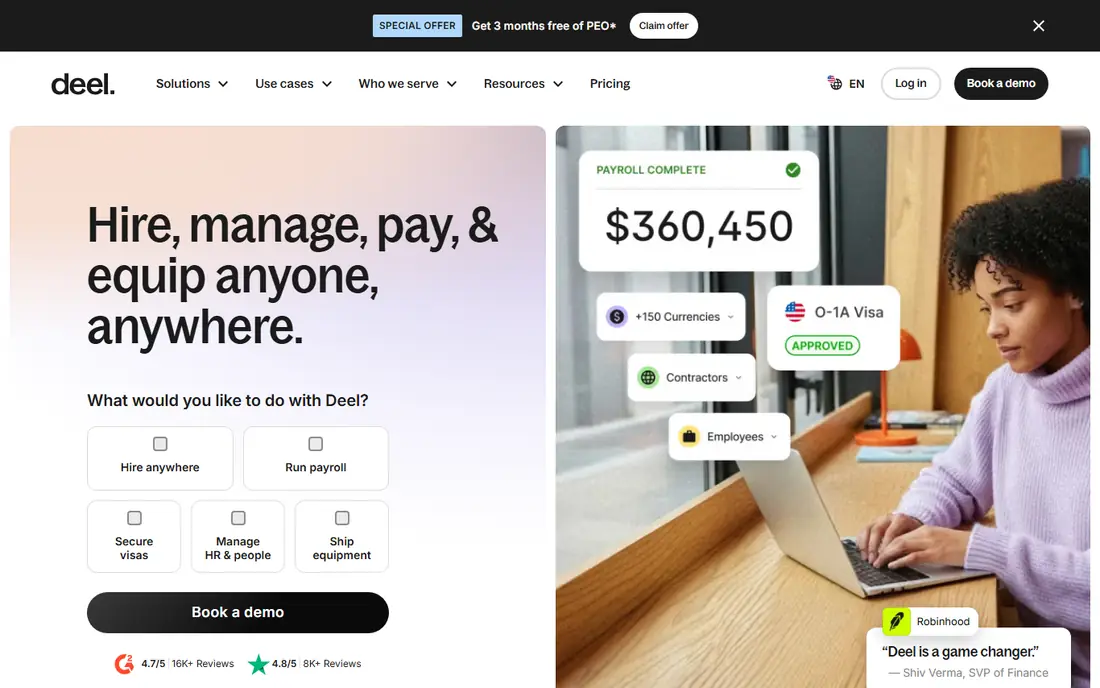
Deel suits companies with a mixed workforce of contractors, EOR employees and direct payroll staff across many countries. One dashboard covers contracts, payments, taxes and compliance checks, which reduces the number of vendors a finance team must chase. Integrations with common HR and finance tools also help as headcount grows.
The price gap matters. Global payroll has been reported from $29 per employee per month, while EOR starts at $599 per employee per month, and contractor management from $49 per contractor per month. A company that only needs payroll should not budget using the EOR figure, and a company that needs EOR should not expect payroll pricing. Get both figures in writing for your countries.
- Contractors, EOR and payroll in one platform
- Broad country coverage
- Many integrations
- EOR pricing is much higher than payroll pricing
- Some modules need a custom quote
Remote appeals to companies that care about who actually employs their staff abroad. Its owned-entity model gives it direct control in many markets, rather than relying only on partners, and its public pricing makes early comparison easier than with quote-only rivals. Contractors, payroll for your own entities, a US PEO and equity tools sit in the same account.
Pricing has been reported at $599 per employee per month for EOR on annual billing, or $699 on monthly billing, with global payroll from $50 per employee per month and contractors from $29 per month. That EOR figure is a serious cost for a small team, so Remote fits best when compliance depth and IP protection justify the price.
- Owned entities in many markets
- Transparent public pricing
- Contractors and equity in one account
- EOR price is high for small teams
- Coverage varies by service type

Papaya Global fits enterprises that pay employees and contractors in many countries and want payroll, EOR and payments on one platform. Centralized payment rails and workforce analytics help finance teams see total labor cost across markets, rather than reconciling many local payroll reports. Coverage across 160 or more countries suits large, spread-out teams.
Smaller companies may find Papaya Global heavier than they need, and EOR pricing has been reported from $499 per employee per month in some comparisons, with Payroll Plus from $29. That split shows why a quote must separate payroll from EOR. For enterprises, the analytics and payment control are the main reason to choose Papaya Global over a simpler platform.
- Centralized payments across many countries
- Workforce analytics
- Enterprise scale
- Enterprise focus can feel heavy for small teams
- EOR pricing is custom in many cases
Oyster HR suits remote-first teams hiring their first few employees abroad. Published pricing, at $699 per employee per month for EOR and $29 per contractor per month, lets a small team budget without a long sales process. Local expert networks help with contracts and compliance questions in each market.
The honest limit is scale. At $699 per EOR employee per month, a team of ten abroad costs far more than payroll through owned entities, so Oyster HR is best for a small number of EOR hires. Confirm payroll coverage separately, since Oyster HR's EOR reach is broader than its native payroll reach.
- Published flat-rate EOR pricing
- No minimum headcount reported
- Local expert support
- EOR price is high per person
- Payroll coverage is narrower than EOR coverage
Rippling appeals to companies that want one system for HR, IT and payroll, rather than separate tools for each job. US payroll and HR are strong, and global payroll, EOR and contractor modules extend that system abroad. For a US-headquartered company that is adding international staff, keeping one vendor can simplify onboarding and device management.
Modular pricing is the drawback. Rippling does not publish a single global EOR price, and the total depends on which modules a company buys. That makes early comparison harder than with Deel or Remote. Rippling is best for teams that already want a unified HR and IT platform, not for teams that only need payroll in two countries.
- One system for HR, IT, finance and payroll
- Strong US base
- Many integrations
- Pricing is modular and quote-based
- Global payroll depth varies by country
Multiplier suits mid-market teams that need EOR coverage at a lower price than Deel or Remote. EOR pricing has been reported around $400 to $499 per employee per month depending on billing, with coverage across 150 or more countries. No setup fees have been reported, which helps early-stage teams control upfront cost.
Payroll pricing is less transparent than EOR pricing, so a team that needs payroll through its own entities should request a written quote. Multiplier is a strong budget EOR pick, but it is not the best choice for a company that needs deep enterprise payroll analytics or treasury integration.
- Lower EOR pricing than many rivals
- Broad EOR coverage
- No setup fees reported
- Payroll pricing is less transparent
- Enterprise depth varies by market
Remofirst stands out on price alone, with EOR reported from $199 per employee per month, well below the $599 to $699 range of larger rivals. That makes it worth a look for startups hiring one or two people abroad who cannot justify a premium EOR fee. Onboarding is designed for small teams without a large HR staff.
The trade-off is depth. Coverage, local support and enterprise features vary by country, so a team should confirm the exact market, benefits handling and termination process before hiring. Remofirst is best as a low-cost EOR option for a small headcount, not as an enterprise payroll replacement.
- Low EOR entry price
- Simple onboarding for small teams
- Contractor support
- Coverage and support depth vary by country
- Enterprise features are thinner
CloudPay fits large companies that run payroll through their own entities and need finance integration. Treasury links, multi-country reporting and payroll controls help finance teams manage cash flow and compliance across many markets. Coverage across 130 or more countries suits multinationals with complex structures.
Small teams should look elsewhere. Pricing is custom, implementation takes planning, and the product is built for enterprise payroll operations rather than a first international hire. For a large company replacing fragmented local payroll vendors, CloudPay's finance integration is the main attraction.
- Enterprise payroll depth
- Treasury and finance integration
- Multi-country reporting
- Custom enterprise pricing
- Implementation can be complex for small teams
Safeguard Global suits compliance-heavy environments where advisory support matters as much as software. Its model pairs payroll and EOR services with local compliance guidance, which helps firms in regulated sectors or complex markets. Coverage across 170 or more countries covers most enterprise footprints.
Pricing is custom and the sales process is enterprise-led, so small teams will find faster, cheaper options elsewhere. For a large firm that needs advice alongside payroll, Safeguard Global's advisory depth can justify the slower, quote-based process.
- Advisory-led compliance support
- Broad multi-country coverage
- EOR and payroll options
- Custom pricing
- Sales-led process can be slow for small teams
How we picked these
We compared current 2026 global payroll and EOR guides, vendor pricing pages and published EOR pricing studies, and kept only platforms that are actively sold and serve real international employment or payroll work. We separated payroll pricing from EOR pricing wherever sources allowed, and we used See website where a vendor does not publish a price. We did not run hands-on trials, and we did not treat country coverage figures as identical across payroll, EOR and contractor services.
What to check before you sign
Start by naming the exact service you need in each country: payroll through your own entity, EOR hiring, or contractor payments. Those three services have different prices, contracts and compliance duties, and a vendor quote that mixes them will mislead a budget. List every country, headcount and worker type, then ask for a quote on that exact list.
Total cost, not headline cost
Ask about implementation fees per entity, deposit requirements, benefits costs, termination costs and currency conversion charges. EOR pricing often excludes local employer taxes and benefits, while payroll pricing may exclude implementation. A written quote that lists each charge is worth more than a low headline rate.
Compliance and worker classification
Ask who holds employment liability, how contracts are drafted, and how worker classification is checked. Misclassifying a contractor as an employee, or the reverse, creates tax and legal risk. This guide is general information only, not legal or tax advice, so confirm country-specific rules with qualified local advisers before hiring.
Reporting and integrations
Check consolidated reporting across countries, finance system integrations and data security terms. Finance teams need one view of total labor cost, while HR teams need onboarding, time off and benefits in one place. Test reporting on a small pilot country before rolling a platform out to twenty markets.
Frequently asked questions
What is the best international payroll software for small teams?
Deel and Remote are strong starting points, with Remofirst worth checking for low-cost EOR hires. Small teams should start with payroll pricing if they have entities, and EOR pricing if they do not. Compare total cost for your exact countries, not a global headline figure.
What is the best global payroll company for enterprises?
Papaya Global, CloudPay, Safeguard Global and ADP-style enterprise providers suit large, multi-country payroll operations. The best choice depends on whether a company needs payment rails, treasury integration or advisory support. Enterprises should run a pilot in two or three countries before a full rollout.
How much does international payroll cost per employee?
Global payroll has been reported from about $29 per employee per month on several platforms, while EOR ranges from about $199 to $699 per employee per month depending on vendor and billing. Contractor management is cheaper, often from $25 to $49 per contractor per month. Local taxes, benefits and implementation fees sit on top of those figures.
What is the difference between global payroll and EOR?
Global payroll pays employees through your own local entity, while an employer of record becomes the legal employer in a country where you have no entity. EOR lets a company hire faster abroad, but it costs much more per person. Contractor platforms pay independent contractors, which is a different legal relationship again.
Do international payroll services handle taxes and compliance?
They handle payroll calculations, filings and compliance checks in the countries they cover, but the employer still holds ultimate responsibility for correct classification and local law compliance. Ask each vendor exactly which filings it handles in your countries, and confirm gaps with local advisers.
Sources
- https://valueaddvc.com/blog/best-payroll-and-eor-providers-for-startups-in-2026-deel-vs-remote-vs-rippling-ranked
- https://www.playroll.com/blog/best-multi-country-payroll-software
- https://www.wisemonk.io/blogs/global-payroll-services
- https://leadchangegroup.com/global-payroll-software/
- https://rankite.com/blog/best-global-payroll-software-for-hr
- https://www.deel.com
- https://remote.com
- https://www.papayaglobal.com
- https://www.oysterhr.com
- https://www.rippling.com
- https://www.multiplier.dev
- https://www.remofirst.com
- https://www.cloudpay.com
- https://www.safeguardglobal.com
See where you really rank - block by block
ProMapRanker scans Google Maps across a grid of your service area. Simple monthly plans from $19, white-label on every plan.
Start freeKeep reading
 outreach alternatives
Outreach Alternatives in 2026
Compare outreach alternatives for 2026, from Salesloft and Apollo to HubSpot and Lemlist, with pricing, channels, features, limits, and honest trade-offs.
Read → best web conference tools
Best Web Conference Tools in 2026
Compare the best web conference tools for meetings, webinars and team calls, with current pricing, free plans and honest limits for each option here today.
Read → best voice cloning tools
Best Voice Cloning Tools in 2026
Compare the best voice cloning tools in 2026, from ElevenLabs and Descript to Resemble and Cartesia, with consent rules, pricing, licenses, and limits.
Read →