 ProMapRanker
Best Insurance Claims Management Software in 2026


Large P and C carriers · Pricing starts at: See website
Key takeaways
- Enterprise carriers usually need a full core suite, while smaller teams get more value from a focused claims tool with faster setup.
- Intake quality drives most of the later savings, because clean photos, documents and first notice of loss data reduce rework for adjusters.
- Most enterprise pricing is quoted, so budget for implementation and training as well as the subscription itself.
- This is general information only and not insurance or legal advice. Quotes, coverage decisions and approval outcomes vary by policy, carrier and claim facts, and no tool guarantees a price or an approval.
Quick comparison
| Pick | Great for | Pricing starts at | Free tier | |
|---|---|---|---|---|
| Guidewire ClaimCenter | Large P and C carriers | See website | No | Visit |
 Duck Creek Claims | Carriers modernising core systems | See website | No | Visit |
 Snapsheet | Fast photo and virtual appraisal claims | See website | No | Visit |
 Origami Risk | Risk pools and TPAs needing risk plus claims | See website | No | Visit |
 BriteCore | Mid sized P and C insurers | See website | No | Visit |
 Claimable | Small claims teams on a budget | See website | Free trial | Visit |
 FileTrac Evolve | Independent adjusters and TPAs | See website | No | Visit |
 Insurity ClaimsXPress | Configurable claims workflow | See website | No | Visit |
The best insurance claims management software
We compared vendor feature pages, pricing pages and public reviews for these tools, and we focused on intake, assignment, reserves, payments and reporting. The list below mixes large core platforms with smaller tools, because the right choice depends far more on claim volume and lines of business than on brand size.

Guidewire ClaimCenter is the default shortlist entry for large property and casualty carriers, and that position is earned by breadth rather than by any single feature. It covers intake, triage, assignment, reserves, payments and litigation management in one file, so adjusters spend less time moving between systems. The rules engine lets carriers set assignment, escalation and reserve guidance by line of business, which matters when a carrier runs personal auto, homeowners and commercial lines side by side.
The honest catch is scale. ClaimCenter suits organisations that can fund a multi month rollout and keep specialists on staff to maintain it. A small carrier or a single TPA will find the setup heavy, and the quote only pricing makes early budgeting harder. If your claim volume is modest, a focused tool below will usually deliver value sooner.
- Full lifecycle from first notice of loss to settlement
- Wide partner and integration options
- Strong workflow and rules configuration
- Long and costly implementation
- Complexity can slow smaller teams
- Pricing is quote only
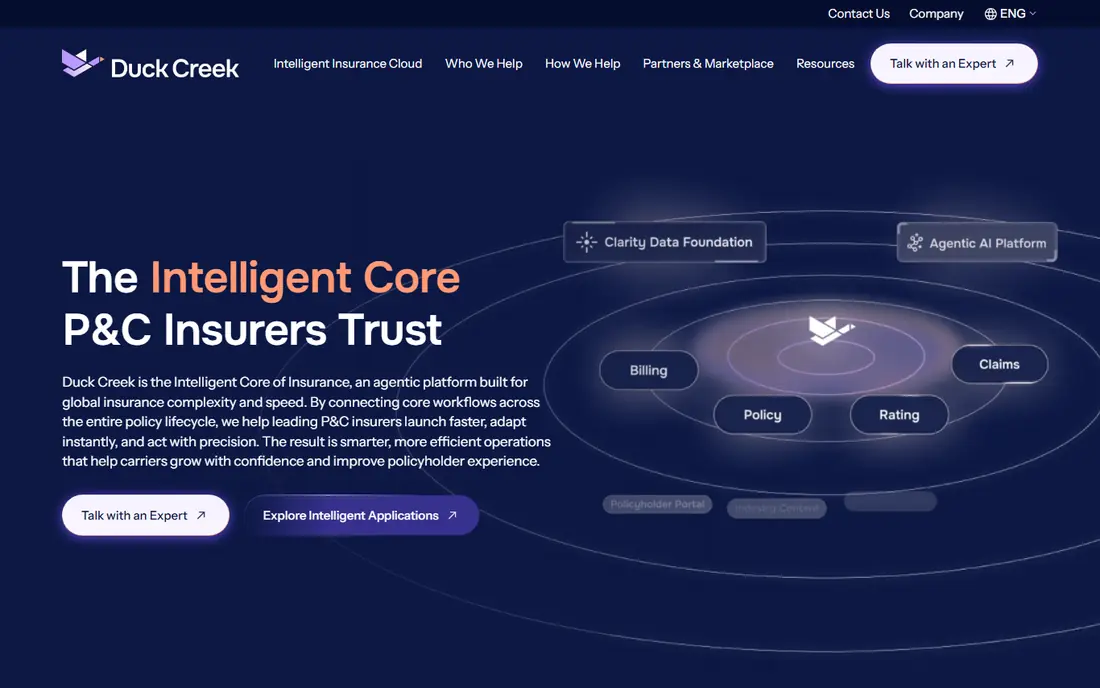
Duck Creek Claims appeals to carriers that want claims handled inside a modern cloud core system rather than as a standalone add on. Because policy, billing and claims share the same platform, policy data flows into the claim file with fewer manual checks, and status changes stay consistent across teams. Configuration tools let business users adjust work processes without rebuilding the system for every product change.
The trade off is scope. Buying Duck Creek for claims alone means accepting a wider platform decision, and that decision deserves a longer evaluation than a point tool. Teams that only need intake and assignment may pay for breadth they never use. For carriers already planning a core replacement, that breadth is the point.
- Cloud based core platform
- Configurable workflows by line of business
- Policy and billing sit in the same suite
- Full platform commitment can be more than a claims only buyer wants
- Implementation still needs planning
- Pricing is quote only
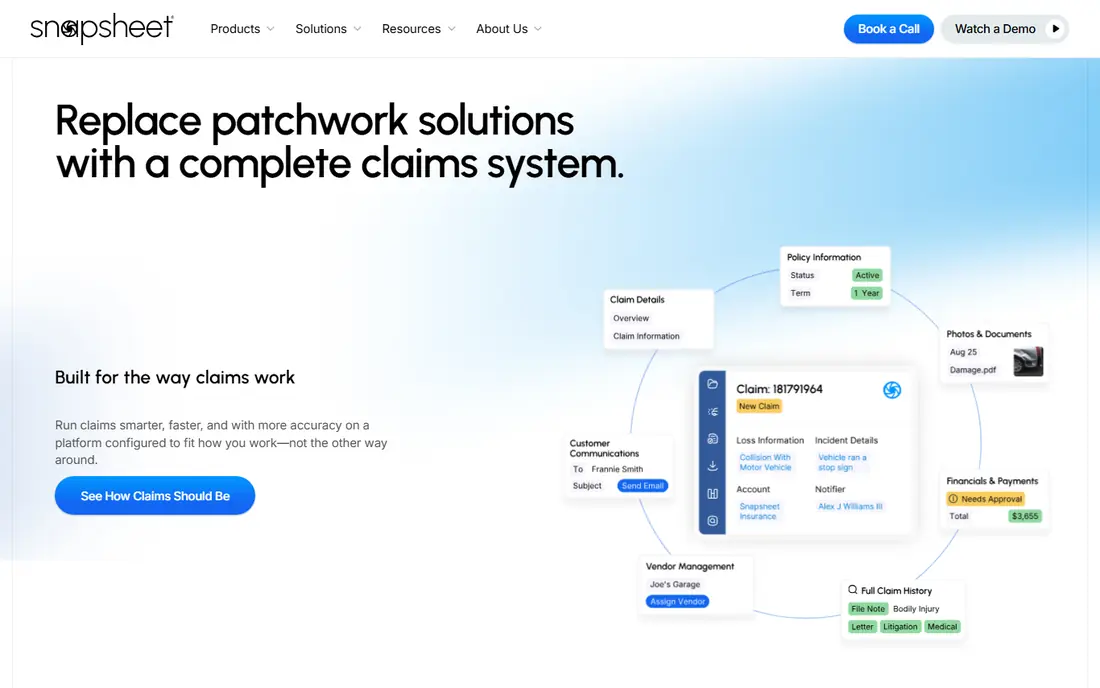
Snapsheet built its name on making the first part of a claim easier, with guided submission that collects photos, documents and structured answers in one flow. That structure helps routing, because the claim arrives with evidence attached rather than as a loose set of emails and attachments. Virtual appraisal tools then let estimators work from that evidence, which can shorten cycle time on straightforward auto and property claims.
Snapsheet is not a replacement for a full core system on its own, and carriers with complex commercial lines will still need deeper workflow and reserve tools. Its strength is speed on high volume, evidence heavy claims. If your backlog sits at intake and appraisal, start here and judge it on cycle time rather than on feature count.
- Guided photo and document intake
- Virtual appraisal workflow
- Designed to cut cycle time on auto and property claims
- Pricing is quote only
- Best fit is narrower than a full core suite
- Smaller teams may find enterprise contracting heavy
Origami Risk suits organisations that manage risk and claims together, such as risk pools, public entities, TPAs and self insured groups. Its workflow ties triage, assignment and tasks to claim status changes, so follow up gaps show up sooner and managers can see where files stall. Dashboards and reporting help risk teams connect claim outcomes back to loss prevention work, which is a real advantage over a claims only queue.
The work is in the configuration. Rules, queues and document definitions need governance, especially when intake volume is high, or status transitions can drift. That is normal for a platform of this depth, but it means the buyer should plan for admin time after go live. For a pool or TPA that lives in its data, the payoff is worth it.
- Rules driven workflow tied to claim status
- Combined risk and claims data
- Strong reporting for pools and TPAs
- Pricing is quote only
- Setup needs careful governance of rules and queues
- May be more than a small team needs
BriteCore targets mid sized P and C insurers and managing general agents that want a complete core system without the weight of the largest suites. Policy administration, billing and claims sit together, and a no code product builder lets product teams define rates and coverages with less developer time. Portals for agents and policyholders keep routine status questions out of the adjuster queue.
BriteCore is lighter to run than Guidewire, but it is still a core system decision, not a quick plug in tool. Teams that need heavy custom analytics often pair it with an outside reporting tool, so factor that into the total cost. For a regional carrier that wants one cloud system and faster product changes, it is a strong middle ground.
- Cloud native policy, billing and claims in one system
- No code product configuration
- Agent and policyholder portals included
- Reporting can feel limited for deep ad hoc analysis
- Pricing is quote based in practice
- Smaller carriers should confirm total cost
Claimable is built for businesses that handle insurance claims without needing a carrier core system. Each claim holds documents, notes, contacts, tasks and a full history, so a small team can answer audit questions and hand a file to a colleague without digging through shared folders. Labels and filters help a team sort claims by type, status or owner, which is often enough for firms that process tens of claims rather than thousands.
The limit is depth. Claimable will not replace reserve management, complex litigation workflow or large scale automation for a carrier. It also lacks the partner ecosystem of the big suites. For a broker, contractor, TPA team or small insurer that needs order and visibility first, that simplicity is a benefit, and the trial lets a team test it on real files.
- Simple claim records with documents, notes and tasks
- Cloud access from anywhere
- Audit friendly claim history
- Less depth for large carrier workflows
- Fewer enterprise integrations than core suites
- Pricing details require a quote check
FileTrac Evolve has a long history with independent adjusting firms, TPAs and managing general agents, and its feature set shows that focus. A built in diary system with reminders keeps adjuster deadlines visible, while time and expense tracking, timesheets and invoicing connect field work to billing. Integrations with estimating and accounting tools help firms close the loop between assignment and payment.
FileTrac is a working tool rather than a showpiece, and buyers who judge it on modern interface polish alone may underrate it. The value sits in adjuster accountability and file control across many outside adjusters. Firms that manage a roster of adjusters, rather than a single in house team, should weigh that strength heavily.
- Built for adjuster management
- Diary, time and expense tracking
- Invoicing and accounting reports
- Interface feels dated next to newer cloud tools
- Setup and training take time
- Pricing is quote only
Insurity ClaimsXPress gives claims teams a configuration driven way to route work, set queues and manage documents across lines of business. That approach suits carriers that want business users to adjust workflows as products and regulations change, rather than waiting on a development cycle for every change. It covers the standard claim lifecycle, with reporting to track where files sit and how long each stage takes.
As with other configurable platforms, the risk is drift. If document definitions and queue rules are not governed, high volume intake can create inconsistent statuses. Buyers should ask for a clear admin model during the demo and test it with their own claim types. For a carrier that values control over its own workflows, ClaimsXPress earns a place on the shortlist.
- Configuration driven rules and queue routing
- Broad P and C claim coverage
- Part of a wider Insurity suite
- Pricing is quote only
- Rule governance matters at high volume
- Implementation planning is essential
How we picked these
We compared official product pages, pricing pages where published, and public reviewer feedback for claims tools that are live in October 2026. We favoured tools with a clear claims workflow, from intake through payment and reporting, and we left out tools that only handle one slice, such as estimating alone, unless that slice is the product itself. Enterprise tools are marked as quote based because their vendors do not publish a standard price, and we did not repeat third party price estimates as vendor prices.
What to check before you sign a claims platform
Start with your own claim mix. Count claims by line, channel and complexity for the last year, and bring that breakdown to every demo, because a tool that shines on simple auto claims can struggle on complex liability files. Ask the vendor to run your messiest claim type end to end, including a reopened claim, a disputed document and a payment correction, and watch how many manual steps remain.
Check intake and integration next. Confirm how first notice of loss arrives, how photos and documents attach to the file, and which policy, payment and estimating systems connect without custom work. Ask who owns data export if you leave, what the contract term and renewal terms are, and how long implementation really takes for a team your size. Finally, confirm security and access controls, audit trails and permission levels, since claim files hold sensitive personal and financial data. This is general information only and not insurance or legal advice, and coverage and approval decisions always rest on the policy and the facts of each claim.
Frequently asked questions
What is insurance claims management software?
It is software that takes a claim from first notice of loss through investigation, decision and payment, keeping documents, notes, tasks and communications in one file. Good tools route work to the right adjuster, track reserves and deadlines, and report on cycle time and outcomes. The best choice depends on claim volume, lines of business and whether you also need policy and billing tools.
How much does insurance claims management software cost?
Enterprise core platforms are usually quote based, with price set by claim volume, users, lines and implementation scope. Smaller focused tools publish monthly prices or offer trials, but even there, setup and training can add cost. Ask every vendor for total first year cost, including implementation, integrations and support, before comparing headline prices.
Can small insurers use the same tools as large carriers?
They can, but they often should not. Large suites bring depth that a small carrier may never use, along with longer rollouts and higher support needs. Smaller tools such as Claimable or a focused TPA platform usually deliver faster value for modest volumes. A mid sized carrier is the natural fit for a cloud core system such as BriteCore.
Does claims software decide whether a claim is approved?
No. Software routes, documents and supports the decision, but approval rests on the policy terms, the evidence and the carrier or administrator applying them. Quotes and coverage outcomes vary, and no vendor tool guarantees a price or an approval. Any vendor that suggests otherwise should be treated with caution.
What should we test during a trial or demo?
Run a real claim type from intake to payment, including photos, a missing document request and a corrected payment. Test assignment rules, deadline alerts, reporting and data export, and ask how a claim is reopened. The demo should reveal manual workarounds, which are the costs that do not appear in a price quote.
Sources
See where you really rank - block by block
ProMapRanker scans Google Maps across a grid of your service area. Simple monthly plans from $19, white-label on every plan.
Start freeKeep reading
 what’s the best risk software for enterprises
What Is the Best Risk Software for Enterprises in 2026
We compared what’s the best risk software for enterprises on risk registers, controls, third-party risk, and reporting, with pricing notes for large teams.
Read → what's the best pam software for enterprises
What is the Best PAM Software for Enterprises in 2026
Find what's the best pam software for enterprises, with vaulting, session recording, just in time access and pricing compared for large enterprise IT teams.
Read → what’s the best grc software
What Is the Best GRC Software in 2026
We compared what’s the best grc software on risk, compliance, audit and vendor risk, so teams can pick a platform that fits their frameworks and budget.
Read →