 ProMapRanker
Best Incrementality Testing Tools in 2026

Key takeaways
- Geo experiments, where some regions see an ad and matched regions do not, remain the most direct way to measure true lift.
- Measured, Haus and INCRMNTAL suit brands with large, multi-channel budgets, while platform lift tools suit teams testing one channel at a time.
- Open source options such as Google Meridian and GeoLift cost no licence fee, but they need analyst time and clean spend and sales data.
- A small lift result is only useful if the test had enough scale and time, so check power and confidence before acting on a single test.
Quick comparison
| Pick | Great for | Pricing starts at | Free tier | |
|---|---|---|---|---|
 Measured | Enterprise incrementality and MMM | See website | No | Visit |
 Haus | Geo experiments at scale | See website | No | Visit |
 INCRMNTAL | Always-on incrementality measurement | See website | No | Visit |
 Recast | Bayesian MMM with geo calibration | See website | No | Visit |
 Google Meridian | Open source MMM | Free | Yes | Visit |
 GeoLift | Open source geo testing | Free | Yes | Visit |
 Northbeam | Ecommerce incrementality and attribution | See website | No | Visit |
 Lifesight | Cookieless measurement and MMM | See website | No | Visit |
 Meta Conversion Lift | In-platform Meta lift tests | Free | Yes | Visit |
The best incrementality testing tools
We compared official product pages, documentation and public pricing information, and we focused on tools that measure causal lift, not just last-click attribution. Several enterprise tools do not publish prices, so we marked those as See website rather than guessing.

Measured is designed for large brands that need incrementality as a governed programme, not a one-off test. It runs geo and audience experiments, then uses test results to calibrate its media mix model, so teams can compare channels on a shared, causal basis. The combined dashboard helps finance and marketing discuss the same numbers.
That breadth comes with enterprise weight. Onboarding, contracts and annual terms suit a brand with a dedicated analytics team, and smaller advertisers will likely find the process heavy. Shortlist Measured when you run many channels, need board-level reporting, and can staff the measurement work properly.
- Combines causal experiments with media mix modelling
- Dashboard blends test, MMM and attribution views
- Many managed integrations
- Built for enterprise budgets and processes
- Pricing is not published
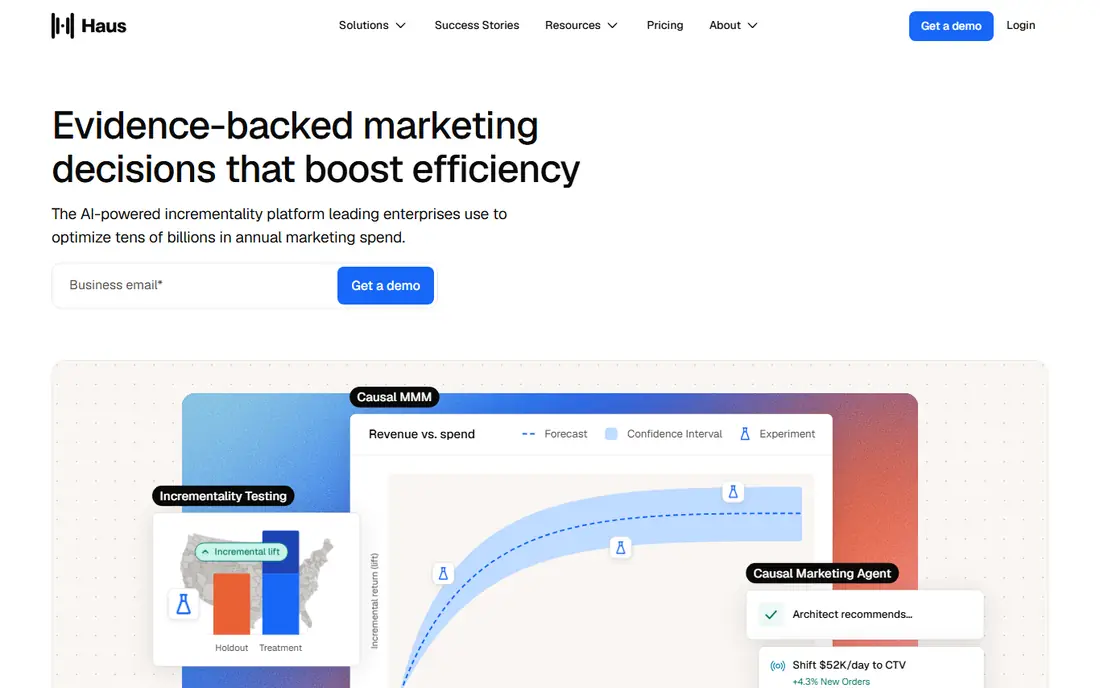
Haus is an incrementality company first, and its product shows it. Its core workflow is geo experimentation: hold out matched regions, measure orders and revenue, and read the lift with proper statistical care. Higher tiers add custom metrics, international tests, warehouse support and non-geo channels such as podcast and TV, plus a causal MMM built on experiment results.
The honest limit is scale. A geo test needs enough regions, spend and time to separate a real lift from noise, so a small local advertiser may struggle to get a clean read. For a national brand with real spend, Haus is one of the cleanest geo testing options available.
- Incrementality-first design for geo tests
- Supports major ad platforms and Shopify and Amazon data
- Causal MMM add-on for larger plans
- Tests need enough geographic scale and time to read
- No published pricing

INCRMNTAL takes a different path from classic holdout testing. Instead of pausing ads in control regions, it uses causal models to estimate what would have happened without spend, continuously, across channels. That always-on view suits brands that cannot or will not run holdouts, and it avoids the revenue cost of deliberately withholding ads from a control group.
The trade-off is trust in the model. An always-on estimate is only as good as its inputs and assumptions, so teams should ask how results are validated and how often the model is checked against real experiments. For brands that need continuous measurement without holdouts, it is a strong, privacy-conscious option.
- Always-on measurement without planned holdouts
- Privacy-first approach without cookies or device IDs
- Covers mobile, web, TV and other channels
- Always-on modelling needs careful interpretation
- Pricing is quote-based and enterprise-leaning
Recast combines a modern Bayesian media mix model with GeoLift, its tool for designing and analysing geo experiments. The idea is practical: use geo tests where uncertainty is highest, then feed those results back into the model to calibrate future estimates. Confidence intervals for every return estimate help teams avoid over-reading a single point number.
Recast is not a plug-and-play dashboard for a team with messy data. It needs consistent weekly spend, sales and outcome series, and someone who can judge model assumptions. For a data-ready brand that wants transparent, privacy-friendly measurement, it is a well-regarded choice.
- Fully Bayesian MMM with confidence intervals
- GeoLift for designing geo tests
- Privacy-friendly, no user-level data needed
- Needs clean, aggregated spend and outcome data
- Best results need analyst involvement
Google Meridian is an open source marketing mix modelling framework built by Google. It estimates the incremental contribution of each channel from aggregated spend, sales, reach and seasonality data, without relying on cookies or user-level tracking. Its newer GeoX work lets geo experiment results feed into the model as priors, which links testing and modelling in a useful way.
The cost is time, not licence fees. A team needs an analyst who can prepare data, run the model, check diagnostics and explain results to stakeholders. For a technically strong team with a limited software budget, Meridian is the best free route to serious incrementality work.
- Free and open source with transparent methods
- Bayesian causal model for channel contribution
- Scenario planning and budget guidance
- Needs analyst time and clean data
- No vendor support team by default
GeoLift is an open source library for designing and analysing geo-based lift tests. You feed in historical location, date and outcome data, and it helps choose test and control markets, run power analysis, and estimate lift once the test ends. Because it uses aggregated data, it is resilient to cookie loss and privacy changes that break user-level tracking.
It is a library, not a managed platform, so a team needs someone comfortable with data and statistics to run it well. For a brand that wants full control over methods and no licence cost, GeoLift is a credible, transparent starting point, and it pairs well with a media mix model.
- Free and open source geo experiment design and analysis
- Transparent and reproducible methods
- Uses aggregated market-level data
- Needs statistical care and clean geo-level data
- No managed service by default
Northbeam suits direct-to-consumer brands that sell online and advertise across Meta, Google, TikTok and other channels. It links store data with ad data to estimate incremental contribution, and it presents attribution beside incrementality so teams can see where last-click views and causal views disagree. That disagreement is often where budget mistakes hide.
B2B or offline-led brands will get less from Northbeam, since its strength is online purchase data. Ecommerce teams should still validate its estimates with a holdout test before shifting large budgets, but as a daily measurement companion, it is a practical pick.
- Built for ecommerce with direct shopping platform links
- Combines incrementality with attribution views
- Useful for multi-channel DTC brands
- Quote-based pricing
- Best fit is ecommerce, not B2B or offline-led brands
Lifesight presents itself as a unified measurement platform that moves teams away from last-click attribution toward modern methods, including incrementality testing, media mix modelling and causal attribution. For a brand tired of juggling separate tools for each method, that single view is appealing, and its cookieless design fits current privacy limits.
As with other enterprise platforms here, pricing is quote-based, and results depend on data quality across channels. Ask for a clear explanation of how its models are validated, and run a geo test early to check that model estimates match experimental results for your brand.
- Unified measurement across MMM, incrementality and attribution
- Cookieless approach suits privacy changes
- Full-funnel view for marketers
- Pricing is not published
- Setup needs consistent data across channels
Meta Conversion Lift is the simplest entry point in this list, and for a Meta-heavy advertiser, it is often the right first test. You set a holdout share, Meta manages assignment, and the report shows the lift from your campaign against a control group that did not see the ads. There is no extra licence cost beyond your ad spend.
The limit is scope. It measures Meta only, using Meta's own conversion definitions, so it cannot tell you whether Meta spend beats Google or TikTok spend. Use it to answer a channel question, then move to a cross-channel tool when you need a portfolio answer.
- Free with a Meta ads account
- Native holdout tests inside Meta
- Direct read on Meta campaign lift
- Only measures Meta, not cross-channel lift
- Platform definitions limit flexibility
How we picked these
We compared official product pages and documentation for tools that measure causal lift through experiments, always-on causal models or Bayesian media mix modelling. We included both enterprise platforms and free open source options, and we excluded pure last-click attribution tools that do not test incrementality. Where a vendor does not publish pricing, we said so rather than repeating third-party estimates as fact.
What to check before you run a test
Start with the decision the test must inform. A test that cannot change a budget, a channel mix or a creative choice is an expensive report, not measurement. Write down the decision, the minimum lift that would change it, and the time you can allow before deciding.
Next, check scale and data. Geo tests need enough regions and sales to read, and models need clean weekly spend and outcome data. Finally, agree how you will act on a null result. A test that finds no lift is still a useful answer, and it should be allowed to cut spend, not just to confirm what the team already believed.
Frequently asked questions
What is incrementality testing?
Incrementality testing measures what an ad actually caused, by comparing outcomes with the ad against outcomes without it. A holdout group, a geo test or a causal model provides the without-it baseline, which last-click attribution cannot.
How is incrementality different from attribution?
Attribution assigns credit for conversions that happened, while incrementality asks whether those conversions would have happened anyway. A channel can look strong on attribution and weak on incrementality if it mostly reaches people who would have bought regardless.
How long should an incrementality test run?
Long enough to gather sufficient data and to cover normal weekly patterns, often several weeks for geo tests. Short tests with small samples produce wide confidence intervals, and acting on them risks mistaking noise for lift.
Can small brands run incrementality tests?
Yes, but with care. Platform lift tools such as Meta Conversion Lift are free with ad spend, and open source tools such as GeoLift cost no licence fee. Small brands should test one clear question at a time and accept that small budgets may only support broad, directional reads.
Do I still need a media mix model if I run geo tests?
Geo tests answer specific channel questions well, but a model helps compare many channels at once and plan budgets. Many teams use both, with geo tests calibrating the model where uncertainty is highest.
Sources
See where you really rank - block by block
ProMapRanker scans Google Maps across a grid of your service area. Simple monthly plans from $19, white-label on every plan.
Start freeKeep reading
 zscaler alternatives
Best Zscaler Alternatives in 2026
Looking for zscaler alternatives? We compare 9 SASE and zero trust platforms on architecture, data protection, pricing, and fit for your network and team.
Read → zapier alternatives free
Best Zapier Alternatives Free in 2026
Nine automation tools for zapier alternatives free in 2026, all with genuinely free tiers, plus free plan limits, starting prices and upgrade paths explained.
Read → which platform is best for online reputation
Which Platform Is Best for Online Reputation in 2026
Wondering which platform is best for online reputation? We compare 8 review, listing, and response tools for small and multi-location businesses and agencies.
Read →