 ProMapRanker
Best Image Annotation Tools in 2026

Key takeaways
- CVAT is the best free starting point for teams that can self-host, with a wide range of annotation shapes and a mature workflow.
- Label Studio suits teams that need a flexible open source editor for images, text, and other data types in one place.
- Roboflow suits computer vision teams that want labeling, dataset management, and model training close together.
- Labelbox, SuperAnnotate, and Encord suit larger teams that need review workflows, model-assisted labeling, and enterprise controls.
- Supervisely and BasicAI give smaller teams affordable or free entry points with solid annotation editors and AI assistance.
Quick comparison
| Pick | Great for | Pricing starts at | Free tier | |
|---|---|---|---|---|
 CVAT | Free self-hosted annotation | Free | Yes | Visit |
 Label Studio | Flexible open source labeling | Free | Yes | Visit |
 Roboflow | End-to-end computer vision work | See website | Yes | Visit |
 Labelbox | Enterprise labeling at scale | See website | Yes | Visit |
 SuperAnnotate | Managed and AI-assisted labeling | See website | Yes | Visit |
 Encord | High-quality review workflows | See website | No | Visit |
 Supervisely | Affordable team annotation | See website | Yes | Visit |
 BasicAI | Low-cost AI-assisted labeling | $9 per month | Yes | Visit |
The best image annotation tools
Image annotation tools let teams draw boxes, polygons, masks, keypoints, and labels on images so machine learning models can learn from them. The best tool depends on data volume, annotation types, review needs, and whether you need a workforce, model-assisted labeling, or only an editor. Quality matters more than speed alone, since noisy labels teach a model the wrong lessons.

CVAT, the Computer Vision Annotation Tool, is a free open source platform for labeling images, video, and 3D data. It supports bounding boxes, polygons, polylines, points, ellipses, cuboids, skeletons, masks, and tags, which covers most computer vision tasks from detection to pose estimation. Teams can self-host it, control their data, and scale workers as needed.
Self-hosting is the main cost: setup, upgrades, and storage fall on your team, and the interface has a learning curve for new annotators. A paid cloud option exists for teams that want hosted convenience. For teams with engineering capacity and a need for a free, capable editor, CVAT is the standard open source choice.
- Wide annotation types
- Free open source core
- Strong for video and 3D tasks
- Self-hosting needs operations work
- Interface takes time to learn
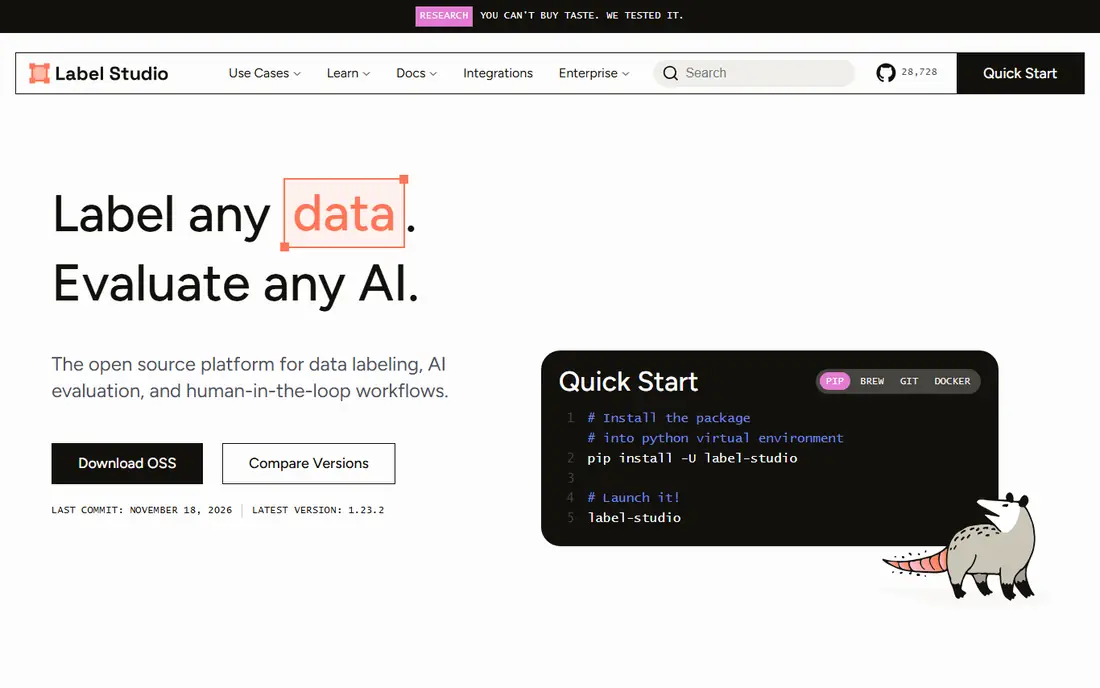
Label Studio is an open source data labeling platform with a flexible interface that teams can configure for images, text, audio, and video. For images, it covers boxes, polygons, masks, keypoints, and classification, and its configuration system lets teams design custom labeling tasks without building an editor from scratch. Model-assisted labeling can pre-label images to speed up human review.
The open source version suits small and mid-size teams, while enterprise tiers add hosted management, security, and support features. Self-hosting still needs technical setup, and very large programs may need paid help to scale. For teams that label more than one data type, Label Studio's flexibility is a strong advantage.
- Flexible labeling interface
- Supports images, text, audio, and video
- Open source core
- Enterprise features are paid
- Setup and scaling need technical work
Roboflow combines image annotation with dataset management, augmentation, and model training, so teams can move from labeled images to a working model without stitching together many tools. Its auto-label and label-assist features use models to suggest boxes and masks, which annotators then correct, and its Universe community shares public datasets for learning and benchmarking.
Pricing varies between public and private projects and by plan, so check the current page for the tier that fits your data privacy needs. Teams that only need a simple editor may find the full platform more than necessary. For computer vision teams building models end to end, Roboflow shortens the path from raw images to trained models.
- Labeling plus dataset and model tools
- Auto-label assistance
- Large public dataset community
- Pricing varies by public or private projects
- Full platform may exceed simple labeling needs
Labelbox is a training data platform for images, video, text, audio, and documents, with labeling editors, model-assisted workflows, and review tools for large programs. Teams can use its models to pre-label data, route work through review stages, and track quality and throughput. Its workforce and services options help organizations that need extra labeling capacity.
Pricing is usage-based or quoted at enterprise scale, so small teams should start with the free tier and test the editor before committing. The platform's breadth can feel heavy for a single small dataset. For organizations labeling at scale with strict quality needs, Labelbox is a proven enterprise option.
- Model-assisted labeling
- Review and quality workflows
- Multimodal data support
- Enterprise pricing is quoted
- Complex for very small projects
SuperAnnotate offers annotation tooling for images, video, text, and audio, plus a managed labeling service for teams that want trained annotators alongside the software. AI-assisted features suggest labels and speed up repetitive work, while the Python SDK helps automate dataset handling and exports. Support for boxes, polygons, keypoints, cuboids, and tiled imagery covers many vision tasks.
Larger plans are priced on request, so budgeting requires a sales conversation, though a startup tier exists for smaller teams. Teams that only need an editor may prefer a simpler open source tool. For teams that want tooling plus optional managed labeling, SuperAnnotate is a practical combination.
- AI-assisted annotation
- Managed labeling marketplace
- Python SDK for automation
- Pricing is quoted for larger plans
- Smaller teams may need the startup tier only
Encord is a data platform for images, video, audio, text, DICOM medical images, and point clouds, with a focus on quality control. Multi-stage review, consensus checks, and annotation analytics help teams catch inconsistent labels before they reach training data. Model-assisted labeling, including segmentation model support, speeds up the first pass while humans keep final judgment.
There is no free plan, and pricing is quoted, so smaller teams cannot easily budget without contacting sales. That positioning suits healthcare, robotics, and other fields where label quality justifies enterprise cost. For high-stakes datasets where errors are costly, Encord's review workflow is a strong fit.
- Strong multi-stage review
- DICOM and video support
- Model-assisted labeling
- No free plan
- Pricing is quoted, which complicates budgeting
Supervisely is a computer vision platform with annotation editors for boxes, polygons, masks, keypoints, and 3D-related tasks, plus project and team management. It suits teams that need a hosted workspace without enterprise pricing, and its free tier lets small teams test the editor before paying. Integrations and automation tools help move labeled data into training pipelines.
Paid pricing varies by plan and region, so the current pricing page is the reliable source. Some advanced automation and enterprise features sit on higher tiers. For small and mid-size vision teams that want a hosted, affordable alternative to enterprise platforms, Supervisely is worth a trial.
- Broad annotation types
- Team and project management
- Free tier for testing
- Paid pricing varies by currency and plan
- Advanced features need higher tiers
BasicAI, also known as BasicAI Cloud, offers image and video annotation with AI assistance at a low entry price per seat. It covers boxes, polygons, polylines, keypoints, classification, and segmentation, which handles most standard vision tasks. The low starting price makes it accessible to startups and small teams that cannot justify enterprise quotes.
Its ecosystem and community are smaller than those of CVAT, Label Studio, or Labelbox, so support and integrations may be thinner for unusual workflows. Teams with very large or regulated programs should test review and export features carefully. For budget-conscious teams that want AI-assisted labeling without a large commitment, BasicAI is a good entry point.
- Low entry price
- AI-assisted labeling
- Broad annotation types
- Smaller ecosystem than larger rivals
- Enterprise support varies by plan
How we picked these
We compared official product and pricing pages, documentation, and public reviews, and we favored tools that are available in October 2026 and that support real image annotation, including boxes, polygons, or segmentation. We mixed free open source editors with hosted and enterprise platforms, and we used See website where pricing is quoted, usage-based, or varies by plan. We did not claim hands-on testing.
How to choose and run a labeling program well
Start with a small, well-defined sample before labeling thousands of images. Write annotation guidelines with examples of edge cases, such as occluded objects, small objects, and ambiguous boundaries, and test them with two annotators on the same images. Agreement between annotators is a better quality signal than raw speed.
Match the editor to the task
Detection needs boxes, segmentation needs masks or polygons, and pose work needs keypoints or skeletons. Check that your chosen tool exports in a format your training pipeline reads, and test the export early rather than after a full dataset is labeled. Model-assisted labeling helps most on repetitive tasks, but humans must still review every suggestion.
Build review into the workflow
Use a second review pass for a sample of labels, track agreement rates, and fix guidelines when the same error repeats. Tools with multi-stage review, such as Encord and Labelbox, help larger teams, while small teams can achieve the same effect with spot checks in CVAT or Label Studio. Quality problems found after training cost far more than review time before training.
Plan for data privacy and scale
Check where data is stored, who can access it, and whether self-hosting is needed for sensitive images such as medical or private photos. Estimate annotator hours from a timed sample, not from vendor speed claims, and budget for review and rework. A tool that scales smoothly matters less than a process that keeps labels consistent as the team grows.
Frequently asked questions
What is the best image annotation tool for beginners?
CVAT and Label Studio are good free starts, since both cover common annotation types without a subscription. Roboflow suits beginners who also want dataset and model tools in one place. Start with a small sample, learn the editor, and only then scale to a full dataset.
What is the best image annotation software for segmentation?
CVAT, Label Studio, Supervisely, and Encord all support polygon and mask segmentation, with different review and AI assistance levels. CVAT and Label Studio suit budget teams, while Encord suits high-stakes work with strict review. Test mask editing speed and export format before choosing.
What is the best image annotation tool for a small team?
BasicAI and Supervisely offer low-cost hosted options, while CVAT and Label Studio offer free self-hosted editors. A small team should weigh hosting effort against price: hosted tools cost more but need less setup, while open source tools cost less but need technical time.
Can AI label images automatically?
AI-assisted tools can suggest boxes, masks, and labels, which speeds up work, but suggestions still need human review, especially on edge cases and rare classes. Fully automatic labeling without review risks teaching a model systematic errors. Use AI for a first pass and humans for correction and quality control.
How much does image annotation software cost?
Costs range from free open source tools to quoted enterprise platforms. BasicAI starts at a low monthly price per seat, Roboflow and Labelbox offer free tiers with paid upgrades, and Encord and larger Labelbox plans are quoted. Model the cost at your image volume and reviewer count, not just the headline plan price.
Sources
See where you really rank - block by block
ProMapRanker scans Google Maps across a grid of your service area. Simple monthly plans from $19, white-label on every plan.
Start freeKeep reading
 zoho inventory alternatives
6 Alternatives to Zoho Inventory, Compared on Price and Fit
Zoho Inventory alternatives: 6 tools compared on price, free plans and fit. Katana leads the list for manufacturers. Fit and flaws are laid out for each entry.
Read → zoho crm alternatives
Best Zoho CRM Alternatives (2026)
Need Zoho CRM alternatives? We compare 7 tools on cost, free access and who each suits. Every pick gets a straight assessment. Built for quick decisions.
Read → zelle alternatives
Best Zelle Alternatives in 2026
Compare the best Zelle alternatives for sending money to friends, paying sellers and moving funds abroad, with honest notes on fees, speed and safety in 2026.
Read →