 ProMapRanker
Best ID Verification Software in 2026


Published pricing and fast decisions · Pricing starts at: $0.80 per verification
Key takeaways
- Veriff and Sumsub are the clearest starting points for teams that want published per-check pricing without a sales negotiation.
- Jumio, Entrust IDV and Trulioo suit regulated and global enterprises that need deep coverage and compliance tooling.
- Persona stands out for product teams that want to build custom verification flows without heavy coding.
- Use these tools only with clear user consent, a stated purpose and lawful handling of identity data, and never for covert checking of another person.
- Per-check price alone is misleading: monthly minimums, add-ons and manual review costs change the real total.
Quick comparison
| Pick | Great for | Pricing starts at | Free tier | |
|---|---|---|---|---|
| Veriff | Published pricing and fast decisions | $0.80 per verification | Free trial | Visit |
 Sumsub | All-in-one KYC, KYB and monitoring | $1.35 per verification | Free trial | Visit |
 Persona | Custom verification flows | See website | Free trial | Visit |
 Jumio | Regulated enterprise onboarding | See website | No | Visit |
 Entrust IDV | Large-scale document and biometric checks | See website | Free trial | Visit |
 iDenfy | Global SMBs with pay-as-you-go needs | See website | Free trial | Visit |
 Trulioo | Global verification without document friction | See website | No | Visit |
 Socure | Risk and fraud signals for US onboarding | See website | No | Visit |
 ID.me | Government and verified-group programs | See website | Yes | Visit |
The best id verification software
ID verification software checks that a person is who they claim to be, usually by reading an identity document, matching a selfie and screening for fraud signals. Businesses use it for account opening, marketplace onboarding, age checks and compliance work. The tools below differ in coverage, pricing transparency and how much control product teams get over the flow.

Veriff is the easiest tool here to budget for, because it publishes per-verification rates and a monthly minimum. That transparency helps startups and scaling fintechs plan costs without waiting for a sales quote. Document verification, biometric checks and fraud signals are combined in one flow, with automation handling most straightforward cases.
The published price is only part of the bill. Add-ons, higher tiers and manual review can raise costs, and the monthly minimum sets a floor even in slow months. For teams that want a clear starting price and broad coverage, Veriff is still a strong first shortlist pick.
- Published self-serve pricing
- Broad document coverage
- Fast automated decisions
- Monthly minimum applies on paid tiers
- Advanced compliance add-ons cost extra

Sumsub suits companies that need more than a single ID check. It combines identity verification with business verification, anti-money-laundering screening and transaction monitoring, so a fintech or crypto platform can run several compliance steps in one place. Document coverage is broad, which helps with cross-border users.
The platform can feel large for a team that only needs simple onboarding checks. Setup and workflow configuration take time, and the monthly minimum means very low-volume teams should compare Veriff and iDenfy first. For end-to-end risk work, Sumsub is hard to beat on breadth.
- Published pricing on two tiers
- KYC, KYB, AML and monitoring in one platform
- Broad document coverage
- Monthly minimum on paid tiers
- Configuration can be complex for smaller teams
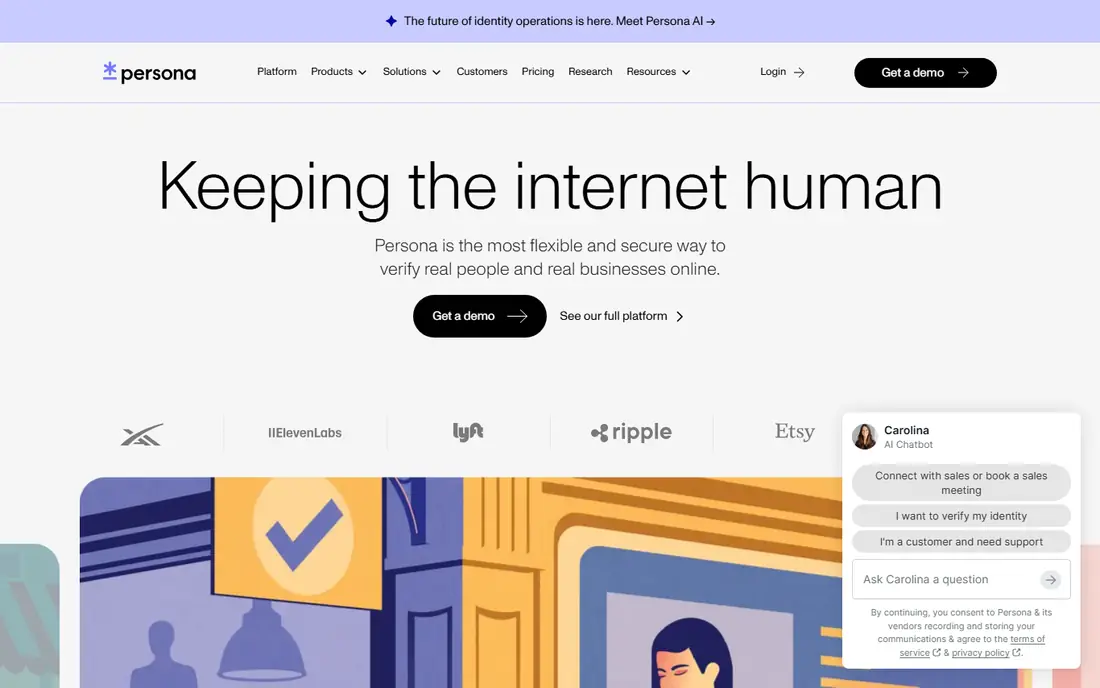
Persona is built for product teams that want control. Its workflow engine lets teams build different verification paths for different risk levels, add extra checks for high-risk applicants and route edge cases to manual review. Case management keeps those reviews organized instead of scattered across inboxes.
Pricing transparency is the weak point, since current public pricing is harder to verify than Veriff or Sumsub. Persona fits best when flow design matters more than a published price, and when you have product or engineering time to shape onboarding properly. Always collect consent clearly in the flow you build, and state what data you collect and why.
- Low-code workflow builder
- Case management and dynamic risk rules
- Strong developer experience
- Pricing is not published in a simple form
- Enterprise plans are quoted
Jumio is a long-standing enterprise choice for banks, lenders and large platforms. It covers thousands of ID types across many countries, with liveness checks and fraud signals designed to catch spoofing and manipulation. For regulated onboarding at volume, that depth and track record carry weight.
Small teams will find the sales-led pricing and integration effort a barrier. Jumio is not a self-serve starter tool, and it is best evaluated through a structured pilot with your real document mix. If compliance and fraud resistance are the top criteria, it belongs on the shortlist.
- Deep financial-services experience
- Strong liveness and fraud detection
- Broad ID coverage
- Quote-only pricing
- Heavier integration lift for small teams
Entrust IDV, formerly Onfido, combines document verification with biometric face matching at enterprise scale. Workflow Studio lets teams build conditional flows without code, adding extra checks for higher-risk cases and skipping steps for returning users. Coverage spans thousands of document types across many countries.
Pricing is quoted, and annual contracts are common, so smaller teams should expect a sales process rather than instant signup. The developer sandbox helps with testing, but production pricing needs a direct quote. For enterprises already using Entrust products, the integration story is an extra reason to consider it.
- Workflow Studio for no-code flows
- Broad document coverage
- Enterprise scale
- Quote-only pricing
- Brand change from Onfido can confuse older comparisons
iDenfy appeals to fintechs and global small businesses that want to pay for what they use. Document verification, liveness checks and AML screening sit in one platform, and pay-as-you-go tiers avoid a large monthly commitment. That structure suits startups with uneven onboarding volume.
Support and enterprise depth may not match Jumio or Entrust for the largest regulated deals, and pricing details should be confirmed directly before budgeting. For a growing global team that wants flexibility, iDenfy offers a practical middle path between free trials and enterprise contracts.
- Pay-as-you-go volume tiers
- Document, liveness and AML screening together
- No monthly minimum on some paths
- Pricing tiers need a current check
- Smaller brand presence in North American enterprise deals
Trulioo takes a different approach by verifying identity against data sources, which can reduce the need for document uploads in some markets. With coverage across many countries, it helps global platforms onboard users who may not have a standard document handy or who abandon document flows. That can raise completion rates where document capture is the bottleneck.
It is not a one-size replacement for document and biometric checks everywhere, since depth varies by country and use case. Pricing is quoted, so budget planning needs a sales conversation. Trulioo fits best as part of a global strategy, sometimes alongside a document-based tool.
- Hundreds of data sources across many countries
- Useful where document upload is friction
- Strong global coverage
- Quote-only pricing
- Document and biometric depth varies by market
Socure focuses on risk decisioning as much as identity proofing. It combines device, network and identity signals to flag fraud and assess risk, which helps US lenders, fintechs and marketplaces approve good users faster while blocking suspicious ones. That signal depth is its main strength.
Teams looking for a simple document-and-selfie flow may find Socure broader than they need, and pricing is quoted. It works best when fraud prevention and approval rates matter as much as document capture, and when you have compliance staff to tune risk rules.
- Strong fraud and risk signals
- Useful for US-focused onboarding
- Identity graph approach
- Quote-only pricing
- Less of a pure document-verification tool than Veriff or Jumio
ID.me is best known for verified identity used across government, healthcare and group discount programs. Consumers can verify once and reuse that identity with partner services, which reduces repeat checks. That reusable model is useful for benefits, veteran, student and workforce verification programs.
Business pricing is contract-based, and the consumer flow is not the same as a developer onboarding API. Companies that need a standard fintech onboarding flow should compare Veriff, Persona or Sumsub first. ID.me earns its place when your users already trust it or when you serve government and verified-group audiences.
- Reusable verified identity across partner services
- Strong government and group verification use
- Free for consumers
- Business pricing is contract-based
- Consumer experience and business needs differ
How we picked these
We compared official product pages, published pricing where available, and public reviews for ID verification tools live in October 2026. We kept only tools that perform document, biometric or data-based identity checks for legitimate onboarding and compliance, and we excluded tools meant for covert checking. Where pricing was not published, we wrote See website instead of presenting third-party estimates as vendor prices. Use these tools only with clear consent, a stated purpose, data minimization and lawful retention practices.
What to check before you buy id verification software
Start with consent and purpose. Your flow should tell users what you will check, why you need it, how long you will keep data, and how they can get help if a check fails. A tool that makes consent and failure handling clear will protect both users and your business. Avoid any use that checks a person without their knowledge, since that raises legal and safety problems and is outside legitimate onboarding use.
Next, test coverage on your real user base. Run documents from your top countries, including older IDs, worn cards and varied lighting, and measure approval rates and manual review rates. A tool that works well for US passports may struggle with other document types, and that gap shows up as lost users.
Finally, model total cost and review load. Add monthly minimums, per-check fees, AML screening, manual review charges and implementation costs. Ask how false rejections are handled, how quickly support responds, and what data the vendor keeps after a check. A low per-check price means little if half your users need manual review.
Frequently asked questions
What is the best id verification software for a startup?
Veriff is a strong startup pick because pricing is published and signup is self-serve, while iDenfy suits pay-as-you-go volume. Persona fits startups with product time to build custom flows, though pricing needs a direct check.
What is the best id verification tool for KYC compliance?
Sumsub, Jumio and Entrust IDV all support KYC work, with Sumsub adding KYB and monitoring in one platform. The right pick depends on your regulator, countries served and whether you need transaction monitoring as well as onboarding checks.
How much does id verification software cost?
Published rates in this list start at $0.80 per verification for Veriff and $1.35 for Sumsub, each with a monthly minimum, while most enterprise tools are quote-based. Always add add-ons and manual review costs to the per-check rate.
Is ID verification software legal and private?
Legitimate tools are designed for onboarding and compliance with user consent, data protection controls and audit trails. You still need your own legal advice on consent, retention and local rules, and you should never use these tools to check someone without a lawful purpose and their knowledge where required.
Can ID verification software catch deepfakes?
Modern tools use liveness checks and fraud signals to catch many spoofing attempts, but no tool is perfect. Ask vendors how they test against injection and deepfake attacks, and keep manual review for high-risk cases rather than relying on automation alone.
What is the best id verification tool for global users?
Trulioo, Veriff, Sumsub and Jumio all offer broad global coverage, with different strengths by country. Test your top five countries first, since coverage and approval rates vary by market and document type.
Sources
See where you really rank - block by block
ProMapRanker scans Google Maps across a grid of your service area. Simple monthly plans from $19, white-label on every plan.
Start freeKeep reading
 zscaler alternatives
Best Zscaler Alternatives in 2026
Looking for zscaler alternatives? We compare 9 SASE and zero trust platforms on architecture, data protection, pricing, and fit for your network and team.
Read → zapier alternatives free
Best Zapier Alternatives Free in 2026
Nine automation tools for zapier alternatives free in 2026, all with genuinely free tiers, plus free plan limits, starting prices and upgrade paths explained.
Read → which platform is best for online reputation
Which Platform Is Best for Online Reputation in 2026
Wondering which platform is best for online reputation? We compare 8 review, listing, and response tools for small and multi-location businesses and agencies.
Read →