 ProMapRanker
Best IaC Tools in 2026: 10 Tools Compared


Multi-cloud teams wanting the widest provider range · Pricing starts at: Free
Key takeaways
- Terraform and OpenTofu suit multi-cloud teams, with the licence as the key difference.
- Pulumi suits developers who prefer a programming language over a config language.
- AWS CloudFormation, CDK and Azure Bicep suit single-cloud teams.
- Crossplane suits Kubernetes-native platform teams.
Quick comparison
| Pick | Great for | Pricing starts at | Free tier | |
|---|---|---|---|---|
| Terraform | Multi-cloud teams wanting the widest provider range | Free | Yes | Visit |
 OpenTofu | Multi-cloud teams wanting an open source Terraform alternative | Free | Yes | Visit |
 Pulumi | Developers who prefer real programming languages | $40 per month | Yes | Visit |
 AWS CloudFormation | AWS-only teams wanting a native, managed service | Free | Yes | Visit |
 AWS CDK | AWS developers who prefer code over templates | Free | Yes | Visit |
 Azure Bicep | Azure-only teams wanting simpler templates than ARM | Free | Yes | Visit |
 Ansible | Teams combining config management with infrastructure tasks | See website | Free trial | Visit |
 Crossplane | Kubernetes-native platform teams | Free | Yes | Visit |
 Spacelift | Teams wanting managed runs for Terraform and OpenTofu | See website | Yes | Visit |
 Terragrunt | Terraform teams managing many environments and modules | Free | Yes | Visit |
The best iac tools
We compared tools that define cloud infrastructure in code, so servers, networks, databases and policies can be reviewed, versioned and repeated. The list covers multi-cloud tools, cloud-native tools and Kubernetes-native options, since the right choice depends on how many clouds you run. We checked official docs and pricing pages, and we favoured tools with a live, supported release in October 2026.
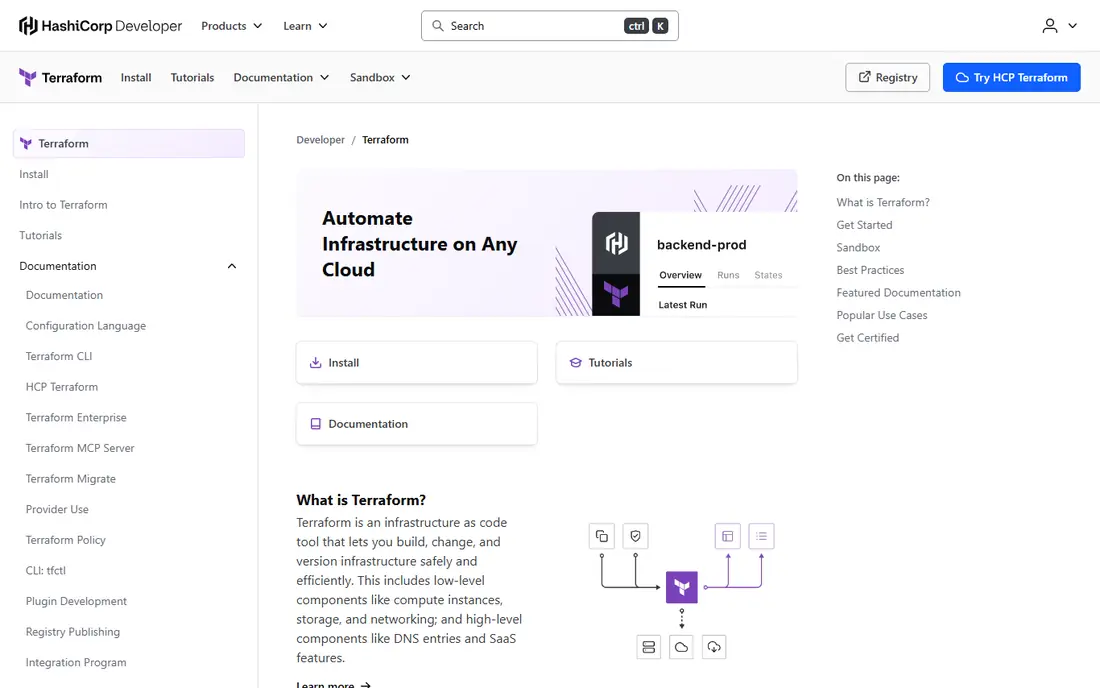
Terraform remains the default multi-cloud IaC tool for many teams, because its provider ecosystem covers AWS, Azure, Google Cloud and hundreds of other services. Infrastructure is written in HCL, stored in version control, and applied through a plan and apply workflow that reviewers can inspect. That breadth is hard to match.
The licence change matters for some buyers. Terraform CLI is under the Business Source Licence, not a fully open source licence, which led to the OpenTofu fork. Managed HCP Terraform pricing is also per resource, so large estates need careful cost modelling. For internal use, neither issue blocks most teams.
- Widest provider ecosystem
- HCL config language
- HCP Terraform for teams
- Licence is BSL, not open source
- Managed pricing is per resource
OpenTofu
Great for: Multi-cloud teams wanting an open source Terraform alternative
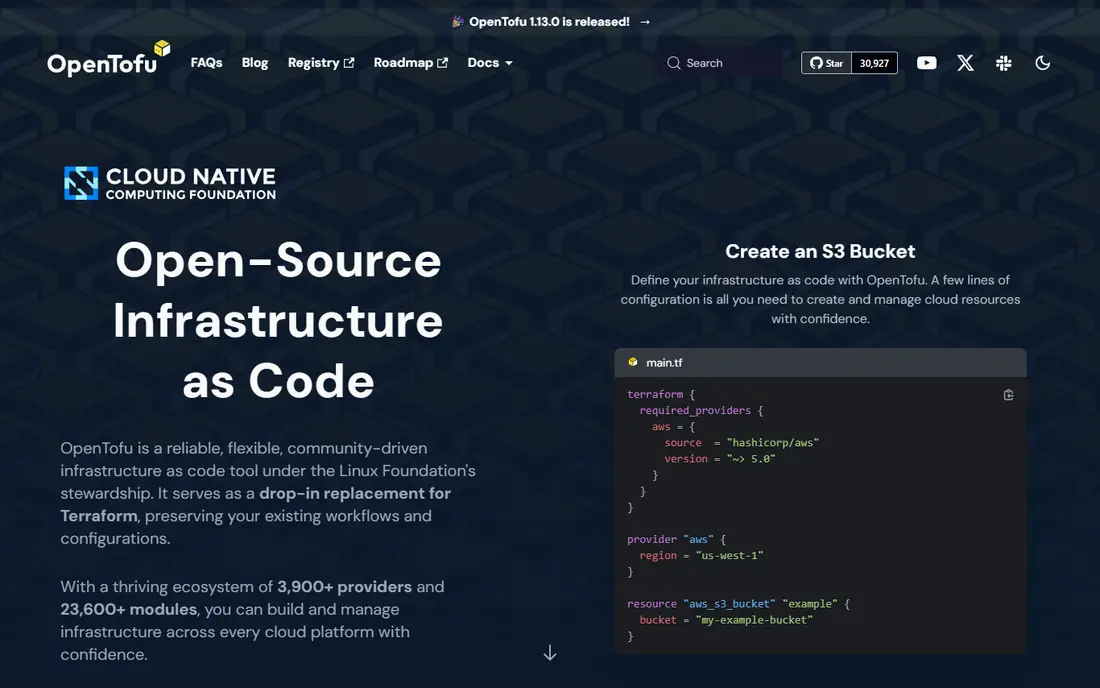
OpenTofu is the community fork of Terraform, governed under the Linux Foundation with an MPL licence. It keeps a familiar HCL workflow and state model, so many Terraform configurations work with limited changes. Teams that prefer a fully open source licence, or that build services around IaC, often choose OpenTofu for that reason.
The ecosystem is smaller than Terraform, and some commercial integrations arrive later. Migration still needs testing, especially for providers and state handling, so run OpenTofu in a non-production environment first. For new multi-cloud projects, it is a credible default.
- Open source MPL licence
- Terraform-compatible workflows
- Community governance
- Smaller commercial ecosystem than Terraform
- Migration needs testing

Pulumi lets teams write infrastructure in a general programming language, such as Python, TypeScript or Go, instead of a config language. That appeals to application developers who already test, reuse and review code in those languages, and who want loops, functions and libraries in their infrastructure. Multi-cloud support covers the major providers.
The trade-off is team fit. Operations-only teams may prefer HCL, and Pulumi Cloud pricing is usage-based, with a free tier and paid tiers from $40 per month. If your team is developer-led, Pulumi can be faster; if it is ops-led, Terraform or OpenTofu may feel simpler.
- Use Python, TypeScript, Go and more
- Multi-cloud support
- Pulumi Cloud for teams
- Managed pricing is usage-based
- Language choice adds complexity for ops-only teams
AWS CloudFormation is the native IaC service for AWS, and it costs nothing beyond the resources it provisions. Templates in JSON or YAML define AWS resources, with rollback, drift detection and stack management built in. For an AWS-only team, that native fit and managed state are strong advantages.
The limit is obvious: CloudFormation only manages AWS. A team that also runs Azure or Google Cloud will need a second tool, which defeats the single-workflow benefit. Template verbosity is another complaint, which is why many AWS teams prefer the CDK for authoring.
- Native AWS service
- No tool fee
- Deep AWS service coverage
- AWS only
- Templates can be verbose
- Multi-cloud needs another tool
AWS CDK lets developers define AWS infrastructure in TypeScript, Python, Java and other languages, then synthesises that code into CloudFormation templates. It suits AWS teams that want reusable constructs, tests and higher-level abstractions, without leaving the AWS managed deployment path. There is no tool fee beyond provisioned resources.
Abstraction is a double-edged tool. Constructs can hide resource details, so reviewers must still check the synthesised template for security and cost. CDK is also AWS-only, so multi-cloud teams should pair it with Terraform or OpenTofu, or choose a multi-cloud tool from the start.
- Write AWS infra in code
- Synthesises to CloudFormation
- No tool fee
- AWS only
- Abstraction can hide resource details
- Learning curve for ops teams
Azure Bicep is Microsoft's simpler language for Azure deployments, replacing verbose ARM JSON templates with a cleaner syntax. It deploys natively through Azure Resource Manager, supports modules and parameters, and costs nothing beyond the Azure resources it creates. Azure-only teams often find it faster to read and maintain than ARM.
The scope is Azure only, so multi-cloud teams need another tool. The module ecosystem is also smaller than Terraform's provider range, though Microsoft and community modules cover common patterns. For an Azure-only estate, Bicep is a practical, low-friction default.
- Simpler than ARM JSON
- Native Azure deployment
- No tool fee
- Azure only
- Multi-cloud needs another tool
- Module ecosystem is smaller
Ansible is best known for configuration management, but many teams also use it for provisioning and infrastructure tasks. Its agentless, YAML-based playbooks are easy to read, and its module library covers cloud, network and system tasks. That breadth suits teams that want one automation tool for servers and infrastructure.
Ansible is not a pure state-based IaC tool like Terraform. Without discipline, playbooks can drift from actual state, since Ansible does not track a full state file in the same way. Use it for configuration and provisioning tasks, and pair it with Terraform or a cloud-native tool for stateful infrastructure where that matters.
- Agentless automation
- Huge module library
- Config plus provisioning
- Not a pure IaC state tool
- Playbooks can drift without discipline
Crossplane turns Kubernetes into a control plane for cloud infrastructure, letting platform teams define cloud resources as Kubernetes objects and compositions. That model suits teams already running Kubernetes, since they can use the same GitOps, RBAC and API patterns for infrastructure as for applications. Multi-cloud providers are supported.
The learning curve is steep for teams without Kubernetes expertise. Compositions, providers and cluster operations all need care, and a small team may find Terraform simpler. For a platform team building an internal developer platform on Kubernetes, Crossplane is a strong, principled choice.
- Kubernetes-native control plane
- Compositions for platforms
- Multi-cloud providers
- Kubernetes expertise required
- Learning curve is steep for non-Kubernetes teams
Spacelift is not an IaC language itself; it is a managed platform that runs Terraform, OpenTofu and related tools with policy controls, private workers and audit trails. Teams that struggle with CI discipline, state locking and policy checks often add Spacelift rather than building that plumbing themselves. It supports multiple IaC frameworks in one workflow.
The cost is an extra layer and a SaaS dependency on top of your chosen IaC tool. Pricing varies by workers and features, so get a quote for your run volume. Spacelift suits teams that already use Terraform or OpenTofu and want governance without building a custom runner.
- Managed Terraform and OpenTofu runs
- Policy controls
- Private workers
- SaaS pricing varies
- Adds a layer on top of your IaC tool
Terragrunt
Great for: Terraform teams managing many environments and modules
Terragrunt is a wrapper for Terraform and OpenTofu that reduces repetition across environments. It helps teams keep configurations DRY, manage remote state consistently, and apply changes across many modules and accounts without copying boilerplate. Large Terraform estates benefit most from that structure.
The wrapper adds its own learning curve, and new Terraform users may find it confusing at first. Start with plain Terraform or OpenTofu, then add Terragrunt when repetition across environments becomes a real burden, not before. For a large, multi-account estate, that timing usually arrives quickly.
- DRY Terraform configs
- Remote state management
- Multi-environment workflows
- Adds a wrapper layer
- Learning curve for new Terraform users
How we picked these
We compared tools with live official sites and docs, a supported release in October 2026, and a real IaC workflow for defining infrastructure in code. We checked licence terms, cloud coverage and managed pricing, and we favoured tools that store infrastructure in version control with a plan and review step. Where managed pricing was usage-based or quoted, we wrote See website or gave the published entry tier rather than guessing a total.
We also separated languages from runners. Terraform, OpenTofu, Pulumi, CloudFormation, CDK, Bicep and Crossplane define infrastructure, while Spacelift and Terragrunt help run and organise those definitions. That distinction helps buyers avoid comparing a language with a runner as if they were substitutes.
How to choose an IaC tool
Start with cloud count. If you run one cloud, a native tool such as CloudFormation, CDK or Bicep is often simplest and cheapest. If you run two or more clouds, Terraform or OpenTofu gives one workflow, and Pulumi gives the same benefit for developer-led teams. If you run Kubernetes as a platform, Crossplane deserves a serious look.
Test the workflow end to end: write a small stack, review a plan, apply it, detect drift and destroy it cleanly. Check state storage, secrets handling, policy controls and cost for your resource count. Finally, confirm licence terms if you build a commercial service around the tool, since that is where Terraform and OpenTofu differ most.
Frequently asked questions
What are the best iac tools?
The best tool depends on cloud count and team skills. Terraform and OpenTofu suit multi-cloud teams, Pulumi suits developer-led teams, and CloudFormation, CDK and Bicep suit single-cloud teams.
What is the best infrastructure-as-code tool for multi-cloud?
Terraform and OpenTofu are the most common multi-cloud choices, with a wide provider range and one workflow across clouds. Choose OpenTofu if an open source licence matters, and Terraform if you need its commercial ecosystem and support.
What are the best infrastructure as code tools for AWS?
AWS CloudFormation and AWS CDK suit AWS-only teams, since both are native and free as tools. Terraform and Pulumi also work well on AWS and add multi-cloud portability if you need it later.
What are the best platforms for network infrastructure as code?
Network infrastructure as code covers VPCs, subnets, firewalls and routing defined in code. Terraform, OpenTofu, Pulumi and cloud-native tools all support network resources, so choose based on cloud count and review workflow, then add network-specific modules.
Should we use Terraform or OpenTofu?
Both use a similar HCL workflow, so the choice often comes down to licence and ecosystem. OpenTofu is open source under the MPL licence, while Terraform uses the Business Source Licence with a larger commercial ecosystem. Test both on a small stack before migrating.
Sources
- https://www.terraform.io
- https://opentofu.org
- https://www.pulumi.com
- https://aws.amazon.com/cloudformation
- https://aws.amazon.com/cdk
- https://learn.microsoft.com/en-us/azure/azure-resource-manager/bicep/overview
- https://www.ansible.com
- https://www.crossplane.io
- https://spacelift.io
- https://terragrunt.gruntwork.io
See where you really rank - block by block
ProMapRanker scans Google Maps across a grid of your service area. Simple monthly plans from $19, white-label on every plan.
Start freeKeep reading
 zscaler alternatives
Best Zscaler Alternatives in 2026
Looking for zscaler alternatives? We compare 9 SASE and zero trust platforms on architecture, data protection, pricing, and fit for your network and team.
Read → zapier alternatives free
Best Zapier Alternatives Free in 2026
Nine automation tools for zapier alternatives free in 2026, all with genuinely free tiers, plus free plan limits, starting prices and upgrade paths explained.
Read → which platform is best for online reputation
Which Platform Is Best for Online Reputation in 2026
Wondering which platform is best for online reputation? We compare 8 review, listing, and response tools for small and multi-location businesses and agencies.
Read →