 ProMapRanker
Comparing 6 Human Risk Management Software Options in 2026


Enterprises needing scale, content breadth and compliance coverage · Pricing starts at: See website
Direct answer
KnowBe4 leads the list, best for enterprises needing scale, content breadth and compliance coverage. Look at NINJIO for teams prioritizing engagement through story-driven security content, and at usecure for SMBs and MSPs wanting automatic, simple security awareness. Prices, free plans and limits for all 6 tools follow.
Key takeaways
- The list opens with KnowBe4, aimed at enterprises needing scale, content breadth and compliance coverage.
- None of the 6 tools, from KnowBe4 to MetaCompliance, has a free plan, so budget for a subscription or use a trial.
- No starting price is shown for any of the 6 tools, KnowBe4 and MetaCompliance included, so plan time for sales calls.
- MetaCompliance suits compliance-driven organizations needing policy plus training.
Quick comparison
| Pick | Great for | Pricing starts at | Free tier | |
|---|---|---|---|---|
| KnowBe4 | Enterprises needing scale, content breadth and compliance coverage | See website | Free trial | Visit |
 NINJIO | Teams prioritizing engagement through story-driven security content | See website | No | Visit |
 usecure | SMBs and MSPs wanting automatic, simple security awareness | See website | Free trial | Visit |
 Hoxhunt | Organizations that want measurable reduction in human risk | See website | No | Visit |
 Mimecast | Mimecast customers wanting risk-aware awareness alongside email security | See website | No | Visit |
 MetaCompliance | Compliance-driven organizations needing policy plus training | See website | No | Visit |
Human Risk Management Software profiles
If you are comparing human risk management software, this page covers 6 tools in one place: what each is best for, what it costs to start, whether it has a free plan, and the main limit to know about.
KnowBe4
Great for: Enterprises needing scale, content breadth and compliance coverage
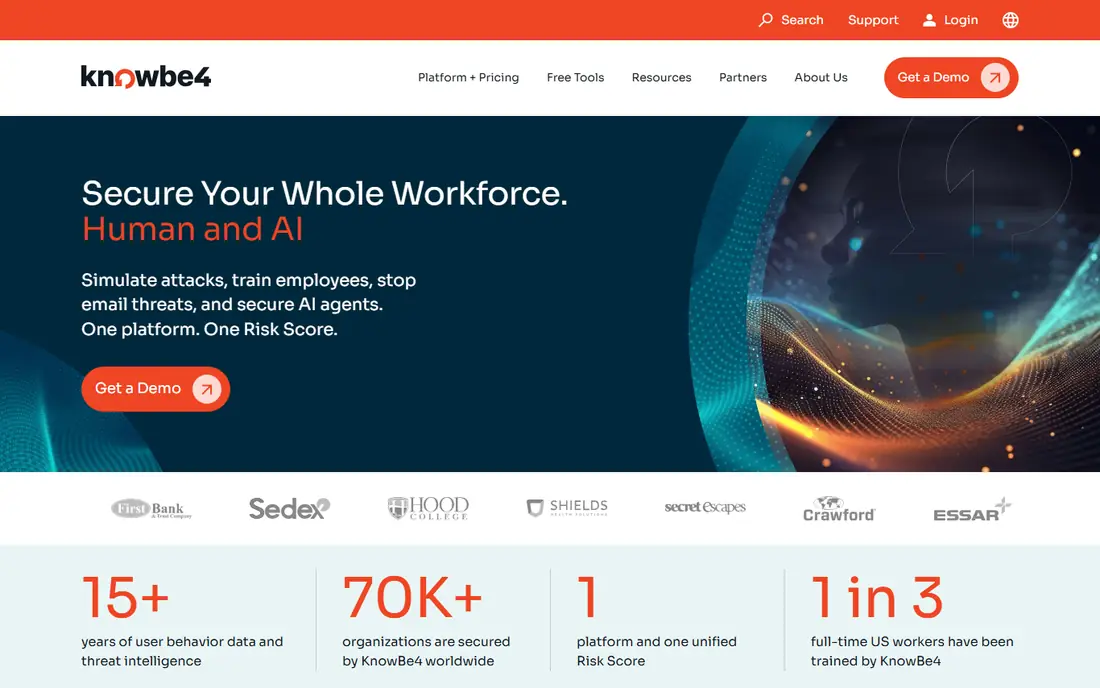
KnowBe4 targets enterprises needing scale, content breadth and compliance coverage. KnowBe4 is the market leader by deployment: the largest security awareness install base, the biggest content library in 35-plus languages, and automatic simulated phishing with user risk scoring. Worth adding: the product includes the full awareness lifecycle: baseline phishing tests, assigned training, simulated campaigns, risk scoring and compliance reporting.
For global enterprises that require consistent training across regions and provable compliance, it is the safe choice. On top of that, the interface carries the weight of its feature breadth. But for enterprise coverage and compliance certainty, KnowBe4 remains the default. No starting price is listed for KnowBe4 here; confirm pricing on the vendor site. On free options: Free trial.
Downsides: Interface complexity.
- Largest content library in dozens of languages
- Automatic phishing campaigns
- Pricing scales with users
NINJIO
Great for: Teams prioritizing engagement through story-driven security content
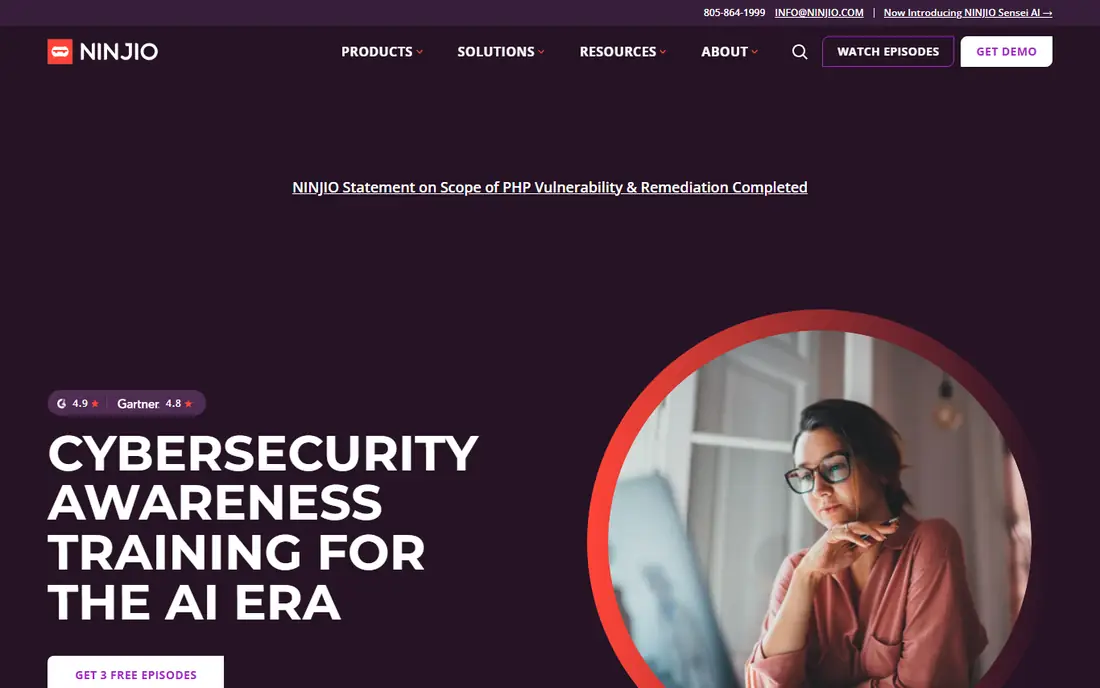
NINJIO is aimed squarely at teams prioritizing engagement through story-driven security content. NINJIO's insight is that nobody watches compliance videos voluntarily. So it makes security content people actually watch: short, Hollywood-style episodes based on real incidents, released on a regular basis like a series.
For organizations where the barrier is apathy instead of sophistication, NINJIO's adoption story is compelling. Engagement and completion rates are the selling point, and they are genuinely higher than traditional training. No starting price is listed for NINJIO here; confirm pricing on the vendor site. NINJIO has no free tier.
Watch-outs: Pricing quote-based.
Where NINJIO stands out: Decent adoption rates.
- Story-driven content employees watch
- Regular fresh episodes
- Phishing simulation lighter
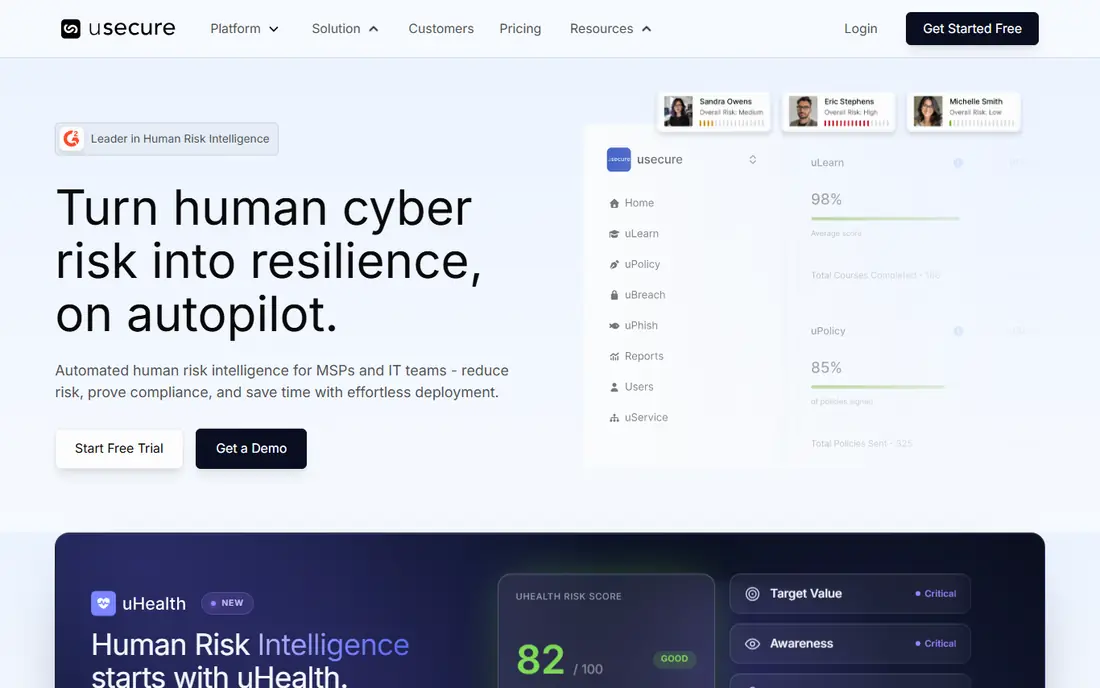
usecure was built for SMBs and MSPs wanting automatic, simple security awareness. Automatic training assignments, phishing simulations and policy management run with minimal admin effort, and the MSP-friendly multi-tenant model serves providers managing plenty of small clients. In daily use, for lean IT teams, that hands-off operation is the feature.
Where it is weaker: Best for smaller organizations.
In practice, enterprise depth in content breadth, risk analytics and customization is thinner than the leaders. But for SMBs and MSPs, usecure hits the usability and price point the big products miss. From a buyer's view, setup takes hours instead of weeks. The automation takes care of the continuing program: new hires get enrolled, simulations run on schedule, reporting stays current. This comparison lists no price for usecure; ask the vendor. On free options: Free trial. Best features of usecure: A decent match for MSP multi-tenant use.
- Solid policy management
- Simple setup and automation
- Smaller content library
Hoxhunt serves organizations that want measurable reduction in human risk. Hoxhunt's thesis is that training should adapt to the person, not the calendar. Its phishing simulations adjust difficulty to each user's behavior: people who report rapidly get harder tests, people who click get coaching in the moment.
On top of that, the results are unusually measurable. In daily use, pricing is premium and the program is phishing-centric by design; broader security culture topics get less depth. But for the core job of making employees resilient to phishing, Hoxhunt is the category's behavior-change leader. Also, organizations track report rates, click rates and risk scores over time, and the trend lines move in the right direction. This comparison lists no price for Hoxhunt; ask the vendor. No free plan comes with Hoxhunt.
Downsides: Best value at scale. Where it shines: Very good reporting culture.
- High user ratings
- Capable behavior-change evidence
- Premium pricing
Mimecast
Great for: Mimecast customers wanting risk-aware awareness alongside email security
In short, Mimecast is for Mimecast customers wanting risk-aware awareness alongside email security. As a standalone HRM system it is less deep than Hoxhunt or KnowBe4; the pitch assumes Mimecast email security underneath.
Where it is weaker: Emerging HRM depth compared with leaders.
For everyday use, Mimecast's awareness offering has evolved toward human risk management, layering risk-aware training onto its email security foundation. Mimecast does not show a starting price in this comparison, so check the vendor site for current pricing. There is no free plan with Mimecast.
- Solid content
- Well suited to existing customers
- Best fit inside Mimecast ecosystem
MetaCompliance
Great for: Compliance-driven organizations needing policy plus training
MetaCompliance is a good fit for compliance-driven organizations needing policy plus training. MetaCompliance pairs security awareness training with policy management, addressing the compliance reality that training alone does not satisfy regulators. Organizations prioritizing measurable risk reduction over compliance coverage should weight that accordingly.
But for compliance-first buyers, MetaCompliance is purpose-built. In practice, frameworks like ISO, GDPR and HIPAA map to content and attestations, giving compliance teams the evidence auditors need. In daily use, behavior-change mechanics are less advanced than Hoxhunt's adaptive approach. On top of that, for regulated industries where the audit trail matters as much as the behavior change, the integrated policy-plus-training model is efficient. No starting price is listed for MetaCompliance here; confirm pricing on the vendor site. No free plan comes with MetaCompliance.
Reasons to shortlist it: Decent customer support.
What to check first: Less gamification than leaders.
- Multilingual content
- Capable compliance framework coverage
- Compliance-first instead of behavior-first
A closer look at human risk management software
Security awareness training used to mean annual slide decks and checkbox compliance. The shift matters since people remain the primary attack vector. Also, credential phishing, business email compromise and social engineering bypass technical controls by targeting humans.
How we compared the tools
Pricing pages, product documentation and feature lists were the main sources, and every entry carries at least one honest drawback. Plan names, prices and limits change often. Treat the figures here as a starting point and verify them with the vendor. The sequence is a judgement call: typical use case first, then pricing transparency, then free access. Use the profiles to check fit.
What to confirm before you sign up
- Request quotes from KnowBe4, MetaCompliance and the others; the list shows no fixed prices.
- Take the trial from KnowBe4 and usecure and push a live task through it before you pay.
- Read the limits listed for KnowBe4 first: breadth over behavior-change depth.
- Confirm the exact Mimecast plan that includes your must-have features.
- Find out what support MetaCompliance includes on your plan, and whether onboarding help costs extra.
Frequently asked questions
How long until phishing click rates drop?
Most organizations see meaningful improvement within two to three quarters of a continuous program. Baseline first, then track phish-prone percentage and report rates; the trend matters more than any single campaign.
How much does it cost?
Pricing is usually per user a month, from around a dollar at scale for entry-level training to multiple dollars for adaptive HRM systems. Worth adding: enterprise programs run into five or six figures annually.
Can I try these options before paying?
Often, yes. KnowBe4 and usecure offer a free trial. Use your own data and a real task during the test, and check what the free tier or trial limits before you rely on it.
Is KnowBe4 the right pick for everyone comparing human risk management software?
No single tool suits every team. KnowBe4 comes first because it fits enterprises needing scale, content breadth and compliance coverage, while NINJIO suits teams prioritizing engagement through story-driven security content and usecure suits SMBs and MSPs wanting automated, easy security awareness. Match the tool to your own size, budget and workflow before deciding.
How is this different from old security awareness training?
HRM systems run continuously, personalize to individual risk, simulate real attacks and measure behavior change. The metric shifts from training completed to risk reduced.
Do these tools publish their prices?
No. None of the tools, from KnowBe4 to MetaCompliance, shows a fixed starting price here, so budget time for quotes.
Sources
See where you really rank - block by block
ProMapRanker scans Google Maps across a grid of your service area. Simple monthly plans from $19, white-label on every plan.
Start freeKeep reading
 zoho inventory alternatives
6 Alternatives to Zoho Inventory, Compared on Price and Fit
Zoho Inventory alternatives: 6 tools compared on price, free plans and fit. Katana leads the list for manufacturers. Fit and flaws are laid out for each entry.
Read → zoho crm alternatives
Best Zoho CRM Alternatives (2026)
Need Zoho CRM alternatives? We compare 7 tools on cost, free access and who each suits. Every pick gets a straight assessment. Built for quick decisions.
Read → zelle alternatives
Best Zelle Alternatives in 2026
Compare the best Zelle alternatives for sending money to friends, paying sellers and moving funds abroad, with honest notes on fees, speed and safety in 2026.
Read →