 ProMapRanker
Best HRIS for Tech and SaaS Companies in 2026


HR, IT, and finance in one system · Pricing starts at: $8 per employee per month
Key takeaways
- Rippling is the strongest fit for tech companies that want HR, IT, and finance automation in one system, while BambooHR suits teams that want core HR simplicity first.
- Gusto suits small SaaS startups that need payroll-first HR, while Workday, ADP Workforce Now, and Paylocity suit larger or more compliance-heavy organisations.
- HiBob and ChartHop suit culture- and data-led mid-size SaaS teams, while Deel suits companies hiring employees and contractors across borders.
- Published pricing is uneven: Rippling, BambooHR, Gusto, and ChartHop publish starting figures in 2026 coverage, while enterprise systems quote on scope.
- We compared core HR coverage, payroll depth, IT automation, global hiring, and published pricing from 2026 coverage, not vendor claims alone.
Quick comparison
| Pick | Great for | Pricing starts at | Free tier | |
|---|---|---|---|---|
| Rippling | HR, IT, and finance in one system | $8 per employee per month | Free trial | Visit |
 BambooHR | Core HR simplicity | $10 per employee per month | Free trial | Visit |
 Gusto | Payroll-first small teams | $49 per month | Free trial | Visit |
 HiBob | Culture-led mid-size SaaS teams | See website | No | Visit |
 Workday HCM | Enterprise HR and finance | See website | No | Visit |
 Deel | Global hiring and payroll | $49 per contractor per month | No | Visit |
 Paylocity | Mid-market all-in-one HR and payroll | See website | No | Visit |
 ADP Workforce Now | Compliance-heavy payroll at scale | See website | No | Visit |
 ChartHop | People data and org planning | $8 per employee per month | No | Visit |
The best HRIS for tech and SaaS companies
We shortlisted systems with live HRIS products in 2026, a clear fit for technology or SaaS teams, and coverage of core HR records, onboarding, time off, and reporting. The nine systems below differ in whether they lead with HR simplicity, payroll depth, IT automation, or global hiring.
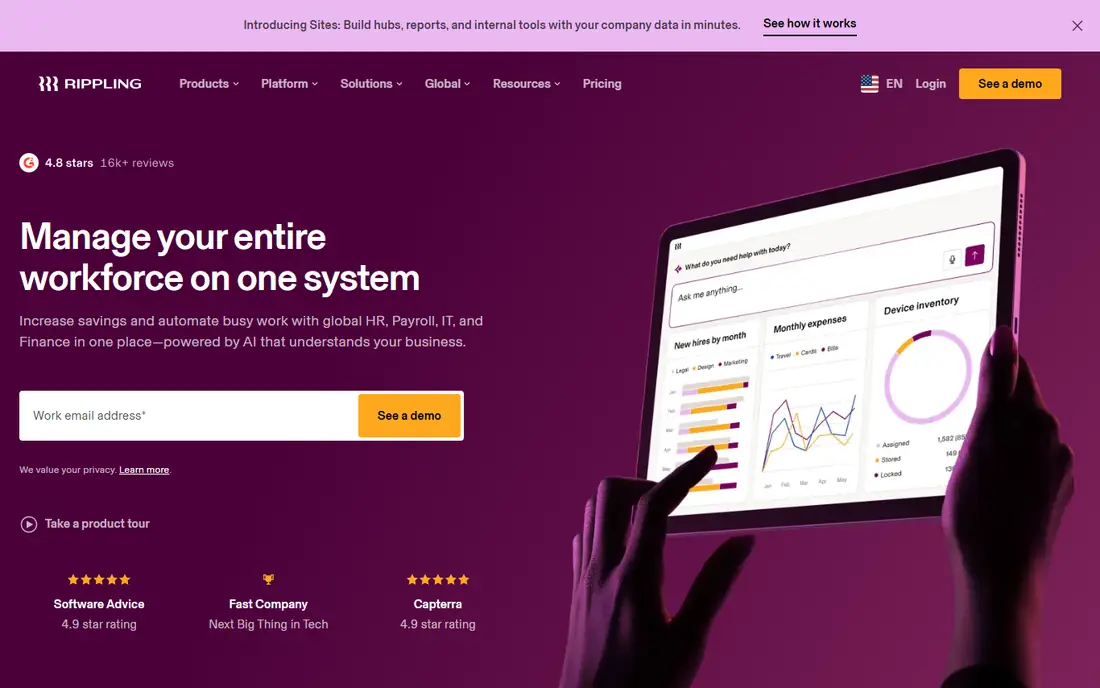
Rippling is the default shortlist pick for a scaling tech company because it treats hiring as an IT event as well as an HR event. Its 2026 coverage describes a unified platform for HR, payroll, IT, and spend, where onboarding can provision a laptop, create accounts, assign apps, and start payroll from one workflow, and offboarding can reverse those steps. For a SaaS team hiring remotely, that automation removes the manual checklist that otherwise grows with headcount.
The risk is scope creep. Rippling's breadth makes it easy to add modules that a small team does not yet need, and published pricing varies across 2026 sources, with some describing a base fee plus per-employee pricing and others describing quote-only terms. We would pick Rippling when HR, IT, and finance automation together justify a single platform.
- Unified HR, IT, payroll, and spend automation in 2026 coverage
- Device and app provisioning tied to hiring
- Global payroll options in coverage
- Pricing is quote-based in some 2026 coverage despite published starting figures
- Easy to overbuy modules
- Implementation needs planning as modules grow
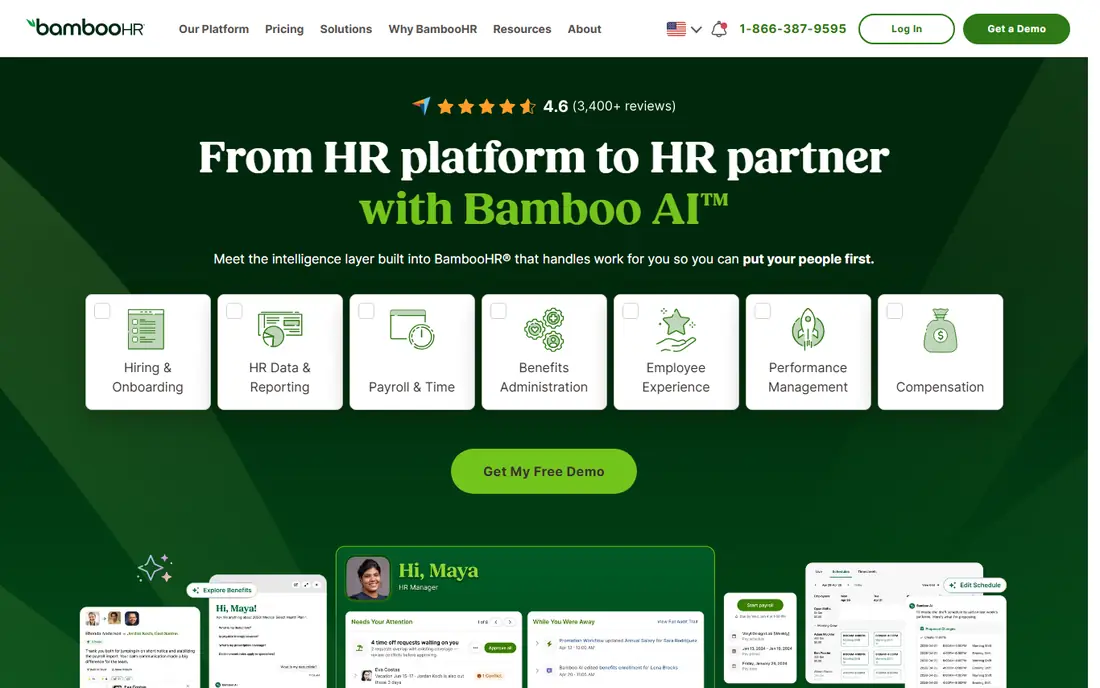
BambooHR suits tech teams that want HR done well without buying a full IT and finance platform. Its 2026 coverage describes a clean core HRIS with employee records, onboarding, time off, and self-service, plus an applicant tracking add-on, with a Core plan from $10 per employee per month and a free trial. For a SaaS startup moving from spreadsheets to a real system, that simplicity shortens implementation and training.
The limits are payroll and depth. Payroll and benefits sit outside the core price, reporting on lower tiers is described as basic, and IT provisioning is not the focus. We would pick BambooHR when core HR simplicity, onboarding, and ease of use matter most, and payroll can be handled separately or as an add-on.
- Simple, well-liked interface in 2026 coverage
- Strong onboarding and self-service
- Core plan from $10 per employee per month in coverage
- Payroll and benefits cost extra
- Reporting is basic on lower tiers in coverage
- Less IT automation than Rippling
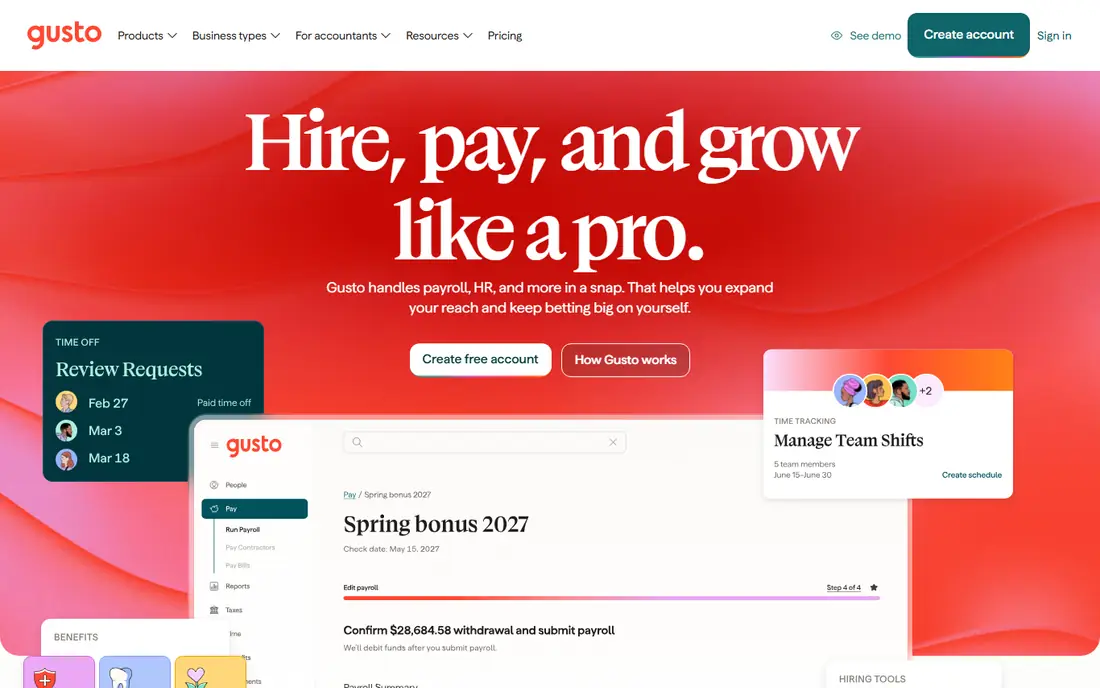
Gusto is the payroll-first pick for a small SaaS startup. Its 2026 coverage describes starting pricing near $49 per month plus $6 per employee on its Simple plan, with automated payroll, tax filing, benefits, and contractor payments in one workflow. For a founder or first operations hire who needs payroll to simply work, with compliance alerts and employee self-service, Gusto's focus on small US teams is a genuine advantage.
The trade-off is scope and geography. Coverage describes Gusto as thin outside the US and limited for complex HR needs, so a team hiring internationally or needing deep talent, performance, and workforce planning will need another system or integrations. The base plus per-employee model also means costs rise steadily with headcount. We would pick Gusto when a small, US-based SaaS team needs payroll-first HR that is easy to run.
- Payroll-first design with transparent starting pricing in 2026 coverage
- Automated tax filing emphasis
- Suits small US teams in coverage
- Thin outside the US in coverage
- Limited for complex HR needs
- Base fee plus per-employee pricing rises with headcount
HiBob, often styled as bob, suits mid-size SaaS teams that care about culture, engagement, and distributed work as much as records. Its 2026 coverage describes a modern, configurable HRIS with strong user experience, culture and engagement features, and support for distributed teams, with typical quoted pricing in the $8 to $18 per employee per month range in some coverage. For a remote-first SaaS company, that combination of HR records and people experience in one system is appealing.
The catch is pricing transparency and payroll coverage. HiBob quotes on scope, so budgeting requires a sales conversation, and payroll depth varies by region, which matters for a team hiring across countries. Configuration also takes time to get right, since a flexible system needs decisions about fields, workflows, and permissions. We would pick HiBob when culture, engagement, and a modern distributed-team experience are priorities, and payroll can be handled through partners or integrations where needed.
- Modern interface and culture features in 2026 coverage
- Configurable HRIS for distributed teams
- Strong engagement and performance tools in coverage
- Pricing is quote-based
- Core HR only in some regions, with payroll varying by region in coverage
- Implementation needs configuration time
Workday HCM is the enterprise pick for a SaaS company that has grown into a large, complex organisation. Its 2026 coverage describes a unified HCM and finance platform with deep global payroll, compliance, workforce planning, and analytics, plus AI-driven skills and planning features. For a public SaaS company, a multinational team, or a company with strict audit and governance needs, that unified governance is the reason to choose Workday despite its cost and complexity.
For most tech startups, Workday is too much, too soon. Coverage describes quote-based pricing, implementation measured in months, and a feature set that only pays off at larger scale. A team under a few hundred employees will usually get more value from Rippling, BambooHR, or HiBob. We would pick Workday when enterprise scale, global complexity, and finance integration justify an enterprise platform.
- Unified HCM and finance platform in 2026 coverage
- Deep global and compliance capabilities
- Workforce planning and analytics strength
- Pricing is quote-based and enterprise-level
- Implementation takes months
- Overkill for teams under 1,000 employees in coverage
Deel suits SaaS companies whose hiring problem is geographic, not just administrative. Its 2026 coverage describes fast, compliant hiring of employees and contractors across many countries, with a contractor plan from $49 per month and employer of record services that let a company employ staff in countries where it has no entity. For a tech team hiring engineers, designers, or support staff across borders, Deel removes the entity, payroll, and compliance work that would otherwise block hiring.
Deel is a global hiring specialist, not a replacement for every HR need. Employer of record pricing is described as steep at low volume, and core HR, performance, and culture features may still need another system. We would pick Deel when global hiring is the main constraint, and pair it with a core HRIS if the team needs deeper HR, performance, and planning features.
- Fast compliant hiring across many countries in 2026 coverage
- Contractor plan from $49 per month in coverage
- Employer of record services in coverage
- Employer of record pricing is steep at low volume in coverage
- Best-of-breed global hiring, not a full core HRIS for all teams
- Costs vary by country
Paylocity fits mid-market SaaS companies that want a single all-in-one platform without moving to enterprise software. Its 2026 coverage describes HR, payroll, talent, time, and workforce management in one system, with a modern interface and a focus on employee experience. For a SaaS company growing from startup tools to a mid-market system, Paylocity offers payroll depth and HR breadth in one relationship.
The trade-off is transparency and scoping. Pricing is quote-based, so total cost depends on modules and headcount, and module breadth means a team can easily buy more than it uses. We would pick Paylocity when a mid-market SaaS team wants all-in-one HR and payroll depth, and is ready to scope modules carefully.
- Mid-market all-in-one HR, payroll, and talent coverage in 2026 coverage
- Modern user experience emphasis
- Workforce management depth
- Pricing is quote-based
- Implementation and support quality can vary
- Module breadth needs careful scoping
ADP Workforce Now suits tech companies where payroll accuracy and compliance are non-negotiable. Its 2026 coverage describes full payroll processing, tax filing, HR, talent, time, and benefits administration, with a scale that runs from mid-market companies to global enterprises. For a SaaS company with complex payroll, multi-state tax, or benefits administration needs, ADP's compliance depth is hard to match with a newer, lighter tool.
The experience can feel heavier than a modern SaaS HRIS. Coverage notes quote-based pricing, a more traditional interface, and support quality that varies by arrangement. A lean SaaS team that values speed and a modern interface may prefer Rippling or BambooHR, even if ADP offers deeper compliance. We would pick ADP Workforce Now when payroll and compliance certainty outweigh interface novelty, and the team has the capacity to manage an enterprise-style implementation.
- Deep payroll, tax, and compliance coverage in 2026 coverage
- Scales from mid-market to enterprise
- Extensive benefits administration
- Pricing is quote-based
- Interface can feel heavier than modern SaaS tools
- Support quality varies by arrangement in coverage
ChartHop suits data-led SaaS teams that want to plan headcount, visualise the organisation, and analyse people data in one place. Its 2026 coverage describes org chart visualisation, people analytics, onboarding, and planning tools, with a starting price of $8 per employee per month. For a SaaS leadership team planning hiring, promotions, and team structure, that planning view complements a core HRIS rather than duplicating it.
ChartHop is not a payroll-first system, so a team that needs deep payroll, tax, and benefits administration will need another platform or an integration. We would pick ChartHop when people data, org planning, and visualisation are the main gaps, and core HR and payroll are already covered or can be integrated.
- Org chart visualisation and people analytics focus in 2026 coverage
- Starting price of $8 per employee per month in coverage
- Onboarding and planning tools
- Analytics-led focus means payroll depth is thinner
- Smaller footprint than Workday or ADP
- Needs clean HR data to deliver value
How we picked these
We compared 2026 HRIS coverage, each vendor's own product and pricing pages, and platform focus, and we kept only systems with live HRIS products in 2026 that fit tech or SaaS teams. We favoured systems with published pricing where available, a clear strength in HR, payroll, IT automation, or global hiring, and a track record in independent 2026 comparisons. We excluded systems that are maintenance-only, region-only without US relevance, or payroll-only tools without core HR records. Where published sources disagreed on a starting price, we used the figure reported most consistently in 2026 coverage and noted quote-based terms where they apply.
How to choose an HRIS for a scaling SaaS team
Start with the hiring plan for the next two years, not the current headcount. A system that fits 30 people may fail at 150 if it lacks global payroll, IT automation, or workforce planning, while an enterprise system bought too early will slow a small team with implementation and cost. Map the next hires by location, employment type, and role, then check each system against that map, including contractors, international staff, and part-time roles.
Next, trial the workflows that happen every week: onboarding, time off approval, payroll changes, manager approvals, and offboarding. Check how each system handles app and device provisioning, access removal, and reporting, since those workflows reveal integration gaps that a feature list hides. Finally, confirm total cost, including base fees, per-employee rates, payroll add-ons, implementation, and integrations, and ask for a written quote at current headcount and at double headcount. A system that looks cheap at 30 people but doubles in cost at 60 is not cheap.
Frequently asked questions
What is an HRIS?
An HRIS, or human resource information system, is software that stores employee records and manages HR processes such as onboarding, time off, benefits, performance, and reporting. For tech and SaaS companies, modern HRIS platforms often add payroll, IT provisioning, and global hiring, turning HR software into a broader people and operations platform.
Should a SaaS startup start with BambooHR, Gusto, or Rippling?
Start with Gusto when payroll is the main need and the team is small and US-based. Start with BambooHR when core HR simplicity and onboarding matter most. Start with Rippling when HR, IT, and finance automation together justify a broader platform, especially for remote or fast-growing teams. All three can work early, but they scale differently, so check the two-year hiring plan before choosing.
Does an HRIS replace payroll software?
Some HRIS platforms include full payroll, such as Rippling, Gusto, Paylocity, and ADP Workforce Now, while others, such as BambooHR core plans and ChartHop, treat payroll as an add-on or integration. Confirm whether payroll, tax filing, and benefits administration are included in the quoted price, since payroll add-ons can change the total cost significantly.
How does an HRIS help with remote and global teams?
A good HRIS centralises records, time off, and onboarding across locations, while global hiring tools such as Deel handle employer of record services, local payroll, and compliance in countries where the company has no entity. For remote teams, also check IT provisioning and access removal, since secure onboarding and offboarding matter as much as HR records.
What is the difference between HRIS, HCM, and HRMS?
These terms overlap heavily. HRIS usually means core HR records and processes, HCM, or human capital management, usually means a broader suite including talent, workforce planning, and analytics, and HRMS is an older term for a similar system. Vendors use the labels inconsistently, so compare features and modules rather than relying on the acronym.
How long does HRIS implementation take?
Implementation varies from days for a simple core HRIS to months for an enterprise HCM platform. Small teams using Gusto or BambooHR can often go live in weeks, while Rippling with IT and finance modules takes longer, and Workday or ADP implementations can take several months. Ask for a written implementation plan, data migration scope, and training plan before signing.
Sources
- https://rankite.com/blog/top-human-capital-management-software
- https://resources.rework.com/tools/hr-people/best-hr-software-2026
- https://www.charthop.com/resource/best-hris-systems
- https://www.guideflow.com/blog/hris-software
- https://hrtoolsnav.net/blog/hr-software-buyers-guide-2026-bamboohr-vs-workday-vs-gusto-vs-rippling
See where you really rank - block by block
ProMapRanker scans Google Maps across a grid of your service area. Simple monthly plans from $19, white-label on every plan.
Start freeKeep reading
 worlds best local seo company
8 Worlds Best Local SEO Companies for Map Pack Growth in 2026
Compare the worlds best local seo company options for Google Business Profile work, citations, reviews, and multi-location rankings and reporting in 2026.
Read → world's best web hosting company
World's Best Web Hosting Company in 2026
Searching for the world's best web hosting company? We compared 10 hosts on price, renewal rates, speed, and support to help you choose well today in 2026.
Read → who's got the best nanny tax services
Who's Got the Best Nanny Tax Services in 2026
We answer who's got the best nanny tax services, comparing full filing, back taxes, software, and pricing so families can handle nanny taxes correctly.
Read →