 ProMapRanker
The best hris for multi-entity companies in 2026


Enterprise multi-entity HR and finance · Pricing starts at: See website
Key takeaways
- Workday, SAP SuccessFactors, and Oracle Fusion Cloud HCM suit large multi-entity firms that need unified HR and finance with deep compliance.
- Rippling, Deel, and Remote suit distributed firms that need to hire and pay across countries without building local entities everywhere.
- Papaya Global suits finance-led firms that treat global payroll as a payments problem across many currencies and entities.
- Multi-entity reporting, intercompany handling, and local compliance differ widely, so test your exact entity mix before buying.
- Free core HRIS tiers from Deel and Remote help small distributed teams, but payroll and employer-of-record services are paid separately.
Quick comparison
| Pick | Great for | Pricing starts at | Free tier | |
|---|---|---|---|---|
| Workday | Enterprise multi-entity HR and finance | See website | No | Visit |
 Rippling | Unified HR, IT, and payroll | $8 per user per month | Free trial | Visit |
 Deel | Global hiring and payroll | $29 per employee per month | Yes | Visit |
 Remote | Global employment with owned entities | See website | Yes | Visit |
 Papaya Global | Global payroll as payments | See website | No | Visit |
 SAP SuccessFactors | Enterprise HR in the SAP ecosystem | See website | No | Visit |
 Oracle Fusion Cloud HCM | Enterprise HR and finance together | See website | No | Visit |
 ADP Workforce Now | Multi-entity HCM at scale | See website | No | Visit |
 HiBob | Modern HR for distributed mid-market firms | See website | No | Visit |
The best hris for multi-entity companies
We compared official product pages, pricing pages, multi-entity features, and public reviews for HR systems that support companies with several legal entities, countries, or payrolls in 2026. Each system below handles multi-entity HR, payroll, or employment in a different way, and each suits a different company size and structure.
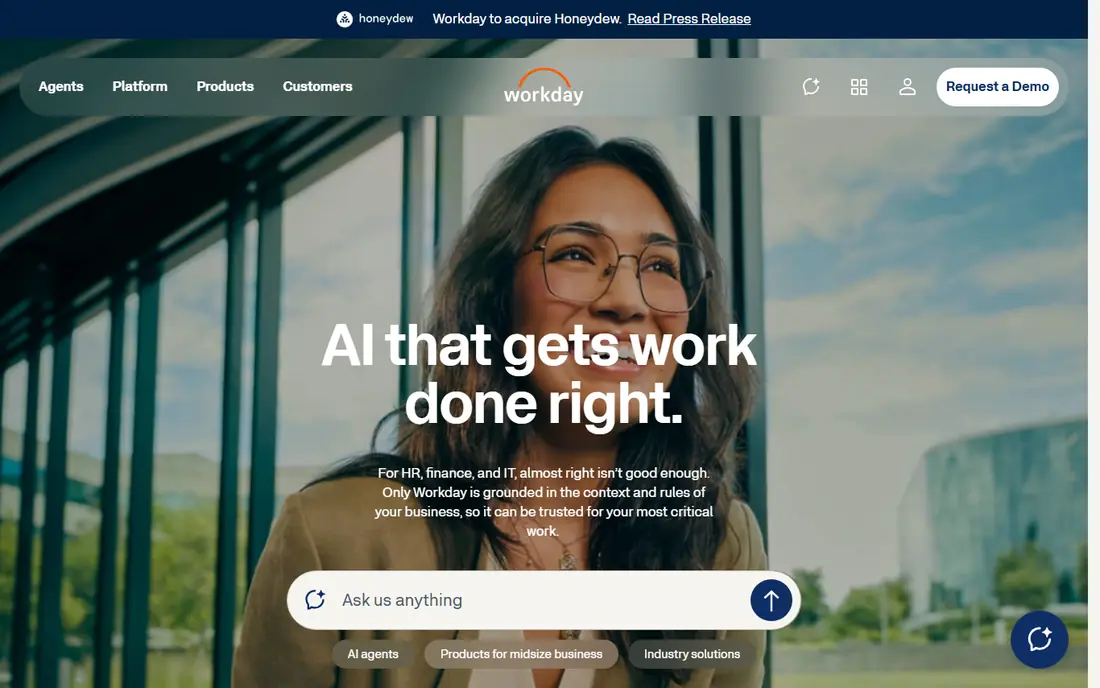
Workday combines human capital management with finance in one system, which helps multi-entity firms keep HR, payroll, and financial data aligned across subsidiaries. It supports multiple entities, currencies, and local compliance rules, with workforce planning and analytics that roll up across the whole group. Large firms use Workday to standardize job structures, pay, and reporting while still handling local payroll rules by country. Workday is enterprise-priced, with implementation that can take months for complex multi-entity groups. Smaller firms may find the cost and setup heavy for their needs. Workday suits large firms that want one HR and finance system across many entities, with strong reporting and governance as the priority.
- Unified HR and finance data model
- Multi-entity and multi-country support
- Strong workforce analytics
- Enterprise pricing and implementation
- Long setup for complex firms
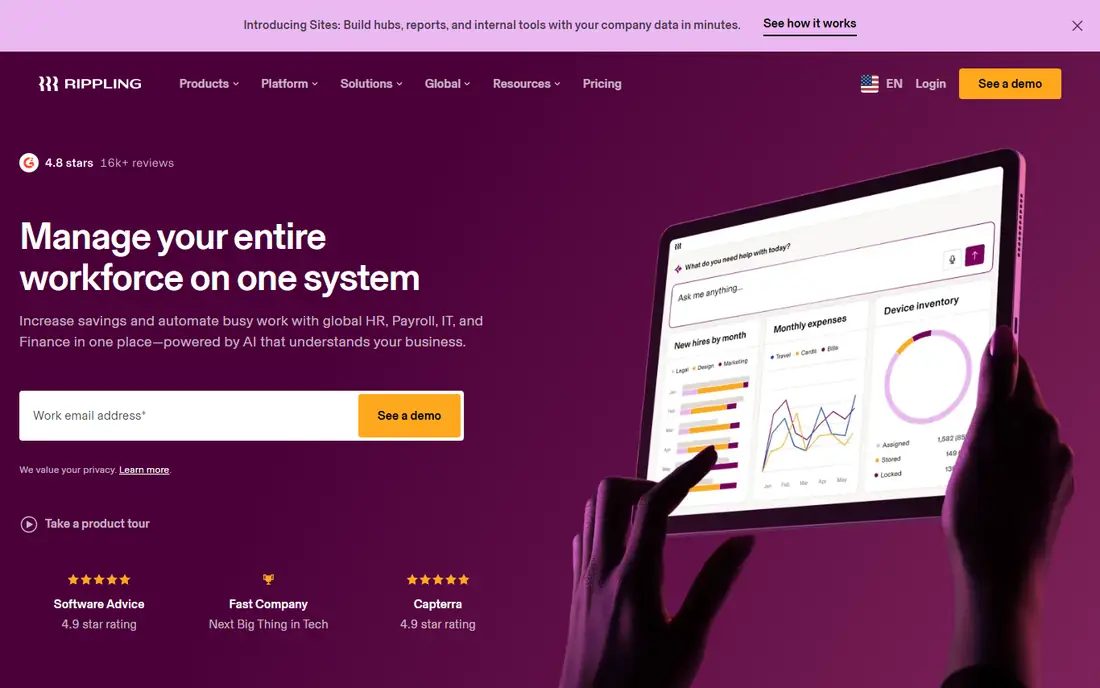
Rippling unifies HR, payroll, IT device management, and spend in one platform, built around a single employee record that updates across systems when someone joins, moves, or leaves. For multi-entity firms, that single record reduces manual work across entities, and its automation can handle onboarding, access, payroll changes, and offboarding in one flow. Rippling also offers global payroll and employer-of-record services for distributed teams. Global coverage is not uniform: native payroll depth is strongest in the US, with partner and employer-of-record models elsewhere, so buyers should check country coverage for their exact entities. Pricing starts at $8 per user per month plus a monthly base fee, with payroll and global services as add-ons. Rippling suits mid-size firms that want HR, IT, and payroll in one system across entities.
- One employee record across HR, IT, and payroll
- Automation across systems
- Multi-entity support
- Global payroll depth varies by country
- Base fee plus per-user pricing adds up
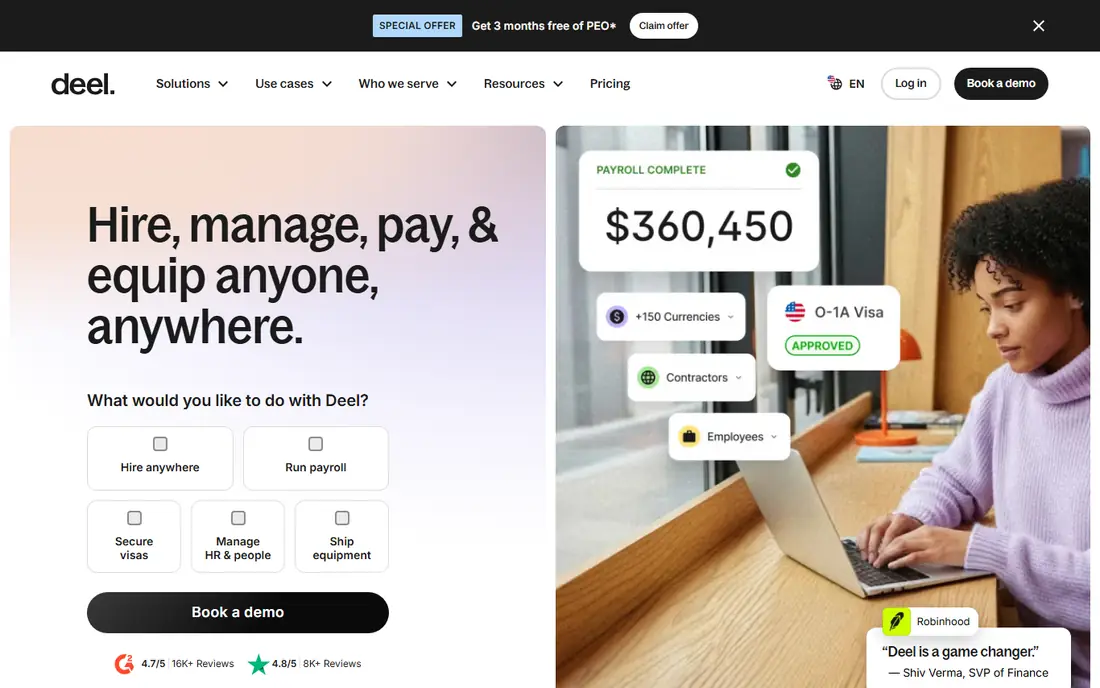
Deel provides global payroll, employer-of-record services, contractor management, and a core HRIS, with coverage across many countries. Its free core HRIS for up to 200 employees helps distributed startups organize people data across entities before they pay for payroll services, while paid global payroll starts at $29 per employee per month in many markets. Deel also handles localized contracts, benefits, and compliance for employees hired through its entities. Employer-of-record pricing is much higher than payroll pricing, and buyers should separate the two when budgeting. Core HRIS features are basic compared with enterprise suites, so large firms may need extra tools for performance and planning. Deel suits distributed firms that hire across many countries and entities without setting up local subsidiaries everywhere.
- Free core HRIS for up to 200 employees
- Global payroll and employer of record
- Contractor management
- Payroll and employer-of-record fees are separate
- HRIS depth varies by plan
Remote offers global employment, payroll, and contractor management through its own legal entities in the countries where it operates, rather than relying only on partners. That owned-entity model aims for consistent compliance, contracts, and payroll handling across entities, which appeals to firms that want fewer third parties in the chain. Its basic HRIS is free, with contractor management and global payroll as paid services. Country coverage is narrower than the broadest global providers, so firms with entities in less common markets should check availability first. Employer-of-record fees are separate and significant. Remote suits firms that value consistent, owned-entity employment across their main hiring countries, with a free HRIS as a starting point.
- Owned legal entities in operating countries
- Free basic HRIS
- Transparent contractor and payroll pricing
- Country coverage is narrower than Deel
- Enterprise features are paid add-ons
Papaya Global treats global payroll as a payments and finance problem, with payroll, employer-of-record, and contractor services across many countries and currencies. Its platform gives finance teams a single view of payroll costs, payments, and compliance across entities, with bank rails through large payment partners. That finance-led view suits firms where payroll accuracy, currency handling, and reporting matter as much as HR workflows. Papaya Global pricing is by quote, based on countries, headcount, and services, so buyers need a clear entity list to compare offers. Its HRIS features are narrower than enterprise HCM suites, so firms that need deep performance, learning, or planning tools may pair it with another system. Papaya Global suits finance-led multi-entity firms that need reliable global payroll across many currencies.
- Payroll across many countries and currencies
- Payments-first design
- Finance reporting
- Pricing by quote
- HRIS depth is less than full HCM suites
SAP SuccessFactors provides core HR, payroll, talent, and analytics for large firms, with strong integration into SAP finance and enterprise resource planning systems. For multi-entity firms already running SAP, that integration keeps HR, finance, and operations data aligned, and its localization covers many countries. Modules cover hiring, onboarding, performance, learning, and succession, so firms can build a full HCM suite in one ecosystem. Implementation is complex, with module choices, localization, and partner work affecting cost and timeline. Pricing is quoted by modules and headcount, so comparisons need a full module list. SAP SuccessFactors suits large firms in the SAP ecosystem that need enterprise HR across many entities with finance integration.
- Deep SAP integration
- Multi-country HR and payroll
- Large enterprise scale
- Complex implementation
- Pricing varies widely by modules
Oracle Fusion Cloud HCM combines core HR, payroll, talent, and workforce planning with Oracle finance and enterprise systems, giving multi-entity firms one cloud platform for people and money. It supports multiple entities, currencies, and local rules, with analytics that roll up across subsidiaries and AI tools for HR tasks. Large firms use it to standardize HR processes while keeping local compliance handling by country. Oracle implementation is enterprise-scale, with cost and timeline that suit large firms more than mid-size ones. Firms outside the Oracle ecosystem should check integration effort carefully. Oracle Fusion Cloud HCM suits large multi-entity firms that want HR and finance together in Oracle cloud, with strong reporting and scale.
- Unified HCM and finance cloud
- Multi-entity support
- Strong analytics and AI tools
- Enterprise pricing and implementation
- Best for Oracle ecosystem firms
ADP Workforce Now provides payroll, HR, time tracking, benefits, and talent tools for mid-size and large firms, with multi-entity support for companies with several subsidiaries. Its strength is payroll depth and compliance handling in the US, plus global payroll through ADP partner networks for firms with entities abroad. That scale and compliance experience suit firms that need reliable payroll across entities with tax and reporting handled centrally. International payroll depth varies, since some countries run through partners rather than native ADP delivery, and integration costs can be significant. Pricing is by quote. ADP Workforce Now suits US-led multi-entity firms that need payroll-centric HCM at scale, with global coverage through ADP networks.
- Large HCM provider
- Payroll, HR, time, and benefits
- Multi-entity support in the US and beyond
- International payroll often via partners
- Pricing by quote
HiBob, known as Bob, is a modern HR platform for mid-market and distributed firms, with core HR, onboarding, time off, performance, and people analytics in a configurable system. It handles multiple entities, locations, and currencies in people data, and it integrates with payroll providers for local pay runs. Its clean design and flexibility appeal to firms that want a modern HRIS without enterprise implementation weight. HiBob does not run native payroll in every country, so multi-entity payroll often needs partner integrations, which adds setup and cost. It also lacks the full finance integration of Workday or Oracle. HiBob suits mid-market distributed firms that want a modern, flexible HRIS across entities, with payroll handled through trusted partners.
- Modern, configurable HRIS
- Good for distributed teams
- Strong people analytics
- Payroll is via partners and integrations
- Enterprise depth less than Workday or SAP
How we picked these
We compared official product pages, pricing pages, multi-entity and payroll features, and public reviews, and we kept systems that support multiple entities, countries, or payrolls in 2026. We looked for entity structures, currency handling, local compliance, and consolidated reporting, not just basic HR record-keeping. We left out single-country payroll tools, pure applicant tracking systems, and HR tools with no multi-entity support. We did not run payroll ourselves, so buyers should test their exact entity mix, run a payroll parallel test, and confirm local compliance before switching systems.
How to choose a multi-entity HRIS
Map entities, countries, and worker types first
List every legal entity, country, worker type, and payroll provider before you demo. A system that covers your top five countries may miss a smaller entity that still needs compliant payroll, and that gap can force a second system.
Test reporting across entities, not just in one
Ask vendors to show consolidated headcount, cost, and payroll reports across entities and currencies, plus intercompany handling. A pretty dashboard for one entity does not prove multi-entity reporting works.
Run a payroll parallel test
Before you switch, run old and new payroll side by side for at least one cycle per country. Check tax, benefits, currency conversion, and reporting, and agree on who fixes errors during transition.
Frequently asked questions
What is a multi-entity HRIS?
It is an HR system that manages people, payroll, and reporting across several legal entities, countries, or subsidiaries in one platform, with local rules and consolidated group reporting.
Do I need an employer of record with a multi-entity HRIS?
Not always. If you already have legal entities in each country, payroll and HRIS may be enough. If you hire where you have no entity, an employer-of-record service from Deel or Remote can employ staff compliantly.
Which HRIS is best for a small distributed company?
Deel and Remote offer free core HRIS tiers that suit small distributed teams, with paid payroll and employer-of-record services added as you grow. Rippling suits firms that also want IT and payroll unified.
Which HRIS is best for a large enterprise with many entities?
Workday, SAP SuccessFactors, and Oracle Fusion Cloud HCM suit large multi-entity firms, with unified HR and finance, deep compliance, and consolidated analytics, though implementation is longer and costlier.
How much does multi-entity HRIS cost?
Costs vary widely, from free core HRIS tiers to quoted enterprise contracts. Compare per-employee fees, payroll fees, employer-of-record fees, implementation, and integration costs together, not just the headline HRIS price.
Can one HRIS handle payroll in every country?
Rarely on its own. Most systems run native payroll in some countries and use partners elsewhere, so check your exact country list and ask how partner payroll is managed, priced, and reported.
Sources
See where you really rank - block by block
ProMapRanker scans Google Maps across a grid of your service area. Simple monthly plans from $19, white-label on every plan.
Start freeKeep reading
 worlds best local seo company
8 Worlds Best Local SEO Companies for Map Pack Growth in 2026
Compare the worlds best local seo company options for Google Business Profile work, citations, reviews, and multi-location rankings and reporting in 2026.
Read → world's best web hosting company
World's Best Web Hosting Company in 2026
Searching for the world's best web hosting company? We compared 10 hosts on price, renewal rates, speed, and support to help you choose well today in 2026.
Read → who's got the best nanny tax services
Who's Got the Best Nanny Tax Services in 2026
We answer who's got the best nanny tax services, comparing full filing, back taxes, software, and pricing so families can handle nanny taxes correctly.
Read →