 ProMapRanker
Best HR Software for Midsize Companies in 2026


Simple, clean HRIS for teams up to about 500 people · Pricing starts at: See website
Key takeaways
- BambooHR is the easiest HRIS for midsize teams that want clean records, hiring, and time off without a long implementation.
- Rippling suits companies that want HR, payroll, IT, and finance on one employee record, though module pricing can add up.
- ADP Workforce Now and Workday suit larger midsize firms with complex payroll, compliance, or multi-state needs, but both require a sales quote and more setup time.
- Payroll is the dividing line: some platforms include it, others sell it as an add-on, so confirm what is included before comparing monthly prices.
- Midsize means roughly 100 to 1,000 employees here, and the best platform for 120 people is rarely the best for 900 people.
Quick comparison
| Pick | Great for | Pricing starts at | Free tier | |
|---|---|---|---|---|
| BambooHR | Simple, clean HRIS for teams up to about 500 people | See website | No | Visit |
 Rippling | One employee record across HR, payroll, IT, and spend | See website | No | Visit |
 ADP Workforce Now | Payroll depth, tax compliance, and workforce analytics | See website | No | Visit |
 Workday | Large midsize companies needing full HCM and planning | See website | No | Visit |
 HiBob | People analytics, engagement, and modern employee experience | See website | No | Visit |
 Paycor | Full HCM with payroll, recruiting, and industry-specific workflows | See website | No | Visit |
 Gusto | Payroll-first HR for the smaller end of midsize | See website | Free trial | Visit |
 Namely | Midsize teams outgrowing basic HR tools | See website | No | Visit |
 Lattice | Performance management and engagement alongside core HR | See website | No | Visit |
The best HR software for midsize companies
We compared official pricing pages, product documentation, and public feature lists for platforms that serve companies well beyond startup size. Prices are mostly quote-based at this scale, so we write See website where a vendor does not publish a firm per-employee price, rather than repeating a third-party estimate as fact.
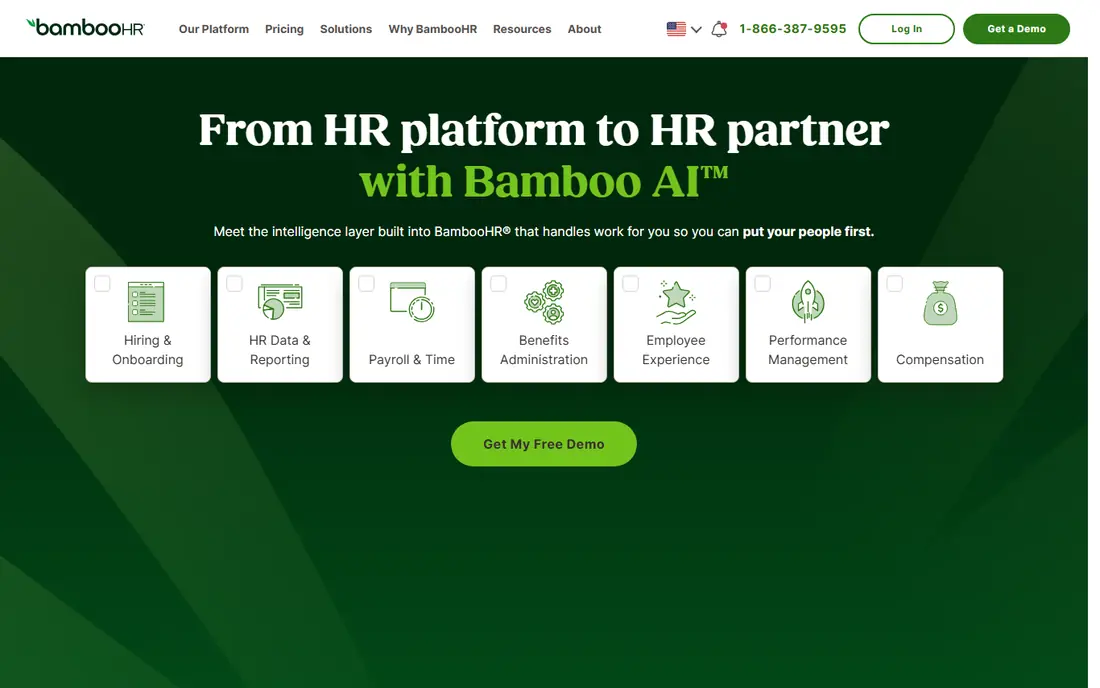
BambooHR keeps winning midsize deals for a simple reason: people actually use it. Employee records, onboarding checklists, time off, and hiring live in one place with little training, which matters when a lean HR team supports several hundred staff.
The catch is scope. Payroll is sold separately, benefits administration varies by plan, and global hiring relies on a partner add-on rather than a native employer-of-record service. Companies approaching 1,000 employees or running complex multi-state payroll may outgrow it, but for a 100 to 500 person company that wants order without enterprise complexity, BambooHR remains our pick for most midsize teams.
- Clear interface that HR teams learn quickly
- Applicant tracking included on entry plans
- Reporting and time off handled well
- Payroll is an add-on rather than built in
- Global employment needs an add-on partner
- Performance tools are basic on lower tiers
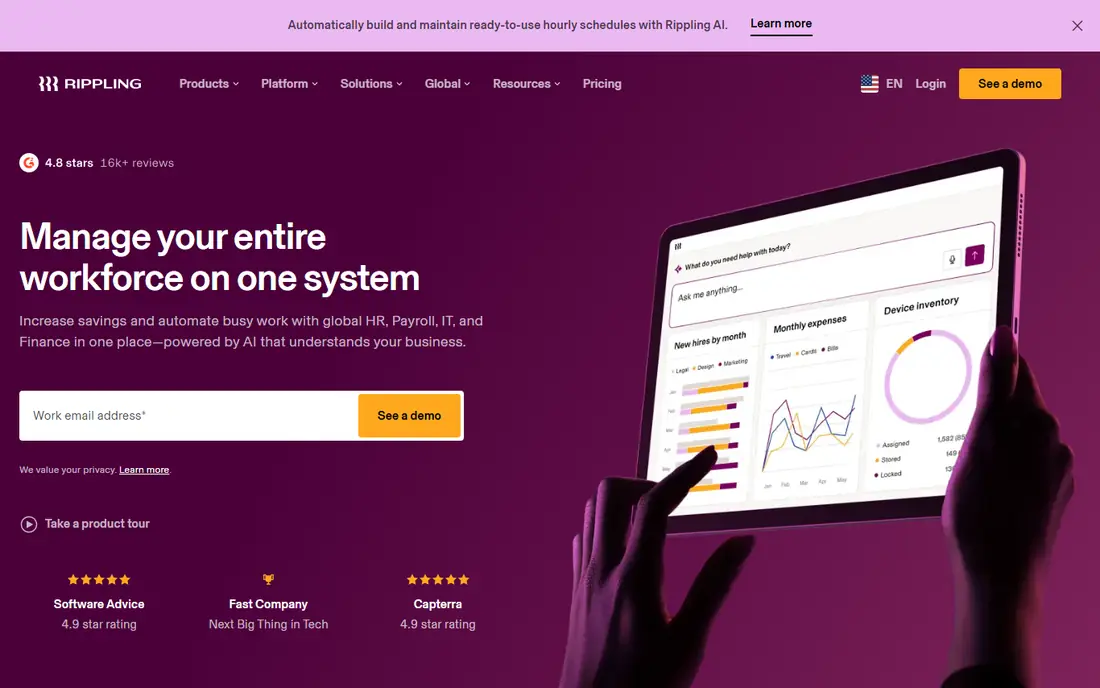
Rippling treats the employee record as the center of everything: hire someone once, and payroll, benefits, device access, and expense cards can follow from that same record. Automation handles onboarding and offboarding steps, such as account creation and removal, which reduces both errors and security risk.
The price conversation needs care. Rippling publishes a starting point for its HR product but quotes most modules individually, so a full stack costs more than the headline figure suggests. Smaller midsize teams should price the exact modules they will use, not the platform in general. If your company wants one system for HR plus IT and finance, Rippling is the strongest fit on this list. If you only need core HR, BambooHR is simpler and cheaper.
- Unified HR, payroll, IT device management, and spend tools
- Strong workflow automation
- Scales from small teams to thousands of staff
- Modular pricing can rise as you add products
- Some newer modules feel less mature
- Implementation needs planning
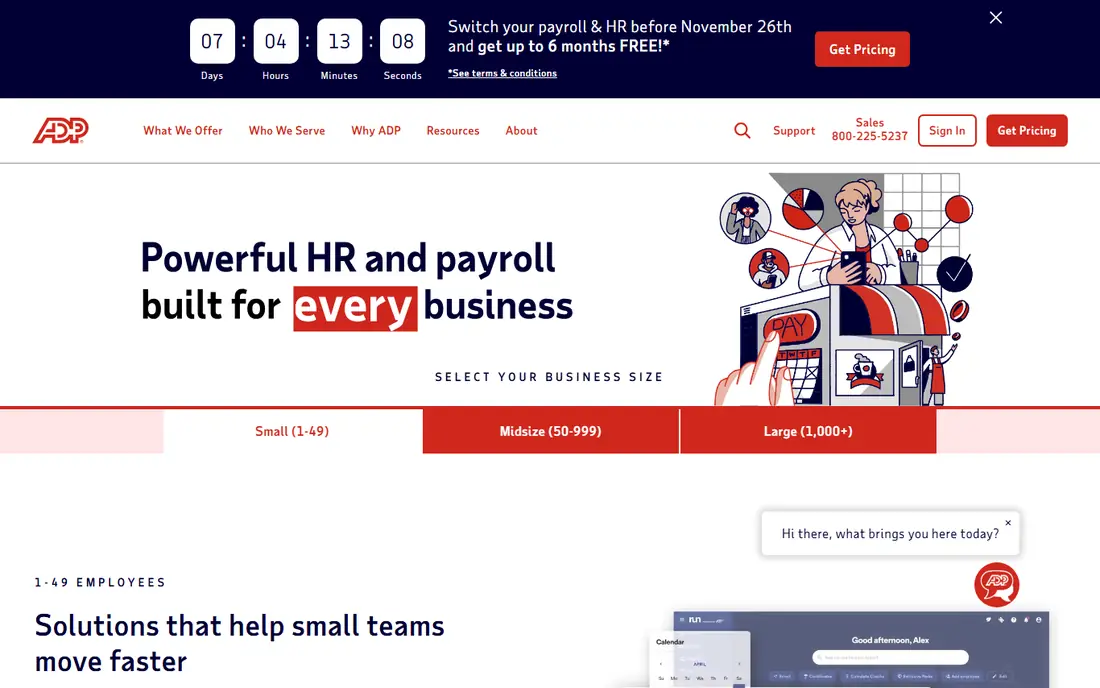
ADP Workforce Now is the established choice for midsize companies that put payroll accuracy first. It handles multi-state tax filing, garnishments, time and attendance, and benefits administration in one system, with reporting and benchmarking that help HR leaders compare turnover and pay trends.
The trade-offs are cost transparency and complexity. Quotes vary by headcount, modules, and services, so budgeting requires a sales conversation and a careful scope document. The interface packs in a lot, and teams used to a consumer-style HR app may find it busy at first. For a company where payroll mistakes carry real legal and financial cost, that depth is worth the setup time.
- Deep payroll and tax handling across all 50 states
- Compliance resources and benchmarking
- Broad integration options
- Pricing is quote only
- Interface can feel dense
- Implementation takes longer than simpler tools
Workday suits the upper end of midsize: companies with 1,000 or more employees, multiple entities, or advanced planning needs. Its strength is joining human capital management with financial planning, so headcount plans, compensation, and budgets can be modeled together. Recruiting, performance, learning, and payroll sit in the same system, which reduces the patchwork that grows when point tools accumulate.
That power comes with enterprise effort and cost. Implementation is a project, not a signup, and annual pricing reflects the full suite rather than a single HR module. Companies with 150 employees will pay for capability they do not use. Companies approaching enterprise scale, or planning acquisitions and international growth, are the ones who get value from Workday, and they should budget for internal ownership of the system after go-live.
- Complete HCM suite with recruiting, talent, payroll, and planning
- Strong analytics and workforce modeling
- Proven at large scale
- Enterprise pricing and implementation effort
- Overkill below a few hundred employees
- Customization needs expertise
HiBob, often called Bob, focuses on the people side of HR: who works where, how teams are structured, how engagement is trending, and where attrition risk sits. Its analytics and benchmarking help midsize leaders answer headcount questions without exporting data to spreadsheets. The interface feels modern, which helps adoption among managers and employees who otherwise ignore HR systems.
Payroll is the gap to plan around. HiBob integrates with payroll providers rather than running US payroll natively in the same way ADP or Rippling do, so a company that wants one vendor for everything should confirm the payroll path before signing. For a midsize company with an existing payroll provider, or with teams in several countries, HiBob is a strong people platform that complements payroll rather than replacing it.
- Strong people analytics and org planning
- Modern interface employees enjoy using
- Good for multi-country midsize teams
- Payroll is handled through partners and integrations
- Pricing is quote only
- Less depth for US payroll compliance alone
Paycor
Great for: Full HCM with payroll, recruiting, and industry-specific workflows
Paycor positions itself as a full human capital management suite for midsize employers, covering payroll, time, recruiting, onboarding, benefits, and talent. Its industry focus helps in sectors with shift work, credential tracking, or location-based scheduling, where generic HR tools miss practical details. Reporting ties payroll and HR data together, which helps leaders see labor cost alongside headcount.
As with other full suites, the buying risk is scope creep: adding modules during a sales process can lift the price well above the initial quote. Ask for a written list of included modules, implementation fees, and per-employee charges before committing. For a midsize company that wants an established vendor with payroll depth and recruiting in one place, Paycor deserves a shortlist spot alongside ADP and Rippling.
- Payroll, HR, recruiting, and time in one suite
- Industry-specific features for sectors such as healthcare and manufacturing
- Solid reporting
- Pricing is quote only
- Module choices need careful scoping
- Smaller teams may find the suite broad
Gusto started as a payroll product and still shows that heritage: payroll, tax filings, benefits, and contractor payments are straightforward to set up and run. For a company growing from 50 toward 200 or 300 employees, Gusto offers a gentler step up than an enterprise suite, with hiring, onboarding, time tracking, and performance tools on its higher tiers. Published starting prices make early budgeting easier than with quote-only vendors.
The limit is scale and depth. Very large midsize companies, or those with complex global payroll, will find Gusto thinner on advanced workforce planning and enterprise controls. It is best viewed as the payroll-first option for the smaller end of midsize, and a good bridge for companies that have outgrown spreadsheets but do not yet need Workday or ADP Workforce Now.
- Clear payroll setup and employee self-service
- Hiring and onboarding included on higher tiers
- Transparent published starting prices
- Better suited below about 500 employees than at 1,000
- Advanced HR analytics are thinner than enterprise suites
- Some features vary by state
Namely targets the exact gap this article covers: companies that have outgrown a basic HR app but do not want an enterprise platform yet. It combines core HR, payroll, benefits administration, and time management, with a company news feed that helps distributed teams stay informed.
Buyers should test reporting and payroll handling for their own states and pay rules during a trial or demo, since depth varies by configuration. Pricing is quote-based, so get the full module list in writing. For a 200 to 800 person company seeking one mid-market system with a friendly employee experience, Namely is a credible alternative to BambooHR plus a separate payroll add-on.
- HR, payroll, benefits, and time in one platform
- News feed and social features aid communication
- Good for companies around 100 to 1,000 staff
- Pricing is quote only
- Reporting depth varies by tier
- Implementation quality depends on scoping
Lattice is included because many midsize companies buy HR software for talent reasons, not just records. Its reviews, goals, feedback, engagement surveys, and compensation tools help managers run consistent performance cycles as headcount grows past the point where informal check-ins work. The HRIS side covers employee records, onboarding, and time off, so it can serve as a core system for smaller midsize teams.
It is not a payroll system, so companies that need payroll in the same purchase should pair Lattice with a payroll provider or choose a full suite instead. Pricing is modular, so performance, engagement, and HRIS costs should be quoted together. For a midsize company whose main HR pain is inconsistent reviews and low visibility into engagement, Lattice is the most focused pick here.
- Strong reviews, goals, engagement surveys, and growth tracking
- HRIS features for records and onboarding
- Analytics connect performance to retention
- Not a full payroll replacement
- Pricing varies by module
- Best as a talent platform rather than a standalone payroll system
How we picked these
We compared official pricing and product pages, feature lists, and public documentation for platforms that actively serve companies with roughly 100 to 1,000 employees. We favored platforms with a clear midsize fit, current US payroll or partner payroll paths, and reporting that works without heavy consulting. Where vendors do not publish prices, we say so rather than copying a review site estimate. We also weighted ease of adoption, since a powerful system that managers avoid using does not help a lean HR team.
How to choose for your headcount and payroll needs
Start by counting what you actually run today: how many employees, how many states, how many pay schedules, and whether contractors or international staff are involved. A single-state team of 150 people with salaried staff has very different needs from a 700-person company with hourly workers in 20 states. Write those facts down before any demo, and ask each vendor to show your exact payroll and time scenarios, not a generic walkthrough.
Separate must-have payroll from nice-to-have talent tools
Payroll accuracy, tax filing, and compliance are non-negotiable and hard to change later. Performance reviews, engagement surveys, and learning tools are valuable but easier to add as a second system. If a vendor is strong on talent but weak on your payroll states, do not let a polished demo override that gap. Conversely, if payroll is already handled well elsewhere, a talent-focused platform such as Lattice or HiBob may serve you better than a full suite.
Test implementation, support, and exit terms
Ask for an implementation timeline, a named contact, data migration help, and support hours in writing. Midsize teams often underestimate migration: cleaning job titles, pay history, and time-off balances takes weeks, and a vendor that rushes it creates errors that surface at payroll time. Check contract length, price increases at renewal, and how you export your data if you leave. A system that holds your records hostage is a poor long-term partner, however good the demo looks.
Frequently asked questions
What is the best HRIS system for medium companies?
For most medium companies, BambooHR is the best HRIS for ease of use, while Rippling is the best choice when HR, payroll, and IT need to share one record. ADP Workforce Now is stronger for complex payroll and compliance, and Workday fits larger midsize firms with planning needs. The best HRIS depends on headcount, payroll complexity, and whether you want one suite or best-of-breed tools.
What are the best HR platforms for midsize companies?
The best HR platforms for midsize companies on this list are BambooHR, Rippling, ADP Workforce Now, HiBob, Paycor, and Namely, with Workday for the upper end of midsize and Lattice for performance-led teams. Shortlist two or three, run the same payroll and reporting scenarios in each demo, and compare total module cost rather than headline price alone.
Is BambooHR good for midsize companies?
Yes, BambooHR works well for midsize companies up to about 500 employees, especially teams that value a simple interface, hiring, onboarding, and time off in one place. Its limits appear with complex payroll, global employment, and very large headcounts, where payroll add-ons or a full suite may fit better. Trial the reporting and approval workflows with your own managers before deciding.
Does Rippling work for midsize companies?
Yes, Rippling is built to scale from small teams to thousands of employees, and its unified record across HR, payroll, IT, and spend is a real advantage for midsize firms. The main caution is modular pricing: quote every module you plan to use, including IT and spend tools, before comparing it with a simpler HRIS. Companies that only need core HR may find BambooHR simpler.
How much does HR software cost for a midsize company?
Most midsize HR platforms price by employee per month plus a base or platform fee, but many vendors quote rather than publish prices, so totals vary widely by modules and headcount. Expect a simpler HRIS to cost less than a full suite with payroll, IT, and analytics, and always ask for implementation fees and renewal terms in writing. A demo quote that omits payroll or benefits modules is not a comparable price.
Should a midsize company choose a PEO or HR software?
A PEO such as a professional employer organization co-employs staff and handles payroll, benefits, and compliance, while HR software leaves employment with your company and gives you the tools to manage it. A PEO suits companies that want to outsource compliance and gain group benefits access, while software suits companies that want direct control and already have HR staff. Compare total cost, benefits quality, and control before choosing, since switching later takes effort.
Sources
See where you really rank - block by block
ProMapRanker scans Google Maps across a grid of your service area. Simple monthly plans from $19, white-label on every plan.
Start freeKeep reading
 zscaler alternatives
Best Zscaler Alternatives in 2026
Looking for zscaler alternatives? We compare 9 SASE and zero trust platforms on architecture, data protection, pricing, and fit for your network and team.
Read → zapier alternatives free
Best Zapier Alternatives Free in 2026
Nine automation tools for zapier alternatives free in 2026, all with genuinely free tiers, plus free plan limits, starting prices and upgrade paths explained.
Read → which platform is best for online reputation
Which Platform Is Best for Online Reputation in 2026
Wondering which platform is best for online reputation? We compare 8 review, listing, and response tools for small and multi-location businesses and agencies.
Read →