 ProMapRanker
Best House Apps in 2026: 9 Apps Compared

Key takeaways
- Zillow offers the broadest browsing, while Redfin and Realtor.com often show fresher listing status because of direct MLS access.
- Trulia and Homes.com add neighborhood context that helps early-stage buyers compare areas, not just houses.
- Compass and Rocket Homes suit buyers who want agent help and financing in the same workflow.
- Use at least two apps when you are serious, because no single app lists every home, and status updates can lag by hours.
Quick comparison
| Pick | Great for | Pricing starts at | Free tier | |
|---|---|---|---|---|
 Zillow | Broadest home search | Free | Yes | Visit |
 Redfin | Fast alerts and tour booking | Free | Yes | Visit |
 Realtor.com | Fresh MLS listings | Free | Yes | Visit |
 Trulia | Neighborhood insight | Free | Yes | Visit |
 Homes.com | Media-rich listings | Free | Yes | Visit |
 Compass | Agent-led search | Free | Yes | Visit |
 Rocket Homes | Search plus mortgage path | Free | Yes | Visit |
 Movoto | Clean MLS search | Free | Yes | Visit |
 StreetEasy | New York City search | Free | Yes | Visit |
The best house apps
We compared these apps on listing coverage, freshness, search filters, tour booking, neighborhood data, and agent connection. All are free to browse, with agent services and mortgage products priced separately.
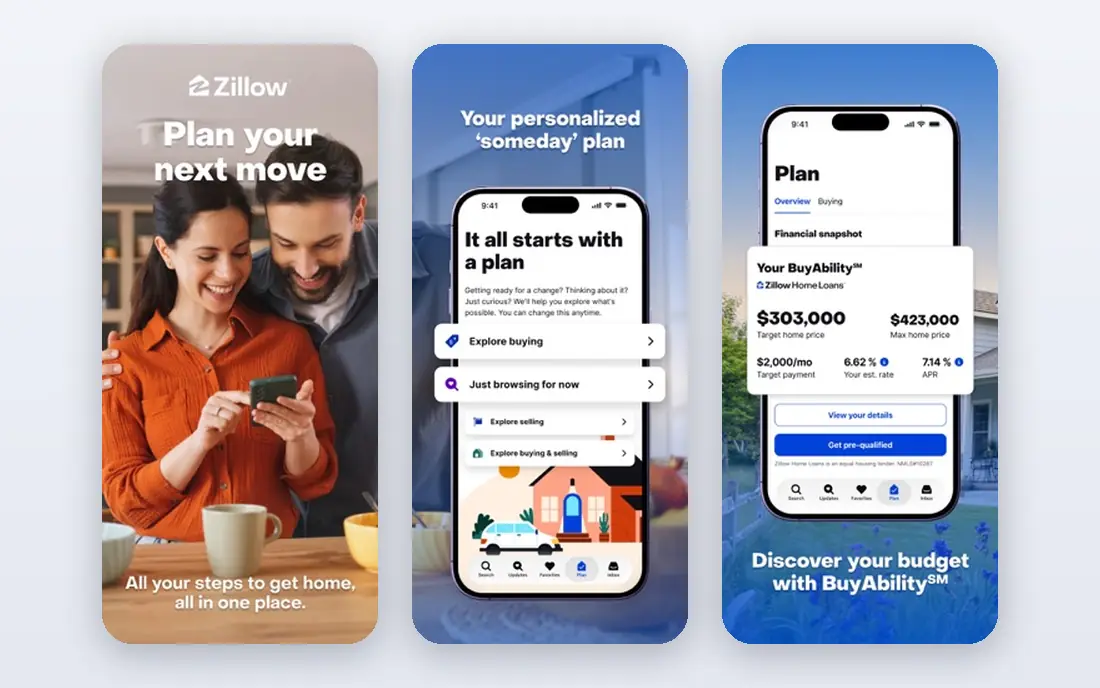
Zillow is the practical first stop for most buyers because of its breadth. It covers homes across the country, including some owner-listed homes that do not appear on every portal. Saved searches send alerts for new listings and price changes, and listing pages often include photos, 3D tours, floor plans, and payment estimates. That combination makes early browsing easy, even before you choose an agent.
The drawback is freshness and accuracy. A home marked active on Zillow may already be under contract, and a Zestimate is an automated estimate, not an appraisal. Use Zillow for discovery and shortlisting, then confirm status, price history, and condition with your agent or on an MLS-sourced portal before scheduling a tour.
- Very large listing database including for-sale-by-owner homes
- Zestimate value estimates on many homes
- Saved searches with price-change alerts
- Listing status can lag behind MLS data in fast markets
- Value estimates can differ sharply from a local appraisal
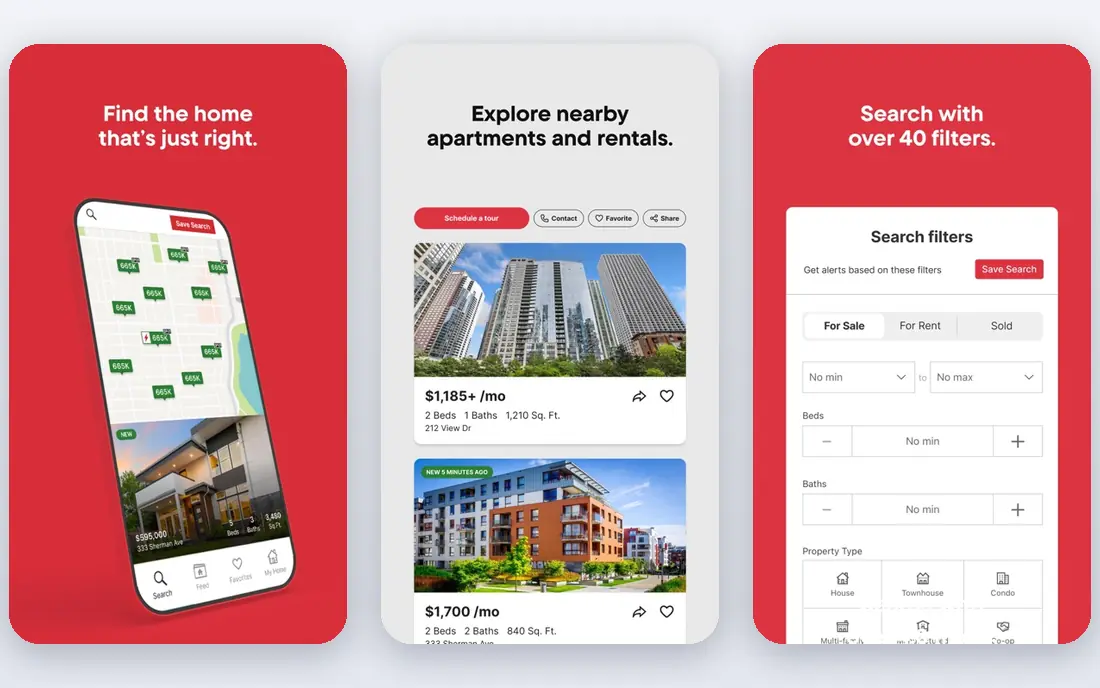
Redfin combines a portal with a brokerage, which gives it direct MLS access in the markets it serves. That access often means faster status updates and alerts than aggregators can offer. Tour booking from the listing page is a real time saver: you can request a same-day or next-day tour without a separate phone call. Price history, sale history, and estimate data sit on the same page.
The limit is coverage. Redfin agents do not serve every town, so rural buyers may find fewer brokerage services even if listings are visible. Some buyers also prefer a single dedicated agent over a team model. If you are in a Redfin market and you move fast, it is one of the strongest apps for active searching.
- Fast MLS-based alerts in many markets
- In-app tour booking with Redfin agents
- Clear price history and estimate data
- Brokerage services are not available in every market
- Agent model suits buyers who prefer a team approach

Realtor.com is operated in connection with the National Association of Realtors, and its listings draw directly from MLS sources. That sourcing helps with status accuracy, which matters when homes sell within days. Listing pages include school data, commute estimates, and neighborhood context, so you can compare areas as well as houses. Search filters cover price, beds, baths, property type, and days on market.
The browsing experience is more data-led than visual, which some buyers will like and others will not. Saved searches and alerts work well once you sign in, but casual browsing without an account is more limited. Pair Realtor.com with Zillow for discovery, and use Realtor.com to double-check status before you act.
- MLS-sourced listings with frequent updates
- School, commute, and neighborhood data on listing pages
- Clear listing status labels
- Interface is less photo-led than Zillow
- Some features require signing in
Trulia, part of the Zillow Group, puts neighborhood life at the center of the search. Maps show schools, commute routes, and local amenities, and resident reviews under What Locals Say give a sense of an area that photos cannot. That focus helps buyers who are choosing between neighborhoods, not just between houses. Filters for lifestyle factors, such as commute time and school ratings, are easy to use.
The overlap with Zillow is the main caveat. Many listings appear on both apps, so Trulia is best used as a second lens on the same search, rather than as a wholly separate inventory source. Use it to compare neighborhoods early, then confirm any shortlisted home on an MLS-sourced app before touring.
- Neighborhood maps, local reviews, and school and crime context
- Owned by the same group as Zillow, with a different emphasis
- Saved searches and alerts
- Listing inventory overlaps heavily with Zillow
- Status freshness can lag in fast markets
Homes.com has rebuilt its portal around media-rich listings and a conversational assistant that helps refine a search in plain language. Listing pages often feature strong photography and video, which helps when you are narrowing a long list from home. The agent-first contact model means inquiries go to a listing agent or a local expert, rather than to a large pool of agents.
Coverage is the question to check in your market. In major metros, Homes.com is a useful second source with distinct presentation. In smaller markets, inventory may be thinner than on Zillow or Realtor.com. Use it to cross-check photos, descriptions, and agent details, and to get a second view of a home you are considering.
- High-quality photos and video on many listings
- Conversational search assistant
- Agent-first contact model
- Inventory depth varies by market
- Newer portal with less name recognition than Zillow or Realtor.com
Compass is a brokerage with a polished consumer portal, and its strength shows when you work with a Compass agent. Listing presentations are clean, collections let you share favorites with your agent, and private exclusives appear in some markets before wider release. For buyers in Compass-heavy cities, that combination of presentation and agent workflow is appealing.
Outside those markets, Compass is less compelling as a pure search app, since its inventory mirrors MLS listings available elsewhere. It also leans on agent services, so buyers who want to browse anonymously for months may prefer Zillow or Realtor.com first. If you already plan to use a Compass agent, the app is a natural fit.
- Polished listings with agent collaboration tools
- Strong presence in many major metros
- Private and coming-soon listings in some markets
- Value depends on Compass agent presence in your area
- Less useful as a standalone browsing app in markets with few Compass agents
Rocket Homes links home search to financing in one workflow. You can browse listings, check affordability estimates, get matched with an agent, and start a Rocket Mortgage pre-approval without leaving the platform. That single path suits first-time buyers who want a clear next step after finding a home they like. Listing pages include payment estimates that help with budgeting.
The tie-in is also the limit. Buyers who already have a lender, or who want to compare lenders independently, may not need the integrated path. Agent services also vary by market, so check local availability. Use Rocket Homes for the combined search and financing view, and compare any mortgage offer with at least one independent lender quote.
- Nationwide listings with mortgage pre-approval path through Rocket Mortgage
- Agent matching
- Affordability tools on listing pages
- Financing tie-in may not suit buyers who already have a lender
- Brokerage coverage varies by market
Movoto, now part of the Lower group, offers MLS-based search in a clean, fast interface. Filters are straightforward, listing pages include school and neighborhood data, and the design avoids the clutter that some larger portals carry. For buyers who want a simple search tool and a direct agent connection, Movoto is a pleasant alternative to the biggest apps.
Brand and coverage are the trade-offs. Movoto does not have the same name recognition as Zillow, and agent coverage varies by market. That makes it best as a second or third app in your search, rather than your only source. If you like its interface, keep it alongside Realtor.com for status checks.
- MLS-based search with a clean interface
- School and neighborhood data
- Agent connection without heavy lead selling
- Smaller brand presence than major portals
- Some markets have thinner agent coverage
StreetEasy is essential for New York City buyers and of little use elsewhere, and that focus is its strength. Building pages track sales history, amenities, and listings within a building, while filters cover doorman service, elevator access, laundry, and other NYC-specific details. Floor plans and price history help buyers compare apartments that look similar in photos but differ sharply in layout and building costs.
If you are not buying in New York City, skip StreetEasy and use a national app instead. If you are, use it as your primary search tool, and confirm any shortlisted apartment with your agent, since co-op rules, board requirements, and building finances are not fully visible in a listing.
- Deep New York City building and listing data
- Floor plans and building pages
- Filters for NYC-specific details such as doorman and elevator
- Useful only for New York City
- Buyers elsewhere should choose a national app
How we picked these
We compared official app listings, listing sources, search features, and agent and financing options for each app. We favored apps that are available in the United States in October 2026, that cover home buying rather than only renting or investing, and that offer free browsing. Where agent or mortgage terms vary by market, we noted that variation rather than publishing a single national figure.
How to use house apps without missing a home
Set up saved searches on two apps, not one, with the same price, bed, bath, and area filters. Turn on push alerts for new listings and price drops, and check status on an MLS-sourced app before booking a tour. Save favorites in one place, such as a shared list with your agent, so you do not lose track of homes across apps. When you find a home you like, note the days on market, price history, and any prior sale data, then ask your agent about comparable sales.
Be careful with contact forms. Submitting an inquiry on a portal can send your details to multiple agents, depending on the app. If you already have an agent, tell the portal or contact your agent directly about a listing you found. That step avoids duplicate outreach and keeps your search organized. Finally, treat value estimates as a starting point, not a price. A local agent's comparable sales analysis and, later, an appraisal carry far more weight than any automated estimate.
A practical search routine
Browse broadly on Zillow or Trulia in the first week to learn prices and neighborhoods. Narrow with Redfin or Realtor.com alerts in the second week, and book tours quickly when a strong match appears. Keep a simple note for each home: price, condition, commute, school fit, and any concern from photos or disclosures. That note makes it easier to compare homes after a busy tour weekend.
Frequently asked questions
What is the best app for buying a house?
Zillow is the best starting point for breadth, Redfin is strong for fast alerts and tour booking, and Realtor.com is strong for fresh MLS status. Most serious buyers use two apps together, since no single app has perfect coverage or freshness.
What is the best homes for sale app?
For general searching, Zillow and Realtor.com lead on coverage and status. For New York City, StreetEasy is the best homes for sale app by a clear margin. For agent-led searching in major metros, Compass and Redfin are strong options.
Are house apps free?
Yes, browsing, saved searches, and alerts are free on the apps in this guide. Agent commissions, mortgage costs, and closing costs are separate, and they are paid as part of the purchase, not for using the app.
How accurate are home value estimates on these apps?
Automated estimates can be useful for a rough range, but they can miss condition, renovations, and local sale details. Use them to shortlist and compare, then rely on your agent's comparable sales and a professional appraisal for pricing decisions.
Should I contact an agent through the app?
If you do not have an agent, an app introduction can be a good start. If you already have an agent, contact that agent directly about a listing, so your inquiry is not sent to other agents. Tell any new agent about your existing relationship before sharing personal details.
Sources
See where you really rank - block by block
ProMapRanker scans Google Maps across a grid of your service area. Simple monthly plans from $19, white-label on every plan.
Start freeKeep reading
 zscaler alternatives
Best Zscaler Alternatives in 2026
Looking for zscaler alternatives? We compare 9 SASE and zero trust platforms on architecture, data protection, pricing, and fit for your network and team.
Read → zapier alternatives free
Best Zapier Alternatives Free in 2026
Nine automation tools for zapier alternatives free in 2026, all with genuinely free tiers, plus free plan limits, starting prices and upgrade paths explained.
Read → which platform is best for online reputation
Which Platform Is Best for Online Reputation in 2026
Wondering which platform is best for online reputation? We compare 8 review, listing, and response tools for small and multi-location businesses and agencies.
Read →