 ProMapRanker
Best Home Refinance Companies in 2026


Fastest fully digital close · Pricing starts at: See website
Key takeaways
- Rocket Mortgage and Better lead for fully online refinancing, while loanDepot and Pennymac suit borrowers who want a mix of digital tools and human help.
- Better states that it charges no lender origination, application, underwriting or loan officer commission fees, though third-party closing costs still apply.
- Credit unions such as PenFed can be a strong fit for eligible members, but membership rules and slower timelines may rule them out for others.
- A refinance only pays when the numbers work for your loan: compare full Loan Estimates with the same rate, points and lock period, not headline rates alone.
- This is not financial advice, and rates vary by credit, equity, loan type and location, so treat every figure here as a starting point for your own quotes.
Quick comparison
| Pick | Great for | Pricing starts at | Free tier | |
|---|---|---|---|---|
| Rocket Mortgage | Fastest fully digital close | See website | No | Visit |
 Better | Low lender fees online | See website | No | Visit |
 loanDepot | Hybrid digital and phone support | See website | No | Visit |
 Rate | Same-day approval path | See website | No | Visit |
 Pennymac | Existing customers and streamlined refis | See website | No | Visit |
 SoFi | Member perks and no lender fees option | See website | No | Visit |
 Chase | Existing bank customers | See website | No | Visit |
 PenFed Credit Union | Credit union pricing for members | See website | No | Visit |
 Freedom Mortgage | FHA and VA streamline refis | See website | No | Visit |
The best home refinance companies
We compared online lenders, banks and credit unions on loan range, fee structure, digital process and closing speed. Each company below serves a different kind of borrower, so start with your situation, not the brand name.
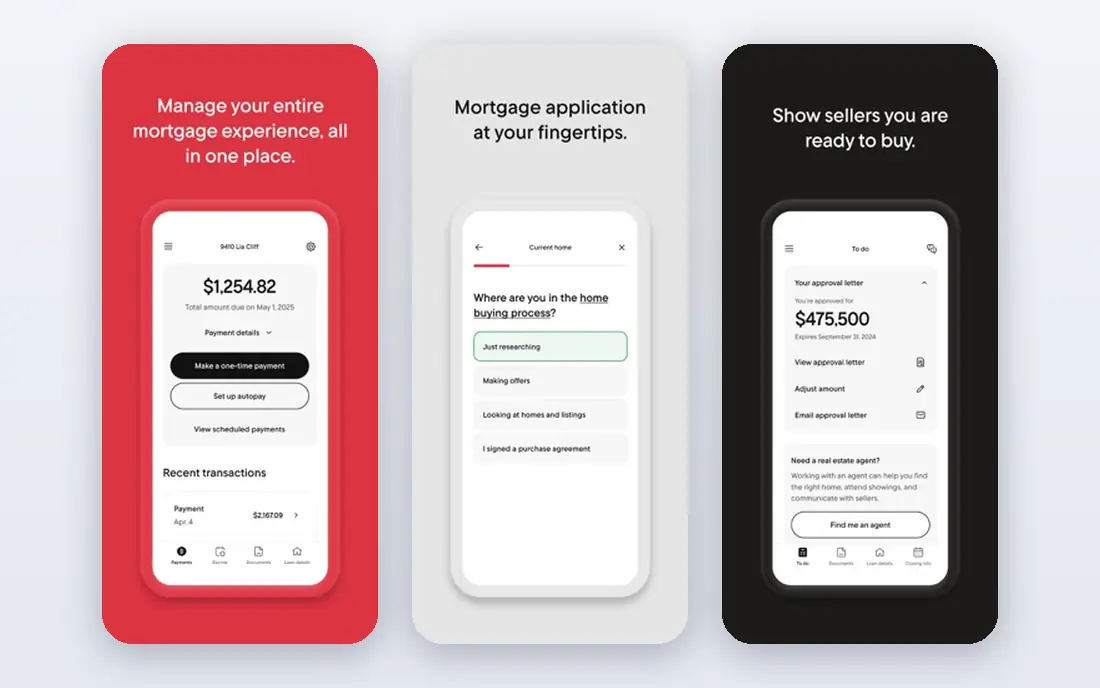
Rocket Mortgage is our pick for borrowers who want to handle a refinance from a phone or laptop with as little paper as possible. The application, document uploads and rate lock all run through its online platform, and published comparisons put its average close at around three weeks.
The trade-off is price transparency at the start. Rocket Mortgage charges lender fees that vary by loan, so a headline rate on its site is not the full story. Ask for a written Loan Estimate early, compare it line by line with at least one rival, and check whether paying points would change the break-even point for how long you plan to stay in the home.
- Fully online application and document upload
- Wide loan range including FHA, VA, conventional and jumbo
- E-close options in many states
- Lender fees can be higher than no-fee rivals
- Phone and branch support is thinner than a traditional bank

Better suits borrowers whose main goal is cutting lender-controlled fees. The company says it charges no origination, application, underwriting or commission fees, which can make its Loan Estimate easier to read than rivals that bury several lender charges in the totals. Its online pricing tool shows points, credits and estimated costs before you commit to a full application.
The catch is that "no lender fees" does not mean "no closing costs." Appraisal, title, recording and prepaid items still appear, and the rate you are offered may include points or credits that shift the total.
- No lender origination, application, underwriting or loan officer commission fees, as stated by the company
- Fully online process
- Rate-and-term and cash-out options
- No branch network for face-to-face help
- Third-party costs such as appraisal and title still apply

loanDepot sits between a pure online lender and a traditional bank. You can start and track the application online, but you can also talk to a loan officer when a question needs a human answer, which helps with trickier files such as self-employment income or a recent credit event. Its loan range covers conventional, FHA, VA and jumbo refinances.
The main drawback is that you will need to request a quote to see real pricing, since its site does not publish a simple rate card. Its lifetime guarantee, which waives lender fees on a future refinance for qualifying customers, is worth asking about in writing, including exactly which fees it covers and what would disqualify you.
- Digital application with licensed loan officers available by phone
- Rate-and-term and cash-out refinances
- Lifetime refinance fee waiver programme for qualifying repeat customers
- Public pricing is less transparent than some online rivals
- Closing timelines vary by loan type
Rate, formerly known as Guaranteed Rate, is a good fit if approval speed is your priority. Its Same Day Mortgage programme aims to give a verified approval within one working day for qualifying borrowers, which can help when you need to lock a rate quickly. The company lends nationally and handles the common refinance types, including jumbo loans.
As with most large lenders, the experience can depend on the individual loan officer and branch team you land with, so read your Loan Estimate carefully and keep your own timeline notes. Fees are set per loan rather than published as one flat figure, so compare the full estimate, including discount points, against at least two other lenders before locking.
- Same Day Mortgage programme for fast verified approval
- Large national lender with conventional, FHA, VA and jumbo options
- Digital application
- Fees vary by loan and are not published as a flat schedule
- Service quality can vary by local team
Pennymac is worth a first call if it already services your current mortgage. A streamlined refinance for an existing customer can mean less paperwork, and keeping origination and servicing with one company avoids a servicer transfer after closing. It also publishes guidance on removing private mortgage insurance, which matters if your equity has grown since you bought.
The downside is pace and polish. Pennymac's online experience is serviceable rather than standout, and published comparisons put its typical close closer to a month than three weeks. If you are refinancing mainly to cut your rate, that slower timeline is only a problem if rates are rising fast, so weigh it against any fee or rate advantage in your Loan Estimate.
- Services the loans it originates, so servicing stays in one place
- Streamlined options for existing customers
- Wide loan range
- Digital tools are less polished than the leading online lenders
- Closing can take longer than the fastest rivals
SoFi fits borrowers with strong credit who like managing money in one place. Its refinance offering includes an option with no lender fees, plus member discounts that can apply across its banking and investing products. The application is online, and the company is a natural pick if you already use SoFi for other accounts.
The limit is eligibility. SoFi tends to suit salaried professionals with solid credit and straightforward income, and borrowers with lower scores or complex files may find better terms elsewhere. Check whether the no-lender-fee option carries a slightly higher rate, and work out which one wins over the years you expect to keep the loan.
- No lender fees option on qualifying loans
- Member rate discounts
- Can bundle banking and investing in one account
- Higher minimum credit expectations than some rivals
- No branch network
Chase is the pick for borrowers who already bank there and want a person to talk to. Existing customers may qualify for relationship pricing discounts, and the branch network gives you somewhere to go when documents get complicated. Chase also handles larger and less standard loans, including jumbo refinances, which some online lenders price less keenly.
The trade-off is speed. Chase refinances typically take longer to close than the fastest digital lenders, and you will need a formal quote to see your real rate and fees. Ask what relationship discount applies, then compare the full Loan Estimate with an online rival.
- Relationship pricing discounts for qualifying existing customers
- Branch network for in-person help
- Jumbo and portfolio loan options
- Closing can take longer than online-first lenders
- Pricing is less transparent before a quote
PenFed is a strong option if you qualify for membership and are not in a rush. Credit unions often price a little below large banks because they return earnings to members, and PenFed states no closing costs on VA refinances for qualifying members. Its refinance range includes conventional, FHA and VA loans, plus adjustable-rate options for borrowers who plan to move or refinance again within a few years.
Membership is the first hurdle, though it is open to a wide group including military-affiliated borrowers and members of partner associations. Timelines can stretch past a month, so PenFed suits borrowers who value price over speed. Confirm membership eligibility before you apply.
- Credit union pricing that can undercut banks
- No closing costs stated on VA refinances for qualifying members
- Range of fixed and adjustable options
- Membership is required
- Closing timelines can run longer than online lenders
Freedom Mortgage is the specialist pick for government loans. If you hold an FHA loan, its streamline refinance can cut paperwork and may not require a new appraisal, and VA borrowers can use an Interest Rate Reduction Refinance Loan (IRRRL) on a similar simplified path. Published comparisons put streamline closes as fast as two to four weeks, and some options carry no origination fee.
For a plain conventional refinance, Freedom Mortgage is less obviously the best choice, and its pricing may not beat the online leaders. If you hold a government loan, its streamline expertise is a real advantage that generalist lenders may not match.
- Specialist in FHA streamline and VA IRRRL refinances
- Options with no origination fee
- Large servicer with experience in government loans
- Less competitive for conventional refinances
- Customer service reviews are mixed
How we picked these
We compared lender feature pages, published fee statements, loan type ranges and public refinance comparisons current in October 2026, and we favoured lenders that publish clear fee information or a clear specialist strength. We excluded lenders with only regional availability, lenders that do not publish a refinance offering, and lenders whose main pitch rested on a single advertised rate with no fee detail. Where sources disagreed on closing times or rates, we described the range rather than picking the most flattering figure, because your rate will depend on your credit, equity and loan type.
What to check before you lock a rate
A refinance decision comes down to three numbers: your new rate, your total closing costs, and how long you will keep the loan. Divide the closing costs by the monthly saving to get the break-even point in months. If you plan to move or refinance again before that point, the deal may not pay, even with a lower rate.
Rate-and-term, cash-out or streamline
A rate-and-term refinance replaces your loan without changing the balance, and it is the simplest way to cut your payment or shorten your term. A cash-out refinance borrows more than you owe and gives you the difference, but it usually carries a higher rate and raises your balance, so it only makes sense for a clear purpose such as a major home improvement. A streamline refinance, available on FHA and VA loans, cuts documentation and sometimes skips the appraisal, which can make it the fastest and cheapest path for borrowers who already hold those loans.
Fees, points and the Loan Estimate
Every lender must give you a Loan Estimate within three business days of your application, and that document is the only fair way to compare offers. Check the origination charges, discount points, appraisal, title and prepaid sections separately, and ask whether any "no closing cost" offer simply rolls costs into a higher rate or a larger balance. Get at least three estimates with the same loan amount, term and lock period, and do not let a lender rush you into locking before you have compared them.
Term length and total interest
A lower monthly payment is not always a better deal. Refinancing back into a new 30-year term after ten years of payments can restart the clock and increase total interest, even if the monthly bill falls. Ask each lender to show the total interest over the full term for a 30-year, 20-year and 15-year option, and pick the shortest term whose payment still fits your budget comfortably.
Frequently asked questions
What is the best company to refinance a mortgage with?
There is no single best company, because the right lender depends on your loan type, credit and priorities. Online lenders such as Rocket Mortgage and Better tend to win on speed and low lender fees, while Chase and PenFed can win on relationship pricing or credit union pricing. Compare at least three Loan Estimates with identical terms before you choose.
Which are the best mortgage companies for refinance if I want the lowest fees?
Better states that it charges no lender origination, application, underwriting or commission fees, and SoFi offers a no-lender-fee option on qualifying loans. Remember that third-party costs such as appraisal, title and recording still apply with any lender. The cheapest deal is the one with the lowest total cost over the time you expect to keep the loan, not the lowest fee line alone.
Is it worth refinancing if my rate would only fall a little?
It depends on your balance, closing costs and how long you will stay. As a rough guide, a fall of around 0.75 percent or more often pays for borrowers with a large balance who plan to stay for several years, while a small fall on a small balance may take too long to break even. Divide total closing costs by the monthly saving to get your break-even point in months, then compare that with your plans.
What credit score do I need to refinance?
Minimum scores vary by lender and loan type, with several lenders in this list accepting scores from around 580 for FHA refinances and higher scores for conventional loans. A higher score usually earns a lower rate, so improving your credit before applying can matter more than picking between two similar lenders. Ask each lender what score band your quote assumes before you compare rates.
How long does a refinance take to close?
Online lenders often close in around three weeks, while banks and credit unions can take four to six weeks, and streamline government refinances can be faster still. Appraisal scheduling, document requests and rate lock expiry are the usual causes of delay. Respond to document requests quickly, avoid opening new credit during the process, and ask your lender for a realistic timeline in writing.
Should I choose a fixed or adjustable rate when refinancing?
A fixed rate suits most refinancers because the payment stays predictable for the full term. An adjustable rate can make sense if you expect to move or refinance again before the fixed period ends, since the initial rate is often lower. Check how much the rate can rise at each adjustment and over the life of the loan, and make sure you could still afford the payment at the maximum rate.
Sources
- https://www.crediful.com/best-mortgage-refinance-lenders/
- https://www.finzelo.net/pages/mortgages/mortgage-refinance.html
- https://mortgage-info.com/blog/best-online-mortgage-lenders-2026
- https://mortgage-info.com/blog/fastest-mortgage-refinance-lenders-2026
- https://www.fool.com/the-ascent/mortgages/better-mortgage-review/
See where you really rank - block by block
ProMapRanker scans Google Maps across a grid of your service area. Simple monthly plans from $19, white-label on every plan.
Start freeKeep reading
 zendesk alternatives
Best Zendesk Alternatives in 2026
Compare the best Zendesk alternatives in 2026, from budget help desks to AI-first support tools, with current pricing, free plans, and honest trade-offs.
Read → wordpress alternatives
Best WordPress Alternatives in 2026
Looking for the best WordPress alternatives? We compare 8 free and paid options for blogs, business sites, stores, and developer-led projects in 2026.
Read → which real estate company has the best training
Best Real Estate Company Training in 2026
Compare which real estate company has the best training, from Keller Williams and eXp to Compass and Coldwell Banker, by program, mentor, and fit in 2026.
Read →