 ProMapRanker
Best HEI Companies in the USA in 2026

Key takeaways
- We read HEI as home equity investment, the established meaning used by the companies in this list, and every company here trades cash today for a share of future home value.
- Point and Unison offer the longest terms, up to 30 years, while Hometap and Unlock use shorter 10-year terms that suit owners with a nearer exit plan.
- Minimum credit scores start at 500 at several companies, but state availability, property type, and the share of appreciation taken matter as much as the headline amount.
- A home equity investment is not a loan, so there are no monthly payments and no interest rate, but the settlement cost can be large if your home rises a lot in value.
- This is not financial advice. Read the full contract, model a strong appreciation case as well as a flat case, and compare at least two offers before signing.
Quick comparison
| Pick | Great for | Pricing starts at | Free tier | |
|---|---|---|---|---|
 Point | Longest term flexibility | See website | No | Visit |
 Hometap | Largest headline amounts | See website | No | Visit |
 Unlock | Low credit scores | See website | No | Visit |
 Unison | Downside sharing on a sale | See website | No | Visit |
 Splitero | Fast pre-approval | See website | No | Visit |
 EquityChoice | Predictable fee structure | See website | No | Visit |
 Nada | Smaller state footprint, second homes | See website | No | Visit |
The best HEI companies in the USA
We compared home equity investment companies on term length, credit requirements, state availability, and how clearly each one explains its share of future value. The seven companies below all offer a lump sum with no monthly payments in exchange for a settlement when you sell, refinance, or reach the end of the term.

Point suits homeowners who want time on their side. A term of up to 30 years removes the pressure of a 10-year deadline, which can matter if you plan to stay put, if a sale falls through, or if refinancing is not attractive when the term would otherwise end. Published comparisons put its funding range at $30,000 to $600,000 and its minimum credit score at 500, which keeps it in reach for owners who would struggle to qualify for a traditional home equity loan.
The trade-off is the same one that applies across this category. Point takes a share of your home's future value, so a strong market works against you at settlement, and the final cost depends on the contract terms, the starting value, and any cap or adjustment in your agreement. Availability is also limited by state, so check eligibility for your address early. We would shortlist Point first when a long term is the deciding factor, and then compare its appreciation share directly against a shorter-term rival.
- Term up to 30 years
- Minimum credit score of 500 in published comparisons
- Amounts up to $600,000 in published comparisons
- Not available in every state
- Settlement can be costly after strong appreciation
- Offer terms vary by property and location

Hometap is the pick for owners who need a larger lump sum and have a clear plan for the next decade. Published comparisons put its maximum at $600,000, with investments of up to about a quarter of a home's value, and a minimum credit score near the low end of the range. That combination explains why it appears at the top of many home equity investment lists, especially for owners funding a renovation, consolidating debt, or covering a large one-off cost.
The 10-year term is the honest catch. If you do not sell or refinance within that period, you must buy out the investment, which may mean borrowing at whatever rates apply then. Hometap also serves a limited set of states, so a strong headline amount means little if your state is outside its footprint. We would choose Hometap when the amount matters most and the 10-year horizon fits your plans, and we would model the buyout cost before applying.
- Amounts up to $600,000 in published comparisons
- Low minimum credit score in published comparisons
- Published investment share approach
- 10-year term creates a firm settlement deadline
- Not available in every state
- Cost rises sharply with appreciation
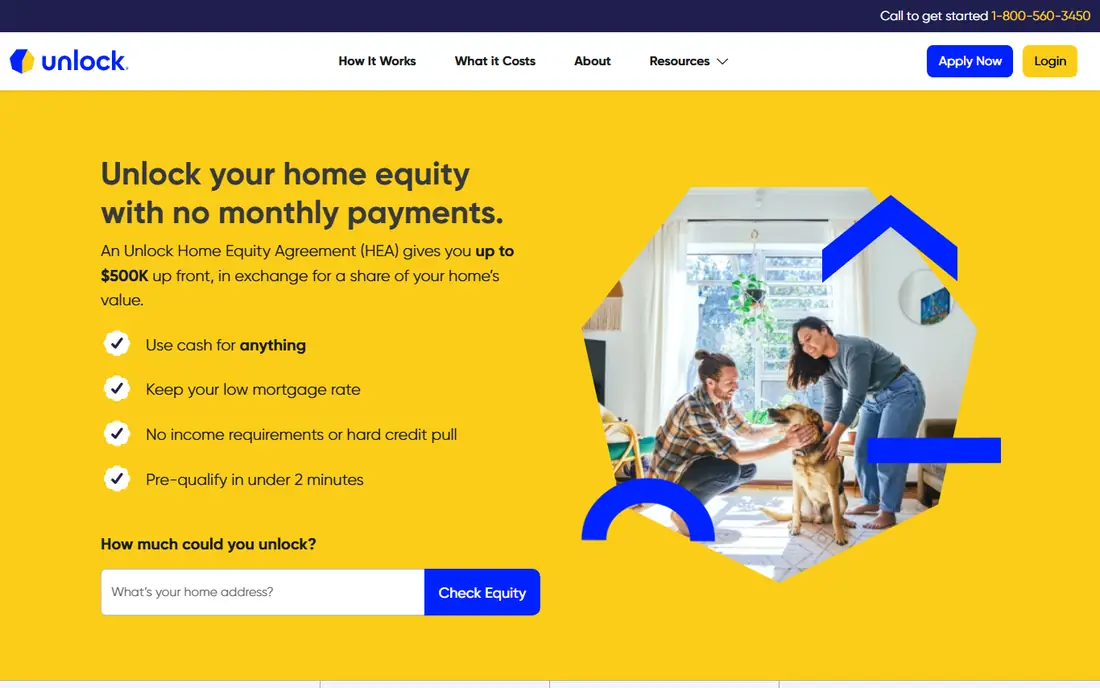
Unlock stands out for homeowners whose credit history would block most traditional borrowing. Published comparisons put its minimum credit score at 500 and its funding range at $15,000 to $500,000, with a 10-year term. For owners with irregular income or a thin credit file, the absence of an income test and monthly payments can be the difference between acting on a plan and waiting years to qualify for a loan.
Published comparisons also describe partial buyouts during the term, which gives owners a way to reduce the eventual settlement in stages rather than facing one large payment. That flexibility is useful, but it does not remove the core cost: Unlock shares in future value, so a rising market increases what you owe. State coverage is also limited. We would shortlist Unlock when credit is the main barrier, and compare its total settlement estimate against Point before deciding.
- Minimum credit score of 500 in published comparisons
- Partial buyouts described in published comparisons
- Amounts up to $500,000 in published comparisons
- 10-year term
- Limited state availability
- Appreciation share can make settlement expensive
Unison takes a different approach to pricing, and that difference deserves close reading. Instead of taking a share of your home's total future value, Unison generally takes a share of the change in value from a starting value set slightly below the appraised value. Published material describes a multiple of the percentage invested, often around four times, so investing 10 percent can mean sharing 40 percent of the change in value. In a flat market that keeps the cost close to the original amount, while in a fast-rising market the settlement grows quickly.
The longer term, up to 30 years, and broader availability in published comparisons make Unison easier to fit into a long stay. The catch is the higher credit bar, with published comparisons putting the minimum near 620 to 680 depending on the source, and the 5 percent starting value discount, which works in the provider's favour from day one. We would pick Unison when downside sharing on a sale and a long term matter most, and only after running both a flat and a strong growth scenario.
- Term up to 30 years
- Share of change in value model rather than total future value
- Broad state availability in published comparisons
- Higher minimum credit score than some rivals
- Starting value set below appraised value
- Appreciation multiple can grow quickly in a strong market
Splitero is the option to check when speed matters. Published comparisons describe pre-approval within one to two business days, with funding amounts from $50,000 to $500,000 and a minimum credit score of 500. Its terms run from 10 to 30 years, and published analysis notes a maturity match feature that can align repayment with the remaining term of a first mortgage. For owners facing a deadline, such as a renovation start date or a debt payoff window, that pace is a real advantage.
Speed comes with a higher upfront fee in published analysis, with one source putting it near 4.99 percent of the payment amount, the highest among the companies it analysed. State availability is also limited, so the fast process only helps if you live in a served state. We would use Splitero when timing is tight, and weigh the higher upfront fee against the value of moving quickly.
- Pre-approval described within one to two business days in published comparisons
- Terms from 10 to 30 years
- Minimum credit score of 500 in published comparisons
- Higher upfront fee than some rivals in published analysis
- Limited state availability
- Appreciation share still drives the final cost
EquityChoice appeals to owners who want the fee discussion kept simple. Published comparisons put its fee in a 3 to 4 percent range, its maximum near $400,000, and its minimum credit score near 600, with a 10-year term. That is a smaller maximum than Point or Hometap, but the narrower fee range makes it easier to compare offers without chasing hidden adjustments, and the 10-year term gives a clear date to plan around.
The limits are plain. Owners who need more than $400,000, or whose credit sits below 600, will need another provider, and EquityChoice serves a limited set of states. Its model still shares in future value, so the fee is only part of the total cost. We would shortlist EquityChoice when a mid-size amount and a clear fee range matter more than squeezing out the largest possible payout.
- Published fee range of about 3 to 4 percent in comparisons
- Amounts up to $400,000 in comparisons
- 10-year term is easy to plan around
- Higher minimum credit score than the lowest-bar rivals
- Smaller maximum amount
- Limited state availability
Nada is a niche pick rather than a headline one, and its value depends heavily on where you live. Published comparisons put its minimum credit score at 500, its maximum near $500,000 to $600,000 depending on the source, and its term at 10 years, with a published annualised cap near 19.99 percent. What earns it a place here is coverage and property type: published comparisons describe it as an option in states such as Arkansas, Louisiana, and Oklahoma where larger rivals may not operate, and as a company that will consider second homes and investment properties.
Those strengths come with strict limits. Investment properties face higher credit requirements and lower caps in published comparisons, and the state footprint remains small. Owners in states served by Point or Hometap should usually start there. We would check Nada when your state or property type rules out the bigger names, and treat its published cap as a ceiling to verify in your own contract, not as a promised cost.
- Minimum credit score of 500 in published comparisons
- Second homes and investment properties considered in published comparisons
- Published annualised cap in comparisons
- Small state footprint
- 10-year term
- Investment properties face stricter terms in published comparisons
How we picked these
We compared official product pages, pricing and term disclosures, and independent comparisons published in 2026, and we kept only companies that offer a live home equity investment product in the United States. We favoured companies with published terms, a clear settlement model, and a track record in independent coverage, and we dropped models that are loans, sale-leaseback deals, or HELOCs, since those are different products with monthly payments or interest. Where published sources disagreed on a maximum, a fee, or a credit minimum, we used the range or the more cautious figure and marked it as a published comparison rather than a vendor promise. Your actual offer will depend on your home value, equity, location, property type, and credit profile.
What to check before you sign
Start with the settlement maths, not the lump sum. Ask each company for a written estimate at three outcomes: your home value flat, up 3 percent a year, and up 6 percent a year, over the full term. That single request exposes the difference between a share of total future value and a share of the change in value, and it shows whether a cap actually limits your cost in a strong market. If a company will not model those cases in writing, treat that as a warning sign.
Next, check the starting value, the fee, and the term together. A discounted starting value, a high upfront fee, and a short term can combine into a much higher effective cost than any one figure suggests. Confirm what happens at the end of the term if you do not sell or refinance, whether partial buyouts are allowed, and what appraisal method will be used at settlement. Finally, confirm state eligibility and property eligibility before you pay for an appraisal, and get a second offer so you can compare appreciation shares side by side.
Frequently asked questions
What does HEI mean in this article?
HEI means home equity investment. We state that reading plainly because the letters are also used for other things, and this article covers only the home equity product, where a company pays you a lump sum today for a share of your home's future value.
Is a home equity investment a loan?
No, it is not a loan in the usual sense. There are no monthly payments and no interest rate, and it generally does not affect your debt-to-income ratio in the way a loan would. You settle by selling, refinancing, or buying out the investment at the end of the term, which is why the settlement amount matters so much.
How much can I get from a home equity investment?
Published comparisons put typical maximums between $400,000 and $600,000, with most companies offering a percentage of your home's value rather than a fixed amount. Your actual offer depends on your home value, your existing mortgage balance, your equity, your state, and your credit profile.
What happens if my home loses value?
Most providers share downside on a sale, meaning the settlement falls if the home value falls, but the details vary by contract. Some models limit downside sharing in the early years or on a buyout without a sale, so read that clause carefully rather than assuming full sharing.
Can I get a home equity investment with a low credit score?
Several companies in this list publish minimum credit scores of 500, which is far below the level most HELOC or home equity loan lenders require. A low score does not guarantee approval, since property, equity, and location still matter, but it does keep this product in reach for owners who cannot qualify for traditional borrowing.
Should I choose a home equity investment over a HELOC?
Choose a home equity investment when avoiding monthly payments matters most and you accept a potentially large settlement later. Choose a HELOC when you want ongoing access to funds, you can handle variable monthly payments, and you prefer a cost that does not grow with your home's appreciation.
Sources
- https://www.finder.com/home-equity/best-home-equity-investment-companies
- https://themortgagereports.com/127491/hei-companies-highest-investment-limits
- https://www.finder.com/home-equity/unison-home-equity-review
- https://themortgagereports.com/127524/fastest-home-equity-investment-companies
- https://www.mymillennialguide.com/best-home-equity-investment-companies/
- https://money.com/best-home-equity-sharing-companies/
- https://heicompare.com/
See where you really rank - block by block
ProMapRanker scans Google Maps across a grid of your service area. Simple monthly plans from $19, white-label on every plan.
Start freeKeep reading
 worlds best local seo company
8 Worlds Best Local SEO Companies for Map Pack Growth in 2026
Compare the worlds best local seo company options for Google Business Profile work, citations, reviews, and multi-location rankings and reporting in 2026.
Read → world's best web hosting company
World's Best Web Hosting Company in 2026
Searching for the world's best web hosting company? We compared 10 hosts on price, renewal rates, speed, and support to help you choose well today in 2026.
Read → who's got the best nanny tax services
Who's Got the Best Nanny Tax Services in 2026
We answer who's got the best nanny tax services, comparing full filing, back taxes, software, and pricing so families can handle nanny taxes correctly.
Read →