 ProMapRanker
Best Healthcare Compliance Software in 2026

Guided HIPAA programs for practices · Pricing starts at: See website
Key takeaways
- The best tool depends on the setting: a care practice, a health tech company, or a large group with multiple sites.
- HIPAA programs need policies, training, risk assessment, vendor records, and incident handling, not just a checklist.
- Software alone does not make a practice compliant, because staff behaviour, contracts, and safeguards still matter.
- Most enterprise tools price by quote, so compare scope, seats, and support for the same employee count.
Quick comparison
| Pick | Great for | Pricing starts at | Free tier | |
|---|---|---|---|---|
| Compliancy Group | Guided HIPAA programs for practices | See website | No | Visit |
 MedTrainer | Training, credentialing, and compliance | See website | No | Visit |
 Accountable HQ | Hands on HIPAA program management | $169 per month | No | Visit |
 HIPAA One | Risk analysis for larger organisations | See website | No | Visit |
 Healthicity | Auditing, compliance, and training | See website | No | Visit |
 Vanta | Automated HIPAA and security frameworks | See website | No | Visit |
 Drata | Automated compliance evidence | See website | No | Visit |
 Sprinto | Fast compliance setup for health tech | See website | No | Visit |
The best healthcare compliance software
These tools help teams organise a compliance program, but they do not replace legal advice or clinical judgment. We compared official product pages, pricing summaries, and public documentation for HIPAA focused and multi framework tools.
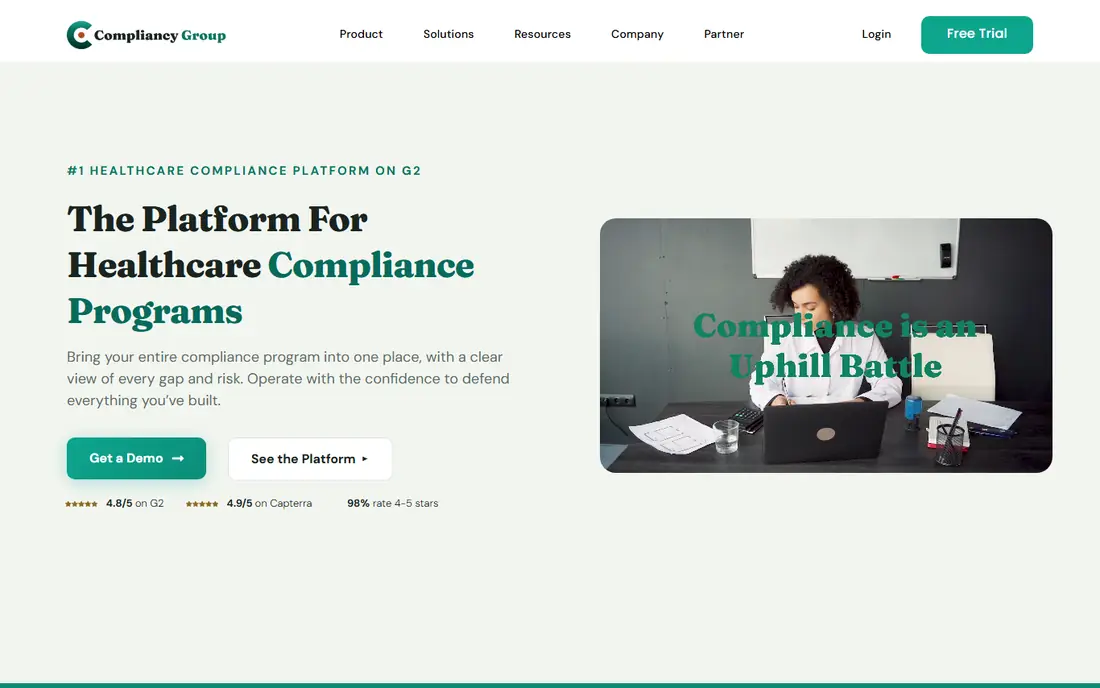
Compliancy Group offers a guided HIPAA compliance platform with risk assessments, policy templates, training tracking, and audit preparation support. Its appeal for practices is structure: instead of starting from blank documents, a team follows a workflow that covers policies, workforce training, and vendor records. That structure helps small practices that do not have a full time compliance officer.
The catch is scope clarity. Plans and advisory support vary, and published pricing summaries conflict, so treat the price as quote based and get the scope in writing. Confirm which tasks your team must complete, which tasks Compliancy Group helps with, and what happens at audit time.
- Guided workflows
- Risk assessments
- Policy templates and training tracking
- Pricing is quote based in current comparisons
- Advisory scope varies by plan
MedTrainer combines compliance training, credentialing, policy management, and exclusion monitoring in one healthcare focused platform. That mix suits practices that juggle staff training deadlines, licence renewals, and policy sign offs at the same time. Managers can see who is overdue, which credentials expire soon, and which policies still need acknowledgment.
The weakness is price transparency for small practices. MedTrainer prices by quote, and reviewers have noted cost as a concern for smaller teams. Ask for pricing by staff count and site count, and confirm whether credentialing, training, and compliance modules are all included or sold separately.
- Compliance training
- Credentialing tracking
- Policy management
- Exclusion monitoring
- Pricing is quote based
- Cost can concern smaller practices
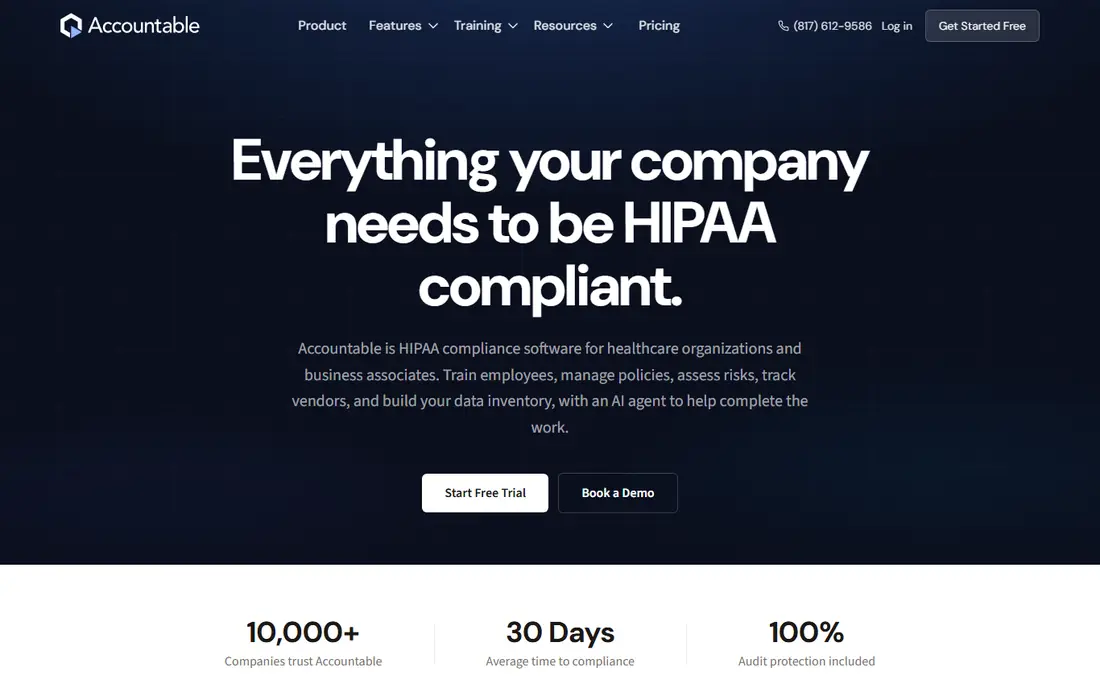
Accountable HQ, often called Accountable, is a HIPAA program management tool with policies, training, risk assessment, and business associate agreement tracking. Its published starting price of $169 per month billed annually, with a stated seat scope, makes it easier to budget than many rivals. That transparency helps small teams compare like with like.
The limit is tiering. Monitoring, dedicated support, and scheduled security testing sit on higher plans, so a team that needs those services should price the higher tier from the start. Confirm the employee count included, the number of entities covered, and what support is included in the base plan.
- Published starting price
- BAA tracking
- Training and risk assessment tools
- Higher tiers add monitoring and support
- Seat scope needs checking
HIPAA One focuses on risk analysis, remediation tracking, and audit preparation for hospitals and larger enterprises. Its strength is rigour: it helps teams document risks, assign fixes, and show progress over time, which matters when an auditor asks for evidence. Larger organisations with complex systems often need that level of detail.
For a solo practice, HIPAA One may feel heavy and expensive. It prices by quote, and the implementation effort is higher than a simple checklist tool. Shortlist it when risk analysis is the main gap, not when you only need training tracking.
- Detailed risk analysis
- Remediation tracking
- Audit preparation
- Pricing is quote based
- Heavier than a small practice may need
Healthicity offers a compliance manager with auditing, compliance tracking, and training management for medical groups. The dashboard view helps compliance leads see overdue training, audit findings, and policy status in one place. That overview is useful when several sites or departments report into one compliance function.
The trade off is fit for very small practices. Healthicity prices by quote and is geared toward larger groups, so a solo clinic may find the setup and cost disproportionate. Ask for a demo using your own site structure, and confirm reporting works for your team size.
- Compliance dashboard
- Auditing tools
- Training management
- Pricing is quote based
- Best for larger medical groups
Vanta automates compliance evidence collection and maps controls across frameworks such as HIPAA, SOC 2, and ISO 27001. For health tech companies that handle protected health information and also need SOC 2, that multi framework view saves duplicate work. Continuous monitoring flags gaps as systems change, rather than only at audit time.
Vanta is less practice focused than Compliancy Group or MedTrainer. A clinic that needs credentialing, staff training content, and patient facing workflows may find Vanta too technical. It suits tech teams with engineering systems to connect and evidence to collect automatically.
- Automated evidence collection
- Multi framework mapping
- Continuous monitoring
- Pricing is quote based
- More tech focused than practice focused
Drata is another automation led compliance platform, with HIPAA workflows, evidence collection, and control monitoring. It helps teams move from spreadsheets to a system that tracks controls, collects proof, and prepares for audit. Health tech and SaaS teams that already use cloud infrastructure often get the most from it, because integrations feed evidence directly.
The catch is implementation. Drata works best when your systems are connected, and a team with mostly manual processes will need to set up those links first. Confirm the integration list, the onboarding support, and the total cost for your framework scope before committing.
- Automated HIPAA compliance workflows
- Evidence collection
- Control monitoring
- Pricing is quote based
- Implementation needs system integrations
Sprinto offers guided compliance setup with policy templates, control tracking, and audit ready reporting, aimed at startups and growing tech companies. Its pitch is speed: a small team can set up a HIPAA program without hiring a full compliance department first. That suits health tech firms that need HIPAA alongside other frameworks.
The limit is practice depth. Sprinto does not focus on clinical credentialing or patient workflow compliance in the way MedTrainer does. Choose it when the main job is a tech company compliance program, and choose a practice tool when credentialing and staff training are the daily work.
- Guided compliance setup
- Policy templates
- Audit ready reporting
- Pricing is quote based
- Less practice specific than MedTrainer
How we picked these
We compared official product pages, pricing pages, and public comparisons for tools that support HIPAA programs or multi framework compliance in October 2026. We included practice focused tools and automation led tools, because healthcare compliance covers both care delivery and health technology. We excluded general HR tools that do not focus on compliance evidence, training, and risk assessment.
What to check before you buy
Start by naming your organisation type. A care practice needs training, policies, risk assessment, vendor agreements, and incident handling. A health tech company also needs evidence from cloud systems, access controls, and security monitoring. A tool that fits one type may miss the core work of the other, so map your required controls before you demo anything.
Next, ask who does the work. Some vendors provide software plus advisory help, while others provide software and expect your team to complete the program. Get the division of labour in writing, including risk assessment support, policy updates, training content, and audit preparation. Also confirm business associate agreement handling, data retention, and data export, since the tool will hold sensitive program records.
Finally, remember the disclaimer that matters most here. This article is general information only, not medical or legal advice, and software alone does not make a practice compliant. Policies must be followed, safeguards must be implemented, and staff must be trained and monitored. Budget for the people time as well as the software cost, and review the program at least annually.
Frequently asked questions
What does healthcare compliance software do?
It organises the records and workflows of a compliance program, including policies, workforce training, risk assessments, vendor agreements, and incident handling. It replaces spreadsheets and shared folders with a system that can show an auditor what was done, when, and by whom.
Does buying HIPAA software make my practice HIPAA compliant?
No. Software helps organise and evidence a program, but compliance depends on policies, safeguards, training, contracts, and day to day behaviour. Your organisation remains responsible for its program, even when a vendor helps with tools or advice.
Which tool is best for a small practice?
Practice focused tools such as Compliancy Group, MedTrainer, and Accountable HQ are usually a better fit than automation led platforms. Accountable HQ publishes a starting price, which helps budgeting, while the others price by quote. Compare training, credentialing, and policy needs before choosing.
Which tool is best for a health tech company?
Automation led tools such as Vanta, Drata, and Sprinto suit tech teams that need HIPAA alongside SOC 2 or ISO 27001. They collect evidence from cloud systems and map controls across frameworks, which reduces duplicate work for engineering and compliance teams.
How much does healthcare compliance software cost?
Prices vary by seats, entities, frameworks, and support level. Accountable HQ publishes a starting price of $169 per month billed annually, while most other tools in this list price by quote. Ask for the total cost for your staff count, sites, and frameworks.
Sources
See where you really rank - block by block
ProMapRanker scans Google Maps across a grid of your service area. Simple monthly plans from $19, white-label on every plan.
Start freeKeep reading
 worlds best local seo company
8 Worlds Best Local SEO Companies for Map Pack Growth in 2026
Compare the worlds best local seo company options for Google Business Profile work, citations, reviews, and multi-location rankings and reporting in 2026.
Read → world's best web hosting company
World's Best Web Hosting Company in 2026
Searching for the world's best web hosting company? We compared 10 hosts on price, renewal rates, speed, and support to help you choose well today in 2026.
Read → who's got the best nanny tax services
Who's Got the Best Nanny Tax Services in 2026
We answer who's got the best nanny tax services, comparing full filing, back taxes, software, and pricing so families can handle nanny taxes correctly.
Read →