 ProMapRanker
Best Gym Apps for Men in 2026

Key takeaways
- JEFIT, Strong and Hevy suit lifters who want fast logging, while Fitbod and Alpha Progression generate or prescribe each session.
- Nike Training Club is the best free starting point for guided workouts, with no paid plan needed for its core library.
- Boostcamp suits lifters who want to follow proven programs for free, with a paid plan for extra tools.
- Freeletics suits bodyweight and interval training, for lifters who train with little or no equipment.
- This article shares general information only, not medical advice. Check with a qualified professional before starting a new training program.
Quick comparison
| Pick | Great for | Pricing starts at | Free tier | |
|---|---|---|---|---|
 JEFIT | Large exercise library and plans | Free | Yes | Visit |
 Fitbod | Generated strength sessions | $15.99 per month | Free trial | Visit |
 Strong | Fast minimalist logging | $4.99 per month | Yes | Visit |
 Hevy | Social logging at low cost | $2.99 per month | Yes | Visit |
 Alpha Progression | Prescribed sets and progression | $12.99 per month | Yes | Visit |
 Nike Training Club | Free guided workouts | Free | Yes | Visit |
 Freeletics | Bodyweight and interval training | See website | Yes | Visit |
 Boostcamp | Proven programs for free | Free | Yes | Visit |
The best gym apps for men
Gym apps for men cover different jobs: logging lifts, following a coach program, generating a session, or training at home with no equipment. The best app depends on how much planning you want the app to do, and how much you want to control yourself. We compared official feature pages, pricing pages and app store listings, not hands-on training over months.
This article shares general information only, not medical advice. Training loads, injuries and health conditions vary by person, so check with a qualified professional before starting a new program, returning after injury, or lifting heavy loads for the first time.

JEFIT has been a gym staple for years, thanks to a large exercise library with demos, custom routines and progress tracking for strength, body measurements and volume. Community programs let you follow routines shared by other lifters, while Elite adds a periodised plan and deeper per muscle analysis. That mix suits lifters who like data and want to see which muscle groups they train most.
The free version includes ads and upsells, which some lifters find distracting in the gym. Elite costs 12.99 dollars per month or 69.99 dollars per year, so check if the plan features matter to you before paying. JEFIT suits lifters who want a deep library and long term tracking in one app, and who do not mind a busier interface.
- Large exercise database
- Community programs
- Body measurement and progress tracking
- Free version includes ads
- Best plan features need Elite
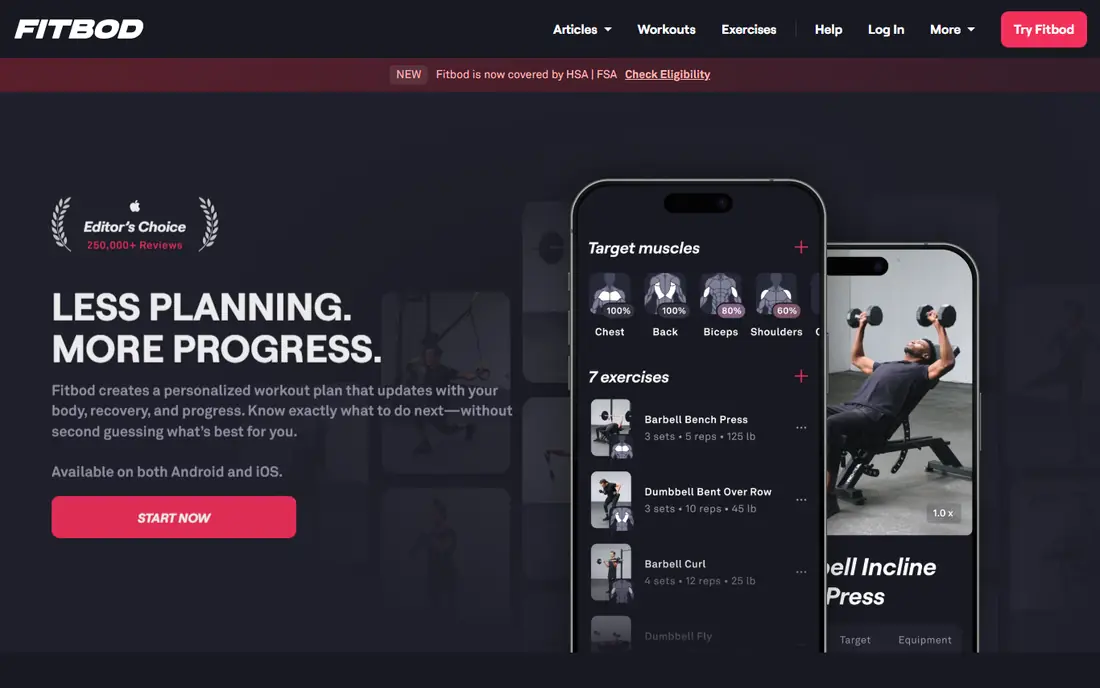
Fitbod builds each gym session for you, based on your available equipment, training history and muscle recovery. That removes daily planning, since you open the app, see a session, and adjust weights or swap exercises as needed. It suits lifters who train in different gyms, travel often, or simply do not want to write their own program.
The trade is price and free access. Fitbod offers a trial rather than a lasting free tier, and paid plans cost 15.99 dollars per month or 95.99 dollars per year. Lifters who already follow a fixed barbell program may find the generated sessions less focused than a coach program. Choose Fitbod when you want the app to plan, and you are happy to pay for that convenience.
- Sessions generated around equipment and recovery
- Wide exercise variety
- Apple Watch support
- No lasting free tier
- Highest price on this list for a logger plus planner

Strong is the plain notebook done well. You build a routine once, then log sets with a few taps, using rest timers and plate calculations on the way. The free tier covers unlimited saved workouts, with a cap on custom routines, which is enough for many lifters to test the app for weeks. Apple Watch support makes logging between sets quick without reaching for a phone.
Strong does not generate full programs in the way Fitbod does, and deeper analysis and CSV export sit behind Pro, priced at 4.99 dollars per month or 29.99 dollars per year. Lifters who want a coach program should look at Boostcamp or Fitbod instead. Pick Strong when you already know your program and want the fastest, least distracting logger.
- Very fast logging
- Apple Watch integration
- Unlimited saved workouts on free tier
- Limited program generation
- Best export and analysis features need Pro
Hevy combines a clean workout logger with a social feed, where you can follow friends, comment on sessions and compare progress. Logging is fast, templates are easy to reuse, and progress photos and body measurements sit alongside training data. Pro costs 2.99 dollars per month, 23.99 dollars per year, or 74.99 dollars for lifetime access, which is strong value for a paid logger.
The free tier caps custom routines, custom exercises and history length, so heavy custom users will hit limits sooner. Hevy also offers less program guidance than Boostcamp or Fitbod, since it focuses on logging rather than coaching. Choose Hevy when you train with friends, want a clean logger, and want a low cost upgrade path.
- Clean logging
- Social feed with friends
- Low Pro price with lifetime option
- Limited program library
- Custom routine and exercise caps on free tier
Alpha Progression suits lifters who want each set prescribed, not just logged. You enter your lifts, and the app suggests weights, reps and progression based on past performance, with rest timers and exercise notes to keep sessions moving. The minimal interface keeps focus on the next set, which helps in a busy gym.
Logging and manual plans are free, but the plan generator and next set advice need Pro, priced at 12.99 dollars per month or 79.99 dollars per year. That makes the free tier a good test, but not the full product for lifters who want prescription. Pick Alpha Progression when you want precise progression guidance without a full coach program.
- Prescribes weights and reps per set
- Progression logic
- Clean minimal interface
- Plan generator and next set advice need Pro
- No lifetime plan
Nike Training Club offers guided workouts for strength, cardio, mobility and yoga, with trainer led sessions that suit home and gym training alike. The core library is free, with no subscription needed for its main workouts, which makes it the best starting point for men returning to training or building a habit. Sessions vary in length and intensity, so you can fit training around a busy day.
Nike Training Club is less of a strength logger than Strong, Hevy or JEFIT, since it focuses on follow along sessions rather than detailed lift tracking. Lifters who want progressive barbell programming should pair it with a logger. Choose it when you want free, guided training now, without paying before you know if you will stick with it.
- Fully free core library
- Guided strength, cardio and mobility sessions
- No subscription needed
- Less strength logging depth
- Less personalised progression than Fitbod
Freeletics is built for training with little or no equipment, using bodyweight intervals, running sessions and coach generated plans. That suits men who train at home, travel often, or prefer high intensity sessions over long barbell workouts. The app adapts sessions to your feedback, time available and equipment, which keeps training practical when life gets busy.
Barbell lifters will find less depth here than in JEFIT, Fitbod or Alpha Progression, since Freeletics centres on bodyweight and conditioning work. Full coach features need a paid plan, so check current prices on the official site before committing. Pick Freeletics when your training is bodyweight based, or when you want conditioning alongside gym work.
- Bodyweight programs with little equipment
- Interval and HIIT sessions
- Coach plans on paid tiers
- Less barbell program depth
- Full coach features need a paid plan
Boostcamp stands out for its free program library, with thousands of programs including many by named coaches. Lifters can follow a proven strength, powerlifting or hypertrophy program, log sessions, and use tools such as a plate calculator and rest timer without paying. That makes it ideal for lifters who want structure but do not want a subscription to start.
Pro, priced at 14.99 dollars per month or 59.99 dollars per year, adds extra tools and removes limits, but the free tier already covers serious training. Boostcamp generates less of each session than Fitbod, since it follows set programs rather than building a new session each day. Choose it when you want a trusted program to follow, for free, with a clear path to paid extras later.
- Large free program library
- Coach programs included
- Plate calculator and rest timer
- Extra tools need Pro
- Less auto generation than Fitbod
How we picked these
We compared official feature pages, pricing pages and app store listings for apps with a real gym, strength or training offering for men. We kept only apps that are live in October 2026 and that cover logging, programming, guided workouts or bodyweight training in a useful way. We favoured a mix of free starts, loggers, generated plans and coach programs, since lifters differ in experience and goals. This article shares general information only, not medical advice. Prices are starting prices from vendor pages and roundups checked in October 2026, and they can change, so confirm the current plan before you subscribe.
What to check before you choose
Logger, program or coach
Decide if you need a logger, a set program or a session generator. Strong and Hevy log well, Boostcamp follows programs, and Fitbod and Alpha Progression prescribe sessions. Buying a logger when you need a program leads to drift, while buying a generator when you already have a program wastes money.
Equipment and training location
Check if the app fits your gym, home setup and travel pattern. Fitbod adapts to different equipment, Freeletics needs little gear, and Nike Training Club works at home or in a gym. An app that assumes machines you do not have will frustrate you quickly, no matter how good its other features are.
Progression and plateaus
Look at how the app handles progression when lifts stall. Some apps raise weights automatically, some follow a fixed program, and some leave progression to you. A clear progression rule matters more than a large exercise list, especially after the first few months when beginner gains slow down.
Try the free tier for a full training week
Use the free tier for at least a full week of real sessions, including a busy day and a tired day. That test shows logging speed, rest timer behaviour, offline use and how the app handles a missed session. Annual plans only save money if you still open the app in month six, so start monthly when you are unsure.
Frequently asked questions
What is the best gym app for men for beginners?
Nike Training Club is the best free start for beginners, since guided sessions teach movement and build a habit without cost. Boostcamp also suits beginners who want a structured program for free. Lifters who want simple logging from day one can start with Hevy or Strong and add a program later.
Which gym app is best for muscle building?
JEFIT, Fitbod and Boostcamp all suit muscle building, with different approaches. JEFIT offers a large library and tracking, Fitbod generates sessions around recovery, and Boostcamp follows proven hypertrophy programs for free. Alpha Progression also suits muscle building when you want each set prescribed. The best pick depends on how much planning you want the app to do.
Is there a good free gym app for men?
Yes. Nike Training Club is fully free for its core library, Boostcamp offers a large free program library, and Hevy, Strong and JEFIT all offer usable free tiers for logging. Free tiers usually cap custom routines or advanced features, but they cover serious training for many lifters before any payment is needed.
Do gym apps work for home workouts?
Yes, especially Nike Training Club and Freeletics, which offer guided and bodyweight sessions with little equipment. Fitbod can also adapt to home equipment, while loggers such as Strong and Hevy work anywhere you train. Check the app for home friendly filters and equipment settings before you commit to a paid plan.
Can a gym app replace a personal trainer?
An app can guide programming and logging, but it cannot watch your form, adjust for injury or give the same feedback as a qualified trainer in person. Apps suit lifters who are confident with basic technique and want structure. Beginners, lifters returning after injury and anyone with pain should seek qualified coaching rather than relying on an app alone.
How much should I pay for a gym app?
Most lifters do well with a free app or a low cost logger, with Pro plans on this list ranging from about 2.99 dollars to 15.99 dollars per month. Pay more only when a feature, such as generated sessions or prescribed progression, clearly changes how often you train. Start free, track consistency for a month, and upgrade only if the paid feature solves a real gap.
Sources
See where you really rank - block by block
ProMapRanker scans Google Maps across a grid of your service area. Simple monthly plans from $19, white-label on every plan.
Start freeKeep reading
 zscaler alternatives
Best Zscaler Alternatives in 2026
Looking for zscaler alternatives? We compare 9 SASE and zero trust platforms on architecture, data protection, pricing, and fit for your network and team.
Read → zapier alternatives free
Best Zapier Alternatives Free in 2026
Nine automation tools for zapier alternatives free in 2026, all with genuinely free tiers, plus free plan limits, starting prices and upgrade paths explained.
Read → which platform is best for online reputation
Which Platform Is Best for Online Reputation in 2026
Wondering which platform is best for online reputation? We compare 8 review, listing, and response tools for small and multi-location businesses and agencies.
Read →