 ProMapRanker
Best Growth Stage SaaS Accounting Software in 2026


Mid-market SaaS firms on an audit or IPO track · Pricing starts at: See website
Key takeaways
- Growth stage SaaS accounting turns on revenue recognition, deferred revenue and close speed, not just invoicing.
- QuickBooks Online Advanced and Xero suit firms up to a few million in recurring revenue, while Sage Intacct and NetSuite suit larger, multi-entity firms.
- Maxio, Puzzle and Stripe Revenue Recognition add billing and revenue depth without a full ERP move.
- Price at total cost, including implementation, billing tools and audit support, not only the subscription.
Quick comparison
| Pick | Great for | Pricing starts at | Free tier | |
|---|---|---|---|---|
| Sage Intacct | Mid-market SaaS firms on an audit or IPO track | See website | No | Visit |
 NetSuite | Large SaaS firms with many entities | See website | No | Visit |
 QuickBooks Online Advanced | Growing firms staying on QuickBooks | $340 per month | Free trial | Visit |
 Xero | Firms that want clean integrations | $90 per month | Free trial | Visit |
 FreshBooks | Small SaaS and service firms | $19 per month | Free trial | Visit |
 Zoho Books | Budget-conscious growing teams | Free | Yes | Visit |
 Puzzle | Stripe-billed startups that want modern books | $120 per month | No | Visit |
 Maxio | B2B SaaS firms that need billing plus revenue | $599 per month | No | Visit |
 Stripe Revenue Recognition | Stripe-first firms that need a revenue subledger | $25 per month | No | Visit |
The best growth stage saas accounting software
We compared official feature pages, pricing pages and product descriptions for accounting tools used by growing SaaS firms. The nine tools below span the path from early growth to enterprise scale.

Sage Intacct is the most common step up for a SaaS firm that has outgrown QuickBooks. Its general ledger handles multi-entity consolidation, dimensions for tracking revenue by product, channel or customer segment, and revenue recognition for subscription contracts. That combination shortens the month-end close and gives auditors a cleaner trail than a spreadsheet-based process.
The partner and CPA ecosystem is another plus, since many accounting firms know Intacct well and can support a growing finance team. The catch is cost and effort. Pricing is quote-based, and implementation typically needs professional help. For a firm approaching audit readiness, an IPO track or complex multi-entity reporting, Intacct is often the right next system, even with that investment.
- Multi-entity and multi-dimensional reporting
- Strong revenue recognition
- Large CPA and partner ecosystem
- Quote-based pricing
- Implementation effort and cost
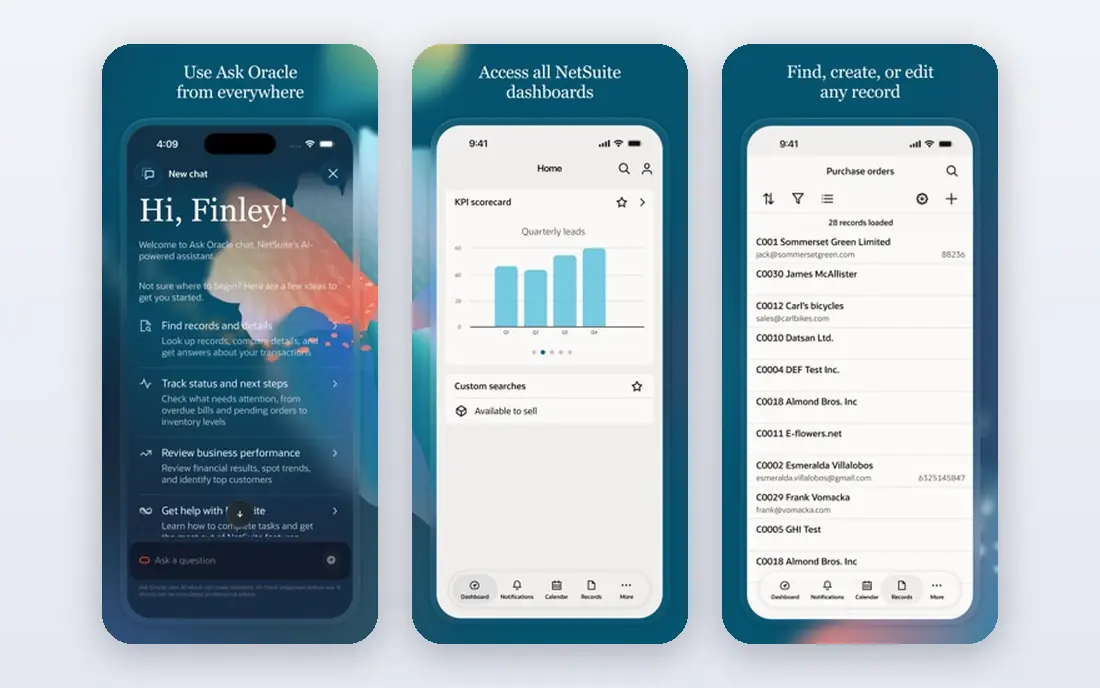
NetSuite is a full ERP, not just accounting software, and that breadth suits large SaaS firms whose pain has spread beyond finance. Accounting, billing, revenue management, CRM, inventory and operations can live in one system, with multi-subsidiary consolidation and an advanced revenue management module for complex contracts. For a firm with many entities, currencies or product lines, that unity is hard to match.
The trade is scale of investment. Pricing is quote-based, and implementation is a major project with consulting costs that can exceed the subscription in year one. Firms below roughly $20 million in recurring revenue often find Intacct or a billing-plus-ledger pairing cheaper and faster. Firms above that scale, or with complex operations, will find NetSuite fits their breadth.
- Full ERP with accounting, billing and operations
- Strong multi-subsidiary support
- Advanced revenue module
- Quote-based pricing
- Large implementation projects
QuickBooks Online Advanced
Great for: Growing firms staying on QuickBooks

QuickBooks Online Advanced is the top QuickBooks Online tier, and it suits growing SaaS firms that are not ready for an ERP move. It supports up to 25 users, with batch transactions, custom workflows, advanced reporting and a large app ecosystem for billing, expenses and payroll. Most bookkeepers and accountants already know it, which keeps hiring and support simple.
Its limit is revenue depth. Revenue recognition for complex subscription contracts is basic, and multi-entity consolidation needs workarounds or add-ons. The list price is $340 per month, which is a step up from lower QuickBooks tiers, but still far below ERP costs. For a firm with one entity and straightforward subscriptions, Advanced can carry growth for a long way before an ERP becomes necessary.
- Familiar to bookkeepers and accountants
- Up to 25 users
- Strong app ecosystem
- Basic revenue recognition
- Multi-entity work needs workarounds
Xero is a popular ledger for growing firms that value a clean interface and a broad app marketplace. Bank reconciliation, invoicing, expense tracking and reporting work well for a small finance team, and multi-currency support suits firms selling outside the US. Its Established plan, at $90 per month, adds multi-currency, project tracking and expense claims for larger teams.
For SaaS revenue depth, Xero needs help. Revenue recognition for subscription contracts usually comes from a marketplace add-on, such as a billing or revenue tool, rather than from Xero alone. That pairing can work well and stays affordable. Firms with complex multi-entity needs or audit-grade revenue rules should compare Intacct before committing to Xero plus add-ons.
- Clean interface and bank reconciliation
- Broad app marketplace
- Multi-currency support
- Revenue recognition needs an add-on
- Less suited to complex multi-entity firms
FreshBooks suits a small SaaS or service firm that needs clean invoicing, expenses and time tracking without accounting complexity. Its interface is friendly for founders who do not have a finance background, and client billing, payment reminders and reporting cover daily needs well. Starting at $19 per month, it is also one of the cheapest tools in this list.
The limit is growth stage fit. FreshBooks is not built for complex subscription revenue recognition, deferred revenue schedules or multi-entity consolidation. A firm that is growing fast should treat it as an early-stage tool and plan a move to QuickBooks, Xero or Intacct when revenue rules or entity count grow. For a small team with simple billing, it is a clear and low-cost start.
- Simple invoicing and time tracking
- Easy for non-accountants
- Good client billing tools
- Not built for complex SaaS revenue
- Limited multi-entity support
Zoho Books is the budget pick for a growing team, with a free tier for firms under set limits and paid plans above it. Invoicing, expenses, bank reconciliation, projects and reporting cover core accounting well, and links to other Zoho apps suit firms already using Zoho CRM or Zoho subscriptions. That ecosystem can replace several separate tools at low cost.
For SaaS-specific depth, Zoho Books needs add-ons or Zoho Subscriptions for billing and revenue handling, much like Xero. US accountant familiarity is also lower than for QuickBooks, so check that your accountant will work in Zoho before you commit. For a cost-conscious team with straightforward subscriptions, Zoho Books offers strong value.
- Free tier for small firms
- Strong Zoho ecosystem links
- Invoicing, expenses and reporting included
- SaaS revenue recognition needs add-ons
- Less US accountant familiarity than QuickBooks
Puzzle is a modern accounting ledger built for startups, with a focus on firms that bill through Stripe. It links billing, bank and card data into a ledger designed for venture-backed teams, with revenue recognition depth that sits above QuickBooks and below a full ERP. Its Complete plan, at $120 per month, suits firms moving from founder-led books to a real finance function.
The trade is maturity. Puzzle is newer than Intacct or NetSuite, with a smaller accountant and partner network, and less depth for very large or multi-entity firms. For a Stripe-first startup in the $1 million to $20 million revenue range that wants modern books without an ERP project, Puzzle is a credible and fast-moving option.
- Modern ledger built for startups
- Stripe billing links
- Mid-depth revenue recognition
- Newer vendor with a smaller partner network
- Less enterprise depth than Intacct
Maxio combines subscription billing and revenue recognition for B2B SaaS firms. It handles complex pricing, usage and hybrid plans, contract changes and deferred revenue, and gives finance teams ownership of billing without waiting on engineering. Its Grow plan starts at $599 per month for firms up to $100,000 in monthly billings, which sets its audience clearly in the growth stage.
Maxio is not a full general ledger, so most firms pair it with QuickBooks, Xero or Intacct for core accounting. That pairing is the point: Maxio owns billing and revenue, the ledger owns the books. Early firms will find $599 a month steep. B2B SaaS firms with complex billing and audit-grade revenue needs will find it pays back in close speed and fewer revenue errors.
- Full billing and revenue recognition for B2B SaaS
- Finance-owned billing workflows
- Strong subscription reporting
- Price is high for early firms
- Needs a ledger alongside it for full accounting
Stripe Revenue Recognition
Great for: Stripe-first firms that need a revenue subledger
Stripe Revenue Recognition is a revenue subledger for firms that already bill through Stripe. It builds revenue schedules from Stripe billing data, automates recognition and produces reports that feed into QuickBooks or Xero. Pricing starts from $25 per month, with higher tiers by volume, which makes it a low-cost way to add revenue depth without changing ledgers.
The limit is scope. It is not a general ledger, and it only helps if billing runs through Stripe. Firms with billing outside Stripe, or with complex non-Stripe contracts, will need a broader tool such as Maxio or Intacct. For a Stripe-first firm that wants cleaner revenue reporting while staying on QuickBooks or Xero, it is a smart and affordable add-on.
- Revenue subledger for Stripe billing data
- Automated schedules
- Links to QuickBooks and Xero
- Needs Stripe billing
- Not a full ledger on its own
How we picked these
We compared official feature pages, pricing pages and product descriptions for accounting tools used by growth stage SaaS firms. We kept tools that handle subscription billing, deferred revenue or multi-entity reporting, and left out generic bookkeeping tools with no SaaS revenue depth and payroll-only tools. Pricing is shown as published where available, and as See website where the vendor prices by quote.
What to check before you buy
Start with your revenue model, not the ledger. List your pricing types, such as flat subscriptions, usage, hybrid plans and annual prepayments, and check how each tool recognises revenue, handles contract changes and reports deferred revenue. Run a real month of contracts through each finalist and compare the close: how many manual journals, how many spreadsheet fixes and how long the revenue report takes.
Next, check the billing-to-ledger flow and the audit trail. Can billing changes flow to the ledger without retyping, and can an auditor trace a revenue number back to a contract. Finally, price the full stack, including billing tools, revenue add-ons, implementation and accountant time. A cheap ledger plus three add-ons can cost more than an ERP, and a costly ERP can still be cheaper than a slow, error-prone close.
Frequently asked questions
When should a SaaS firm move from QuickBooks to Sage Intacct or NetSuite?
Move when multi-entity reporting, complex revenue recognition or audit demands make QuickBooks work slow or risky. Common triggers are several entities, complex contracts, a pending audit or a board that needs faster, cleaner closes. Many firms move to Intacct first and to NetSuite later, when operations also need an ERP.
What is deferred revenue in SaaS accounting?
Deferred revenue is cash received for a subscription before the service is delivered. It sits as a liability until each period of service is earned, then moves to revenue. Clean deferred revenue schedules are central to SaaS accounting, and they are a key test for any tool in this list.
Do I need Maxio or Stripe Revenue Recognition if I use QuickBooks?
Not always. Simple subscriptions can run on QuickBooks alone. Add a revenue tool when contracts get complex, with usage, mid-term changes or annual prepayments, or when month-end revenue work takes days and still needs manual fixes.
Is Xero a good choice for a US SaaS firm?
Yes, for many firms, especially those selling internationally or wanting a clean app marketplace. Check that your accountant works in Xero and that your revenue needs are covered, either in Xero or through an add-on, before you commit.
How much does growth stage SaaS accounting software cost?
Costs range from free or $19 a month for early tools to quote-based ERP deals that run to tens of thousands a year. Budget for the ledger, billing and revenue tools, implementation and accountant time together, not only the headline subscription.
Sources
See where you really rank - block by block
ProMapRanker scans Google Maps across a grid of your service area. Simple monthly plans from $19, white-label on every plan.
Start freeKeep reading
 zoro.to alternatives
Best Zoro.to Alternatives in 2026
We compare the best zoro.to alternatives in 2026, listing only legal licensed anime streaming services, from Crunchyroll to free options for fans today.
Read → zip alternatives
Best Zip Alternatives in 2026
We compare the best zip alternatives for buy now, pay later in 2026, covering pay-in-4 plans, fees, spending limits, and credit reporting options today.
Read → yesware alternatives
Best Yesware Alternatives in 2026
Compare the best yesware alternatives for sales email tracking, templates, and sequences, with current pricing and honest tradeoffs for small sales teams.
Read →