 ProMapRanker
Best Generative AI SEO Platforms in 2026

Key takeaways
- Content scoring tools and full SEO suites solve different problems, so pick by the job you repeat most often, not by the longest feature list.
- Surfer SEO, Frase, and Clearscope focus on briefs and draft scoring, while Semrush and Ahrefs add keyword research, audits, and AI visibility tracking.
- Budget options such as NeuronWriter and RankIQ cover core optimization for far less, but they offer narrower research data than the large suites.
- AI scores do not prove a page will rank or be cited, so every draft still needs fact checking, original detail, and a human edit before it goes live.
- Plan limits on articles, tracked prompts, and users matter more than the headline price, so check those caps before you commit to a year.
Quick comparison
| Pick | Great for | Pricing starts at | Free tier | |
|---|---|---|---|---|
 Surfer SEO | Live content scoring | $49 per month | No | Visit |
 Frase | Research to published draft | $39 per month | Free trial (7 days) | Visit |
 Clearscope | Editorial teams | $129 per month | Free trial (14 days) | Visit |
 MarketMuse | Site-wide topic planning | Free | Yes | Visit |
 Semrush | All-in-one SEO plus AI visibility | $139 per month | Yes | Visit |
 Ahrefs | Backlinks and keyword research | $29 per month | Yes | Visit |
 Scalenut | Topic clusters and AI drafts | $59 per month | Free trial | Visit |
 RankIQ | Low-competition blog keywords | $49 per month | No | Visit |
 NeuronWriter | Budget on-page optimization | $23 per month | Yes | Visit |
 Alli AI | Automated on-page fixes | $299 per month | Free trial (10 days) | Visit |
The best generative ai seo platforms
We compared official pricing pages, feature pages, and public documentation for tools that help content appear in search results and in AI answers. Here are the ten that fit best for ordinary business owners and small content teams.
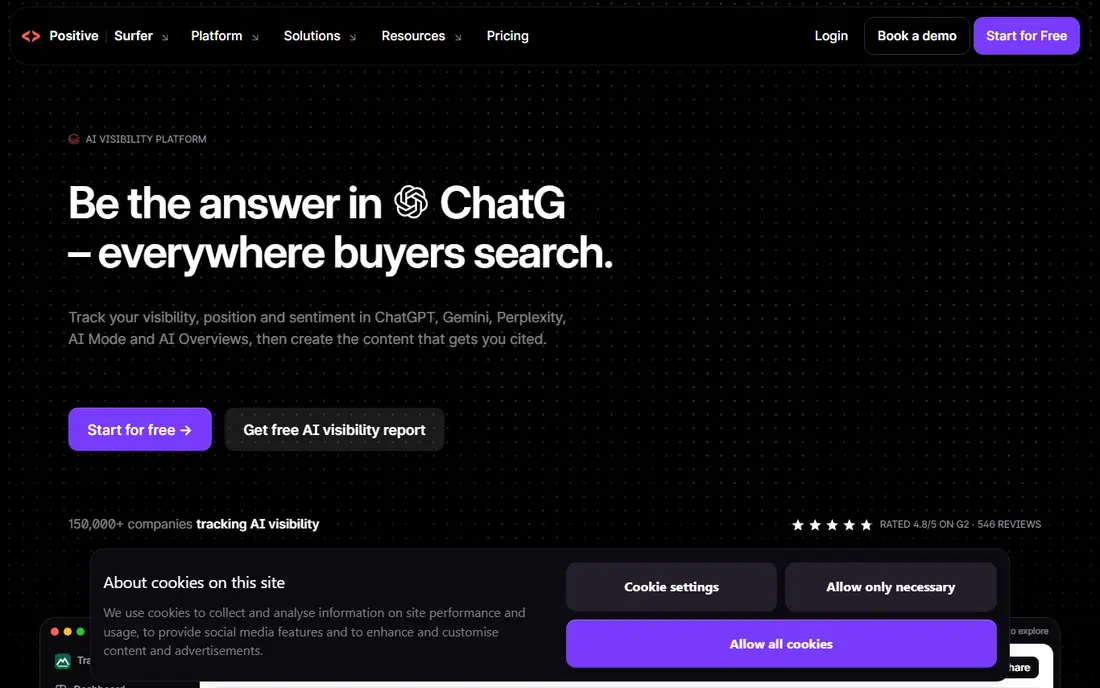
Surfer SEO suits writers who already have a draft and want clear guidance on terms, headings, and length. Its editor compares your text with pages that rank now, which makes revision work concrete instead of guesswork. Teams that publish often will like the brief and audit tools, which help older pages stay current.
The catch is the credit model. Entry plans limit how many documents you can create, and AI visibility tracking sits on higher tiers, so a small team should map its monthly output to the plan before paying. Surfer does not replace keyword research or link building on its own, so pair it with a research tool if you need those jobs covered.
- Real-time Content Score tied to ranking pages
- Brief builder and audit tools
- AI visibility tracking on higher plans
- Annual billing applies to the lowest listed price
- Article credits are limited on entry plans

Frase is a good fit for a solo marketer or a small team that wants one loop from research to draft to published page. It pulls questions and topics from search results, builds a brief, and scores the draft for both classic search and AI search. That single flow saves time when you move between separate tools for each step.
The limit to watch is volume. Starter covers a set number of articles and audit pages each month, and it stops at those caps until the next cycle. If you publish more than ten articles a month, the next tier is the realistic starting point, not an upgrade you can postpone.
- Fast SERP research and brief creation
- SEO and AI search scores in one workflow
- Publishing links to common content systems
- Monthly article and audit limits on Starter
- White-label reporting is reserved for higher plans

Clearscope fits teams where several editors and writers share one standard for quality. Its reports are easy for a non-technical writer to follow, and unlimited users mean you do not pay per seat as the team grows. That structure helps agencies and in-house teams that review a steady stream of drafts.
Price is the honest trade-off. At $129 per month, it costs more than tools aimed at solo bloggers, and the plan still caps tracked queries, pages, and drafts. It is best when editorial consistency matters more than finding the cheapest score, and when the team will actually use the shared reports every week.
- Clean grading reports for writers
- Unlimited users and projects on listed plans
- Shared editorial standards
- Higher entry price than budget optimizers
- Draft and page limits still apply
MarketMuse suits a site owner who wants to plan coverage across many topics rather than polish one post at a time. It looks at your inventory, finds gaps, and ranks which topics deserve attention first. That planning view is useful before you spend months writing in the wrong order.
The free plan gives a limited number of queries each month, which is enough to test the approach on a small site. Larger sites will need a paid plan, and pricing is not published in a simple list, so you should request a quote with your site size and topic count in hand. It pairs well with a scoring editor rather than replacing one.
- Topic modeling across a whole site
- Free plan for basic queries
- Clear prioritization for content gaps
- Paid pricing is quote-based
- Less suited to quick single-article scoring
Semrush is the pick when one subscription must cover research, site health, content, and reporting. It handles keyword lists, backlink checks, site audits, and position tracking, and its higher plans add tracking for AI search answers. Teams that also run paid search get extra value from the same account.
The downside is scope. A solo blogger may use only a small part of what is included, and the entry price reflects the full suite. Start with the free plan to test the interface, and check whether AI visibility sits on the tier you plan to buy, since that feature changes the value of the plan for this topic.
- Keyword research, audits, and competitor data in one account
- AI visibility tracking on higher plans
- Broad toolset for paid and organic work
- Large toolset can overwhelm a solo user
- AI visibility is not on the lowest paid plan
Ahrefs fits teams that make decisions from link and keyword data first. Its backlink index and keyword tools help you judge how hard a topic will be to win, and its audit tool finds technical problems that hold pages back. The Starter plan at $29 per month gives a low-cost way in, with a free tier for limited checks.
It is not a dedicated content editor, so writers who want live draft scoring should pair it with Surfer, Frase, or Clearscope. Higher tiers add more credits and AI citation tracking, and those costs rise quickly, so confirm the credit limits for your team size before you choose a tier.
- Strong backlink and keyword data
- Site audit and rank tracking
- Free tier for basic checks
- Content scoring is not its core strength
- Higher research tiers cost much more
Scalenut suits small teams that want planning, drafting, and optimization in one place without buying a full suite. Its cluster tool groups related topics, and its drafting workflow turns a brief into a structured draft that you can then edit and score. That helps teams that publish in batches around a theme.
The price to compare is the monthly list price, not only the annual equivalent, since the two differ. Scalenut works best when a human editor still shapes the final text, checks facts, and adds examples that a generated draft cannot supply. Used that way, it speeds production without handing the whole article to automation.
- Topic clusters and SERP analysis
- Cruise-style drafting workflow
- AI search content features
- Monthly price is higher than the annual equivalent often quoted
- Depth of research data is narrower than the large suites
RankIQ is built for bloggers and small publishers who need topics they can actually rank for soon. It highlights lower-competition keywords and gives a clear grade for each post, which keeps the workflow simple. If your site is new or small, that focus matters more than a huge keyword database you will never use.
The trade-off is breadth. Large sites with many categories, technical products, or enterprise reporting needs will find it limited. There is no free plan, so read the feature list closely and use any trial or refund terms on offer before you commit to a full year.
- Focus on keywords a smaller site can realistically win
- Simple reports for bloggers
- Content grading included
- Narrower fit for large or technical sites
- No free plan
NeuronWriter is our pick for a tight budget. It covers the core job, which is checking a draft against terms and topics found on ranking pages, for much less than Clearscope or Surfer. The Search Console link helps you tie optimization work to pages that already get impressions, which is a sensible place to start.
Expect a plainer interface and fewer built-in links to other tools. That is a fair trade at this price, as long as you do not need team reporting or deep integrations. For a solo writer or a small business owner editing their own pages, it delivers most of the practical value.
- Low entry price
- Semantic term coverage
- Google Search Console connection
- Interface is less polished than premium editors
- Fewer integrations than larger tools
Alli AI fits agencies and larger sites that need to fix many pages at once. It finds on-page issues across a site and can apply approved changes in bulk, which saves hours compared with editing page by page. That scale is its main reason to pay the higher price.
Small sites should pause before choosing it. The entry cost is hard to justify for a handful of pages, and automated changes still need review, since a bulk edit can alter wording or structure in ways you did not intend. Use the trial on a test set of pages, and keep a backup before any bulk change.
- Bulk on-page optimization suggestions
- Technical checks alongside content fixes
- Agency-friendly workflows
- High entry price for small sites
- Automation still needs human review before changes go live
How we picked these
We compared official pricing pages, feature descriptions, and public documentation for tools that cover generative AI search, content optimization, or both. We kept only tools that exist and work now, that clearly fit SEO content work, and that publish enough detail to judge price and limits. We left out general chat tools, since they do not track rankings or score content against search results on their own.
What to check before you pay
Start with the job you will do every week. If you write and revise articles, a scoring editor such as Surfer, Frase, or Clearscope will matter most. If you plan a whole site or choose topics, add MarketMuse or a research suite such as Semrush or Ahrefs. If budget is tight, NeuronWriter or RankIQ can cover the core work while you grow.
Check limits, not just price
Count your monthly articles, tracked keywords, and AI prompts, then match those counts to the plan. A low headline price can still cap you below your output, and overage or tier jumps can erase the saving. Ask how credits reset, whether unused credits carry over, and what happens when you hit a cap mid-month.
Keep a human in the loop
AI drafts and scores are starting points, not finished work. Check every claim, add your own examples and product details, and edit for tone and accuracy. Pages that read as generic or that repeat errors will not earn trust, even if a tool gives them a high score. Track results in Search Console and in AI answer checks over several weeks before you judge a tool.
Frequently asked questions
What are the best generative ai seo tools for a small business?
For most small businesses, Frase or Surfer covers drafting and scoring at a manageable price, while NeuronWriter is the budget pick. Add Semrush or Ahrefs only when keyword research, audits, and competitor tracking become weekly work rather than occasional checks.
What is the best generative ai seo software for AI search visibility?
Semrush, Frase, and Surfer all offer AI visibility tracking, but the feature often sits on higher tiers, so check the plan details. No tool can promise a citation in an AI answer, since those answers change with the query, the source mix, and the model used.
How do generative ai seo platforms differ from general AI writers?
General writers produce text from a prompt, while SEO platforms add search data, briefs, scoring against ranking pages, and tracking for search and AI answers. That extra data is what makes them useful for publishing decisions, even though the draft still needs a human edit.
Are free plans enough to start with?
A free plan can test the interface and a small set of queries, as with MarketMuse, Semrush, and Ahrefs. It will not cover regular publishing, since free tiers cap queries, articles, or tracked terms, so treat free use as a trial, not a long-term publishing plan.
Should I buy one tool or combine two?
Many small teams combine one research suite with one scoring editor, since no single tool leads at every job. That combination costs more, so start with one tool, use it for a month of real articles, and add a second only when a clear gap shows up in your workflow.
Sources
- https://surferseo.com/pricing
- https://www.frase.io/pricing
- https://www.clearscope.io/pricing
- https://www.marketmuse.com/pricing
- https://www.semrush.com/pricing
- https://ahrefs.com/pricing
- https://www.scalenut.com/pricing
- https://www.rankiq.com/pricing
- https://www.neuronwriter.com/pricing
- https://www.alliai.com/pricing
See where you really rank - block by block
ProMapRanker scans Google Maps across a grid of your service area. Simple monthly plans from $19, white-label on every plan.
Start freeKeep reading
 zscaler alternatives
Best Zscaler Alternatives in 2026
Looking for zscaler alternatives? We compare 9 SASE and zero trust platforms on architecture, data protection, pricing, and fit for your network and team.
Read → zapier alternatives free
Best Zapier Alternatives Free in 2026
Nine automation tools for zapier alternatives free in 2026, all with genuinely free tiers, plus free plan limits, starting prices and upgrade paths explained.
Read → which platform is best for online reputation
Which Platform Is Best for Online Reputation in 2026
Wondering which platform is best for online reputation? We compare 8 review, listing, and response tools for small and multi-location businesses and agencies.
Read →