 ProMapRanker
Best Generative AI Development Company in 2026


Broad enterprise generative AI applications · Pricing starts at: See website
Key takeaways
- The best generative AI development companies build production systems, not just demos, with retrieval, evaluation, and monitoring included.
- LeewayHertz and Master of Code Global suit broad enterprise and customer-facing work, while Addepto suits data-heavy knowledge systems.
- Neoteric and RTS Labs are strong for validation and evaluation discipline before a larger build.
- SoluLab, Markovate, and InData Labs cover product builds, workflows, and data science alongside generative AI.
- Pricing is almost always project-based, so a short discovery phase and a clear scope matter more than a headline rate.
Quick comparison
| Pick | Great for | Pricing starts at | Free tier | |
|---|---|---|---|---|
| LeewayHertz | Broad enterprise generative AI applications | See website | No | Visit |
 Master of Code Global | Customer-facing conversational AI | See website | No | Visit |
 Addepto | Enterprise knowledge bases and retrieval | See website | No | Visit |
 Neoteric | Validating an idea before a larger build | See website | No | Visit |
 RTS Labs | Production AI with evaluation discipline | See website | No | Visit |
 SoluLab | Generative AI inside a wider product | See website | No | Visit |
 Markovate | Product-focused generative AI workflows | See website | No | Visit |
 InData Labs | Data science plus custom generative AI | See website | No | Visit |
The best generative AI development companies
A good partner in this field does more than connect a model to a chat box. It helps you choose data sources, design retrieval, test answers, control costs, and keep the system safe once real users start using it.
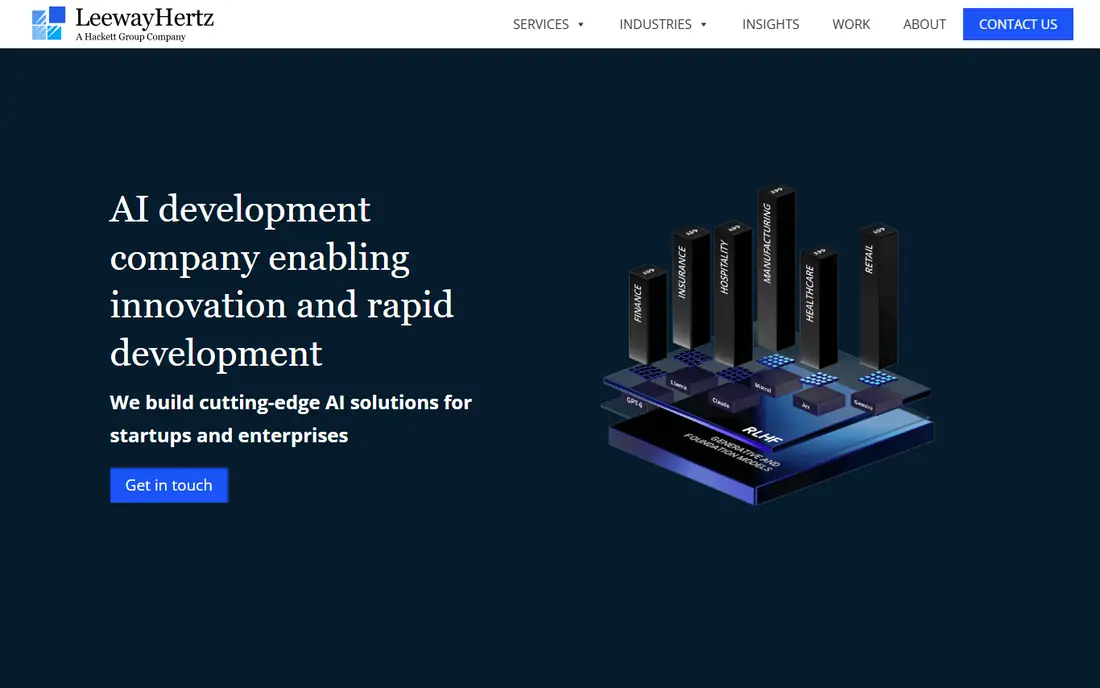
LeewayHertz is a useful first call for larger companies that need generative AI across several use cases. Its public work covers assistants, workflow automation, and compliance-related systems, which suggests it can handle regulated content as well as general business tools. That breadth helps when a project starts as one chatbot and grows into several connected tools.
The downside of breadth is focus. A small startup with one narrow feature may find the process heavier than it needs. LeewayHertz fits best when the system must connect to existing business data, serve many users, and pass internal security review.
- Wide service range across industries
- Published reference work on compliance and enterprise assistants
- Full-cycle delivery
- Enterprise scope can mean longer timelines
- Pricing is project-based and not published
Master of Code Global stands out for companies whose customers will talk to the AI directly. Its case work includes shopping assistants and support chatbots, where answer quality and tone matter as much as raw model power. That experience helps teams avoid a common failure, which is a technically fine chatbot that frustrates customers.
Teams that need heavy data pipelines or model training may need a second partner for that layer. For a customer-facing assistant, though, Master of Code Global offers a clear lane. Ask for examples in your industry and for how it measures answer accuracy after launch.
- Strong focus on conversational products
- Published shopping and support assistant work
- Experience with customer experience metrics
- Less suited to purely internal data engineering projects
- Pricing depends on scope
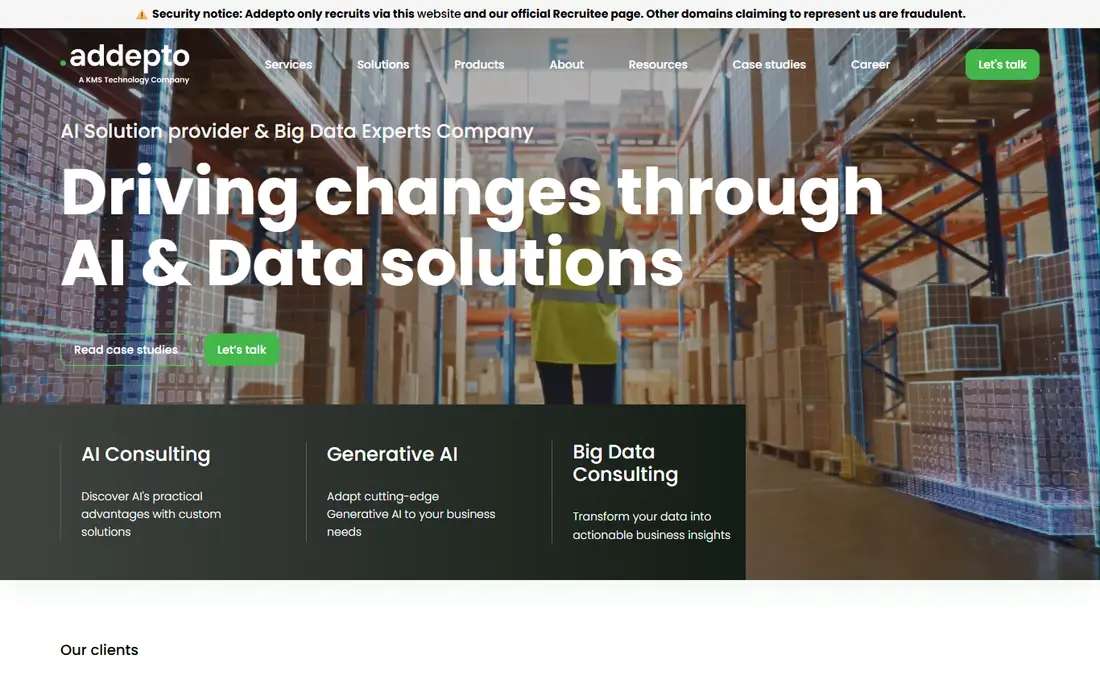
Addepto is a strong choice when the main problem is knowledge, not conversation. Many companies have manuals, tickets, contracts, and internal docs spread across systems, and an assistant is only useful if it can find the right passage and cite it. Addepto public work points to that retrieval strength, especially for industrial and technical documentation.
That focus means Addepto may not be the best pick for a marketing content tool or a simple chatbot with no data layer. For knowledge bases, support search, and agent systems that must act on company data, it deserves a shortlist spot. Ask how it handles conflicting documents and stale content.
- Strength in retrieval and agentic systems over technical documents
- Enterprise data experience
- Production delivery focus
- Smaller public profile than the largest firms
- Project pricing is not published
Neoteric appeals to teams that are not yet sure what to build. Its approach starts with discovery, testing, and a smaller build, which reduces the risk of spending a large budget on a feature users do not want. That discipline is valuable in generative AI, where demos are easy and production value is harder to prove.
Once a product is proven, you should confirm who maintains it, how evaluation continues, and how costs scale. Neoteric can handle larger builds too, based on its public platform work, but its clearest advantage is helping you prove value early.
- Product discovery and validation approach
- Longer generative AI platform builds in public work
- Agile delivery style
- Validation focus may suit early stages more than long-term maintenance
- Pricing is scope-based
RTS Labs is the pick for teams that worry most about wrong answers, rising token costs, and unclear ownership after launch. Its published comparison work stresses model selection, evaluation sets, and cost control, which are the areas where many generative AI projects fail after the demo. That framing matches what engineering and finance leaders actually need to approve a project.
The trade-off is pace in the first weeks. A team that wants a quick prototype may find the evaluation work slows the start. In return, you get a system with clearer tests, better cost visibility, and a stronger case for wider rollout.
- Explicit focus on evaluation and hallucination control
- Cost engineering
- Integration depth
- Evaluation rigor can extend early timelines
- Pricing is not published
SoluLab suits companies building a product where generative AI is one feature among many. Its background covers mobile apps, web platforms, and integrated systems, so an AI assistant can sit alongside billing, user accounts, and existing workflows without a separate rebuild. Published work on multi-agent orchestration also helps for more complex tasks.
Pure AI research teams may prefer a more specialized firm. For product teams that need a working app with AI inside it, SoluLab offers a practical path. Confirm which parts of the system your own team will own after handover.
- Broad software product experience
- Multi-agent and LLM integration work
- Coverage of blockchain and Web3 alongside AI
- Broad scope can dilute generative AI specialization
- Pricing varies by project
Markovate is a good fit for product teams that want generative AI tied to a workflow, such as onboarding, content review, or customer support triage. Its positioning stresses practical workflows rather than research, which helps keep a project grounded in time saved or tasks completed. That focus also makes it easier to judge success after launch.
Larger regulated enterprises should check security, data handling, and support coverage in detail before committing. For mid-size product teams, Markovate offers a focused, workflow-first alternative to a general enterprise consultancy.
- Focus on workflows with measurable return
- Product application experience
- Clear service menu for AI apps and agents
- Smaller firm profile
- Enterprise compliance depth varies by project
InData Labs works well when your data needs work before any model can help. Many generative AI failures start with messy, duplicated, or poorly labeled data, and a data science team can clean, structure, and evaluate that data first. Its public work includes NLP analysis across models, which points to that combined skill set.
If you already have clean data and only need a chatbot, a more conversational specialist may move faster. If data quality is your main risk, InData Labs is a sensible choice. Ask for a data readiness review as the first deliverable.
- Data science foundation beside generative AI
- NLP and analytics experience
- Custom model work
- Generative AI is one practice among several
- Timelines depend on data readiness
How we picked these
We compared company service pages, published case work, and independent comparison guides for firms that build custom generative AI systems in 2026. We favored firms with public production examples, clear service descriptions for retrieval, agents, or chatbots, and a working official site. We excluded pure model labs, pure SaaS tools, and talent marketplaces, because they solve a different buying problem.
What to ask before you sign a generative AI contract
Start with data and evaluation, not model choice. Ask which sources the system will use, how it will handle wrong or outdated documents, and how answer quality will be tested each week. A good partner should show you an evaluation set, a cost estimate per thousand queries, and a plan for monitoring after launch.
Ownership matters just as much. Clarify who owns prompts, evaluation data, and integrations, and what happens if you switch model providers. Also agree on security basics in writing, including access controls, data retention, and where your data is processed. A short paid discovery phase is often cheaper than a large build based on assumptions.
How to compare proposals fairly
Ask every firm for the same three things: a named system they shipped, the user group that used it, and the outcome it produced. Then compare timelines, maintenance terms, and total cost over twelve months, not just the build fee. That comparison reveals which firms are selling a demo and which are selling a system you can run.
Frequently asked questions
What is the best generative AI development company?
There is no single best firm for every project. LeewayHertz suits broad enterprise work, Master of Code Global suits customer-facing chat, and Addepto suits knowledge retrieval, so the best choice depends on your main use case and data.
How much does a generative AI development company cost?
Most firms price by project scope, team size, and timeline, and they do not publish standard rates. Expect a discovery phase first, then a build quote that includes data work, evaluation, integration, and maintenance.
What are the best generative AI development companies for startups?
Neoteric and Markovate suit startups and growth-stage teams, because they focus on validation and product workflows. Start with a narrow use case, prove value, and expand only after users show real benefit.
What should a generative AI company deliver besides a chatbot?
It should deliver retrieval design, evaluation tests, cost controls, security settings, monitoring, and documentation for handover. A chatbot without those parts is a demo, not a production system.
How long does a custom generative AI project take?
Timelines vary by data readiness and integration depth. A focused pilot can take weeks, while an enterprise system connected to several internal tools can take months. Ask for milestones tied to tested features, not just calendar dates.
Do I need to provide my own data and models?
You provide the business data and access, while the firm usually helps choose and configure models. Clarify data ownership, retention, and model provider terms before development starts, especially for sensitive company content.
Sources
See where you really rank - block by block
ProMapRanker scans Google Maps across a grid of your service area. Simple monthly plans from $19, white-label on every plan.
Start freeKeep reading
 zoho inventory alternatives
6 Alternatives to Zoho Inventory, Compared on Price and Fit
Zoho Inventory alternatives: 6 tools compared on price, free plans and fit. Katana leads the list for manufacturers. Fit and flaws are laid out for each entry.
Read → zoho crm alternatives
Best Zoho CRM Alternatives (2026)
Need Zoho CRM alternatives? We compare 7 tools on cost, free access and who each suits. Every pick gets a straight assessment. Built for quick decisions.
Read → zelle alternatives
Best Zelle Alternatives in 2026
Compare the best Zelle alternatives for sending money to friends, paying sellers and moving funds abroad, with honest notes on fees, speed and safety in 2026.
Read →