 ProMapRanker
Best Free Card Value App in 2026

Key takeaways
- CollX is the best free starting point for sports and trading cards, with scanning, a large database, and a marketplace.
- Ludex suits mixed sports and trading card collections, with a free tier and paid plans for unlimited scans.
- TCGplayer, Cardmarket, and PriceCharting are best for price checks, while Ripbin, Rare Candy, and Slabline add tracking and graded values.
- A scan price is an estimate for a typical copy, not a guarantee for your copy, since condition, grade, and edition change value a lot.
Quick comparison
| Pick | Great for | Pricing starts at | Free tier | |
|---|---|---|---|---|
 CollX | Free scanning and marketplace | Free | Yes | Visit |
 Ludex | Mixed sports and TCG scanning | Free | Yes | Visit |
 TCGplayer | TCG price checks | Free | Yes | Visit |
 Cardmarket | European TCG prices | Free | Yes | Visit |
 PriceCharting | Price history and tracking | Free | Yes | Visit |
 Ripbin | Free sports and Pokemon values | Free | Yes | Visit |
 Rare Candy | Pokemon value checks | Free | Yes | Visit |
 Slabline | Graded card values | Free | Yes | Visit |
The best free card value app
Card values move with sales, condition, and grade, so a good free app should show recent sales, not just an asking price. The apps below all offer a genuinely free tier for value checks, and they cover sports cards, Pokemon, and other trading card games in different ways. This is not financial advice, and card prices can fall as well as rise.

CollX is our pick for most collectors because it combines a free scanner, a large database, and collection tracking in one app. Published guides note a database of 20 million or more cards, with historical auction data used to estimate value. You can scan a card, add it to a collection, and watch a running total, which is useful for a growing binder.
The free tier covers the core job, but Pro, listed at $9.99 per month in published app store comparisons, adds unlimited collection size, marketplace credits, and extra tools. For a casual collector, the free tier is enough to check values and track a modest collection. For a large collection, check the free limit before you scan hundreds of cards.
- Free scanning with a large card database
- Collection tracking with portfolio value
- Built-in marketplace
- Paid Pro plan needed for unlimited collection size and extra tools
- Scan values are estimates for a typical copy
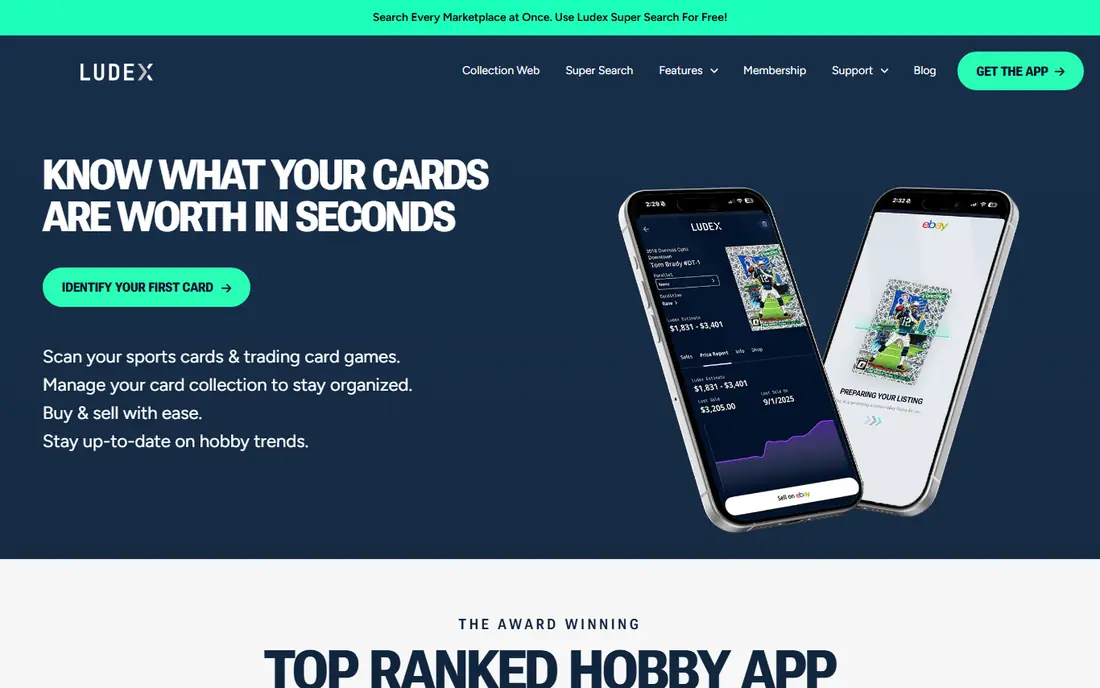
Ludex suits collectors who own both sports cards and trading card games, since it covers both in one scanner. The free tier lets you test scanning and collection tracking, while paid plans, listed from $4.99 per month in published comparisons, allow unlimited scans and fuller price reports. That dual coverage is rare, and it saves switching apps for different card types.
The free tier is limited, so a large collection will hit scan limits quickly. Published reviews also note weaker sports pricing detail than some sports-only apps, with no grade-level breakdown in some cases. For a mixed collection under a few hundred cards, Ludex is a strong free start. For a large sports-only collection, compare CollX as well.
- Covers sports and trading card games
- Free tier for basic scanning
- Paid plans for unlimited scans
- Free tier limits scans
- No grade-level breakdown in some published reviews
TCGplayer is the best free price checker for trading card games, with market data for Pokemon, Magic: The Gathering, Yu-Gi-Oh, and other games. Published guides call it the best free option for TCG prices, with barcode scanning in the app and both market prices and recent sales data. That sales-based view is more useful than a single asking price.
Sports collectors will find less here, since TCGplayer centers on trading card games. Condition still matters, so a heavily played card will sell for less than a near-mint listing. Use TCGplayer to check a TCG price before a trade or purchase, and cross-check a high-value card against recent sold listings.
- Free price checks for Pokemon, Magic, and Yu-Gi-Oh
- Market prices and sales data
- Large marketplace
- Sports card coverage is limited
- Prices reflect market listings and sales, not your copy condition
Cardmarket is the main European marketplace for trading card games, and it is a strong free price reference for European collectors. Prices reflect real European listings, which can differ from US prices due to supply, shipping, and demand. For a collector in Europe, that local view is more useful than a US-only price.
US collectors should use Cardmarket as a second reference, not as a sole price, since shipping and regional demand change the picture. Cardmarket is also a marketplace first, so collection tracking is thinner than in CollX or Ludex. Use it to check a fair European price, then compare with TCGplayer for a US view.
- Free price checks for European TCG markets
- Large marketplace with real listings
- Useful for Magic and Pokemon in Europe
- US prices may differ from European prices
- Marketplace focus means less collection tracking
PriceCharting tracks prices across sports cards, Pokemon, video games, and other collectibles, with price history that helps you see whether a card is rising or falling. That history is useful before a purchase, since a single current price can hide a sharp recent move. A free tier covers basic checks, with a paid Collector plan listed at $5.99 per month in published app store comparisons.
The paid tier matters for deeper history and tracking, so heavy users may need it. Even with history, PriceCharting values are estimates based on market data, not a formal appraisal of your copy. Use it to spot trends, then check recent sold listings for a high-value card before you buy or sell.
- Price history for sports, Pokemon, and games
- Collection tracking tools
- Free tier for basic checks
- Paid Collector plan needed for fuller history in published comparisons
- Values are estimates, not appraisals
Ripbin is a free card price database, scanner, and collection locker that covers sports cards and Pokemon, with daily repricing from real sales data. Its own published terms state that browsing, valuing, scanning, and locker repricing are free with no monthly fee, which makes it a strong free option for casual and serious collectors alike. Grade-by-grade values help when you own a graded card.
Because Ripbin is newer than some rivals, coverage may vary by set or card type, so test it on your own collection before relying on it alone. For most common sports and Pokemon cards, it is a useful free check alongside CollX. For a rare or graded card, cross-check against recent sold listings as well.
- Free browsing, scanning, and collection locker
- Daily repricing from sales data
- Grade-by-grade values in published terms
- Newer service than CollX or TCGplayer
- Coverage may vary by card type
Rare Candy focuses on Pokemon cards, with a scanner that identifies name, set, and number, then shows an estimated value. Published terms note daily price updates and a free collection tracker, which makes it a clean choice for Pokemon collectors who do not need sports coverage. The scan flow is simple, which helps at a card show or shop.
Sports collectors should look elsewhere, since Rare Candy centers on Pokemon. Condition and edition still matter, so a raw card and a graded card of the same name can differ a lot in value. Use Rare Candy for a fast Pokemon price check, then confirm a high-value card against TCGplayer and recent sold listings.
- Free Pokemon scanning and value checks
- Collection tracker built in
- Daily price updates in published terms
- Pokemon-focused, so sports coverage is limited
- Values are estimates for a typical copy
Slabline suits collectors who own graded slabs from PSA, BGS, SGC, or CGC, with values based on recent comparable sales for the exact graded card. Published terms note a free Ledger tier for up to 25 cards, with paid tiers for larger collections and insurance schedules. That graded focus is useful, since a PSA 10 and a PSA 9 of the same card can differ sharply in value.
Raw card collectors will find less here, since Slabline centers on graded slabs. It is also not an insurer or appraiser, even though it offers protection scores and reports. Use Slabline to track a graded collection, and use a scanner app for raw cards you have not yet graded.
- Free tier for up to 25 graded cards in published terms
- Values from recent comparable sales
- Protection and tracking tools
- Focus is graded slabs, not raw cards
- Paid tiers needed for larger collections
How we picked these
We compared official product pages, app store listings, and published price-app comparisons for tools that offer a genuinely free tier for card value checks in 2026. We favored apps that show sales-based prices, cover sports or TCG categories clearly, and offer collection tracking. We did not claim hands-on testing, and we did not invent prices or accuracy figures. Where a price was listed only in a third-party comparison, we noted it as published, and you should confirm it in the app store before purchase.
How to check a card value well
Start with the exact card, not just the player or character name. Check year, set, card number, parallel, serial number, and edition, since each detail can change the price. A 1st Edition, Shadowless, or low-numbered parallel of the same card can be worth far more than a common printing, and a misidentified parallel is the most common pricing error.
Next, check condition honestly. Look at corners, edges, centering, and surface under good light, and compare your copy with the grade or condition being priced. A scan app prices a typical copy, not your copy, so a damaged card will sell for less. For a high-value card, check recent sold listings on a marketplace, not just asking prices, since asking prices can sit unsold for months.
Finally, track values over time instead of checking once. Add cards to a collection tracker, watch price history, and set a personal rule for buying or selling. Card prices can move fast with news, player performance, or set releases, so a single check is a snapshot, not a forecast. This guide is for information only, not financial advice.
Frequently asked questions
What is the best free card value app?
CollX is the best free starting point for most collectors, with scanning, a large database, and collection tracking. TCGplayer is best for free TCG price checks, while Ripbin and Rare Candy offer strong free Pokemon and sports value checks. The best app depends on whether you collect sports cards, Pokemon, or both.
How accurate are free card value apps?
Free apps are generally accurate for recent market values when they use real sales data, but accuracy depends on the exact card, condition, and grade. Always check the set, parallel, and condition, and cross-check a high-value card against recent sold listings before you buy or sell.
Is CollX free?
CollX has a free tier for scanning and collection tracking, with a paid Pro plan listed at $9.99 per month in published app store comparisons. The free tier is enough for many casual collectors, but Pro adds unlimited collection size and extra tools. Check the current app store listing for free limits.
What is the best app for Pokemon card values?
Rare Candy and TCGplayer are both strong free options for Pokemon values, with scanning and market prices. PriceCharting adds price history, while Ripbin offers free scanning and daily repricing. Test two apps on the same card, since each uses slightly different sales data.
Should I trust a scan price for a graded card?
Use a graded-focused tool like Slabline for graded cards, since grade changes value a lot. A scan price for a raw card does not apply directly to a graded copy. Check recent sales for the exact grade and certification, and treat any app value as an estimate, not an appraisal.
Sources
See where you really rank - block by block
ProMapRanker scans Google Maps across a grid of your service area. Simple monthly plans from $19, white-label on every plan.
Start freeKeep reading
 zscaler alternatives
Best Zscaler Alternatives in 2026
Looking for zscaler alternatives? We compare 9 SASE and zero trust platforms on architecture, data protection, pricing, and fit for your network and team.
Read → zapier alternatives free
Best Zapier Alternatives Free in 2026
Nine automation tools for zapier alternatives free in 2026, all with genuinely free tiers, plus free plan limits, starting prices and upgrade paths explained.
Read → which platform is best for online reputation
Which Platform Is Best for Online Reputation in 2026
Wondering which platform is best for online reputation? We compare 8 review, listing, and response tools for small and multi-location businesses and agencies.
Read →